BCBA Practice Exam: Choose the Right Format
A BCBA practice exam should help you rehearse the decisions the current examination asks you to make: identify the relevant facts, discriminate between close concepts, choose the best procedure, and explain why the distractors do not fit. A large question count can be useful, but it is not enough by itself. The quality of the outline alignment, scenarios, rationales, and review process determines what you learn from the attempt.
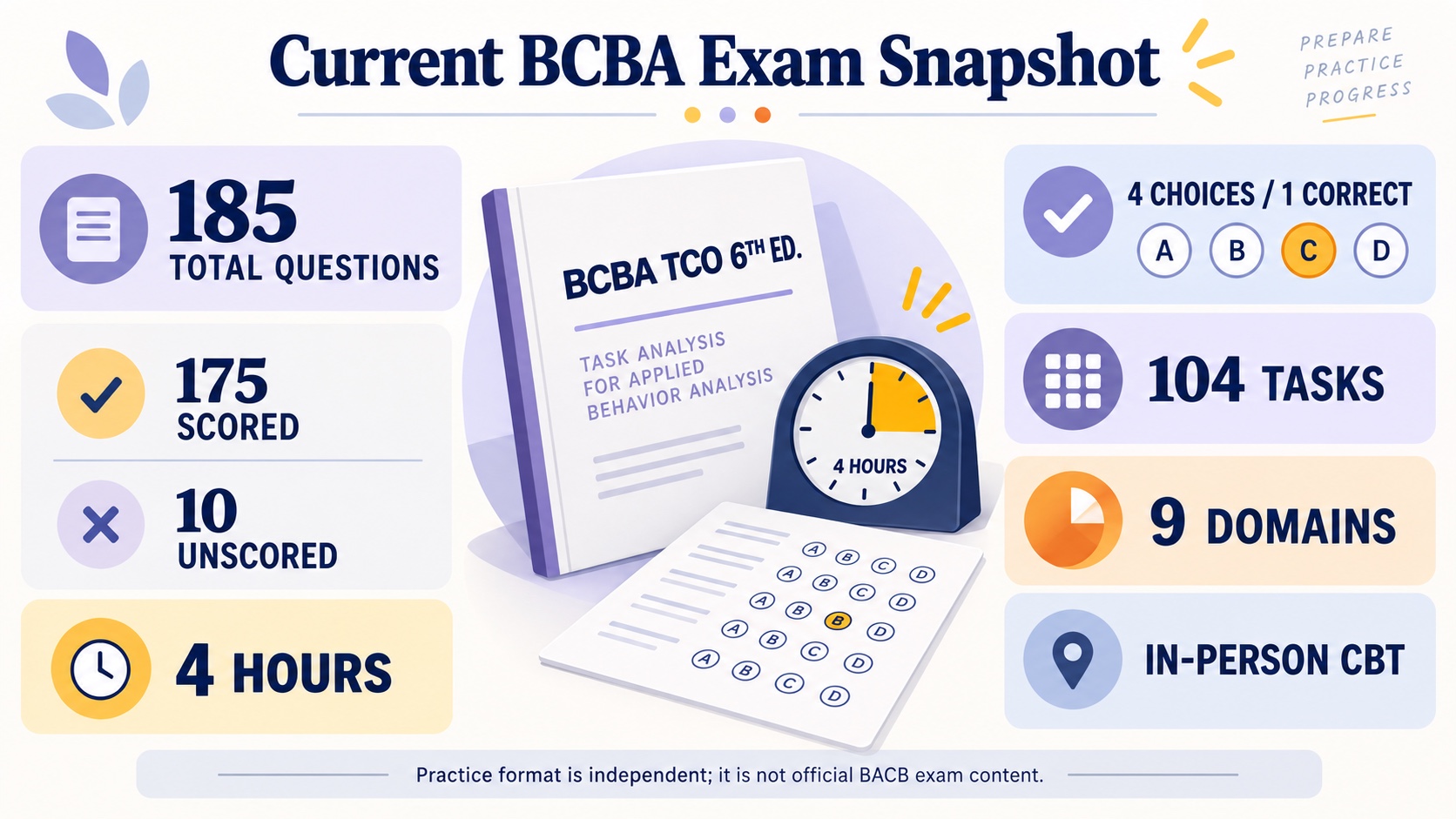
The current BCBA examination is based on the BCBA Test Content Outline (6th ed.). The BACB describes 175 scored questions and 10 unscored questions, four answer choices with one correct answer, and four hours to complete the examination. This guide explains how to choose between diagnostic, domain, mixed, and full-length practice; how to use the nine-domain blueprint; and how to turn a result into a specific next study action without treating an independent score as an official prediction.
Table of Contents
What a current BCBA practice exam should mirror
Use the official examination boundary as a quality check. A full-length practice session can mirror 185 questions and a four-hour time limit to rehearse stamina and pacing. An independent practice provider cannot know which of its items would be scored or unscored on the BACB examination. The 175-and-10 distinction belongs to the official examination structure; a practice test should not pretend to recreate that scoring process.
| Check | Current BCBA examination boundary | What practice should make clear |
|---|---|---|
| Content edition | BCBA Test Content Outline, 6th ed. | Identify the edition and review date instead of using a vague “updated” label |
| Question format | Multiple choice; four possible answers and one correct answer | Use original scenarios with one defensible best answer |
| Length and time | 185 total questions in 4 hours | Offer a full-length rehearsal and shorter formats for learning |
| Content map | 104 tasks across 9 content areas | Show domain or task tags and explain the coverage logic |
| Scoring | Questions are equally weighted; result is based on overall performance | Describe the practice result as diagnostic evidence, not a BACB decision |
| Delivery | In-person, computer-based testing at authorized Pearson VUE sites | Separate online practice convenience from the real delivery setting |
The current BCBA Handbook also says the BACB cannot endorse specific study guides or other preparation materials, and that buying study materials does not guarantee a pass. That boundary is useful when evaluating a practice page. Be cautious with “official BCBA questions,” “guaranteed pass,” or a fixed practice percentage presented as if it were a BACB readiness rule. An independent practice resource can be helpful while still being unofficial.
Choose the right practice format
There is no single best practice format for every stage. Choose the session based on the decision you need to make.
Short diagnostic set
A short mixed set is a good starting point when you need a baseline. Mark your confidence before viewing feedback: sure, uncertain, or guess. A wrong answer marked “sure” may reveal a misconception. A correct answer marked “guess” may reveal fragile knowledge. The purpose is not to create a dramatic score; it is to locate a useful pattern quickly.
Domain or task practice
Use a domain set when the diagnostic points to a cluster such as measurement, assessment, behavior-change procedures, or ethics. Domain practice lets you compare nearby concepts and see repeated decision rules. It is especially useful after a full mock when you know the broad area but need to identify the task that keeps producing the error.
Mixed untimed practice
A mixed set without a timer trains flexible retrieval. The topics change from item to item, so you must decide which information matters before applying a procedure. Use this mode when you can explain individual concepts but still lose accuracy when the question shifts from measurement to assessment, intervention, or supervision.
Full-length timed rehearsal
Use a 185-question, four-hour session when you are ready to rehearse pacing, sustained attention, flagging, and returning to uncertain items. A full mock is not automatically the best first step. If you do not yet know how to review an error, a long test may simply produce a large, noisy list of misses. Repair the review method first, then use full-length practice to test endurance and consistency.
These formats can belong to one study system. Start short, move to targeted repair, mix domains, and then rehearse the full boundary. A full mock should answer “How do I perform across a long mixed session?” It should not be forced to answer “Which definition do I still misunderstand?”
Use the 6th-edition blueprint without overfitting
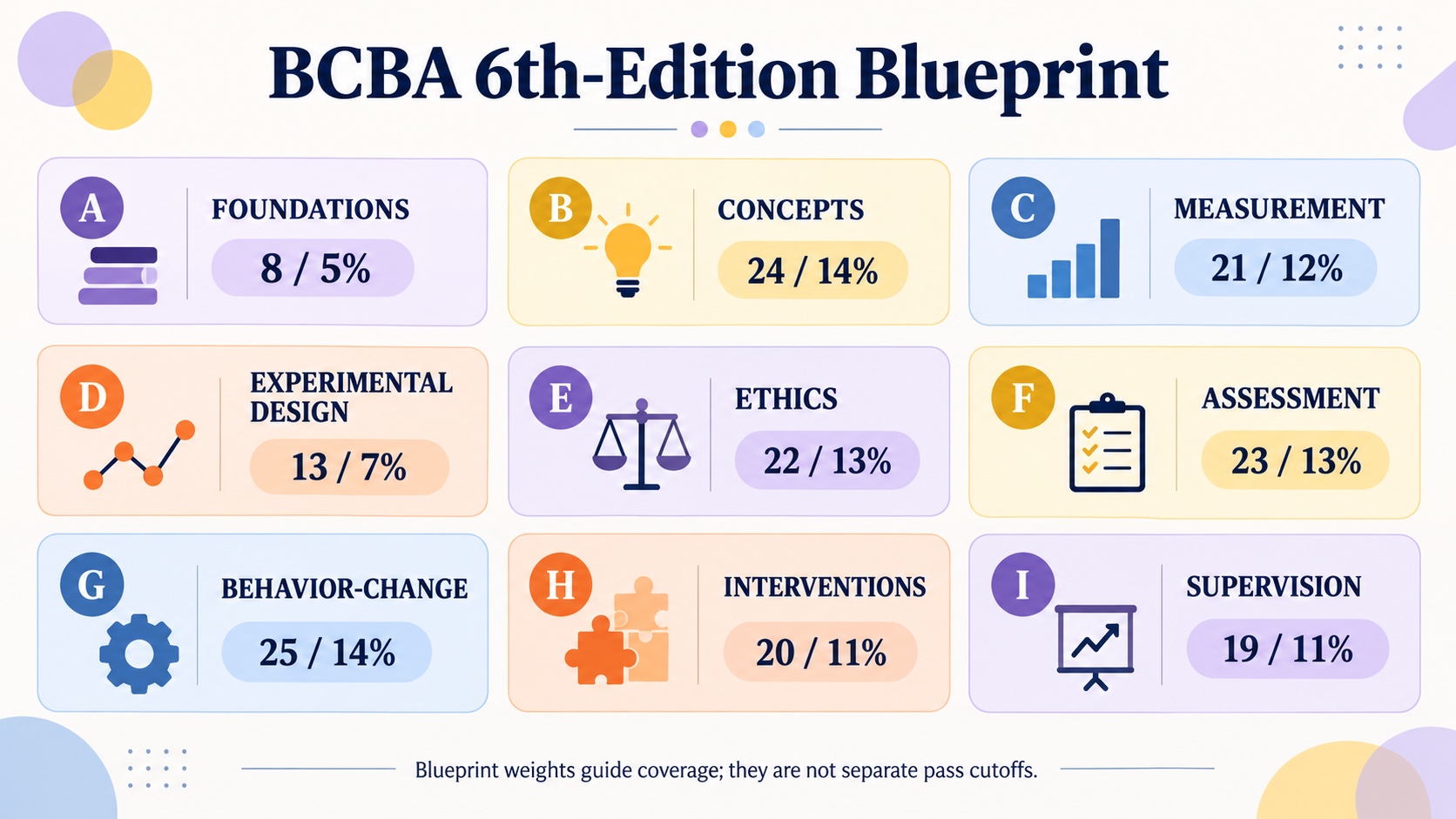
The BCBA Test Content Outline (6th ed.) contains 104 tasks across nine content areas. The current Handbook gives the following rounded planning weights:
| Area | Questions | Rounded share | Study signal |
|---|---|---|---|
| A. Behaviorism and Philosophical Foundations | 8 | 5% | Clarify assumptions, goals, and the scope of behavior analysis |
| B. Concepts and Principles | 24 | 14% | Discriminate contingencies, schedules, stimulus control, and verbal behavior |
| C. Measurement, Data Display, and Interpretation | 21 | 12% | Match measurement, graphs, validity, reliability, and decisions |
| D. Experimental Design | 13 | 7% | Read design logic, threats, and single-case evidence |
| E. Ethical and Professional Issues | 22 | 13% | Apply ethics, competence, confidentiality, culture, and legal context |
| F. Behavior Assessment | 23 | 13% | Choose and interpret skill, preference, descriptive, and functional assessments |
| G. Behavior-Change Procedures | 25 | 14% | Apply reinforcement, punishment, prompting, shaping, and generalization procedures |
| H. Selecting and Implementing Interventions | 20 | 11% | Connect assessment, goals, procedures, implementation, and evaluation |
| I. Personnel Supervision and Management | 19 | 11% | Plan training, feedback, supervision, and performance support |
Use these rounded percentages to ask whether a question bank is broadly balanced and where to allocate more practice time. Do not turn them into nine separate pass cutoffs. The BACB states that the questions are equally weighted and that the examination result is based on overall performance. A smaller domain can still contain a high-value gap, especially when the problem is not a missing fact but a recurring judgment error.
Blueprint weighting also should not become a reason to ignore transfer. A measurement question may connect to intervention integrity. An ethics scenario may include a supervision or confidentiality decision. A full practice exam should mix the content areas so you learn to identify the controlling issue rather than answer only when the heading gives it away.
How to evaluate a practice exam
When two practice products look similar, evaluate the learning design instead of choosing the one with the most dramatic claim. A useful BCBA practice exam should make these features visible:
- Current source boundary: it names the BCBA TCO 6th ed. and does not quietly depend on an older outline.
- Applied scenarios: items require a decision about data, contingencies, assessment, intervention, ethics, or supervision rather than isolated word matching.
- Close but explainable distractors: the alternatives are plausible enough to test discrimination, and the explanation identifies the fact that rules each one in or out.
- Coverage information: domain or task tags are available so that a result can lead to a review decision.
- Originality and boundaries: the provider clearly labels its questions as independent practice and does not claim BACB endorsement or access to live items.
- Useful feedback: the platform supports confidence marking, review notes, or an error record rather than showing only a percentage.
A shorter practice set can still be well designed. It may be better for learning because it lets you slow down, predict an answer, and study the rationale. A full-length mock is better for stamina and pacing. The right comparison is not “short versus long”; it is whether the format matches the job you need done today.
Review questions for reasoning, not just answers
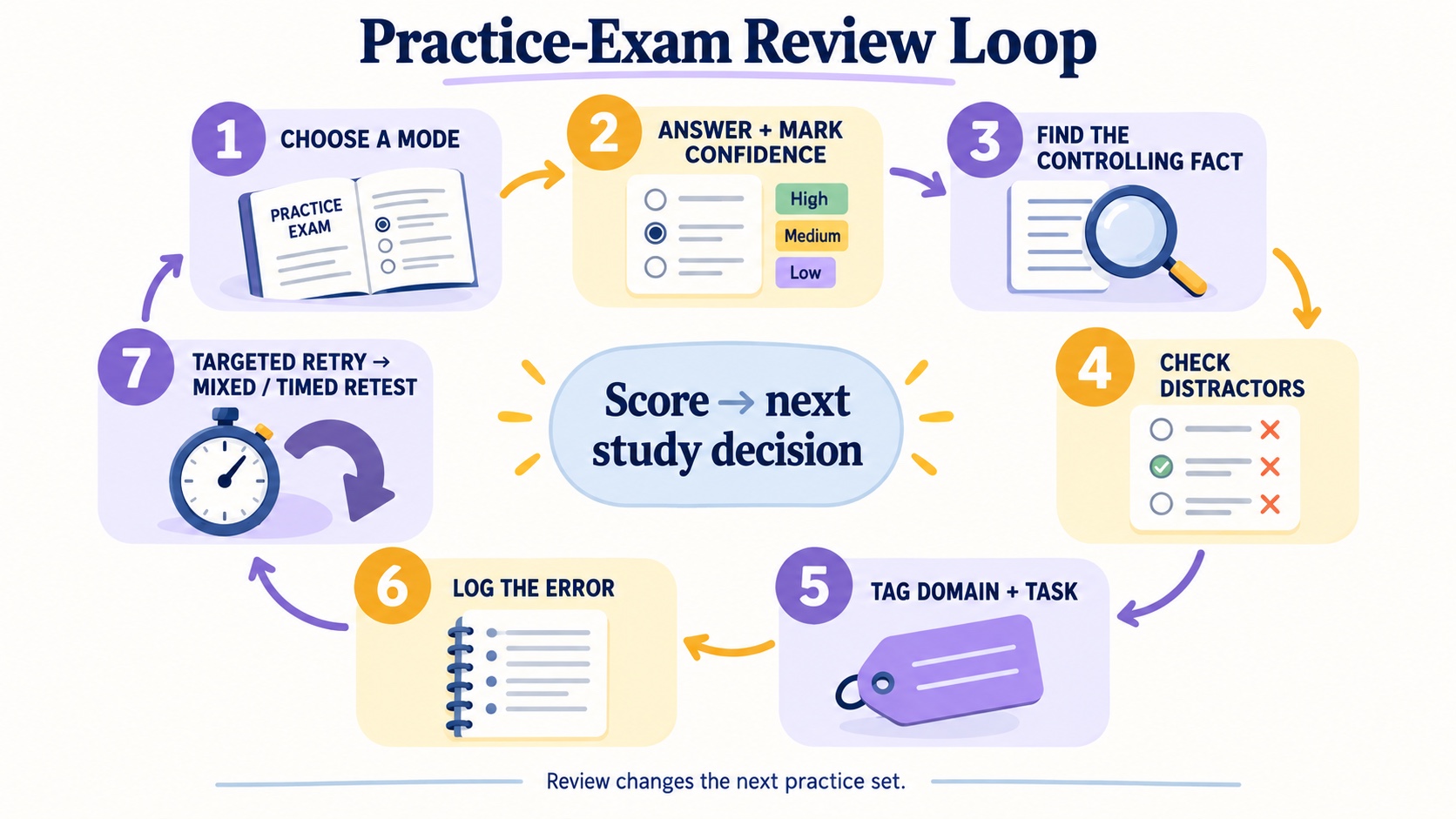
After you submit an item, delay the urge to record only “right” or “wrong.” First ask what the question required you to decide. Then use a four-part review:
- Locate the controlling fact. Identify the measurement dimension, contingency, assessment result, ethical responsibility, or supervision context that should control the decision.
- Explain the best answer. State the rule or process in your own words and connect it to the facts in the stem.
- Inspect each distractor. Explain whether it is wrong because it uses the wrong concept, skips a necessary step, exceeds scope, or is less effective for the stated goal.
- Schedule a new-example retry. Return later with a different scenario. Recognizing the same sentence is not the same as transferring the distinction.
Classify the error so the next action is specific. A knowledge gap calls for a theory block or source review. A discrimination error calls for a compare-and-contrast set. An application error calls for more scenarios. A reading error calls for slowing down around qualifiers such as “first,” “most appropriate,” or “best.” A pacing error calls for timed sets after the reasoning is stable.
For example, suppose you choose a functional analysis option when a question only gives descriptive information and asks what should happen next. The issue may not be that you have never studied functional analysis. The issue may be that you skipped the information boundary and selected a later step too early. Your repair target is then “match the next assessment decision to the evidence available,” not “reread every assessment chapter.”
How to read your practice result
If the result is low, do not respond by immediately taking another full mock. Check whether the misses cluster around concepts, evidence interpretation, ethics, application, or pacing. Select two repair targets, study them actively, and use new questions before returning to a long mixed set.
If the result is uneven, compare performance with confidence and domain/task tags. A domain with several confident misses may signal a misconception. A domain with correct guesses may need retrieval practice even though the percentage looks fine. Review the pattern across more than one fresh set before deciding that a content area is permanently weak or strong.
If the result is strong, use it to test consistency rather than to claim readiness. Change the scenario type, include close distractors, and try a new mixed set under a different session. The BACB uses its own examination forms and criterion-referenced scoring process; an independent practice percentage cannot replace that decision.
A seven-day practice cycle
- Day 1 — Confirm the map: save the current BCBA TCO 6th ed., list the nine domains, and choose a study question for the week.
- Day 2 — Run a diagnostic: use a short mixed set and mark confidence before feedback.
- Day 3 — Repair one high-weight cluster: practice concepts, behavior-change procedures, or another area that produces repeated errors.
- Day 4 — Repair a reasoning boundary: work on measurement versus assessment, intervention selection, ethics, or supervision through new scenarios.
- Day 5 — Review distractors: complete the rationale loop and schedule targeted retries.
- Day 6 — Rehearse pacing: use a longer mixed set or full-length 185-question, four-hour session if your review method is ready.
- Day 7 — Retest and decide: use new examples, review recurring errors, and choose theory, targeted questions, mixed practice, or another timed rehearsal.
Common BCBA practice-exam mistakes
Taking a full mock before learning how to review
A long score can hide the reason for each miss. Start with a format that lets you explain answers, then scale up to endurance practice.
Using an old edition without checking the boundary
The current BCBA exam is based on the 6th-edition TCO. Check the source and edition instead of trusting a product title that only says “BCBA exam.”
Turning domain weights into pass rules
The rounded percentages guide coverage. They are not separate domain-level passing thresholds, and the official result is based on overall performance.
Memorizing the answer letter
Letter memory does not transfer to a new scenario. Explain the controlling evidence and why each distractor fails.
Treating a provider as official
Independent questions and mock exams can support learning without being BACB materials. Keep the source label visible and avoid claims about endorsement, live questions, or guaranteed results.
Ready for the next BCBA practice session?
ABA Study Online provides original, unofficial BCBA practice questions and longer website practice destinations. Use the website for a mixed or mock-exam block, then use the ABA Study Online app for short flashcards, section review, progress checks, and saved mistakes between sessions.
Try the BCBA practice questions or Explore the website mock exams
FAQ and official sources
How many questions are on the BCBA examination?
The current BACB Handbook lists 185 total questions: 175 scored and 10 unscored questions. A full-length practice exam can use 185 questions to rehearse the overall structure, but an independent provider cannot identify which of its questions would be scored on the real form.
How long should a BCBA practice exam take?
Use the official four-hour boundary for a full timed rehearsal. Use shorter untimed sets when your main goal is learning a concept or reviewing a rationale.
Is an online BCBA practice exam official?
No. The official examination is delivered in person through computer-based testing at authorized Pearson VUE sites. An online practice exam is an independent study resource unless the BACB itself identifies it as an official resource.
Can a practice score tell me whether I will pass?
No. A practice result describes performance on that particular set. Use repeated performance on new scenarios and the quality of your explanations to decide what to study next; do not use an unofficial percentage as a pass guarantee.
Which outline should I use?
Use the current BCBA Test Content Outline (6th ed.) and the current BCBA Handbook. Recheck the BACB source when your application and authorization are current because candidates must test under the current edition in effect for their examination.