Free BCBA Practice Exam: How to Use It Well
Searching for a BCBA practice exam free option makes sense when you want a quick way to test your readiness without buying another resource. The important question is not simply whether the questions are free. It is whether the practice session reflects the current exam blueprint, makes you explain your choices, and gives you a useful plan for the next round.
This guide shows you how to use free practice as a diagnostic tool. It explains the current BCBA exam structure, how to spread practice across the Test Content Outline (TCO), how to review wrong answers, and what the 2027 requirements update does—and does not—change. The practice material on ABA Study Online is original study content, not a BACB examination, leaked item bank, or pass guarantee. For current rules, compare your preparation with the BCBA Test Content Outline and the BACB Examination Information page.
Table of Contents
Short answer: what a free practice exam can do
A free practice exam can help you rehearse the task the real exam demands: read a scenario, identify the relevant behavior-analytic principle, compare plausible answers, and choose the option best supported by the information provided. It can also expose patterns. You may know a definition but miss an application question, rush through measurement items, or choose a familiar intervention before checking the function of behavior.
It cannot tell you that you will pass. A practice set does not contain secure BACB items, may use a different difficulty mix, and may not reproduce the exact experience of the examination. Treat the result as a snapshot of your current preparation. The value comes from the error log you create after the session.
Know the current BCBA exam before you practice
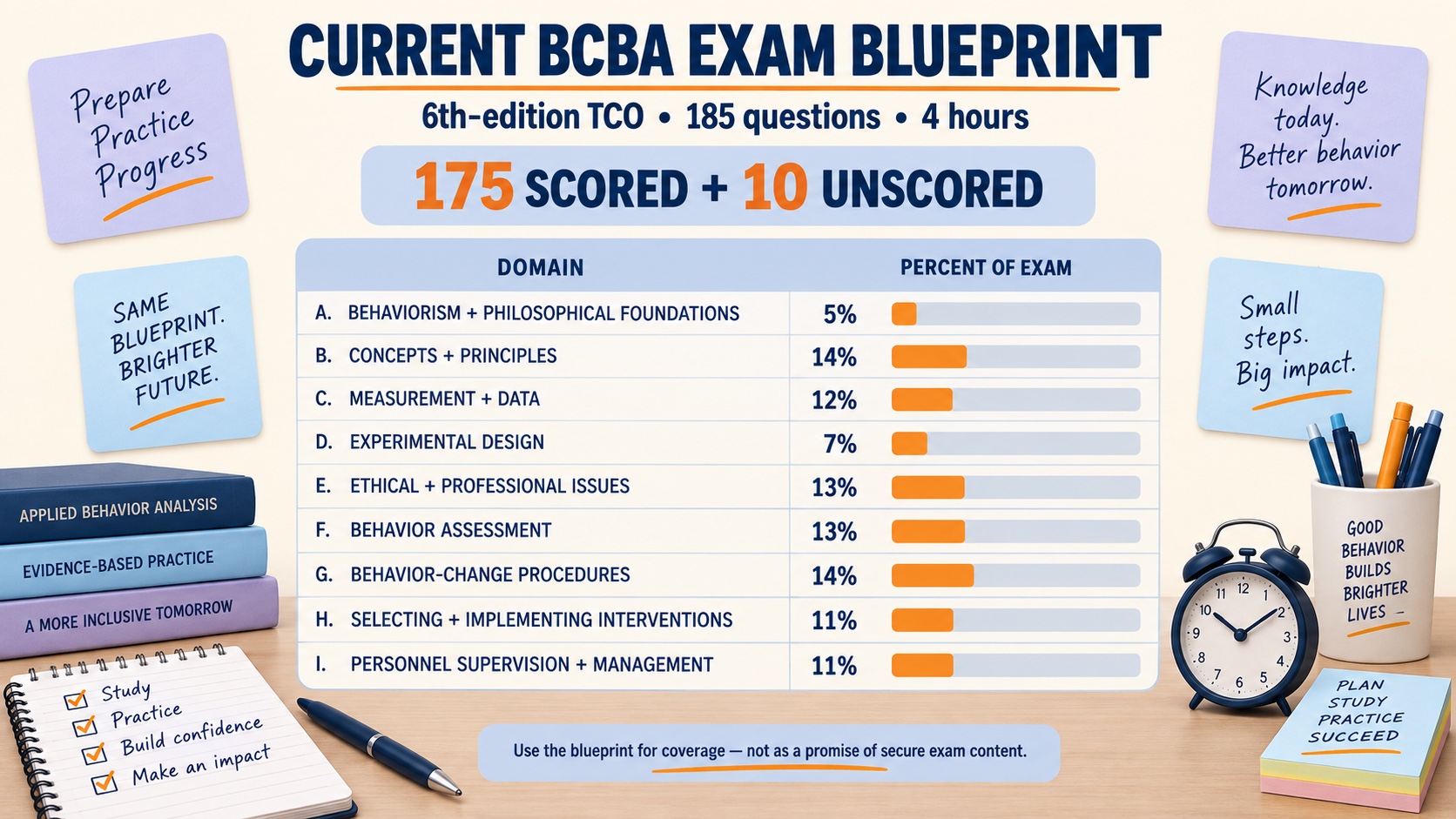
The current BCBA Test Content Outline is the 6th edition and describes the content used for the examination beginning in 2025. It organizes 104 tasks into nine domains. The examination includes 185 multiple-choice questions: 175 scored questions and 10 unscored pilot questions. Each question has four answer choices with one correct answer, and the BCBA examination length is four hours. The BACB examination is delivered in person through authorized Pearson VUE testing sites.
Those facts help you design a realistic study session, but they do not mean every free practice set must contain 185 questions. A shorter set can be more useful when you are learning. You can use a 25-question session to practice one skill, a 50-question session to compare domains, and a longer mixed session when you are ready to rehearse stamina. Label the session honestly so you know whether you were studying a topic or simulating a full test.
Also remember that the BACB uses a criterion-referenced scoring process. A raw percentage from an independent practice set is not the same thing as a scaled examination result. Do not turn one number into a pass prediction.
Use the TCO to balance your practice
A free practice exam should be connected to the blueprint rather than built from whichever terms are easiest to write. The current domain distribution is a helpful planning signal:
| Domain | Focus | TCO share |
|---|---|---|
| A | Behaviorism and Philosophical Foundations | 5% |
| B | Concepts and Principles | 14% |
| C | Measurement, Data Display, and Interpretation | 12% |
| D | Experimental Design | 7% |
| E | Ethical and Professional Issues | 13% |
| F | Behavior Assessment | 13% |
| G | Behavior-Change Procedures | 14% |
| H | Selecting and Implementing Interventions | 11% |
| I | Personnel Supervision and Management | 11% |
Domains B and G have the largest shares, but “largest” does not mean “study only these.” A balanced plan still includes ethics, assessment, data, design, intervention selection, and supervision. If your free set has 25 questions, a perfectly proportional distribution is not always practical; use the blueprint to notice what is missing across several sessions. Five tiny quizzes that only test reinforcement terms will not give you broad coverage.
Build a useful free practice session
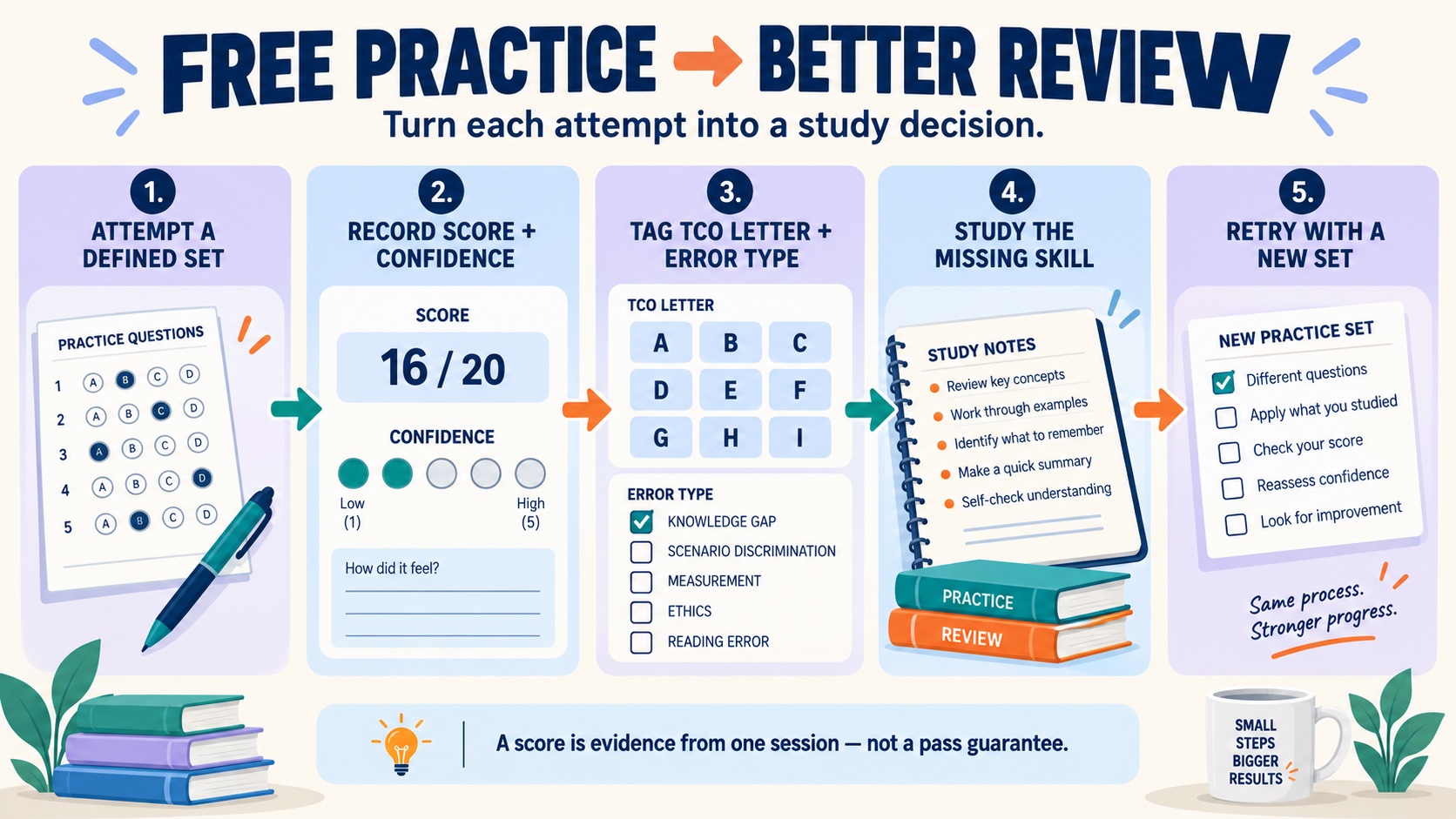
Before you click Start, write down the purpose of the session. This one sentence prevents a practice quiz from becoming passive score collection.
- Choose the session type. Pick focused practice for one TCO domain, mixed practice for transfer across domains, or a timed rehearsal for pacing.
- Set a stopping rule. Decide whether you will answer 25, 50, or another defined number of questions. Do not keep adding items until the result feels better.
- Answer before checking. Record your choice and confidence. If you are unsure, mark the uncertainty instead of opening a reference immediately.
- Explain the choice. After each item, write one short reason. This separates recognition of a term from understanding how it applies.
- Tag the item. Add the TCO domain and the error type: knowledge gap, scenario discrimination, measurement calculation, ethics judgment, or careless reading.
- Schedule the review. Put the missed concepts on a short study list and choose a retry date. Review should change the next practice session.
For a timed session, keep the environment simple and use one answer per item. For a learning session, it is acceptable to pause and consult a source after you have committed to an answer. The two formats answer different questions: “Can I reason under time pressure?” versus “What do I need to learn?” Mixing them without a label makes the score difficult to interpret.
Review wrong answers like data
The most valuable part of a free BCBA practice exam usually begins after the last question. Make a four-column error log:
- What happened? Record the question topic and the answer you chose.
- Why did I choose it? Write the rule, assumption, or cue that led you there.
- What makes the best answer better? Name the decisive detail in the scenario.
- What will I do next? Choose a short reread, worked example, flashcard, data exercise, or targeted retry.
Consider a measurement question in which you choose duration when the scenario asks how quickly a response begins after an instruction. The problem may not be that you forgot every measurement definition. It may be a discrimination error: you saw “time” and selected a familiar measure without matching the measure to the question. Your next step should include several short contrasts among latency, duration, interresponse time, and frequency—not another random full-length quiz.
For an ethics question, do not memorize a catchy phrase and stop. Ask which client welfare, confidentiality, competence, consent, or multiple-relationship issue is active, what facts are missing, and what action is within the practitioner’s role. A strong rationale explains why the selected answer is supported and why the distractors fail under the stated facts.
How to interpret your score
Use your score for comparison only when the conditions are comparable. Note the number of questions, domains represented, time used, whether you reviewed answers during the session, and whether the items were new. A 76% on a focused set of familiar vocabulary is not the same evidence as 76% on a new mixed set completed under a time limit.
Look for three patterns instead of chasing one target percentage:
- Accuracy: Are you choosing the best answer, not merely a plausible one?
- Consistency: Does performance hold across different scenarios and domains?
- Independence: Can you explain the answer without immediately checking a note?
When a result drops, that is information. It may reflect more difficult items, unfamiliar domains, fatigue, or a timing problem. Change one variable at a time in your next session so you can see what actually helped.
Does 2027 mean a new BCBA exam?
Not according to the current BACB transition guidance. The January 1, 2027 changes concern BCBA eligibility and maintenance requirements, including pathway, coursework, fieldwork, continuing-education, and ongoing-supervision rules. The guidance specifically separates those certification changes from examination and TCO updates and states that there are currently no upcoming changes to the BCBA examination or TCO.
That means you should not describe this page as a “7th-edition BCBA exam” guide unless the BACB later publishes an official new TCO and effective date. Continue using the current 6th-edition TCO for exam-content planning, while checking the current BCBA Handbook and transition resources for your own eligibility timeline. Exam preparation and certification eligibility are related, but they are not the same research question.
Your next practice step
Start with a defined free set, record your confidence, tag every missed item by domain and error type, and schedule a targeted retry. If you cannot explain what changed between attempt one and attempt two, the practice loop is incomplete.
FAQ and official sources
Is a free BCBA practice exam worth using?
Yes, when you use it to diagnose skills and plan review. It is less useful when you collect scores without reading rationales or tracking the domains you miss.
How many questions should a free practice set have?
Use the number that matches your purpose. A short focused set is useful for learning; a longer mixed set is better for stamina and pacing. Label the session and compare like with like.
Can a practice score predict whether I will pass?
No. Independent practice sets differ in content, difficulty, wording, and scoring. A score is evidence about that session, not a certification result or promise.
Where should I verify the current BCBA exam content?
Use the current BCBA Test Content Outline, the BACB Examination Information page, and the BCBA Handbook resources. For 2027 eligibility changes, read the BACB’s transition guidance.
Sources checked for this guide: Behavior Analyst Certification Board, BCBA Test Content Outline (6th ed.); BACB Examination Information; BCBA Handbook resource page; and Guidance for Meeting the BCBA Requirements During the 2027 Transition.