BCBA Pathways: Compare the 4 Current Routes and the 2027 Transition
If you are researching BCBA pathways, the first question is not “Which route sounds easiest?” It is “Which eligibility pathway matches my degree, behavior-analytic preparation, fieldwork, and application timing?” The BACB’s current BCBA Handbook lists four pathways. The official 2027 requirements reduce the choices for new applicants to two beginning January 1, 2027, so a pathway decision must be dated and evidence-based.
This guide is a planning map, not an eligibility determination. Use the current BCBA Handbook, the 2027 requirements and transition guidance, and your university or supervisor for the final decision. A pathway label alone does not make a degree, course sequence, fieldwork record, or application complete.
Table of Contents
Short answer: how the pathways differ
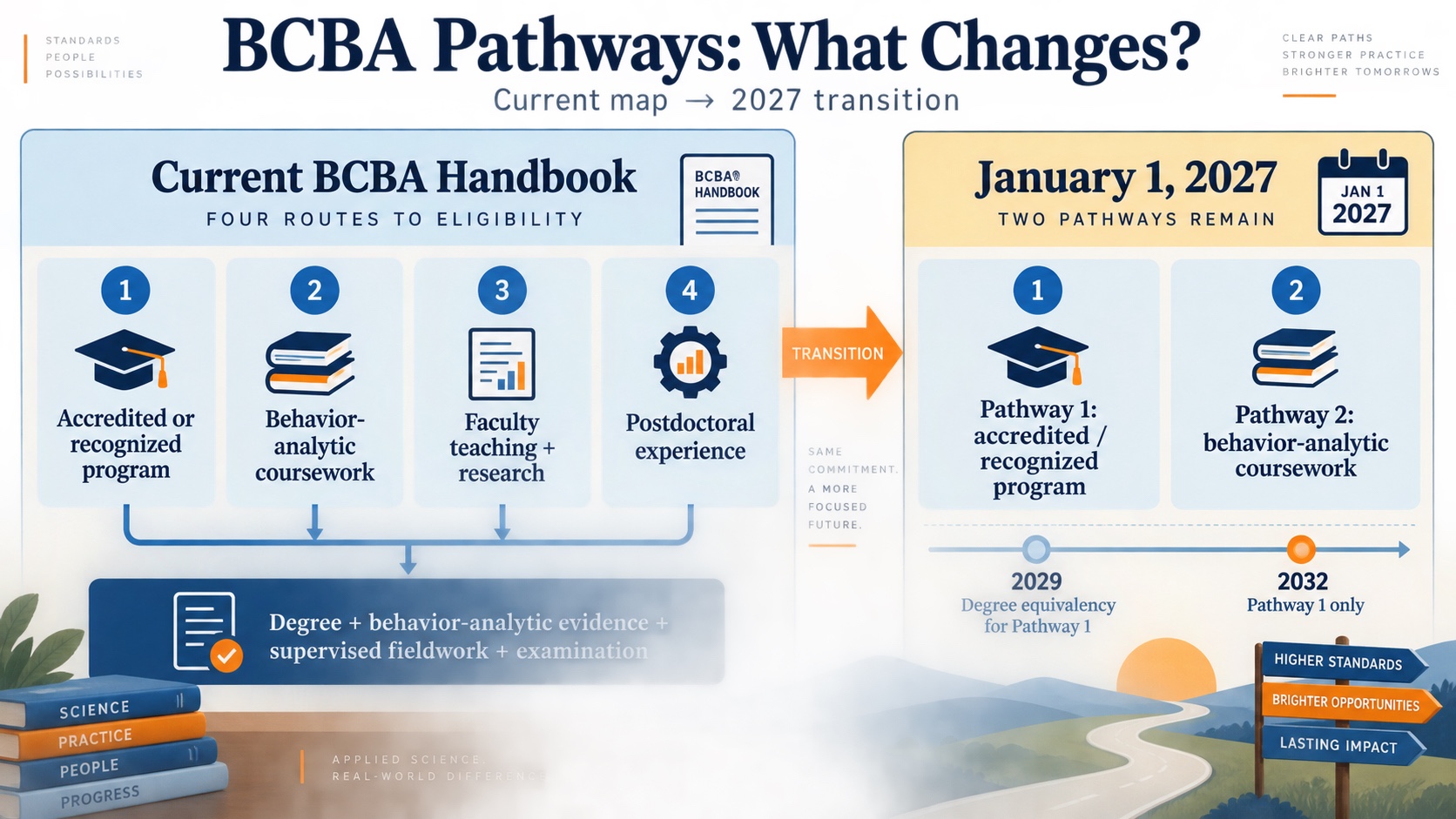
Every current BCBA eligibility pathway connects four broad requirements: the required degree, behavior-analytic content or experience, supervised fieldwork, and a passing BCBA examination. What changes is the evidence used for the degree and behavior-analytic content. Pathway 1 relies on an accredited or recognized behavior-analysis program. Pathway 2 uses a qualifying master’s degree plus behavior-analytic coursework. Pathway 3 uses faculty teaching and research. Pathway 4 uses postdoctoral experience in applied behavior analysis.
The 2027 framework keeps Pathways 1 and 2, discontinues Pathways 3 and 4 for applicants who have not met the current requirements by the transition deadline, and adds revised coursework and fieldwork rules. This is an eligibility transition, not a claim that the BCBA examination has become a “7th edition.” Keep pathway planning separate from the current exam content outline.
The four pathways in current 2026 materials
The current BCBA Handbook presents four routes. Treat the following as a map of the evidence category, not a shortened substitute for the handbook’s detailed requirements.
- Pathway 1 — accredited or recognized program: you have a master’s degree or higher from an APBA-accredited program or an ABAI-accredited or recognized behavior-analysis degree program under the accepted recognition categories. The degree must have been conferred during the period the program met the relevant status.
- Pathway 2 — behavior-analytic coursework: you have a master’s degree or higher and qualifying behavior-analytic coursework, with the required documentation or attestation route and supervised fieldwork. Course titles alone do not prove that every content and freestanding-course requirement is met.
- Pathway 3 — faculty teaching and research: you qualify through the current handbook’s faculty teaching and research route, in addition to the degree, fieldwork, and examination requirements. This is not simply “I taught one ABA class”; the evidence must match the handbook’s faculty and research criteria.
- Pathway 4 — postdoctoral experience: you qualify through the current handbook’s doctoral and postdoctoral experience route, along with supervised fieldwork and the examination. A postdoctoral job title alone is not the same as documented qualifying experience.
For all four routes, separate the pathway evidence from fieldwork evidence. A degree pathway can answer how your education or professional experience satisfies the behavior-analytic content requirement; it does not automatically make every workplace activity count as supervised fieldwork. Keep transcripts, attestations, fieldwork forms, supervision records, and application documents in distinct folders.
A practical comparison
| Question | What to identify | Why it matters |
|---|---|---|
| Degree | Master’s or doctoral degree, degree date, institution, and pathway-specific status | A degree level alone does not identify the pathway. |
| Behavior-analytic content | Accredited-program evidence, qualifying coursework, faculty/research evidence, or postdoctoral evidence | This is the main point of difference among the four current routes. |
| Fieldwork | Supervised or Concentrated Supervised Fieldwork records under the applicable rule set | Work experience must be documented separately and meet the fieldwork rules. |
| Application timing | Whether the complete application can be received before the 2027 transition | The applicable requirements depend on the date and completeness of the application. |
| Exam | Current BCBA examination eligibility and official exam information | A pathway change is not automatically a new exam edition. |
A useful comparison worksheet has one row for each evidence item and one column for the source that supports it. If you cannot point to the exact current handbook section, an official requirements document, or a program record, mark the item “verify” instead of “complete.” This small habit prevents a broad pathway label from becoming a false sense of eligibility.
What changes on January 1, 2027
The BACB’s 2027 BCBA requirements state that beginning January 1, 2027, applicants may use two pathways: Pathway 1, an APBA-accredited or ABAI-accredited/recognized program route, and Pathway 2, a behavior-analytic coursework route. Pathways 3 and 4 are not carried forward as 2027 application pathways. The transition guidance says that anyone who wants to apply under Pathway 3 or 4 must apply and meet all current requirements before January 1, 2027.
The 2027 change also affects Pathway 2 coursework structure and fieldwork details. The BACB’s transition resources should be read together with the updated handbook, not summarized as one number or one deadline. The official 2027 requirements page also identifies later changes: degree-equivalency requirements for Pathway 1 begin in 2029, and the BACB lists Pathway 1 as the only BCBA eligibility pathway beginning in 2032. Those future dates are planning context, not permission to ignore the rule set that applies to your application.
If you are unsure whether you can submit a complete application before the transition, do not count only the day you expect to pass the examination. Review the official statement about complete application materials, payment, and supporting documents. Then make a dated checklist with the university, supervisor, and relevant BACB instructions.
How to choose a planning route
- Write the application target date: identify whether you are planning for a complete application before January 1, 2027 or under the 2027 requirements. If the date is uncertain, plan against the transition guidance.
- Audit the degree record: note the degree level, conferral date, institution, accreditation or recognition status, and the exact period that status applied.
- Map the content evidence: list the program record, coursework, attestation, faculty/research evidence, or postdoctoral evidence that could support the route. Do not use a course title or job title as a substitute for the official requirement.
- Audit fieldwork separately: track fieldwork type, supervisory period, supervision, observations, unrestricted activities, contracts, and signed forms under the rule set that applies.
- Check the official route: compare your worksheet with the current BCBA Handbook and transition documents, then ask the university or supervisor to identify gaps. The goal is a documented question list, not self-approval.
Common BCBA pathway mistakes
- Counting four current pathways as four permanent choices: the 2027 transition changes which routes are available to new applicants.
- Confusing pathway with fieldwork type: Pathway 1 or 2 is not the same thing as Supervised versus Concentrated Supervised Fieldwork.
- Assuming any ABA degree qualifies: the program’s accreditation or recognition status and the degree date can matter.
- Treating a 2027 eligibility update as a seventh exam edition: verify exam content separately in the official TCO inventory.
- Waiting until the exam to review the pathway: education, fieldwork, documentation, application, and examination are connected but separate checkpoints.
BCBA pathways FAQ
How many BCBA pathways are there?
Current BCBA Handbook materials describe four pathways: accredited or recognized program, behavior-analytic coursework, faculty teaching and research, and postdoctoral experience. Beginning January 1, 2027, the BACB’s 2027 requirements describe two pathways for applicants: Pathway 1 and Pathway 2.
Can I use Pathway 3 or Pathway 4 in 2027?
The transition guidance says applicants who want to use Pathway 3 or 4 must apply and meet all current requirements before January 1, 2027. Check the official transition document and current handbook for the complete application standard.
Is BCBA changing to a 7th edition exam in 2027?
A change in eligibility pathways is not proof of a new exam edition. Check the BACB’s current Test Content Outline inventory and examination-information page for exam-content and version information.
Does choosing a pathway guarantee eligibility?
No. A pathway is a route for organizing evidence. Degree details, coursework or experience, fieldwork, documentation, application timing, and all other current requirements still have to be satisfied and reviewed under the applicable rules.