BCBA Pathway 2: Coursework, Fieldwork, and the 2027 Boundary
If you are researching BCBA Pathway 2, you are probably trying to answer a practical question: can your graduate degree, behavior-analytic coursework, and supervised fieldwork fit the current route to BCBA certification? The answer depends on the exact handbook rules, the institution and Program Contact connected to your coursework, the fieldwork records you can document, and the application date you are planning around.
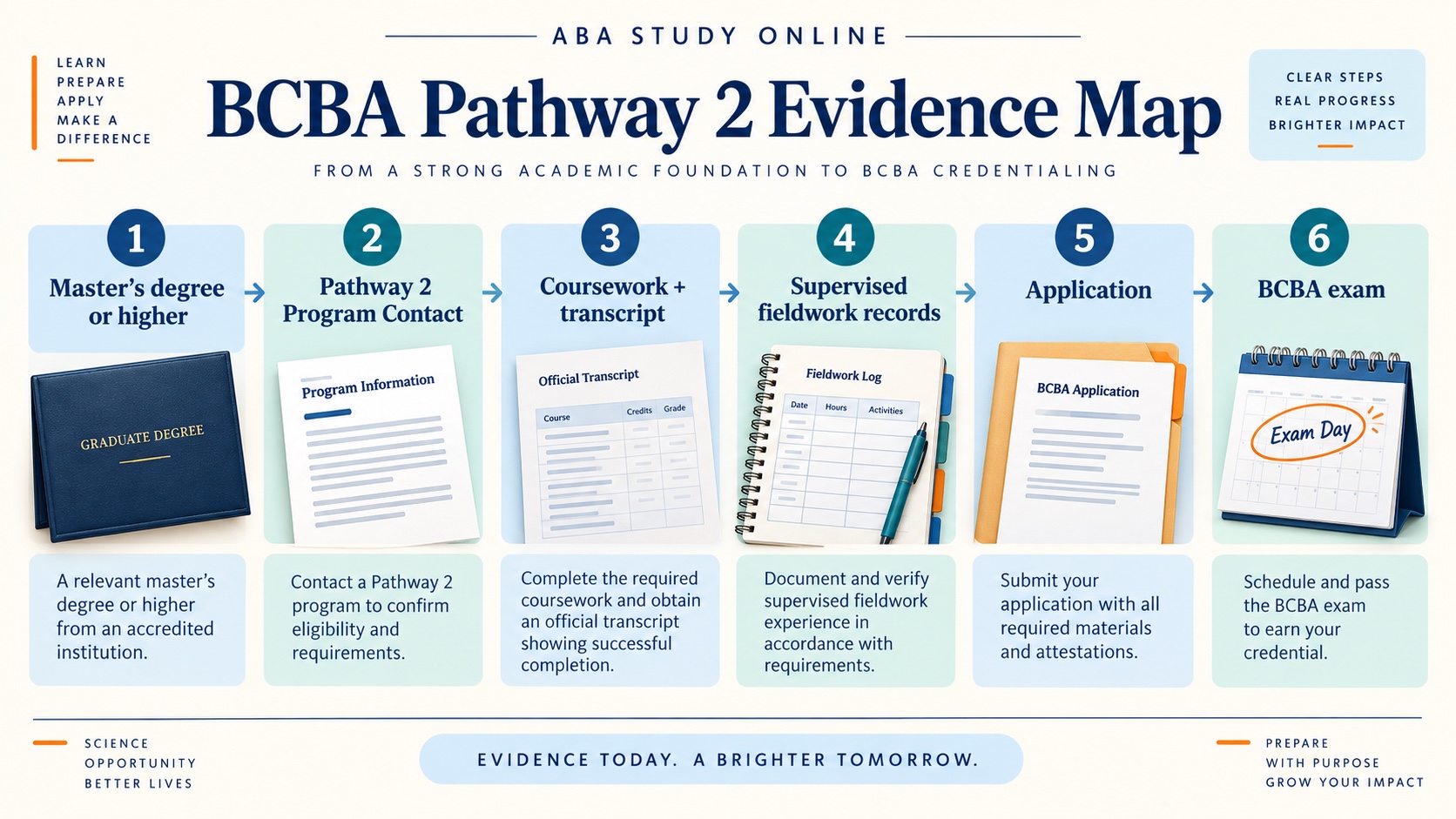
Pathway 2 is not a shortcut and it is not a single online course. It is one of the BACB eligibility routes that combines a qualifying master’s degree or higher, qualifying coursework, supervised fieldwork, and the BCBA examination. This guide explains the decision points in plain language and separates the current pathway from the requirements scheduled for 2027.
Quick answer: the current BCBA Pathway 2 route generally requires a master’s degree or higher, qualifying behavior-analytic coursework through a qualifying Pathway 2 Program Contact, supervised fieldwork, and the BCBA examination. Official transcripts and fieldwork documents matter because the application is an evidence review, not simply a statement that you completed a related program. The BACB makes the final determination for an individual application, so a school’s marketing language cannot replace the current handbook.
Degree, coursework, and the Program Contact
Start with the degree question
Pathway 2 begins with a master’s degree or higher from a qualifying institution. The degree title and the behavior-analysis coursework are separate questions. A graduate degree in a related field may be useful, but it does not automatically show that the coursework and institutional conditions meet the BCBA route. Begin with the current BCBA Handbook and keep an official transcript available for the application review.
Understand the Pathway 2 Program Contact
The coursework route is connected to a qualifying Pathway 2 Program Contact. That role is important because the Program Contact and institution provide the context for whether the coursework is organized and documented under the applicable pathway. When comparing programs, ask who the current Program Contact is, which institution is responsible for the coursework, how the courses appear on the transcript, and which application-year rules the program is using.
Do not treat a course provider’s general statement that it is “ABA-based” as proof that the course satisfies the BCBA pathway. Save the course titles, syllabi, credits or hours, grades, institution information, and any written pathway guidance. If a transcript or course history is unusual, ask the current Program Contact and use the BACB’s formal process rather than relying on a social-media answer.
Coursework is evidence, not just a topic list
For current planning, the safest workflow is to map every course to the applicable handbook or pathway documentation before you register. Check the academic level, institution, dates, credits, passing grade, and whether the course is within the relevant time window. Keep the mapping in a spreadsheet or study folder. This turns a vague question—“Does my program count?”—into a set of evidence questions you can actually verify.
Fieldwork and application evidence
Fieldwork is a separate planning track
Qualifying coursework does not replace supervised fieldwork. Fieldwork must be organized, supervised, and documented under the rules that apply to your pathway and application period. Before you start, identify the supervisor, establish the supervision arrangement, confirm the required forms, and decide how you will record unrestricted and restricted activities. A fieldwork log made at the end of the year is much harder to repair than a monthly record maintained from the first contact.
Use the current handbook and fieldwork guidance for the exact monthly limits, observation expectations, supervision percentages, and documentation. Keep copies of contracts, monthly forms, supervisor signatures, and any required final verification. If your fieldwork changes employers, supervisors, or settings, record the transition rather than assuming that a later form will explain it.
Build an application evidence folder
- Degree evidence: the official transcript and institution information required by the current application route.
- Coursework evidence: course titles, credits or hours, grades, dates, syllabi where useful, and the relevant Program Contact context.
- Fieldwork evidence: supervision contract, monthly forms, observation records, activity records, and final verification.
- Identity and attestation evidence: the current forms and declarations required by the application.
- Exam evidence: the application determination and later scheduling instructions; a practice score is not an eligibility determination.
A clean folder also helps you study. As you organize your evidence, create a separate review list for definitions, measurement, assessment, intervention, ethics, and the remaining exam content areas. The current BCBA Test Content Outline is the exam-outline reference; do not label a new exam edition “7th edition” unless the BACB publishes that change.
Current planning versus the 2027 boundary
The application date matters. The BACB’s published 2027 transition materials state that the new requirements begin January 1, 2027, and they describe a future Pathway 2 structure that is more specific about instructional hours and content areas. If you are applying around the transition, compare your timeline with the official transition document and current handbook. Do not combine today’s and 2027 figures into one blended checklist.
For the 2027 Pathway 2 requirements, the published document describes a master’s degree or higher and 315 instructional hours across six content areas: Basic Principles of Behavior, Theory and Philosophy in Behavior Analysis, Research Methods in Behavior Analysis, Behavior Assessment and Intervention, Organizational Behavior Management, and Ethics in Behavior Analysis. The document also specifies freestanding-course expectations for the listed areas. Your job is to map your actual transcript and course structure to that document; do not assume that a course title alone proves coverage.
The same 2027 materials describe fieldwork changes, including 2,000 hours for the standard option or 1,500 for the concentrated option, minimum supervision percentages, observation requirements, and at least 60% unrestricted activities. New 2027 forms are intended for fieldwork beginning January 1, 2027. These are planning boundaries, not permission to rewrite an old form or retroactively apply future rules to a current application.
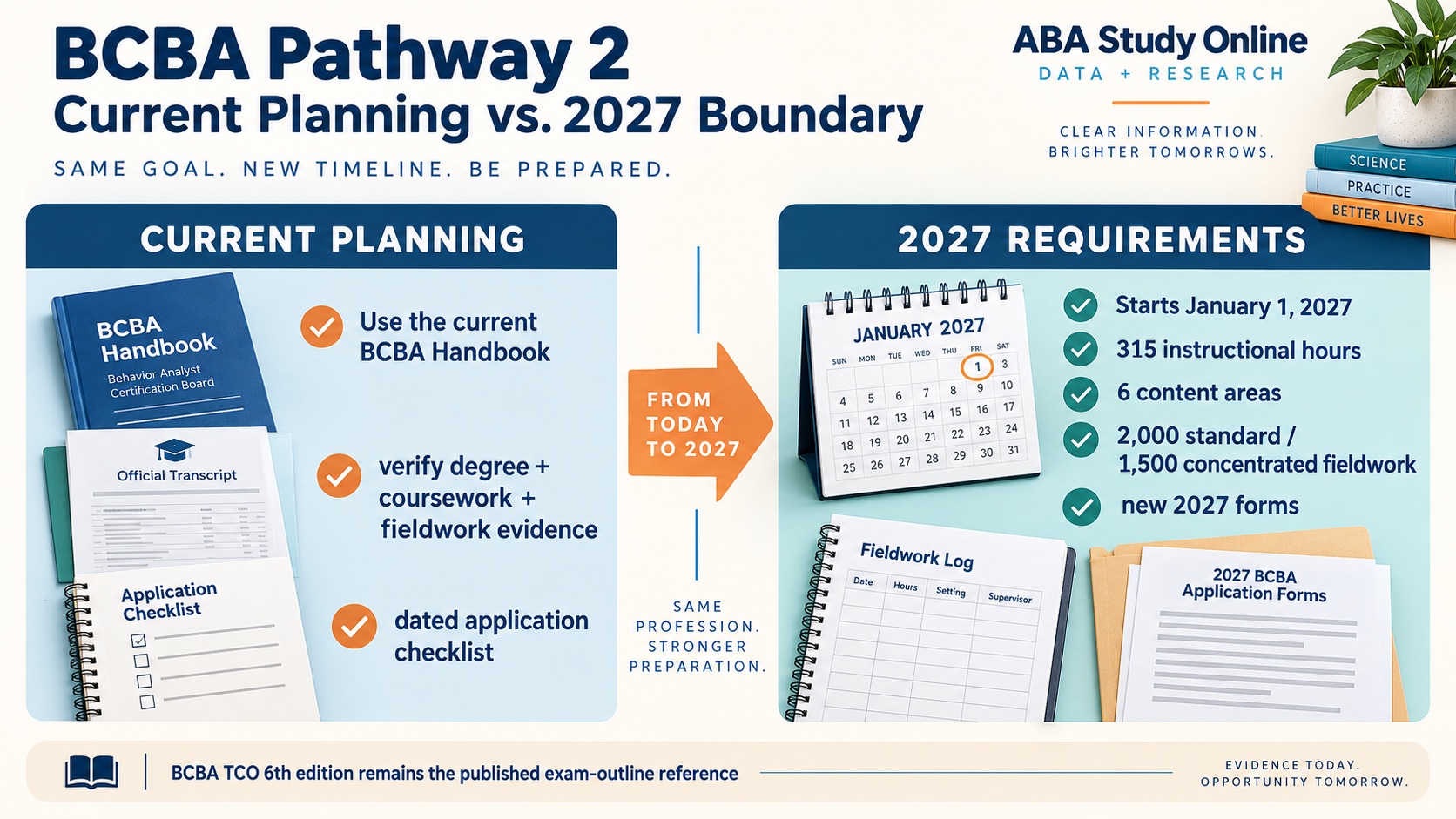
One point is easy to confuse: the 2027 transition materials still reference the BCBA Test Content Outline, 6th edition, which became effective January 1, 2025. The transition to 2027 eligibility requirements is not evidence of a “7th edition” exam. Keep exam-outline research and eligibility-rule research as two separate notes.
A Pathway 2 document checklist
- Write down the application year you are planning for and save the current BCBA Handbook and transition document.
- Confirm the degree level, institution, award date, and transcript access.
- Identify the qualifying Pathway 2 Program Contact connected to the coursework.
- Map each course to the applicable coursework requirements, including hours or credits, grade, dates, and institution.
- Choose a supervisor and document the fieldwork arrangement before counting hours.
- Maintain monthly records and reconcile hours, supervision, observations, and unrestricted activities.
- Use the current forms for the fieldwork period and keep signed copies.
- Prepare the application folder, then use the BACB determination and current scheduling instructions for the exam.
This checklist is a planning aid, not an individual eligibility decision. The BACB’s formal review controls the outcome, and requirements can change. When your facts do not fit a simple example, pause and seek current guidance instead of guessing.
Common planning mistakes
- Choosing a course by title only: “behavior analysis” in a title does not answer the institution, level, hours, grade, or pathway questions.
- Ignoring the Program Contact: the institutional pathway context is part of the evidence.
- Starting fieldwork before setting up records: missing signatures and unclear monthly boundaries are difficult to reconstruct.
- Mixing current and 2027 rules: label every document with the date and application period it supports.
- Calling study material official: practice questions and course notes can support learning, but they are not BACB decisions or official exam content.
- Assuming a 7th-edition exam: verify the current TCO directly; the published transition materials reference the 6th edition.
FAQ
What is the difference between BCBA Pathway 1 and Pathway 2?
They are different eligibility routes with different education and coursework evidence. Pathway 2 is associated with a qualifying master’s degree or higher, qualifying behavior-analytic coursework through the applicable Program Contact, fieldwork, and the exam. Use the current handbook for the exact route rather than inferring eligibility from a degree title.
Can Pathway 2 coursework be online?
Format alone does not answer whether coursework qualifies. Check the institution, academic level, Program Contact, credits or hours, grade, dates, and the current pathway rules. Keep the transcript and course documentation.
Does Pathway 2 require the BCBA 7th edition exam?
Not according to the current published transition materials used for this guide. They reference the BCBA Test Content Outline, 6th edition, effective January 1, 2025. Eligibility changes for 2027 and the exam-outline edition are separate questions.
Can ABA Study Online decide whether my pathway qualifies?
No. ABA Study Online can explain terminology, organize study topics, and provide practice resources, but the BACB’s current handbook and formal application review control an individual eligibility decision.
For study support, see the BCBA learning path, BCBA practice questions, and ABA glossary. These links are educational resources, not a certification guarantee or a substitute for current BACB instructions.