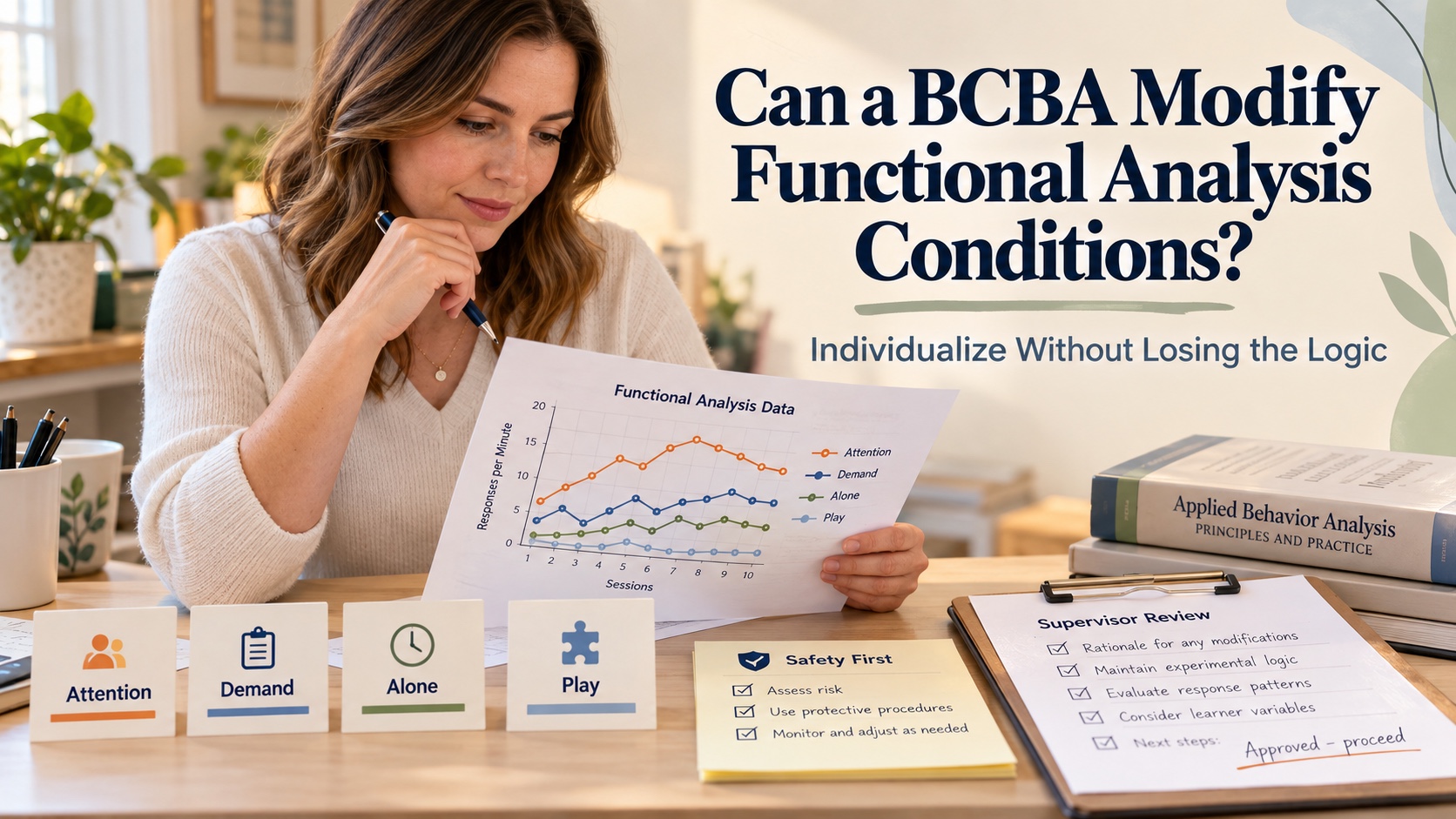
Can a BCBA Modify Functional Analysis Conditions for an Individual?
If you have seen the study statement “It is acceptable for your BCBA to modify the way conditions are set up in a functional analysis to meet the particular needs of the subject,” the safest answer is not a blanket yes or no. A BCBA may individualize functional-analysis conditions when the change is clinically justified, planned, measured, and interpreted carefully. That does not mean any condition can be changed casually without affecting what the assessment tells you.
The key distinction is between individualization with a reason and uncontrolled alteration. A functional analysis is an analytic assessment: the clinician arranges conditions to test hypotheses about variables related to behavior. If the arrangement changes, the reason, procedure, and data interpretation need to remain clear.
Short answer
Yes, a BCBA can modify how functional-analysis conditions are arranged to reflect the person, setting, suspected variables, safety needs, or practical constraints. Research describes modifications to antecedents, consequences, session arrangements, and designs when an initial assessment is unclear or when standard conditions do not represent the relevant events.
But the word “modify” does not mean “improvise.” A responsible modification should have a clinical question behind it. The BCBA should identify what changed, why it changed, how the change will be measured, and what conclusions the resulting data can support. If the alteration is not documented, a later reader may not know whether a different data pattern reflects the person’s behavior or a different assessment arrangement.
What a functional analysis is testing
A functional analysis systematically manipulates environmental events and measures behavior under different conditions. The purpose is to test a functional relation between relevant events and the target behavior, not simply to observe whether behavior occurs. The assessment may compare test conditions with a control condition, use repeated sessions, and display data so the clinician can inspect level, trend, variability, and differentiation.
That logic explains both sides of the question. A standard condition can provide a useful starting structure, but the standard version may not include the exact antecedent or consequence that matters for one person. At the same time, removing or changing several variables at once can make the result difficult to interpret. Individualization should improve the fit between the assessment and the hypothesis while preserving a clear connection between condition, behavior, and outcome.
It also matters who is making the decision. An RBT or other implementer may notice that a demand, item, person, or transition does not match the written procedure. That observation is important data for the supervising clinician. It is not permission for the implementer to redesign the analysis independently.
When modification can be justified
One reason to modify conditions is that an initial functional analysis is inconclusive. Hagopian and colleagues’ review of 176 inpatient cases described additional modifications in pursuit of differentiation and reported that modifications could involve antecedents, consequences, design, or combinations of those elements. The practical lesson is not that every analysis must become complicated. It is that assessment can involve ongoing hypothesis testing when the first arrangement does not answer the question.
Another reason is that the relevant event is individualized. A generic “demand” may not be the same as the actual task that reliably precedes behavior for a particular learner. A generic tangible may not represent the item, activity, or removal event that matters in that person’s routine. Current research on idiosyncratic variables describes cases in which standard conditions did not include the relevant antecedent or consequence, so the assessment was adapted to test a more precise hypothesis.
Safety and feasibility can also shape the format. A clinician may select a brief, trial-based, synthesized, or otherwise adapted assessment when the standard arrangement creates unnecessary risk or cannot be implemented responsibly in the setting. A safer format still needs a clear rationale and careful interpretation. “It was easier to run” is not enough by itself.
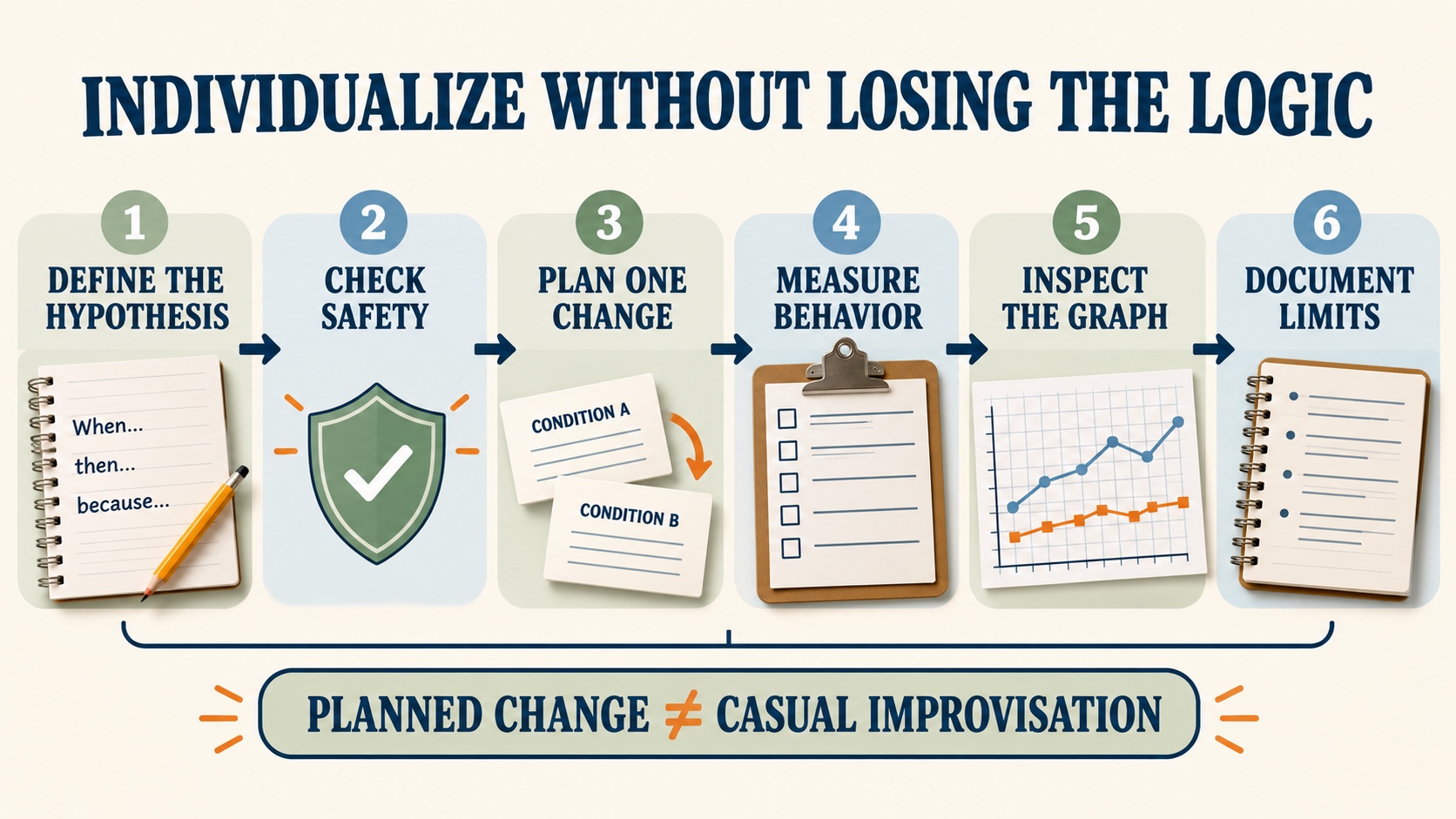
What protects validity
Before changing a condition, ask what question the change is meant to answer. Is the concern that the antecedent is not representative? Is the suspected reinforcer too generic? Is the session too risky, too long, or too difficult to complete? A specific question creates a better bridge between the modification and the data.
- Define the behavior. Use an observable, measurable target so a change in the record can be interpreted.
- State the hypothesis. Identify the antecedent, consequence, motivating context, or other variable being tested.
- Plan the change. Record which feature will change and which features will remain stable enough for comparison.
- Protect safety. Select procedures, materials, staff, and stopping rules that fit the risk and the clinician’s training.
- Collect usable data. The data system should match the question and capture enough repeated information to support interpretation.
- Inspect the result. Look for differentiation and other features of the data, rather than deciding from one dramatic session.
- Document the reasoning. Preserve the original arrangement, the modification, the dates, the observations, and the limits of the conclusion.
A modification can increase ecological relevance while also changing the scope of the conclusion. For example, an analysis using a specific classroom task may tell you more about that task than about every possible demand. A synthesized arrangement may test a meaningful combination of events, but it may not isolate each component separately. The correct interpretation depends on what was actually tested.
That is why “the BCBA can modify conditions” is not a shortcut answer to every functional-analysis question. The more important study skill is recognizing the tradeoff: individualization may improve relevance or safety, while uncontrolled changes may weaken comparison and make the functional relation harder to interpret.
What an RBT should do
An RBT typically implements the current written procedure within training and supervision. If the plan says to use a certain demand, item, prompt, consequence, timing rule, or data method, the RBT should follow that plan as trained. If the procedure appears unsafe, impossible, unclear, or mismatched to the current situation, pause when appropriate and contact the supervisor according to the service protocol.
The RBT can contribute valuable information: the learner’s response to a particular material, a change in setting, a missed step, an unexpected event, or a pattern in the data. The supervisor can then decide whether the assessment needs clarification or redesign. The RBT should not silently substitute a preferred item, change reinforcement, skip a condition, or alter session length and then present the data as if the original plan had been followed.
For exam study, remember the role boundary as a sequence: implement, observe, measure, report, and seek clarification. “Follow the plan” and “report a problem with the plan” are not contradictory. Fidelity is valuable because the supervisor needs to know what procedure actually occurred.
A simple example
Imagine that an initial demand condition uses generic worksheets, but the learner’s challenging behavior is reported to occur most often when a specific writing task is presented. The BCBA might decide that the relevant task needs to be represented in a planned condition. That change could make the test more relevant to the hypothesis.
The BCBA would still need to specify the task, define the behavior, state what consequence follows the behavior, collect data across the relevant conditions, and describe the limits of the interpretation. The decision would not be “the BCBA changed the setup, so any result is valid.” The decision would be “the setup was changed for a stated reason, and the data must be read in light of that change.”
FAQ
Is the statement about modifying functional-analysis conditions true or false?
As a study statement, it is too broad if it means unlimited modification. The defensible answer is that a BCBA may individualize conditions when clinically justified, systematic, safe, documented, and interpreted within the limits of the modified assessment.
Does modifying a condition make the functional analysis invalid?
Not automatically. Research describes planned modifications used to pursue differentiation, improve safety, or test individualized variables. Validity depends on the question, procedure, data, analysis, and interpretation—not on whether the arrangement is identical to a textbook example.
Can an RBT change the functional-analysis conditions?
An RBT should not independently redesign the assessment. The RBT should implement the trained procedure, record what happens, report concerns, and obtain supervisor clarification before changing a programmed feature.
Why is documentation important?
Documentation lets the team distinguish the original plan from the modified plan and understand what the data actually represent. It also makes later supervision, graph review, replication, and communication more reliable.
Academic sources
- BACB BCBA Test Content Outline, 6th ed.
- BACB BCBA Handbook
- Hagopian et al. (2013), initial functional-analysis outcomes and modifications
- Rahaman et al. (2024), review of functional-analysis adaptations
- Lavin et al. (2026), idiosyncratic test conditions
- ABA Study Online functional-analysis learning resource
- ABA Study Online RBT learning path