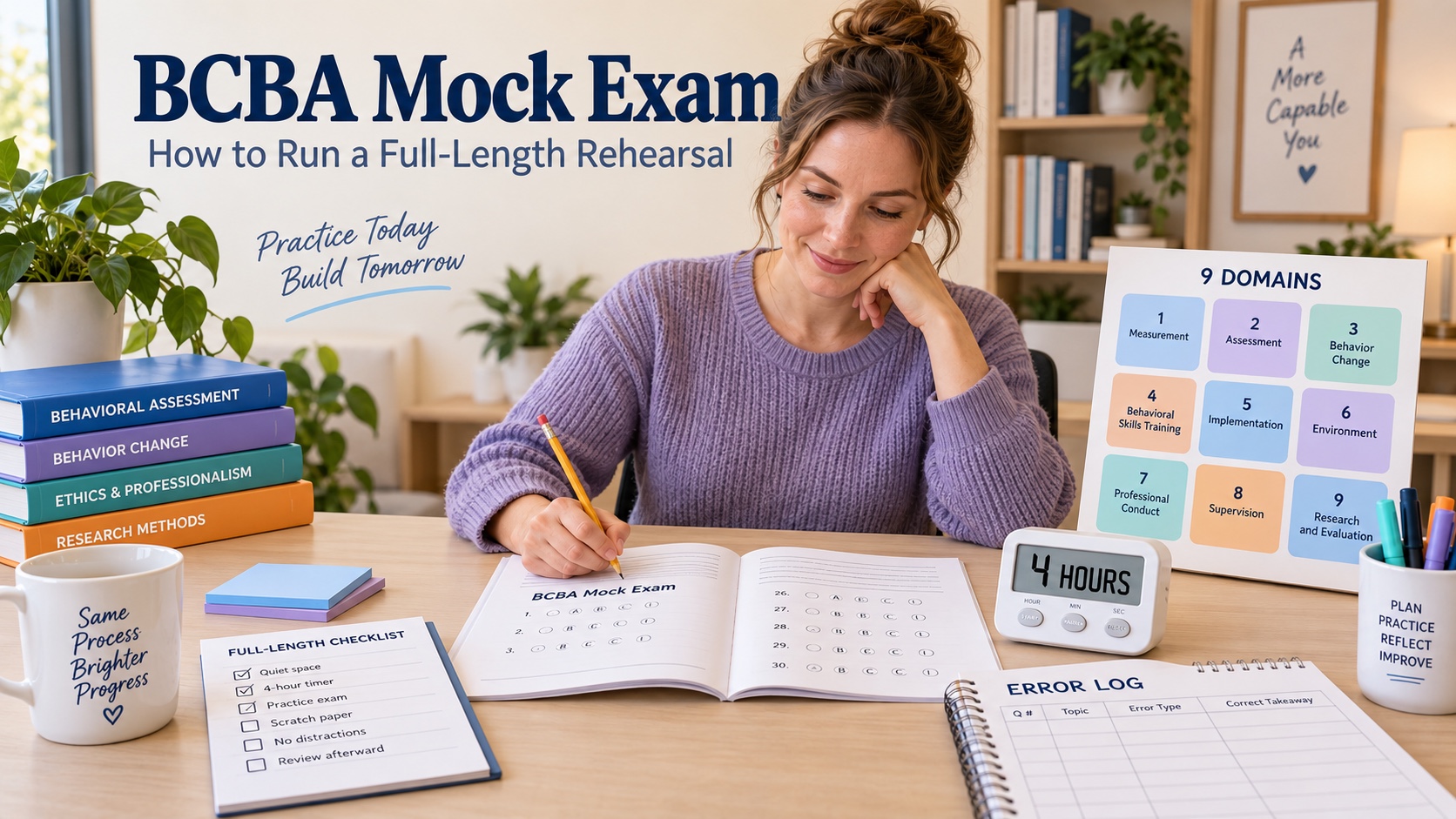
BCBA Mock Exam: How to Run a Full-Length Rehearsal
A BCBA mock exam is most useful when you treat it as a controlled rehearsal, not a prediction of your official result. The practice should resemble the current exam’s broad timing and structure, use original and secure-content-safe questions, and produce an error log you can act on. A score without review may tell you that something felt difficult; a score paired with pacing, confidence, domain, and error-type notes can tell you what to study next.
The current BCBA examination is based on the 6th-edition Test Content Outline. Before you begin, check the current BACB Handbook and examination resources because formats, policies, and document versions can change. This guide explains how to plan the practice session and interpret the learning data without inventing a pass cutoff or implying BACB endorsement.
Table of Contents
Current BCBA mock-exam snapshot
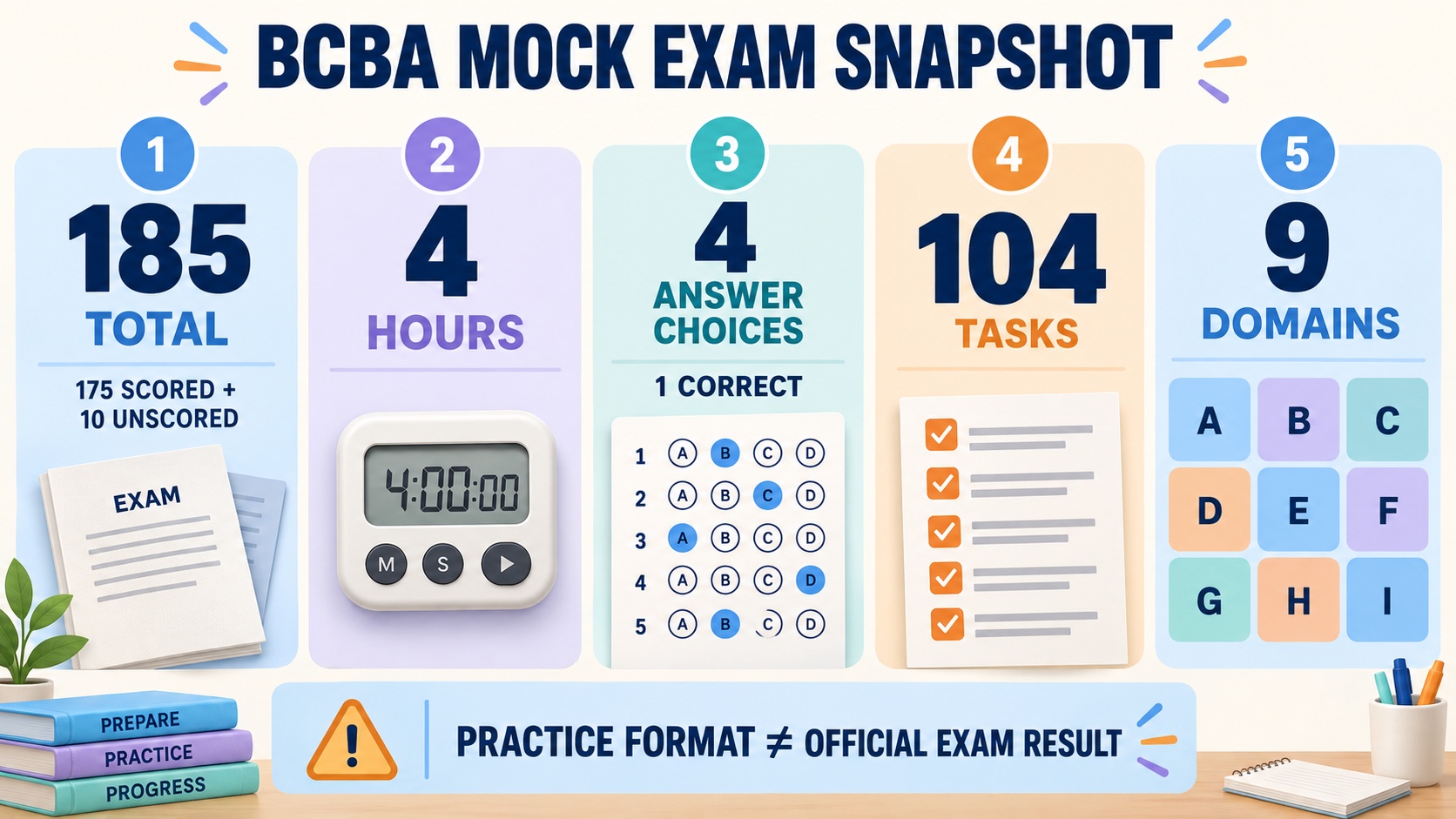
A practice simulation can mirror the current public structure without copying protected content. The current outline and Handbook describe:
- 185 questions in total: 175 scored questions plus 10 unscored pilot questions.
- Four hours: use a realistic time boundary when you are ready for a full rehearsal.
- Four answer choices: one answer is correct for each question.
- 104 tasks across nine domains: use the outline to organize review, not to predict a personal score.
- Overall performance: the result is not a separate pass/fail decision for each domain.
The nine-domain blueprint is a study-planning map. Rounded planning shares are A 8%, B 14%, C 12%, D 7%, E 13%, F 13%, G 14%, H 11%, and I 11%. A practice set can use those proportions to avoid spending all of its time on one favorite topic, but the percentages do not tell you which exact questions will appear or what score you need to pass.
Keep one boundary visible: neither a commercial mock exam nor a free practice page should claim to contain live, recalled, leaked, or reconstructed BACB questions. The point of original practice is to rehearse decision making, terminology, application, and ethical judgment while respecting examination confidentiality.
Three ways to use a mock exam
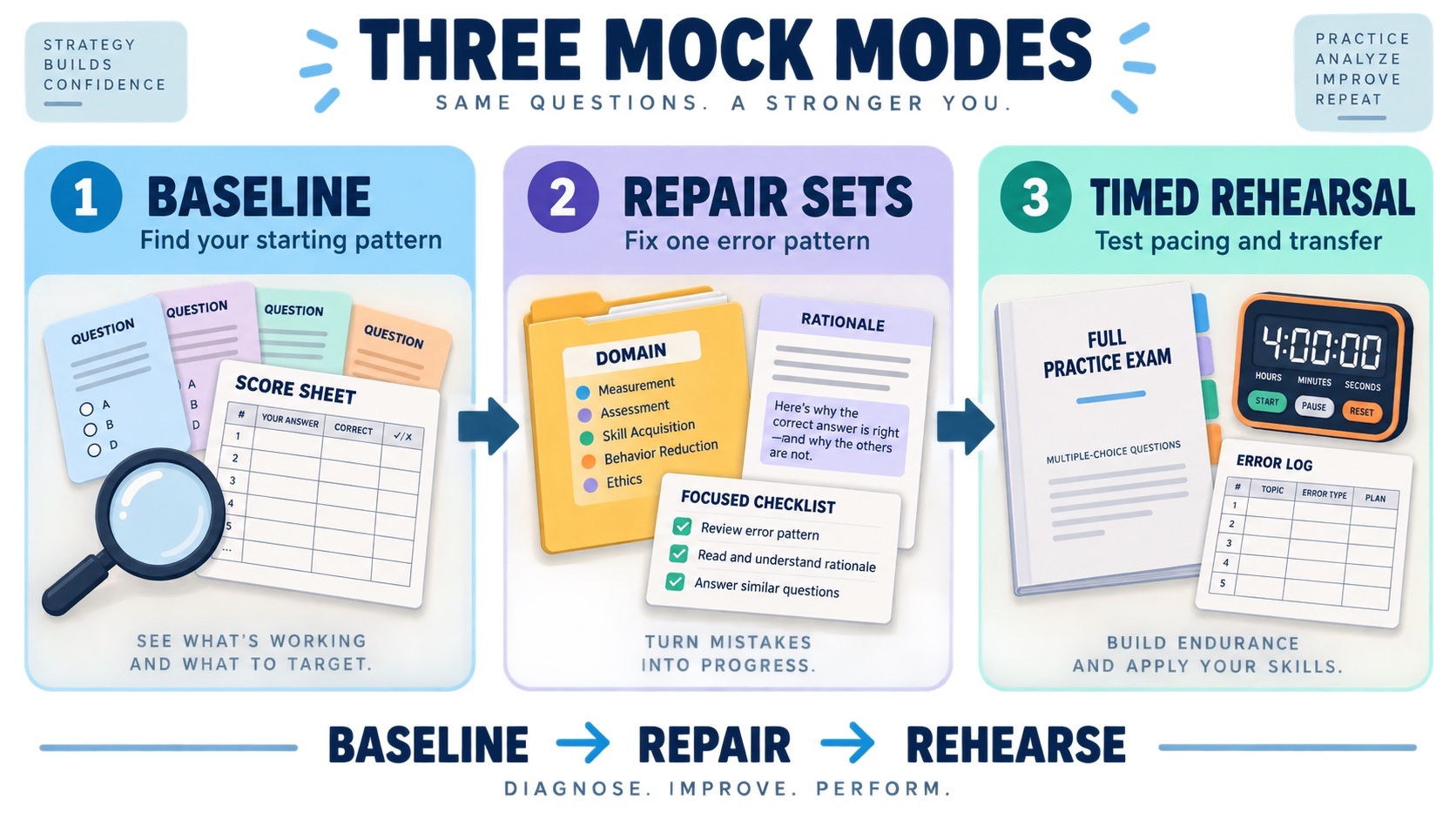
Mode 1: baseline
Take a baseline when you need information about your starting point. You do not need perfect preparation first. Choose a mixed set, record the date, use consistent timing, and mark confidence beside each answer. The goal is not to celebrate or panic over a single percentage. The goal is to see which questions you miss, which questions you guessed correctly, and where time pressure changes your decisions.
Mode 2: repair sets
After the baseline, stop taking full tests for a moment and repair patterns. A repair set might contain questions from one domain, one task family, or one error type such as definition confusion, data interpretation, ethical boundary, or failure to identify the question’s controlling detail. Review the rationale, explain why each distractor is wrong, and write a short rule in your own words.
Mode 3: timed rehearsal
Use a full-length timed rehearsal when you want to test stamina, pacing, and transfer. Clear the desk, silence notifications, use the same break assumptions each time, and avoid looking up answers while the session is running. A realistic rehearsal should create useful discomfort without turning into a punishment. If you cannot finish, record where the time went and whether the cause was reading speed, indecision, fatigue, or unfamiliar content.
How to run a full-length rehearsal
Prepare the environment before the first question. Decide whether you will use a timer, how you will record uncertain items, and what you will do if the platform freezes. Use original practice questions from a source that explains its scope and current-edition alignment. If a page hides the question source, has no rationales, or promises that its score equals a BACB result, treat that as a quality warning.
During the rehearsal, use a simple three-mark system:
- Answer: you selected the best option and could explain why.
- Uncertain: you selected an option but were deciding between two or more choices.
- Flagged: you need to revisit the item because of a terminology, data, ethical, or reasoning question.
Do not turn the practice into an open-book study session unless that is the explicit purpose of the set. A baseline with notes beside you measures retrieval with support; a timed rehearsal measures independent decision making under a boundary. Both can be useful, but they answer different questions.
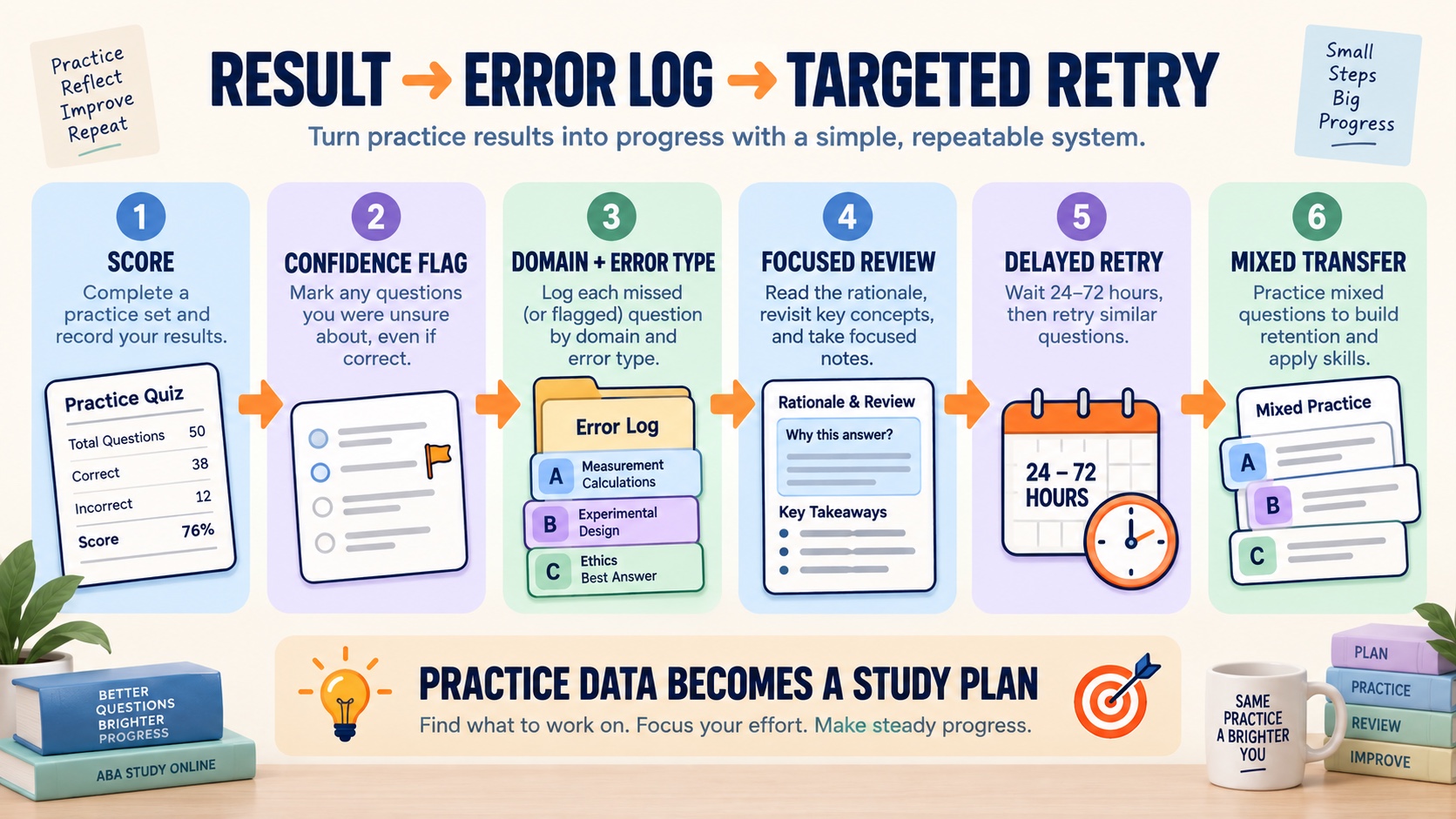
After the session, wait long enough to review with a clear head. Record total attempted, correct, incorrect, unanswered, time remaining, and number of uncertain answers. Then review the rationale for every missed or uncertain item. A correct answer chosen for the wrong reason is a learning signal, not a clean success.
Choose a pacing plan before you begin
A four-hour boundary is easier to learn when you make the pacing question visible. You might divide the session into four working blocks with a short check-in after each block, or use a simple average-time target while allowing harder scenarios more attention. The exact practice method is yours; the important part is to record it and use the same method in the next rehearsal so you can compare sessions.
Notice the difference between slow because you are thinking carefully and slow because you are rereading without a decision rule. For the first pattern, write a short justification and move on. For the second, flag the item, choose the best supported answer, and return only if time allows. A mock exam should teach you how your attention behaves under pressure, not encourage you to spend ten minutes rescuing one question.
Check the mock before trusting its report
A useful mock should tell you what it measures. Look for the current-edition scope, original-question statement, answer explanations, domain tags, timing information, and a clear explanation of whether unscored practice items are included. Check whether the score report distinguishes correct answers from unanswered questions and whether it lets you review reasoning instead of only showing a percentage.
Also check the boundaries around data and privacy. You should know whether an account is required, what information is stored, whether results can be exported, and how the resource describes its relationship to the BACB. A polished dashboard is not evidence of accuracy, and a free set is not automatically low quality. The useful question is whether the resource gives you enough transparent information to decide how much confidence to place in the result.
How to interpret the result
Start with the raw result, but do not stop there. Ask four questions:
- What was the pacing pattern? Did you run out of time, rush the final block, or spend too long on a few difficult items?
- What was the confidence pattern? Which answers were uncertain even when correct, and which incorrect answers felt certain?
- What was the error pattern? Were the misses caused by a knowledge gap, reading error, data calculation, ethical boundary, or distractor trap?
- What was the transfer pattern? Could you apply the rule to a new scenario, or only recognize a familiar phrase?
Use the nine-domain blueprint as context. A low result in a small domain still deserves attention if the errors reveal a foundational concept. A high result in a large domain does not prove that every task is secure. Do not create a personal pass prediction from one mock, one percentage, or one domain chart.
Compare results across time only when the conditions are reasonably similar. A quiet, timed session and an open-book evening quiz are different measurements. Keep both if they help, but label them honestly so an easier practice context does not look like a sudden mastery gain.
If a pattern remains unclear, bring the item and your reasoning—not only the answer—to a qualified instructor, supervisor, or study partner. Explaining the decision path often reveals the missing step faster than rereading the same page in isolation.
Good review is specific, patient, repeatable, and completed carefully before the next full rehearsal together.
Build an error log that changes your study plan
A practical error log has one row per missed or uncertain item. Record the domain, the task or concept, your chosen answer, the best answer, the reason your option was tempting, the rule or evidence you missed, and the next action. The next action should be specific: reread a concept, calculate a new data example, compare two ethical decisions, explain a distractor aloud, or complete a short delayed retry.
Consider a learner who misses three questions about graph interpretation. The useful conclusion is not simply “Domain C is weak.” The learner might discover that the first miss was a slope-versus-level confusion, the second was a reading error about the phase line, and the third was a failure to connect the graph to the stated decision rule. Those are three different repairs. A targeted study block can address each one more efficiently than another random 185-question set.
Return to a mixed set after a delay. Immediate repetition can feel fluent because the wording is familiar. A delayed retry tests whether the rule transferred. If the same error returns, simplify the explanation, find a new example, or ask a qualified instructor or mentor to challenge your reasoning.
Common mock-exam mistakes
- Taking full tests every day: without repair work, repeated scores may hide the same misunderstanding.
- Chasing a magic score: an unofficial mock cannot establish the BACB pass standard or guarantee an outcome.
- Ignoring uncertain correct answers: lucky or poorly reasoned correct answers still need review.
- Studying only large domains: weight can guide time, but foundational errors can appear anywhere.
- Reviewing only the correct answer: understanding why distractors fail is part of decision practice.
- Using secure-content claims: live, recalled, leaked, or reconstructed questions are not a legitimate study promise.
- Confusing practice with certification: a mock score is not an application approval, official score, or pass guarantee.
BCBA mock exam FAQ
How many questions should a full-length BCBA mock exam have?
The current public examination structure is 185 total questions: 175 scored and 10 unscored pilot questions. A practice provider can use a different training design, but it should explain whether its set is a short diagnostic or a full-length rehearsal and how that difference affects interpretation.
Should I use the official domain percentages to calculate my score?
Use the percentages to balance study and identify coverage gaps. Do not use them to predict the exact questions on the examination or invent separate domain pass cutoffs. The current Handbook describes an overall examination result.
Is a BCBA mock exam the official BACB exam?
No. A mock exam is an independent practice resource. Official examination content is confidential, and a legitimate practice resource should use original questions and avoid claims of live or recalled items.
Where should I review after a mock?
Use the current BCBA Test Content Outline and Handbook for scope, then use your error log to choose theory review, original practice questions, glossary work, or spaced app review. ABA Study Online’s BCBA learning path, BCBA practice questions, ABA glossary, free resources, and app review tools can support that study loop. None is a substitute for the official examination or a guarantee of passing.
A strong BCBA mock exam session ends with a next action, not just a number. Rehearse under a clear boundary, diagnose the reasons behind errors, repair the smallest useful skill, and return later for a mixed transfer check.