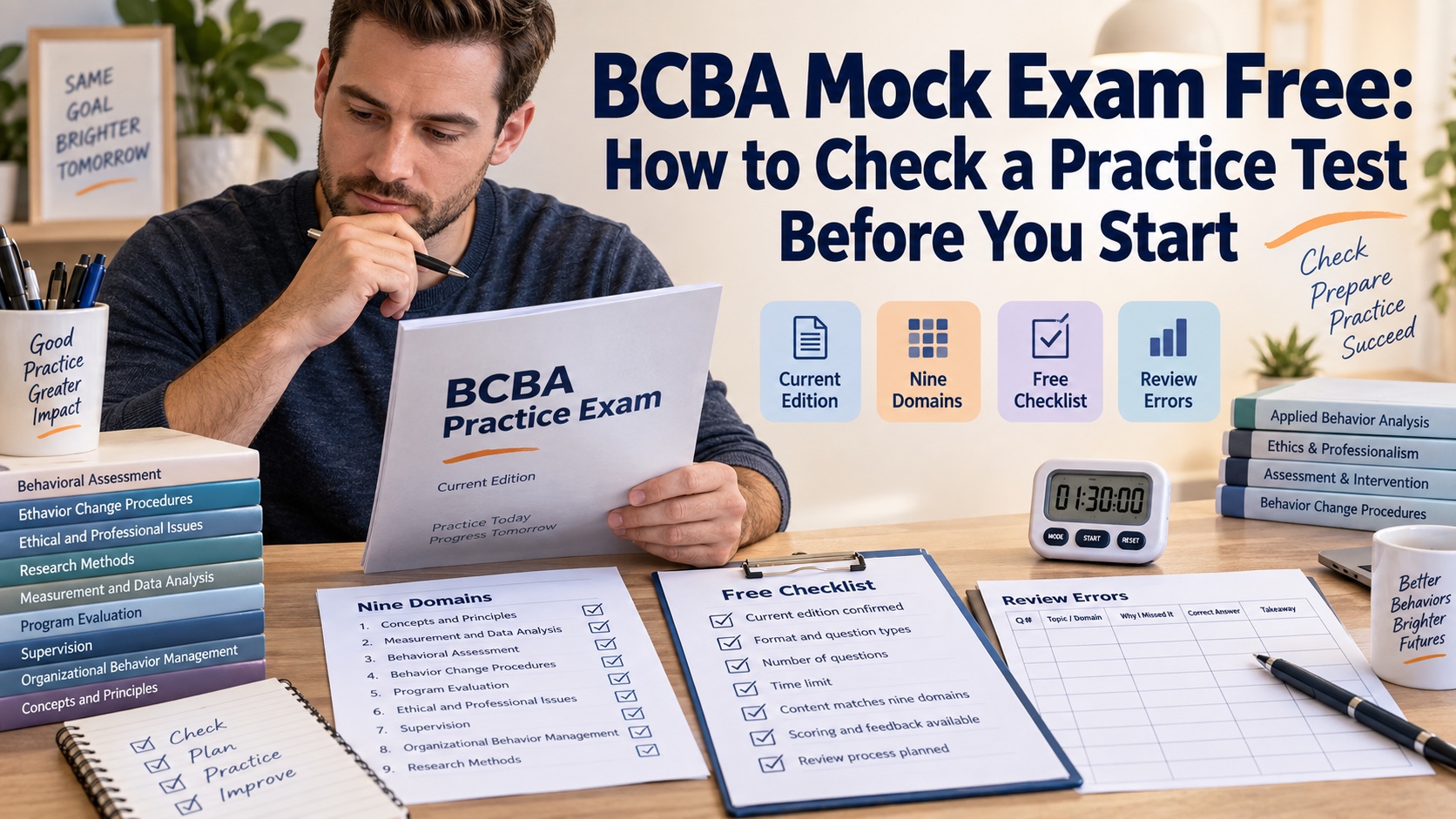
BCBA Mock Exam Free: How to Check a Practice Test Before You Start
Searching for a BCBA mock exam free can feel like an easy way to choose a practice resource: open the page, answer questions, and look at the score. But “free” describes access or price, not the quality of the content. A free test may be current and useful, or it may be built around an older outline, hide its explanations, collect more data than you expect, or present an unofficial number as if it were an official readiness result.
This guide gives you a practical quality check before you begin. It uses the current BCBA Test Content Outline (6th ed.) and Handbook as the reference point, then shows how to turn one free attempt into a focused repair plan. It is independent educational information—not BACB examination content, a score converter, a pass prediction, or a guarantee of certification.
Quick answer: A free BCBA mock exam is worth using when it identifies the current 6th-edition basis, describes its question source, shows meaningful domain coverage, explains answers, and helps you review errors. A free score is still only a score on that particular practice set. It cannot reproduce an official scaled result, identify BACB pilot items, or guarantee that you will pass.
What “free” tells you—and what it does not
Free access can be genuinely helpful. It lowers the barrier to a first diagnostic, lets you compare a study method before committing time or money, and gives you a chance to practice the interface. It can also come with tradeoffs that are easy to miss when the headline emphasizes zero cost.
Before starting, separate these questions:
- Access: Is the whole test free, or only a short preview?
- Currency: Does the page identify the BCBA TCO (6th ed.) and its review date?
- Coverage: Does the practice include all nine content areas, or only the topics the publisher prefers?
- Learning value: Are explanations available for correct and incorrect choices?
- Score meaning: Does the page clearly label the result as unofficial practice data?
- Data boundary: Do you know what account information, email, cookies, or progress records the site collects?
A free resource can pass all of these checks. A paid resource can fail them. Price is not the quality test; transparency is.
The current BCBA examination snapshot
Use the official BCBA Handbook and BCBA Test Content Outline (6th ed.) to check whether a free practice page is using the right boundary. The current materials describe:
- 185 total questions: 175 scored questions and 10 unscored pilot questions.
- Four hours: the current examination time.
- Four answer choices: one correct answer for each item.
- 104 tasks: organized across nine content domains.
- Overall performance: questions are equally weighted, and the result is based on overall examination performance rather than a separate pass score for each domain.
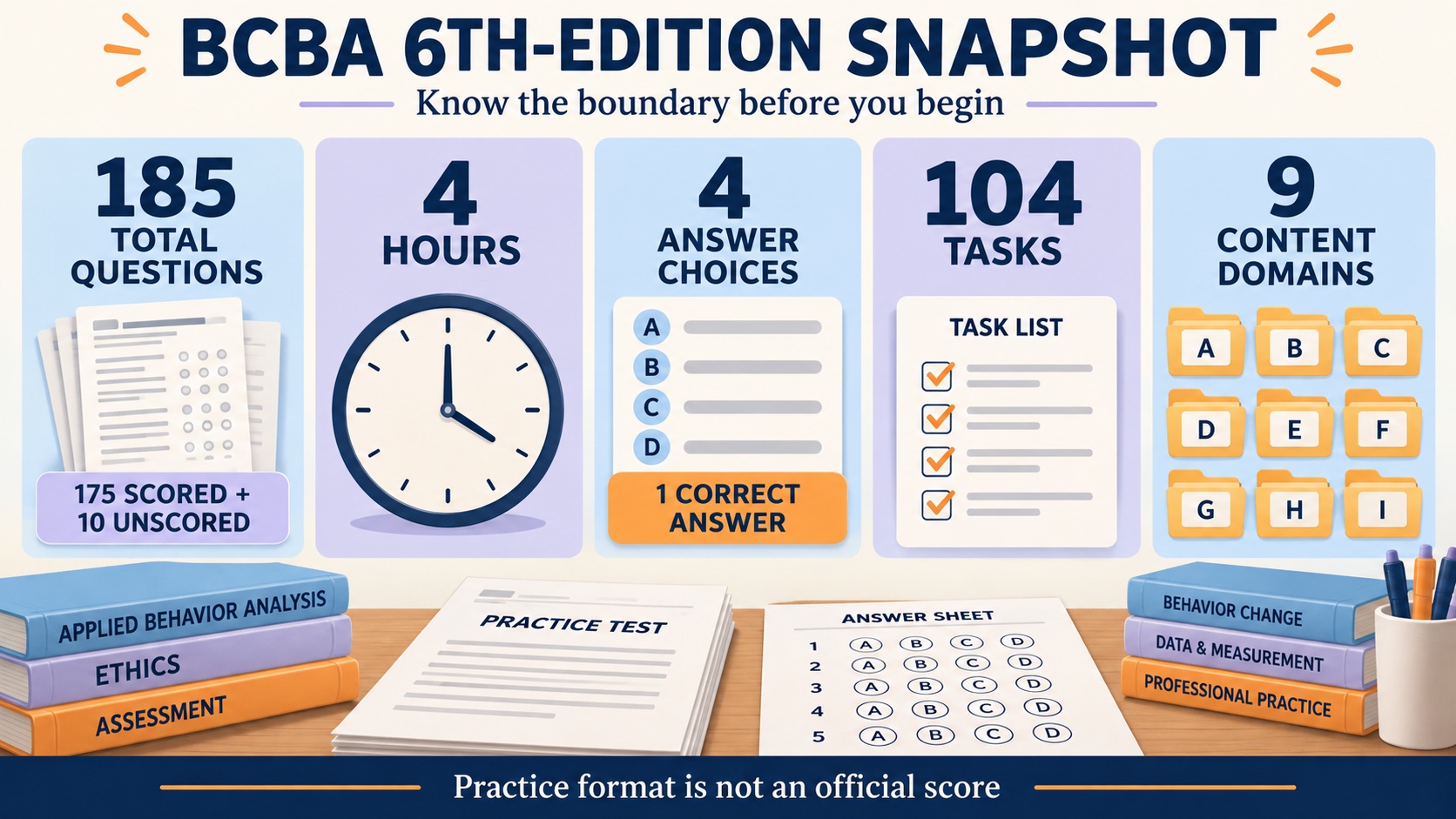
A third-party practice test cannot tell you which of its questions would be scored or unscored on the official examination. It can imitate the current structure for practice, but its result remains independent study data. Be cautious with any page that turns a practice percentage into a fixed “you are ready” threshold.
A free-mock quality checklist
Run this check before spending an hour or more on a free test. You do not need a perfect platform; you do need enough information to interpret the experience.
1. The edition is visible
Look for the BCBA Test Content Outline (6th ed.) and the time boundary the page is designed for. A vague “updated BCBA practice test” label does not tell you whether the domain names, task coverage, and scenario level are current. If the page uses older terminology without explaining the relationship, treat it as a review lead rather than a current mock.
2. The question origin is honest
Independent practice questions should be described as original educational content. A responsible page should not claim access to live, recalled, leaked, or reconstructed BACB questions. BCBA examination content is confidential. A dramatic claim about “real questions” is a reason to stop, not a reason to trust the resource.
3. Coverage is more than vocabulary
A balanced mock should include decisions involving concepts, measurement, experimental design, ethics, assessment, behavior-change procedures, intervention selection, and supervision. A page that tests only definitions may still be useful as a warm-up, but it should not be presented as a complete representation of the examination.
4. Rationales show the evidence
After choosing an answer, you should be able to see why it fits the scenario and why the distractors do not. A useful rationale identifies the controlling detail: the measurement dimension, contingency, design feature, ethical boundary, assessment evidence, implementation condition, or supervision responsibility. “Correct answer: C” is an answer key, not a full learning explanation.
5. The score is labeled correctly
The score should be described as a result on that question set. It is not an official scaled score, does not reveal the BACB passing standard, and cannot establish eligibility or certification readiness by itself. A quality page makes that boundary easy to see rather than hiding it in tiny text.
6. The interface supports review
Check whether you can flag uncertain questions, revisit rationales, see domain information, and record an error. A simple interface can be enough. The important part is that the test does not end at the percentage. You need a bridge from result to next study action.
What if the free test has no useful explanations?
Do not treat a bare answer key as a complete study resource. You can still use the questions as a limited retrieval exercise, but record the item number, your answer, your confidence, and the concept you believe it tested. Then verify the concept against the current TCO, your course materials, a trusted textbook, or a qualified instructor. If the wording is ambiguous and the page gives no rationale, mark the item as “not interpretable” instead of building a rule from it.
This distinction protects your study notes. A free question may be useful for noticing a topic, while its explanation may be too thin to teach the reason. Keep those two judgments separate. The best practice resources make the reasoning visible; when they do not, use the item cautiously and move to a source that can explain the decision.
Use the 6th-edition blueprint for coverage
The current TCO contains 104 tasks across nine domains. The rounded planning weights below can help you notice whether a free test is balanced:
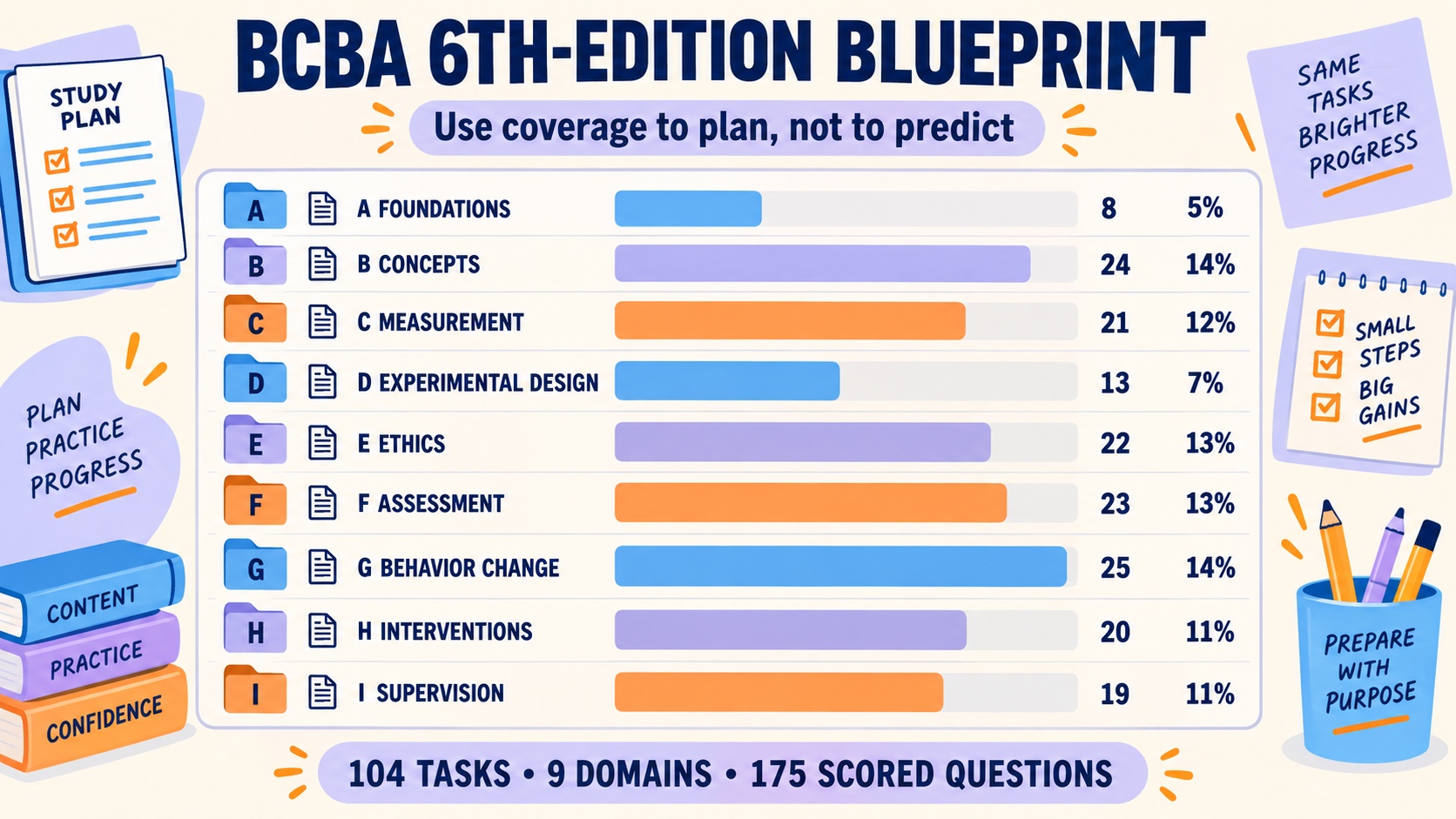
- A. Behaviorism and Philosophical Foundations: 8 questions, 5%.
- B. Concepts and Principles: 24 questions, 14%.
- C. Measurement, Data Display, and Interpretation: 21 questions, 12%.
- D. Experimental Design: 13 questions, 7%.
- E. Ethical and Professional Issues: 22 questions, 13%.
- F. Behavior Assessment: 23 questions, 13%.
- G. Behavior-Change Procedures: 25 questions, 14%.
- H. Selecting and Implementing Interventions: 20 questions, 11%.
- I. Personnel Supervision and Management: 19 questions, 11%.
The percentages are rounded planning weights, not promises about the exact order or wording of a future form. They also do not mean that a candidate can ignore a smaller domain. A five-percent area can still reveal a major reasoning gap, and a high-weight area can expose a problem with application rather than memory.
Use a free mock in three passes
One attempt becomes more useful when you give it a clear job.
- Pass one—baseline: take a mixed set without opening a textbook for each item. Mark your confidence before viewing feedback. The result shows where your current retrieval is strongest and least stable.
- Pass two—repair: sort missed and guessed items by domain and error type. Review one narrow concept, then answer a new scenario that requires the same distinction.
- Pass three—rehearsal: after targeted review, use a longer timed session to practice stamina and pacing. Record time checkpoints and flagged items, not only the final percentage.
A free mock is often most valuable as a first diagnostic. You do not need to wait until you feel “ready” to learn from one, but you should avoid taking the same form repeatedly until you memorize its wording. Delayed retry on new questions gives you better evidence of transfer.
For pacing practice, a full-length-style session can mirror the official four-hour boundary, but it should be described honestly if it is shorter. A 25-question free quiz can be an excellent study tool; it is simply not the same task as a 185-question rehearsal.
Read the result without overinterpreting it
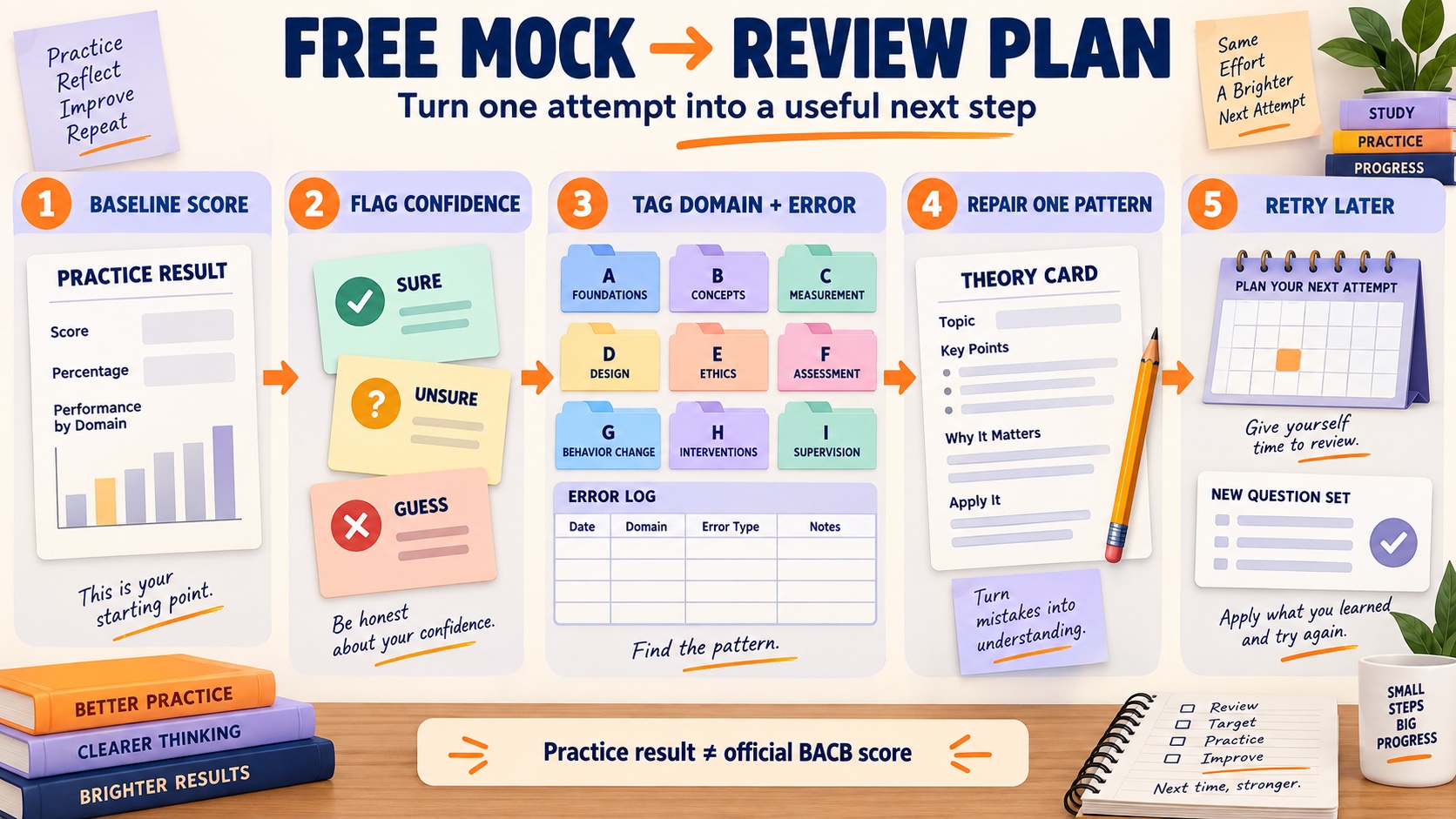
Read the result in three layers:
- Overall percentage: how you performed on this set, with this wording, on this day.
- Domain pattern: where errors cluster, using the current blueprint as a map.
- Confidence pattern: which answers were guesses or confident errors, even when the final choice was correct.
Suppose your free mock score is 68%. The number alone does not tell you whether you need more conceptual reading, better data interpretation, slower scenario reading, or a more disciplined answer-review process. Look at the error record. If several misses involve selecting an intervention before identifying the assessment evidence, your next block should focus on that decision sequence. If the misses are mostly confident changes from a correct first answer, practice committing to the evidence instead of adding more content.
Use a short note for each important item: “The scenario gives me ___; the best answer is ___ because ___; the tempting distractor fails because ___.” This format makes your reasoning visible. It also gives you material to review later in the BCBA learning path or with original BCBA practice questions.
Check privacy and examination-security boundaries
Free websites may use different account, cookie, email, analytics, and progress-tracking systems. Before registering, look for a privacy notice and decide what information is necessary for the study feature you want. Do not upload BACB examination content, recalled questions, or confidential testing information to a practice site.
The BACB’s current materials make examination security a serious boundary. Independent practice should be based on public outlines, training concepts, and original scenarios. It should not invite candidates to share what appeared on a live form or imply that remembering a test item is a legitimate study method.
If you want to compare the free diagnostic with a structured website practice option, you can view the ABA Study Online mock-exam area as a separate destination. That link is for navigation, not an official BACB score or endorsement. Keep your certification decisions anchored to the current BACB Handbook and your own official application information.
BCBA free mock-exam FAQ
Is a free BCBA mock exam automatically outdated?
No. A free resource can be current and well designed. Check its edition, review date, domain coverage, explanations, and question-origin statement instead of judging it by price.
How many questions should a free BCBA mock have?
There is no single required length for an independent practice set. The current official examination has 185 total questions, but a free diagnostic may be shorter. The page should describe whether it is a warm-up, diagnostic, or full-length-style rehearsal.
Can a free mock score predict whether I will pass?
No. It is a practice result on a particular set of unofficial questions. Use it to identify review patterns, not as an official scaled score or guarantee.
Should I only practice the highest-weight BCBA domains?
No. Use the blueprint to distribute time, but review every domain and pay attention to the reasoning gap behind each miss. A small domain can still contain an important weakness.
Are free BCBA mock questions the real BACB questions?
They should not be. BACB examination content is confidential. Responsible independent practice uses original questions and clearly says that it is unofficial.
Official sources and next study paths
- BACB BCBA Handbook
- BACB BCBA Test Content Outline (6th ed.)
- BACB Test Content Outlines
- BACB Examination Information
- BACB Terms of Use and examination-content boundary
For additional independent study, use the free ABA resources and the ABA Study Online app for spaced review. These tools support learning and practice; they do not issue BACB scores, certification, or an examination guarantee.