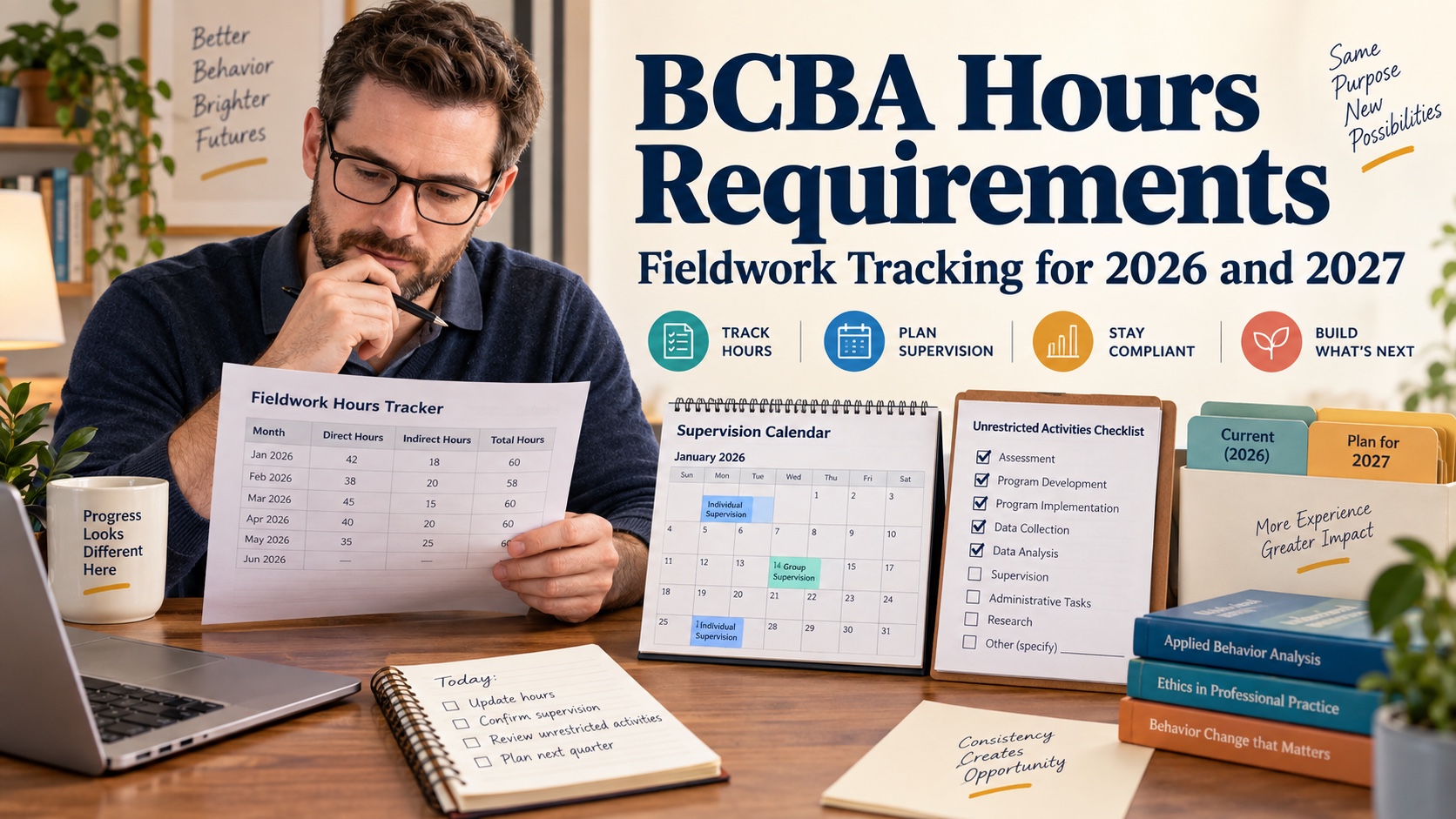
BCBA Hours Requirements: Fieldwork Numbers, Supervision, and the 2027 Transition
If you are searching for BCBA hours requirements, the number you need is only the beginning. You also need to know which type of fieldwork you are accruing, how many hours can be recorded in each supervisory period, how much supervision is required, what counts as unrestricted activity, and which forms apply to your application timeline. A spreadsheet that shows a large total can still hide a problem if the monthly requirements were not met.
The current BCBA Handbook describes two main fieldwork options: 2,000 hours of Supervised Fieldwork or 1,500 hours of Concentrated Supervised Fieldwork when the more intensive requirements are met. The published 2027 BCBA requirements change several fieldwork details and introduce new forms, so current and 2027 planning should be kept in separate dated checklists. The BACB’s current handbook and transition materials control an individual application.
Quick answer: under the current BCBA Handbook, most trainees complete either 2,000 hours of Supervised Fieldwork or 1,500 hours of Concentrated Supervised Fieldwork. Supervised Fieldwork requires 5% supervision per supervisory period; Concentrated Supervised Fieldwork requires 10%. Both options involve monthly tracking, supervisor contacts, client observation, individual-supervision limits, and at least 60% unrestricted activities. The hours count only when the applicable requirements and documentation are met.
Current BCBA fieldwork hours requirements
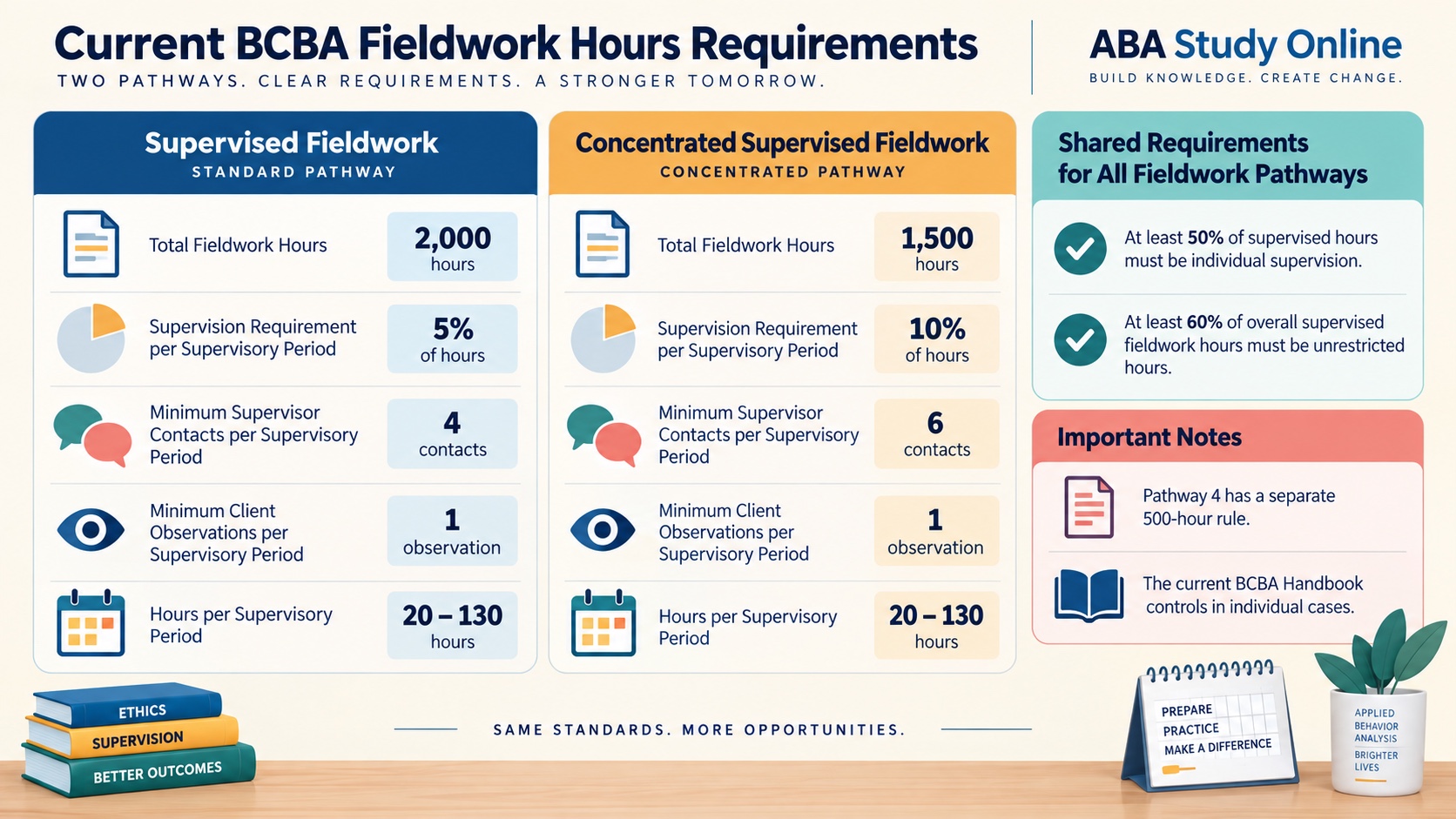
The current handbook describes a one-calendar-month supervisory period and gives a fieldwork-hour range of at least 20 and no more than 130 hours per supervisory period. The two options are not simply two labels for the same schedule:
- Supervised Fieldwork: 2,000 hours required, 5% supervision per supervisory period, at least 4 supervisor contacts, and at least 1 client observation.
- Concentrated Supervised Fieldwork: 1,500 hours required, 10% supervision per supervisory period, at least 6 supervisor contacts, and at least 1 client observation.
- Both options: at least 50% of supervised hours must be individual rather than group supervision, and at least 60% of overall supervised fieldwork must be unrestricted.
The concentrated option has a higher supervision burden because the total hour target is lower and the supervision is more intensive. Do not choose a fieldwork type only because 1,500 looks faster. You need a supervisor, setting, schedule, and documentation system that can meet the applicable monthly requirements consistently.
Monthly supervision and tracking rules
A fieldwork month should be planned before it starts. Record the setting, responsible supervisor, fieldwork type, total hours, supervision contacts, individual and group supervision, client observation, and the activities that make up the month. Then compare the record with the current handbook before the month is closed.
For Supervised Fieldwork, 5% of the hours in the supervisory period must be supervised, with at least four supervisor contacts. For Concentrated Supervised Fieldwork, the supervision percentage increases to 10% and the contact requirement increases to six. At least half of the supervised hours must be individual supervision in either type; group supervision cannot replace the entire individual component.
The fieldwork-hour range matters too. Under the current handbook, the supervisory period uses a minimum of 20 and maximum of 130 fieldwork hours. A month with too few or too many hours is not repaired simply by averaging across the year. If you change employers, supervisors, settings, or fieldwork type, keep the records separate enough that a reviewer can see which requirements were met under which supervision structure.
Supervision is not just a signature at the end of a form. The BACB describes supervised fieldwork as an experience in which trainees apply coursework in real-world settings under ongoing guidance. Supervisors observe, meet with trainees, support technical and ethical development, and help ensure quality services. Your tracking system should therefore preserve meeting dates, observation notes, feedback, and signed verification—not only a running hour total.
Restricted versus unrestricted activities
At least 60% of overall supervised fieldwork must be unrestricted under the current handbook. The point is to give a trainee experience with work that more closely represents the tasks a BCBA may perform after certification, not to fill the log with only direct implementation. Examples in the current handbook include observing clients, analyzing data, developing programs, training staff or caregivers on behavior-analytic procedures, and meeting with clients about services.
Restricted activities can still be part of fieldwork, but they should not quietly become almost the entire fieldwork experience. A useful monthly review asks:
- What percentage of the total hours was unrestricted?
- Which activities show assessment, data analysis, program development, training, or service planning?
- Can the activity be explained in observable terms rather than as a vague job title?
- Did the supervisor review whether the activity fits the current handbook and the trainee’s development?
If you are also an RBT, do not assume that every RBT task automatically counts toward BCBA fieldwork. The BACB specifically distinguishes RBT maintenance supervision from BCBA supervised fieldwork. Keep those records separate and discuss the overlap with your supervisor before counting the activity.
Can you combine fieldwork types?
Trainees may use Supervised Fieldwork, Concentrated Supervised Fieldwork, or a combination, but the requirements for each fieldwork type must be met for the period and supervision structure in which it is claimed. The current handbook explains that concentrated hours have approximately 1.33 times the temporal value when determining progress toward the 2,000-hour requirement. That conversion is a planning aid, not permission to ignore the actual hours or the supervision rules.
For example, a trainee may have some months under the standard option and other months under the concentrated option. The trainee should label each month, keep the applicable supervision percentage and contact count, and maintain a cumulative calculation that shows actual hours and any handbook-based temporal value. Do not use a single “total hours” cell that hides the fieldwork type.
Pathway-specific exceptions also matter. The current handbook notes a separate 500-hour supervised-fieldwork rule under Pathway 4. That does not mean every BCBA trainee can use 500 hours. First identify the pathway and application rules that apply to you, then use the current handbook rather than a social-media summary.
What changes for 2027?
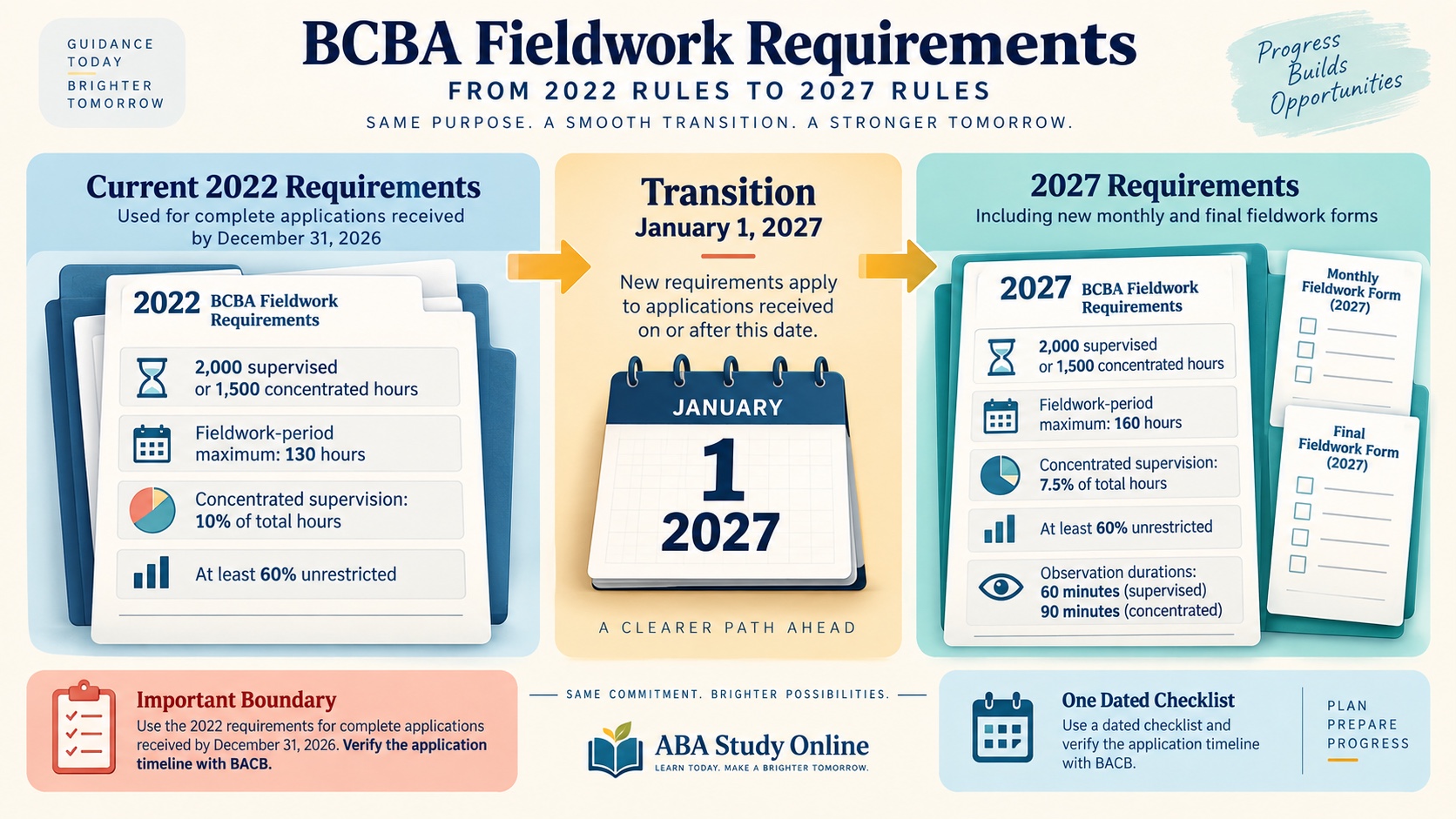
The published 2027 BCBA requirements keep the headline targets of 2,000 hours of Supervised Fieldwork or 1,500 hours of Concentrated Supervised Fieldwork, but they change several fieldwork details. The fieldwork-period maximum increases from 130 to 160 hours. The 2027 overview lists 5% supervision for Supervised Fieldwork and 7.5% for Concentrated Supervised Fieldwork, with 60 minutes of client observation for supervised work and 90 minutes for concentrated work. At least 60% unrestricted activities remains part of the 2027 overview.
The date boundary is important. BACB materials state that the 2027 requirements take effect January 1, 2027 and that complete applications reviewed under current 2022 requirements must be received by December 31, 2026. Applicants after the transition will use the 2027 monthly and final fieldwork forms. Do not backfill a 2027 form for old work or combine a current-rule month and a 2027-rule month in one unlabeled record.
Because the transition depends on application timing and complete documentation, use two separate tabs or folders:
- Current-rule record: label the 2022 requirements, current forms, and the application deadline that applies to your plan.
- 2027-rule record: label the 2027 requirements, new monthly and final forms, and the January 1, 2027 boundary.
A fieldwork tracking system that is easier to audit
A simple tracker can prevent many avoidable problems. Use one row per supervisory period and include:
- month and exact dates;
- fieldwork type and supervision structure;
- total fieldwork hours;
- restricted and unrestricted hours;
- individual and group supervision hours;
- supervisor contacts and client observation;
- supervisor name, signature, and documentation location; and
- rule set: current 2022 or 2027.
At the end of every month, perform a short reconciliation. Compare the schedule with the log, confirm that the total is inside the fieldwork-period range, calculate the supervision percentage, verify contacts and observation, check the unrestricted percentage, and save the signed form. If a number is wrong, correct the record while the month is still fresh and document the correction according to the applicable process.
Keep copies of the supervision contract, monthly forms, final verification, observation evidence, and any communication about a change in supervisor or setting. A strong folder makes it easier to answer a future application question and easier for a supervisor to catch a gap before it becomes a large backlog.
Common mistakes
- Counting only the grand total: monthly requirements and fieldwork type determine whether hours are countable.
- Using 1,500 without concentrated supervision: the lower target comes with the concentrated requirements.
- Letting restricted work dominate: at least 60% unrestricted is a current requirement for the overall supervised fieldwork.
- Mixing RBT supervision with BCBA fieldwork: the two systems have different purposes and requirements.
- Using 2027 forms too early: match forms and rules to the fieldwork period and application timing.
- Assuming the transition changes only the total: the 2027 fieldwork-period maximum, concentrated supervision percentage, observation durations, and forms also matter.
FAQ
How many hours are required for BCBA certification?
Under the current BCBA Handbook, trainees generally complete either 2,000 hours of Supervised Fieldwork or 1,500 hours of Concentrated Supervised Fieldwork. The applicable supervision percentages and monthly requirements must also be met.
What is the difference between 2,000 and 1,500 BCBA hours?
The 2,000-hour option is Supervised Fieldwork with 5% supervision per supervisory period. The 1,500-hour option is Concentrated Supervised Fieldwork with 10% supervision and more supervisor contacts. The lower number does not mean fewer requirements overall.
How many unrestricted hours do I need?
The current handbook requires at least 60% of overall supervised fieldwork to be unrestricted. Track restricted and unrestricted activities separately and ask your supervisor to review the classification.
Do BCBA hours requirements change in 2027?
Several fieldwork details change for the published 2027 requirements, including the fieldwork-period maximum, concentrated supervision percentage, observation durations, and forms. The headline totals remain 2,000 supervised or 1,500 concentrated hours. Use the current BACB transition guidance for the application boundary.
For related study support, use the BCBA learning path, BCBA practice questions, and ABA glossary. These resources can help organize concepts and practice decisions, but they do not replace a qualified supervisor or the current BACB requirements.