
BCBA Hour Requirements: Track Fieldwork for Today and 2027
If you are searching for BCBA hour requirements, the first answer is usually “2,000 or 1,500.” That answer is incomplete. The total depends on whether you are accruing supervised fieldwork or concentrated supervised fieldwork, and the requirements around supervision, observations, monthly limits, unrestricted activities, and forms matter just as much as the headline total.
The timing of your application matters too. The BACB states that significant BCBA eligibility and maintenance changes take effect January 1, 2027. This guide compares the current handbook framework with the published 2027 requirements so you can plan your record. Use the current BCBA Handbook and transition guidance as the final authority for your situation.
Table of Contents
Short answer: how many BCBA hours are required?
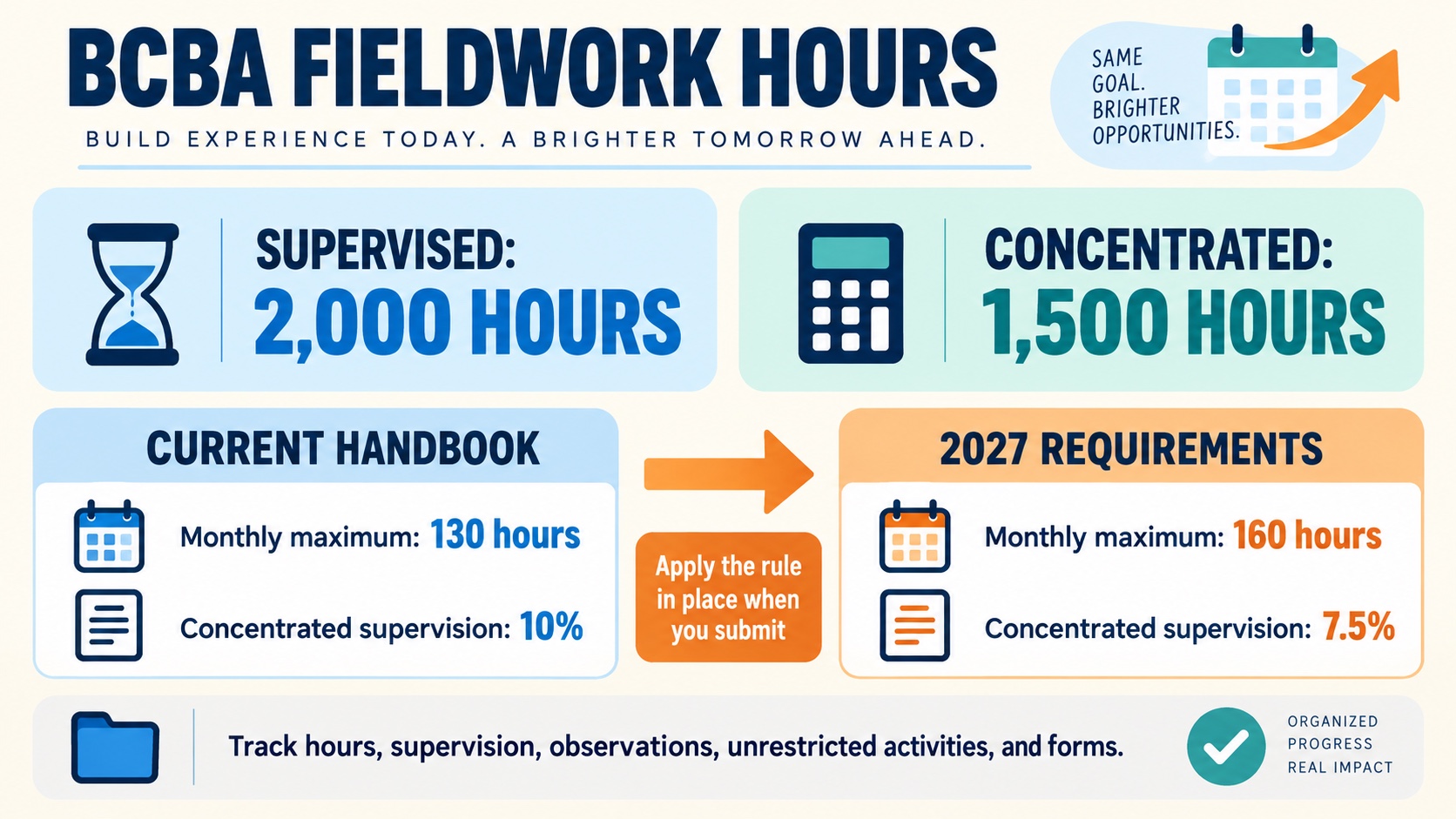
Under the BCBA fieldwork framework, supervised fieldwork requires 2,000 hours. Concentrated supervised fieldwork requires 1,500 hours. These are different fieldwork types, not two portions that every trainee automatically adds together. The supervisor, supervision percentage, monthly range, observation rule, and documentation must match the fieldwork type you are claiming.
Do not choose concentrated fieldwork simply because the total is smaller. It has a different supervision requirement and a different structure. Before you start counting, discuss the fieldwork type, setting, supervisor qualifications, and application timeline with the qualified supervisor or program advisor.
Current supervised and concentrated fieldwork
The current BCBA Handbook describes a monthly supervisory period. Under the current framework, fieldwork hours generally fall between a minimum and maximum monthly range, and the details differ between supervised and concentrated fieldwork. The handbook’s current comparison uses a monthly maximum of 130 hours. Supervised fieldwork uses 5% supervision, while concentrated fieldwork uses 10% supervision.
The current handbook also requires the trainee to complete the relevant observation and contact requirements for the fieldwork type. The exact form, timing, and supervisor qualifications matter. A spreadsheet showing a total number of hours is not enough if it does not show how the hours were supervised and verified.
Fieldwork is also not simply “time spent near ABA.” The hours must meet the applicable activity requirements and be supervised by a qualified supervisor. Ask how your work will be classified before you begin; changing a label after many months can create a documentation problem.
What changes for 2027?
The published 2027 BCBA Requirements keep the headline totals at 2,000 hours for supervised fieldwork and 1,500 hours for concentrated fieldwork. The surrounding rules change:
- Supervised fieldwork uses 5% supervision; concentrated fieldwork uses 7.5%.
- The monthly fieldwork range becomes a minimum of 20 and a maximum of 160 hours.
- Client observations are 60 minutes cumulative per supervisory period for supervised fieldwork and 90 minutes for concentrated fieldwork.
- At least 50% of supervised hours must be individual rather than group supervision.
- At least 60% of total supervised fieldwork hours must be unrestricted activities.
- Applicants after January 1, 2027 use the corresponding 2027 monthly and final fieldwork forms.
These differences are large enough that you should not copy a friend’s tracking sheet and assume it fits your application. The rule in place when you submit the application controls the requirements you must meet. If you are unsure when you will apply, the BACB transition guidance recommends planning so your records can demonstrate compliance with both sets of requirements.
Hours are not the only requirement
Unrestricted activities are work that gives you experience with behavior-analytic activities outside the narrowest direct implementation tasks. The applicable requirements describe examples such as assessment, data analysis, treatment planning, report writing, and program development. Do not classify an activity by its job title alone. Keep enough detail that your supervisor can evaluate whether the activity meets the applicable definition.
Client observations, supervision contacts, individual versus group supervision, and the percentage of supervision must also be visible in your record. If a month has enough total hours but misses the required supervision or observation, the total cannot repair that gap by itself.
How to describe unrestricted activities
“Unrestricted” should be more precise than “indirect.” An entry such as “worked on program” does not tell a reviewer what you actually did. A stronger record might describe analyzing a learner’s data to inform a treatment decision, drafting a behavior plan section for supervisor review, preparing a graph and discussing its interpretation, conducting an assessment step, or writing a report from documented observations.
Keep the description connected to behavior-analytic work and the setting in which it occurred. If you observed a supervisor, note whether you were analyzing the process, practicing a skill, or simply watching. If you prepared materials, explain how the preparation supported assessment, teaching, intervention, or documentation. Your supervisor should be able to review the entry and determine whether it belongs in the category you selected.
This level of detail also helps with transition planning. A future form may ask for a different field, percentage, or supporting record, but a clear monthly description gives you evidence to map the work to the applicable rule. It is easier to classify a specific activity than to reinterpret a vague total months later.
Keep copies of signed forms, supervisor feedback, and any audit log in the same record system. A tracker can calculate totals, but it cannot replace the supervisor’s verification or the official form. Treat the spreadsheet as a navigation tool and the signed documentation as the evidence package.
Schedule a short monthly review with your supervisor. Bring the raw log, not only the total, and resolve unclear entries while the work is easy to remember.
That habit protects both accuracy and confidence throughout the application process and future transitions too.
Forms are evidence, not decoration. The 2027 requirements include new monthly and final fieldwork forms. If you are planning across the transition, ask whether maintaining both the current and 2027 forms each month is appropriate for your situation. The BACB transition guide specifically discusses documenting both sets when the application date is uncertain.
A fieldwork tracking routine
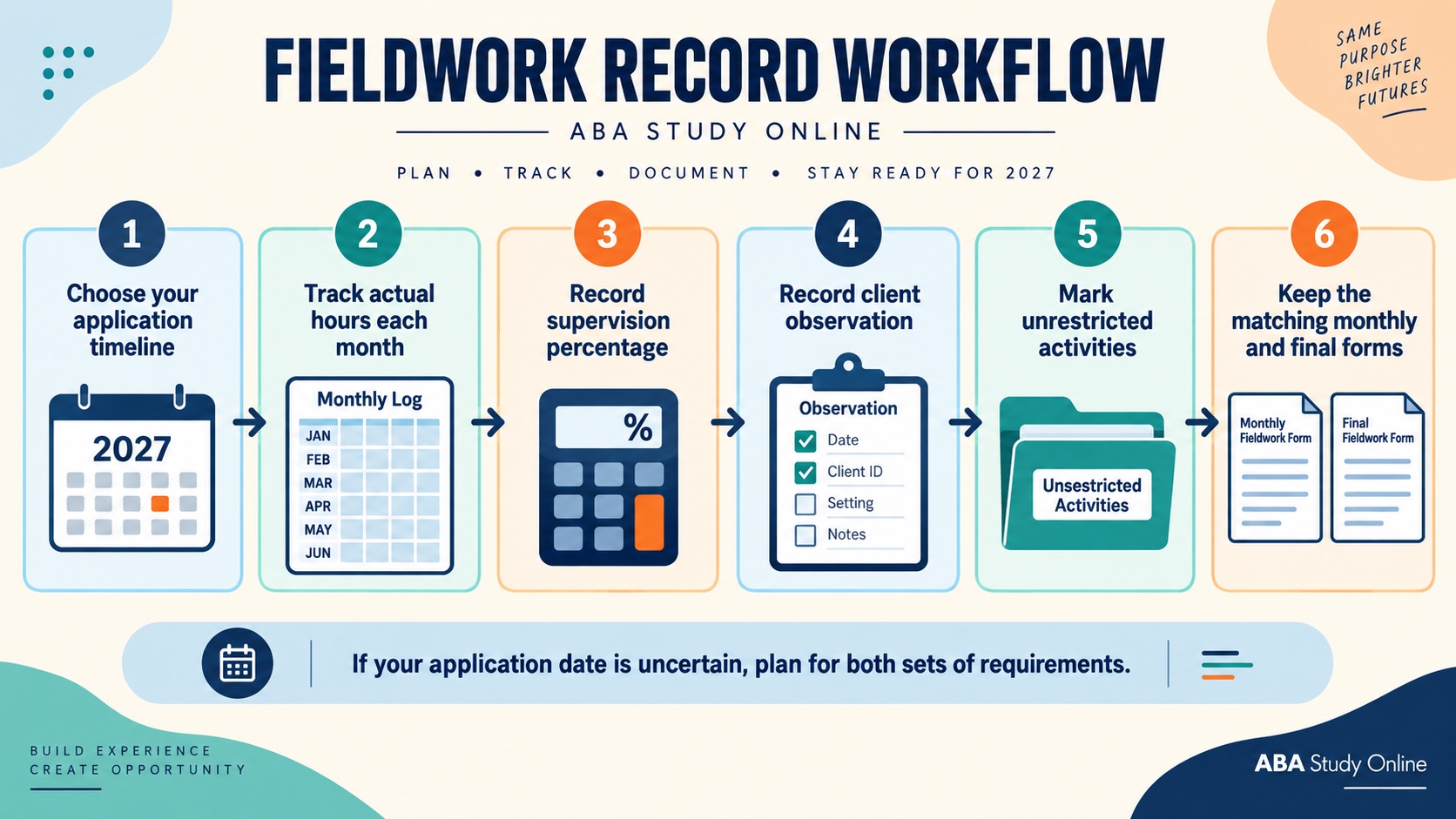
- Choose the timeline: write down whether you expect to apply before or after January 1, 2027.
- Identify the fieldwork type: record supervised or concentrated and the total target.
- Log actual hours: enter each month’s direct and indirect work, setting, and activity description.
- Record supervision: track the percentage, individual/group split, contacts, and client observation.
- Mark unrestricted activities: keep examples and supporting work products where appropriate.
- Match the form: have the supervisor review the monthly record and complete the form that corresponds to the requirements in force.
Review the record monthly, not at the end of the year. A monthly check can catch an over-limit month, a missing observation, an unclear activity description, or a supervisor qualification question while the details are still recoverable.
How to plan when your application date is uncertain
Do not solve transition uncertainty by guessing which rule is “probably close enough.” Read the official transition guide with your supervisor, identify the likely application date, and decide whether to maintain parallel documentation. The goal is to make the record auditable under the applicable requirements, not to create two conflicting stories.
Also remember that fieldwork hours are only one part of BCBA eligibility. Degree, behavior-analytic coursework, fieldwork documentation, and the examination remain separate requirements. The 2027 changes also affect coursework and pathways, so a fieldwork spreadsheet cannot answer every eligibility question.
When in doubt, bring the question to your supervisor or program advisor with the handbook page and your monthly record open. A documented question is easier to resolve than an unexplained total discovered during an application review.
Common hour-tracking mistakes
- Counting before choosing a fieldwork type: the same hour is not automatically interchangeable across structures.
- Using the 2022 monthly maximum for a 2027 application: use the form and rules that match the application timeline.
- Logging “ABA work” without a description: write what activity occurred and why it qualifies.
- Ignoring the observation: total hours do not replace the required client observation.
- Waiting until the application month: missing signatures and forms are much harder to reconstruct later.
FAQ and official sources
Is the BCBA requirement 1,500 or 2,000 hours?
It depends on the fieldwork type: supervised fieldwork is 2,000 hours and concentrated supervised fieldwork is 1,500 hours. Each type has its own supervision and documentation requirements.
Does 2027 change the total number of hours?
The published 2027 requirements retain 2,000 supervised hours and 1,500 concentrated hours, but change several surrounding requirements, including supervision percentage, monthly maximum, observations, unrestricted activities, and forms.
Which rule applies if I am between 2026 and 2027?
The requirements in place when you submit your application control. If the date is uncertain, use the BACB transition guidance and plan documentation that can demonstrate compliance with both sets where appropriate.
Official sources: Review the BCBA Handbook, the 2027 BCBA Requirements, and the 2027 transition guidance before making a fieldwork decision.