
BCBA Fieldwork Requirements: Hours, Supervision, and the 2027 Transition
BCBA fieldwork requirements are easy to reduce to a single number, but the hour total is only one part of the eligibility picture. You also need the correct fieldwork type, a qualified supervisor, the right monthly supervision pattern, enough unrestricted activity, and records that can support the hours if the BACB reviews them. If you are planning for 2027, you also need to keep the current requirements separate from the revised 2027 requirements.
This guide gives you a practical map of the rules as they appear in the current BCBA Handbook. It is an educational overview, not a personal eligibility decision. Your application date, pathway, supervision contract, and the current handbook and transition guidance control when a detail affects your fieldwork.
Table of Contents
Short answer: what counts as BCBA fieldwork?
BCBA fieldwork is supervised practical experience in applied behavior analysis. It is meant to help a trainee apply behavior-analytic knowledge in real settings while receiving ongoing guidance from a qualified supervisor. It is not simply any job in an ABA organization, any time spent near clients, or every hour labeled “ABA” by an employer.
To count, an activity must fit the applicable BACB fieldwork requirements, the supervision structure, the supervision contract, and the documentation system. The supervisor and trainee need to be able to explain what happened, how it was supervised, how it was categorized, and why the activity was appropriate for developing behavior-analytic practice.
The safest habit is to decide how an activity will be counted before the month closes. Do not wait until the application to discover that the hours were missing a required observation, fell outside the contract, or were restricted activities recorded as unrestricted.
How many fieldwork hours are required?
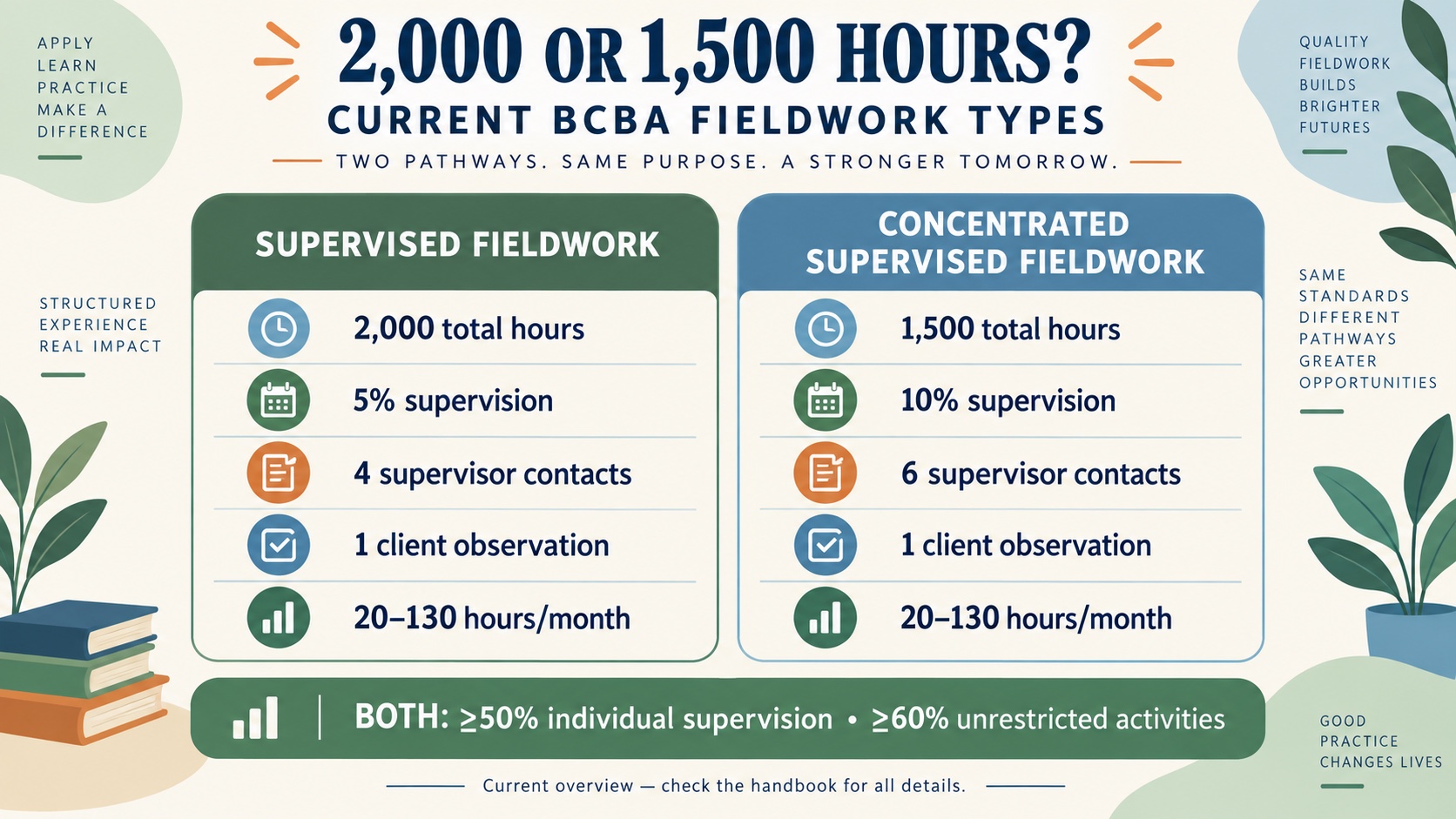
The current handbook’s high-level overview lists two fieldwork types:
| Fieldwork type | Total hours | Current supervision rate |
|---|---|---|
| Supervised Fieldwork | 2,000 hours | 5% of fieldwork hours in the supervisory period |
| Concentrated Supervised Fieldwork | 1,500 hours | 10% of fieldwork hours in the supervisory period |
These are overview figures, not a complete checklist. Under the current 2022 requirements, both types use a one-calendar-month supervisory period and a monthly fieldwork range of at least 20 hours and no more than 130 hours. A trainee may use one fieldwork type or combine types, but the detailed rules for the selected structure must be met. Hours cannot become eligible just because they appear in a spreadsheet.
The supervisor also matters. The BACB overview describes a supervisor as an active BCBA with no current disciplinary sanctions who is certified for at least one year and meets the ongoing supervision CEU requirement, or an active BCBA with less than one year of certification who receives monthly consultation from a qualified consulting supervisor. The detailed handbook requirements and supervision contract still control.
What must happen each supervisory period?
For the current requirements, a supervisory period is one calendar month. A trainee should work with the supervisor to check each month’s minimum and maximum hours, required contacts, client observation, supervision percentage, individual-versus-group balance, and unrestricted activity percentage.
| Current 2022 requirement | Supervised Fieldwork | Concentrated Supervised Fieldwork |
|---|---|---|
| Hours in the month | 20–130 | 20–130 |
| Supervisor contacts | 4 contacts | 6 contacts |
| Observation with a client | 1 observation | 1 observation |
| Supervision | 5% of hours | 10% of hours |
| Individual supervision | At least 50% of supervised hours must be individual | |
| Unrestricted activities | At least 60% of overall fieldwork hours | |
A contact is not automatically created by sending a recording to a supervisor. The BACB’s fieldwork FAQ explains that supervisor-trainee contacts must happen in real time. A video may support a client observation, but without immediate, real-time feedback it may not meet the contact or total supervised-hours requirement. If the trainee and supervisor review the video together with real-time discussion, the same hour may meet more than one requirement when all conditions are satisfied.
Group supervision is also not a shortcut around individual supervision. At least half of the supervised hours must be individual, which means group supervision may not exceed half of the supervised hours. The exact calculation should be checked monthly, not estimated at the end of a long fieldwork period.
What are unrestricted activities?
Unrestricted activities are practical activities that more closely represent the work a BCBA performs after certification. The handbook gives examples such as observing clients and analyzing data, developing programs, training staff or caregivers on behavior-analytic procedures, and meeting with clients to discuss services. The activity must still be appropriate to the trainee’s competence and the supervisor’s direction.
Restricted activities can be valuable, especially when they build direct implementation skills, but they do not automatically become unrestricted because they take place in a clinic or involve a client. A trainee who spends nearly every hour implementing existing programs may be gaining experience while still falling short of the 60% unrestricted requirement.
Ask three questions about each activity:
- What behavior-analytic task did I perform?
- How does the task resemble work within the BCBA scope rather than only direct implementation?
- What did my supervisor observe, review, or give feedback on, and where is that record?
Do not classify an activity only by its job title. A “behavior technician” may perform some activities that meet fieldwork requirements and many that do not. The supervisor and trainee need to categorize each activity using the applicable handbook and checklist.
How to document your fieldwork
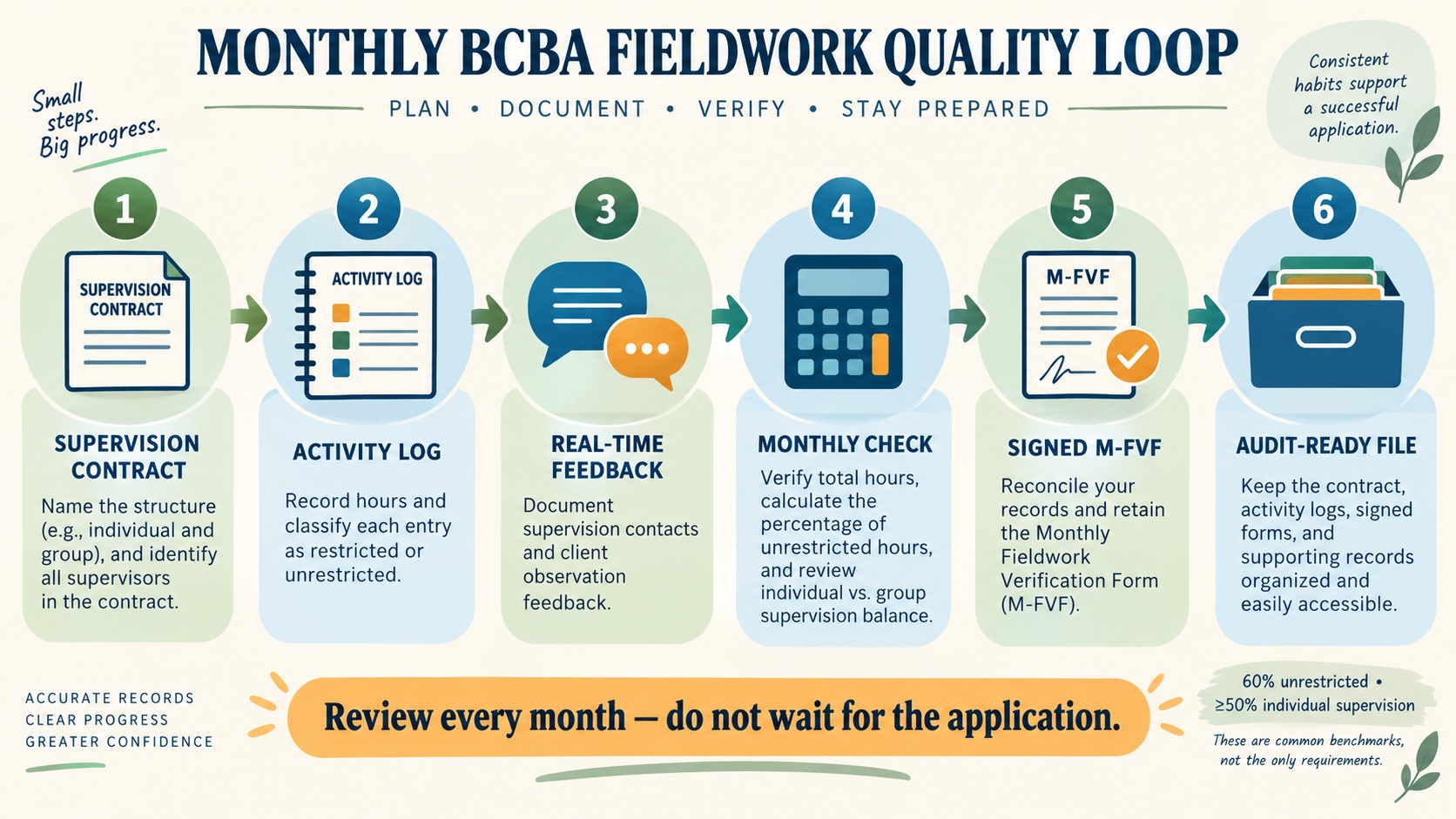
Start with a supervision contract that names the supervisor or supervisors and describes the structure. If multiple supervisors are involved, include them correctly and use the appropriate verification forms. The BACB FAQ notes that an observation from a BCBA who is not in the supervision contract does not satisfy the observation-with-a-client requirement for that fieldwork structure.
Maintain a documentation system throughout the experience. A useful record can include the date, setting, activity description, hours, restricted/unrestricted category, supervision contact, feedback, client observation, and any follow-up action. The record should be detailed enough that you and your supervisor can reconstruct the month without relying on memory.
At the end of each month, reconcile your log with the Monthly Fieldwork Verification Form. Check the total hours, supervision percentage, individual supervision, contacts, observation, and unrestricted percentage. Keep signed forms and supporting records together. The BACB may audit fieldwork at any time and may request the supervision contract, Monthly Fieldwork Verification Forms, documentation system, audit log, or other records. If an audit begins, respond within the specified time frame; noncompliant or unsupported hours may be disqualified.
Be cautious with “double dipping.” Some hours may satisfy both RBT or BCaBA supervision and BCBA fieldwork when all requirements, supervisor qualifications, contracts, and activity standards are met. That does not mean all work hours count twice. A person qualified to supervise an RBT may not meet the qualifications to supervise BCBA fieldwork, and unrestricted activities may fall outside an RBT’s role.
Why the supervision contract matters
The contract is more than an administrative form. It identifies who is responsible for supervision, how the experience will be organized, what documentation system will be used, and how the trainee and supervisor will communicate about activities and feedback. If the work setting changes, a supervisor is added, or the fieldwork structure changes, update the arrangement before relying on new hours.
A clear contract also helps separate three questions that are often blended together: whether an activity is behavior analytic, whether it is appropriate for the trainee’s development, and whether it satisfies a specific BACB fieldwork requirement. An activity can be useful professional learning without satisfying every fieldwork category. Recording that distinction protects the trainee, the supervisor, and the people receiving services.
What changes under the 2027 requirements?
The BACB’s 2027 BCBA requirements begin January 1, 2027. The official handbook describes two pathways: an accredited or recognized degree program pathway and a behavior-analytic coursework pathway. Pathways 3 and 4 are no longer offered in the 2027 eligibility requirements. If you are applying around the transition, read the BACB’s guidance for your application date instead of assuming that a page written for the 2022 requirements answers your situation.
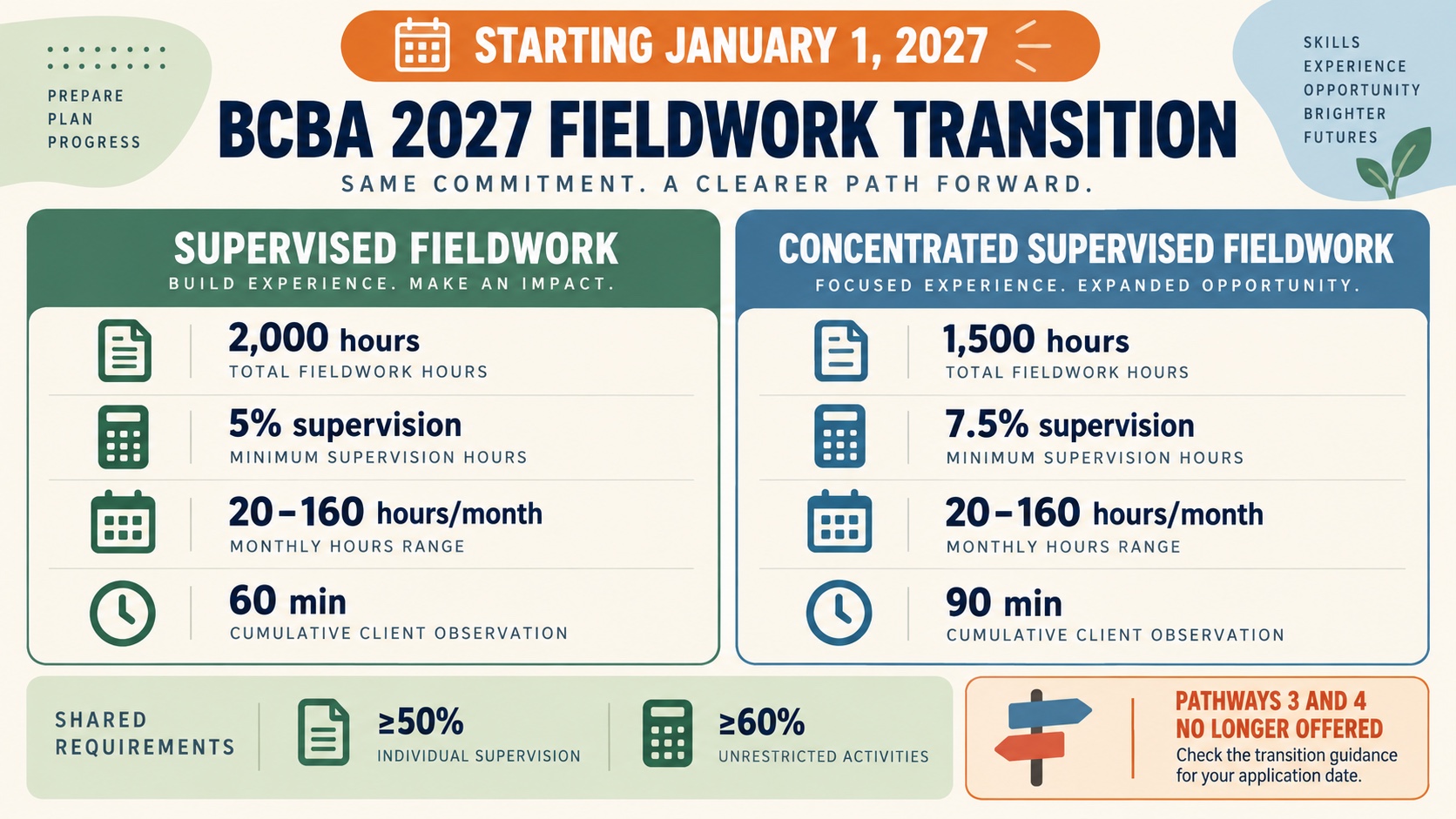
The 2027 fieldwork overview keeps the total-hour figures at 2,000 for Supervised Fieldwork and 1,500 for Concentrated Supervised Fieldwork, but several monthly details change:
| 2027 fieldwork requirement | Supervised Fieldwork | Concentrated Supervised Fieldwork |
|---|---|---|
| Total hours | 2,000 | 1,500 |
| Supervision per month | 5% of hours | 7.5% of hours |
| Monthly fieldwork range | 20–160 hours | |
| Client observation | 60 minutes cumulative | 90 minutes cumulative |
| Individual supervision | At least 50% of supervised hours must be individual | |
| Unrestricted activities | At least 60% of total supervised fieldwork hours | |
The key planning point is not that one set of numbers is “better.” It is that the correct set depends on the requirements governing the application. Update your forms and tracking template only after confirming the transition rule. The BCBA resource page already separates current forms from 2027 Monthly and Final Fieldwork Verification Forms, which is a helpful reminder not to mix documents casually.
Common fieldwork mistakes
- Tracking only a total: a large total can still fail if monthly requirements, supervision, observations, or unrestricted percentages are missing.
- Using the wrong form: current and 2027 forms should not be mixed without checking which requirements govern the application.
- Calling all client work unrestricted: direct implementation is not automatically unrestricted.
- Counting asynchronous review as contact: real-time supervisor-trainee interaction matters for the contact requirement.
- Adding a supervisor informally: supervisors should be included in the contract and applicable verification structure.
- Waiting until the application: missing signatures or unsupported monthly records are much harder to repair later.
- Treating a general website as a personal determination: the BACB handbook and your supervisor or training program must resolve case-specific questions.
A practical tracking routine
At the start of each month, confirm the fieldwork type, planned hour range, supervisor contacts, observation plan, and unrestricted activity opportunities. During the month, write the activity description while the details are fresh. After each supervision contact, record the feedback and the next action rather than only marking “supervised.”
At month-end, run a short audit: total hours, supervision percentage, individual-versus-group balance, client observation, unrestricted percentage, signatures, and supporting records. If one item is short, bring it to the supervisor before assuming that the month can be fixed by adding a note later. This routine turns fieldwork from a large retrospective spreadsheet into a series of small, reviewable decisions.
For structured review, the BCBA learning path can organize theory and requirements topics, free BCBA questions can support application practice, the ABA glossary can clarify terminology, and the ABA Study Online app can support repeatable study. These are learning layers, not BACB approval or a substitute for supervision.
FAQ and official sources
How many hours are required for BCBA fieldwork?
The current overview lists 2,000 hours of Supervised Fieldwork or 1,500 hours of Concentrated Supervised Fieldwork. The 2027 overview retains those totals, but the monthly supervision and observation details change.
What percentage of BCBA fieldwork must be unrestricted?
The current and 2027 overviews require at least 60% of total supervised fieldwork hours to be unrestricted activities. The detailed handbook and supervisor should guide classification.
Can RBT work count toward BCBA fieldwork?
Some hours may meet both sets of requirements when every applicable condition is satisfied, but RBT work does not automatically count as BCBA fieldwork. Supervisor qualification, contracts, activity type, and fieldwork rules all matter.
What changes in 2027?
The 2027 BCBA requirements use two pathways, discontinue Pathways 3 and 4, retain the 2,000/1,500 totals, change Concentrated Supervised Fieldwork supervision to 7.5%, use a 20–160 monthly range, and specify 60/90 minutes of cumulative client observation. Read the transition guidance for your application timing.
Can the BACB tell me whether a specific activity counts?
The BACB’s fieldwork FAQ says trainees and supervisors should use the handbook and checklist to categorize activities. Discuss the activity with your supervisor and keep the rationale in your documentation system.