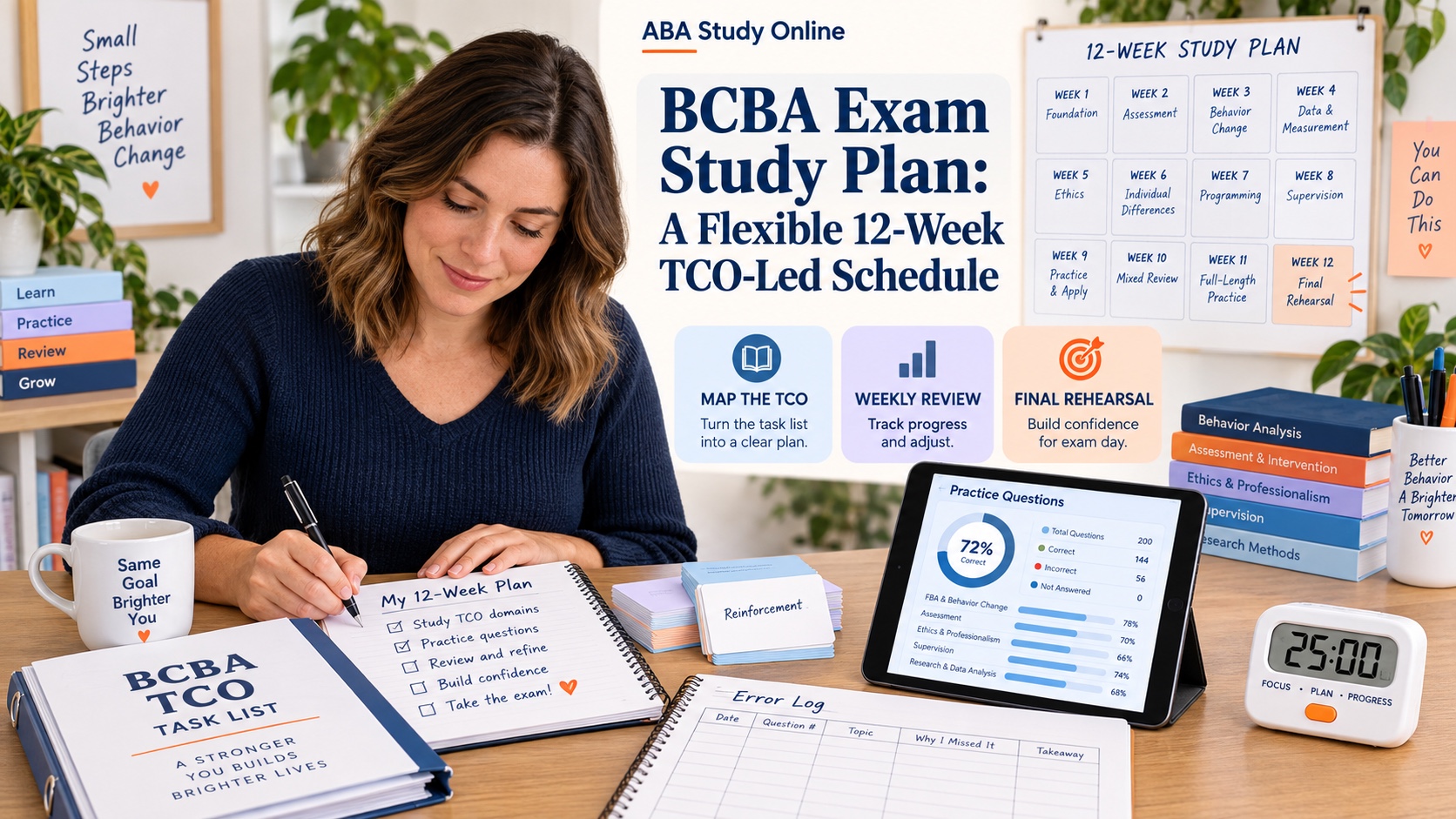
BCBA Exam Study Plan: A Flexible 12-Week TCO-Led Schedule
A BCBA exam study plan should do more than assign a number of hours to a calendar. It should tell you what to learn first, when to switch from focused study to mixed practice, how to use practice errors, and how to rehearse pacing without turning every session into a mock exam.
The schedule below is a 12-week template. It is not an official BACB program, a required timeline, or a pass guarantee. You can stretch it, compress it, or repeat a phase. The essential structure is to start with the current BCBA Test Content Outline, study concepts in context, practice applied decisions, review errors, and let your evidence choose the next target.
Table of Contents
Set up the plan before Week 1
Open the current BCBA TCO and create a one-page map of its nine domains and 104 tasks. Mark each area with one of three labels: learn if you cannot explain the task, practice if you understand the terms but miss scenarios, or maintain if you can answer reliably under your current conditions.
Next, complete a short baseline set. Do not use the result as a prediction. Record the conditions instead: new or familiar questions, focused or mixed topics, timed or untimed, open-book or closed-book. Note your confidence beside each answer. A wrong answer with high confidence deserves a different repair than a wrong answer you knew was a guess.
Finally, choose a realistic weekly rhythm. A plan that fits your work and supervision schedule is more useful than a heroic schedule you abandon after four days. Decide how many short sessions you can protect, when one longer review can happen, and where you will keep an error log. The app, printed notes, or a simple spreadsheet can all work if the record is clear enough to guide the next session.
The 12-week BCBA study plan
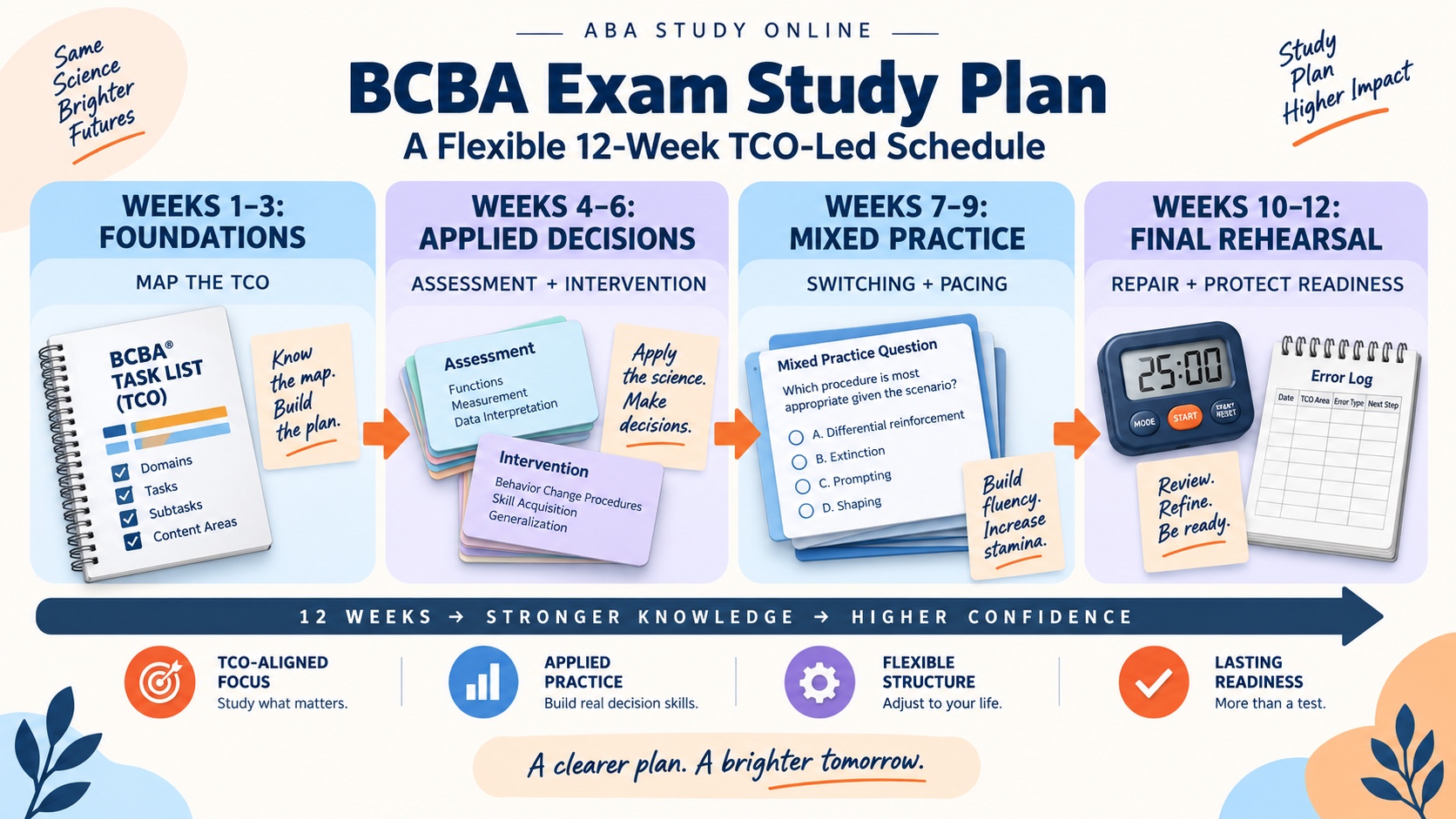
Weeks 1–3: Build the map and repair foundations
Start with the domains that support later decisions: philosophical foundations, concepts and principles, measurement, and experimental design. Learn definitions through examples, compare near-neighbor concepts, and practice identifying the relevant task in a short scenario. Add ethics early rather than leaving it for the last week; professional decisions often depend on noticing boundaries and missing information.
Your goal is not to finish every page of every book. Your goal is to create usable explanations. For each focus area, write a brief definition, a concrete example, a nonexample, and one clue that would change the answer. End each session with a small practice set and tag errors by TCO area.
Weeks 4–6: Apply assessment and behavior-change decisions
Move into behavior assessment, behavior-change procedures, intervention selection, and implementation. Practice the sequence of a decision: what is observed, what information is missing, what assessment or measurement is appropriate, and what intervention choice is justified by the evidence. Mix in earlier foundation topics so you practice recognizing the task instead of waiting for a chapter label.
At the end of Week 6, repeat a baseline-style mixed set under consistent conditions. Compare patterns, not only the percentage. Are you confusing similar terms? Choosing an intervention before checking function? Missing a graph feature? Rushing “most appropriate” questions? Each pattern should create a repair block for the next phase.
Weeks 7–9: Mix domains and strengthen supervision reasoning
Use mixed practice across all TCO domains, including personnel supervision, management, ethics, and professional issues. These weeks are about switching costs: read a new scenario, identify the role and task, select the relevant evidence, and explain why the alternatives are weaker.
Schedule one longer timed block each week, but review it more slowly than you completed it. Mark items you guessed, changed, or answered with low confidence. A mixed set is valuable when it shows how your reasoning behaves under uncertainty, not only when it produces a high number.
Weeks 10–12: Rehearse, repair, and protect readiness
In Week 10, target the two or three domains with the clearest error pattern. In Week 11, complete one or two longer mixed rehearsals with planned breaks and a review window. In Week 12, reduce novelty. Review concise notes, high-value distinctions, ethics boundaries, data interpretation, and your own error patterns. Keep sleep, access needs, scheduling, and test-day logistics in the plan.
At the end of each phase, pause for a short audit: What can I now explain without notes? Which question types still create hesitation? Which study activity produced useful evidence? Use the answers to adjust the next phase rather than treating the calendar as fixed.
Build a repeatable study session
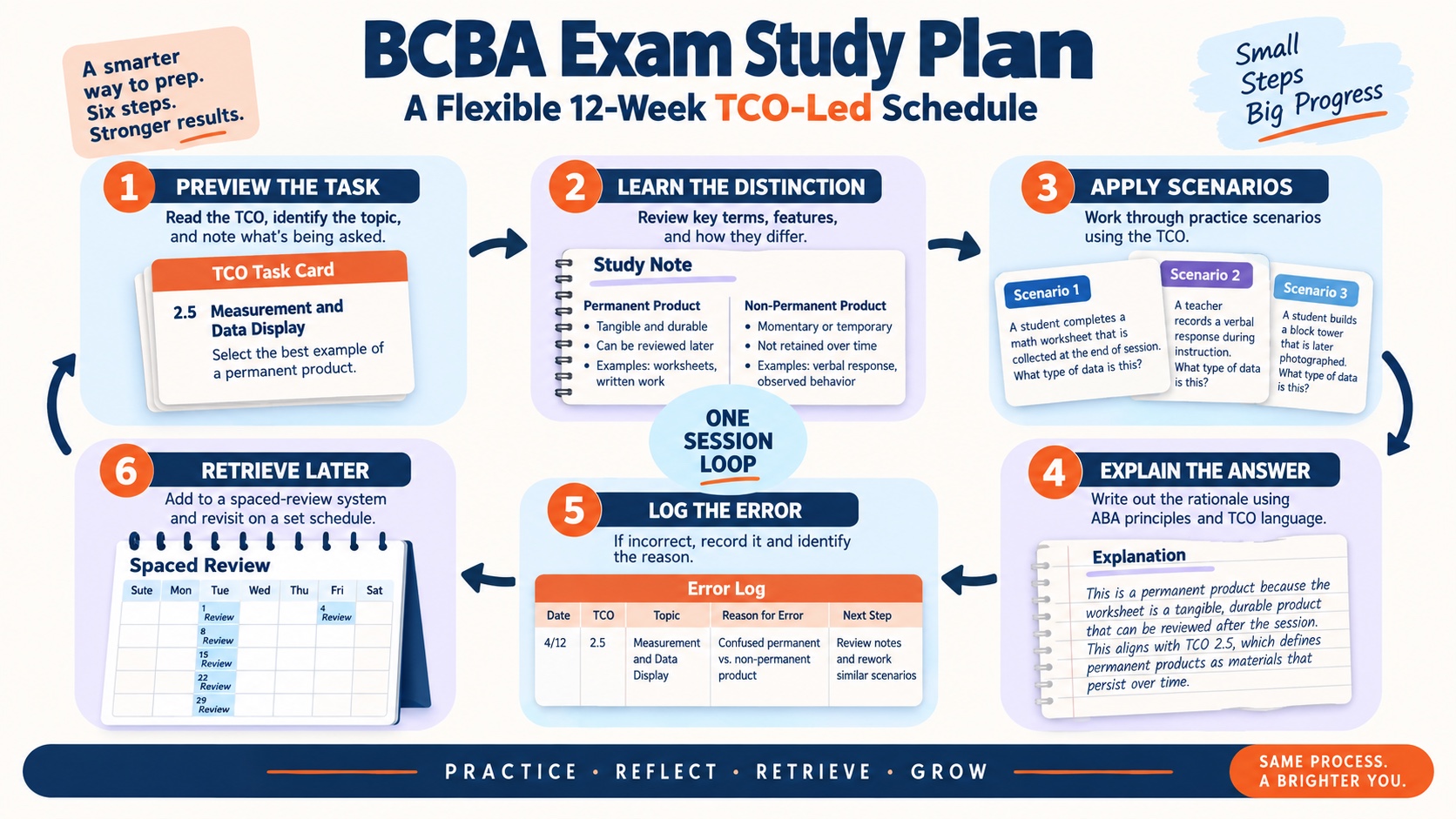
A useful session can be short. Begin by naming one task or reasoning target. Spend a few minutes retrieving what you already know, then study the missing distinction. Complete a small set of applied questions. Review correct answers you guessed as well as incorrect answers, and write one sentence about the evidence that should control the decision.
- Preview: choose the TCO task and the question you want to answer.
- Learn: read, watch, or review an explanation with examples and nonexamples.
- Apply: complete a focused scenario set without immediately checking every answer.
- Explain: justify the correct option and weaken the distractors.
- Log: tag the error or uncertainty and choose the next repair action.
- Retrieve: revisit the distinction later in a mixed or spaced session.
Let error data change the plan
Do not keep following the calendar when the evidence says the job has changed. If you miss questions because you cannot identify the task, return to the TCO and concept map. If you know the concept but choose the wrong intervention, practice decision sequences and missing-information checks. If your content accuracy is stable but your timed performance collapses, add pacing blocks rather than rereading every domain.
Use three simple labels in your log: repair now, space and revisit, and maintain. This keeps one difficult question from taking over the whole plan while still giving persistent patterns enough time. Review the log once a week and move the next target based on repeated evidence, not on whichever topic feels most comfortable.
Use the final two weeks differently
Final review should become narrower and calmer. Confirm the current official examination information, check your appointment and accommodation steps if applicable, and stop introducing multiple new resources. Complete mixed practice under realistic conditions, but protect time to review. A mock score is useful only when it leads to a better study decision; it is not an official pass prediction.
Keep exam preparation separate from certification-process changes. The BCBA 2027 transition resource concerns eligibility and fieldwork planning. It does not automatically establish a new examination outline. Use the current TCO for exam content and the applicable handbook or transition resource for application requirements.
Common study-plan mistakes
- Planning only by hours: time without a task, practice condition, and review action is hard to evaluate.
- Reading without retrieving: familiarity can feel like mastery until a scenario asks you to choose.
- Saving ethics for the end: professional boundaries deserve spaced, applied review.
- Changing resources every week: consistency makes your error patterns easier to read.
- Using one score as a verdict: track conditions, confidence, and domain patterns instead.
BCBA study plan FAQ
How long should a BCBA exam study plan be?
It depends on your baseline, schedule, exam date, and weak areas. A 12-week template is a useful starting point, not a universal requirement. Extend foundation or repair phases when your error data shows that you need them.
How many hours a day should I study?
Choose a repeatable schedule you can protect. Short focused sessions plus a weekly mixed review may be more useful than occasional long sessions with no error analysis.
Should I take a mock exam every week?
Not necessarily. Use focused practice while learning, mixed sets when you need switching practice, and longer timed blocks as you approach the exam. Always leave enough time to review what the result teaches you.
Does the 2027 transition change this study plan?
Keep exam content and certification requirements in separate notes. Verify the current BCBA TCO for exam topics and the official transition or handbook pages for eligibility and fieldwork changes.