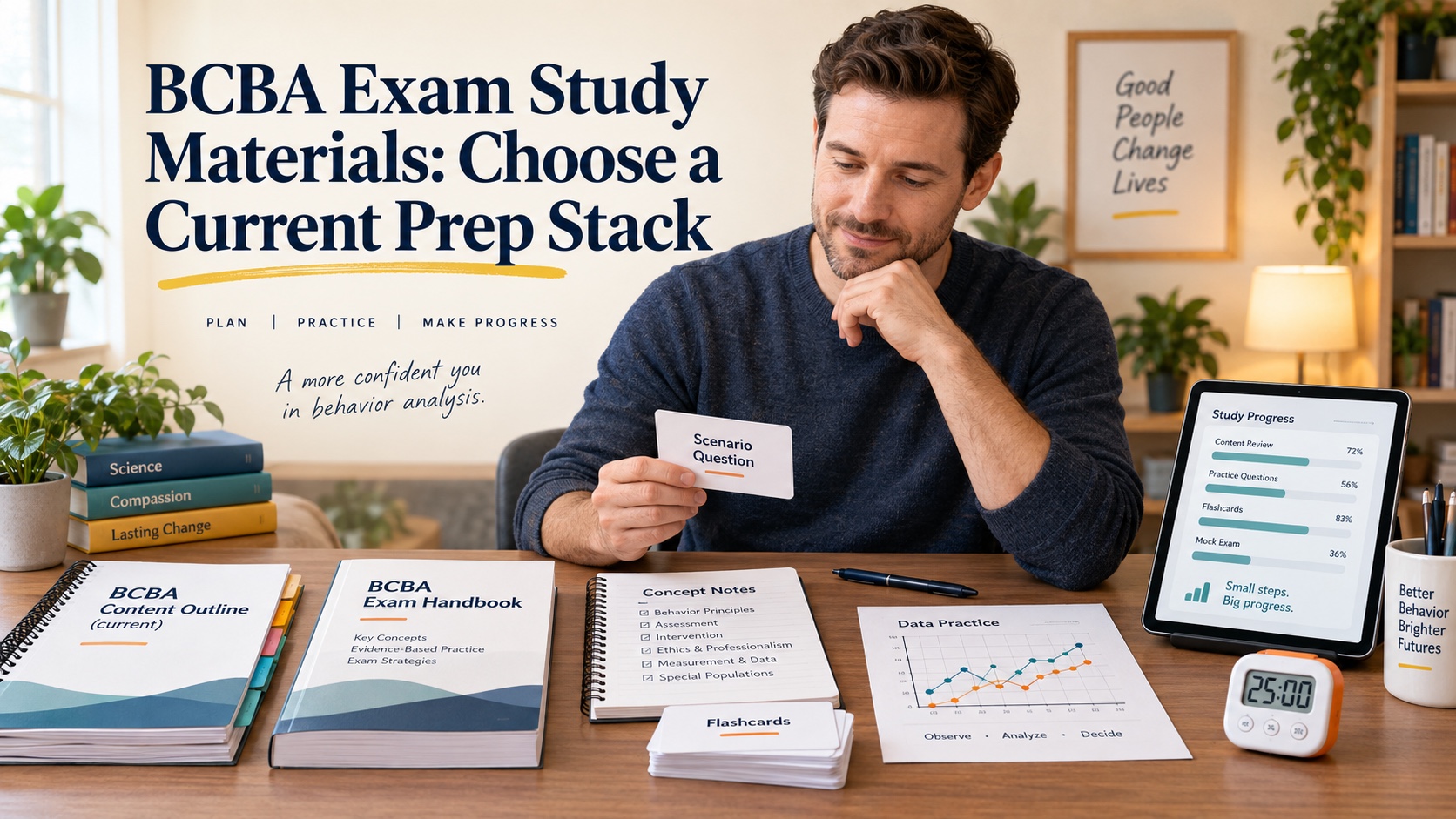
BCBA Exam Study Materials: Choose a Current Prep Stack
Searching for BCBA exam study materials can feel like opening ten browser tabs at once. One resource has a study guide, another has flashcards, another advertises a large question bank, and a fourth promises a readiness score. The most expensive or feature-heavy option is not automatically the most useful one.
A better decision starts with the job you need a material to do. Do you need to understand a difficult concept, apply it to a scenario, revisit an error, build a daily habit, or practice a longer timed session? This guide explains how to choose a current, independent prep stack without confusing a commercial product with an official BACB resource.
Quick answer: what a complete prep stack includes
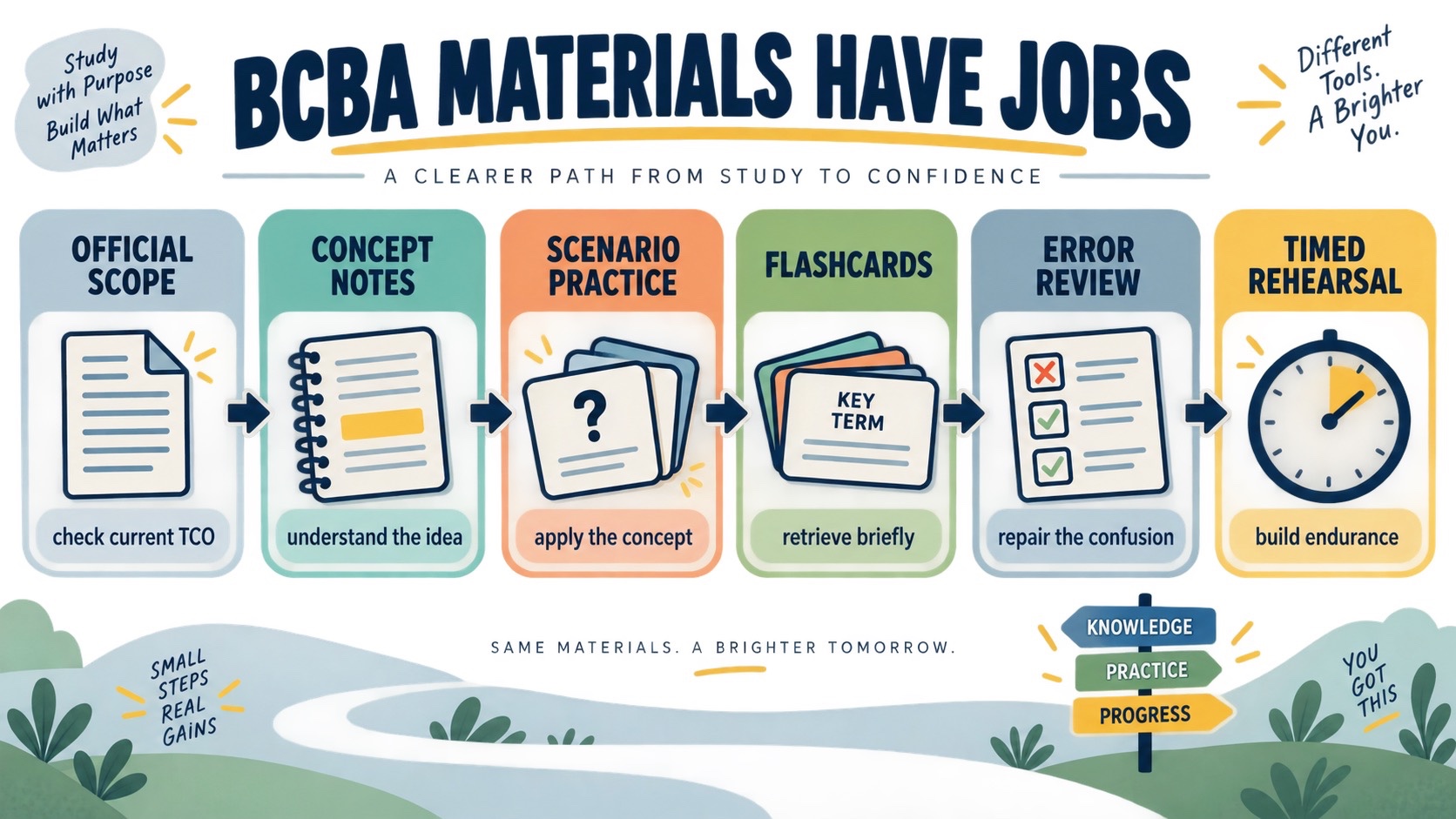
A practical BCBA exam-material stack has five functions. First, it has an official scope reference so you know what the certification examination covers. Second, it has explanations that make concepts understandable. Third, it gives you original scenario practice. Fourth, it records what you missed or guessed so you can return to it. Fifth, it offers longer or timed rehearsal when you have enough foundation to learn from the result.
Those functions can come from free resources, paid materials, an app, or a combination. You do not need one product for every function. You need a study system in which every material has a clear job and every missed question creates a next action.
Check the current official boundary first
The current BACB BCBA Test Content Outline is the sixth edition. It describes 104 tasks organized into nine domains and identifies 175 scored questions plus 10 unscored pilot questions. The nine domains cover foundations, concepts, measurement, experimental design, ethics, assessment, behavior-change procedures, intervention selection and implementation, and personnel supervision and management.
Use the official outline to check whether a prep resource is current. It is a scope boundary, not a complete daily study plan. The BACB examination-information page points candidates to the BCBA Handbook for preparation information, policies, and rules, while the BACB does not endorse specific commercial study products. Treat a guide, app, flashcard set, question bank, or mock as independent unless the BACB identifies it as official.
One practical warning: current search results can contain conflicting exam numbers. When a commercial page, review, or social post disagrees with the current BACB TCO, use the official source for exam-format claims and record the date you checked it.
What each material type is for
1. The TCO and Handbook: your scope check
Keep the current TCO and Handbook available while you study. Use them to verify domain language, examination boundaries, administration details, and certification-process questions. They tell you what the official organization publishes; they do not promise that reading the documents once will produce application skill.
2. Concept notes or a study guide: your explanation layer
A study guide is useful when you need a clear explanation of a distinction such as reinforcement versus punishment, direct versus indirect measurement, internal versus external validity, or assessment information versus intervention choice. Strong notes define the term, show a bounded example, distinguish a nearby concept, and explain what evidence would support the decision. A long glossary without application is not enough.
3. Practice questions: your application layer
Practice questions show whether you can use a concept in a new scenario. Look for original items and rationales that explain the best answer and why the distractors are weaker. A question bank that only displays a letter after each attempt may create a score, but it does not necessarily repair the reasoning behind the error.
4. Flashcards: your short-retrieval layer
Flashcards are well suited to concise definitions, discriminations, ethical boundaries, formulas, and short decision rules. Keep the front and back focused. After learning a definition, add a scenario card that asks you to apply it. If every card becomes a paragraph, move the explanation into notes and keep the card for retrieval.
5. Mock exams: your endurance and pacing layer
A full mock exam can rehearse pacing, navigation, attention, and the experience of making many decisions in one sitting. It works best after you have enough concept coverage to interpret the result. Use a mock to identify what to repair; do not treat an independent score as an official readiness decision or a pass prediction.
6. An error log or progress system: your feedback layer
For every missed or uncertain item, record the domain, the concept, the error type, your confidence, and the next review action. A dashboard can make that process easier, but a simple note or spreadsheet can work too. The essential feature is delayed return: the same idea should come back after you have had time to forget and retrieve it again.
7. Audio and video: your flexible review layer
Audio can help you revisit a familiar explanation during a commute, and video can demonstrate a procedure or walk through a data display. Neither should become passive background noise. Pause, predict, explain the decision, and then check your reasoning.
A buying checklist for commercial resources
Before paying for a course, guide, question bank, or app, evaluate the system behind the sales page. Use this checklist:
- Current edition: Does the provider name the current BCBA TCO and show when the content was reviewed?
- Visible coverage: Can you see how lessons or questions connect to the current domains, rather than relying on a general “complete coverage” claim?
- Reasoning feedback: Does each rationale explain the stem, the best answer, the distractors, and the relevant principle?
- Track separation: Are BCBA, BCaBA, and RBT materials clearly separated so you are not studying from a blended bank with unclear scope?
- Review controls: Can you save, flag, filter, and revisit missed or uncertain questions after a delay?
- Study fit: Does the format work with your reading needs, device, schedule, and available session length?
- Independent language: Does the provider avoid BACB endorsement claims, secure-question claims, and guarantees of certification or passing?
- Purchase conditions: Check access length, renewals, refunds, account requirements, privacy, and which features are included in the price.
Separate volume from coverage. A large bank can still be narrow if every item tests familiar vocabulary. Look for varied scenarios across concepts, measurement and graphs, assessment, intervention, ethics, and supervision, with enough variation to test transfer rather than memory for one answer pattern.
Also match the purchase to the bottleneck. If you cannot explain a concept, choose explanations. If you can define it but miss scenario decisions, choose practice with rationales. If you know the material but lose consistency, choose a review queue. If you run out of time, choose timed blocks and pacing practice. A focused purchase is usually more useful than collecting several overlapping resources.
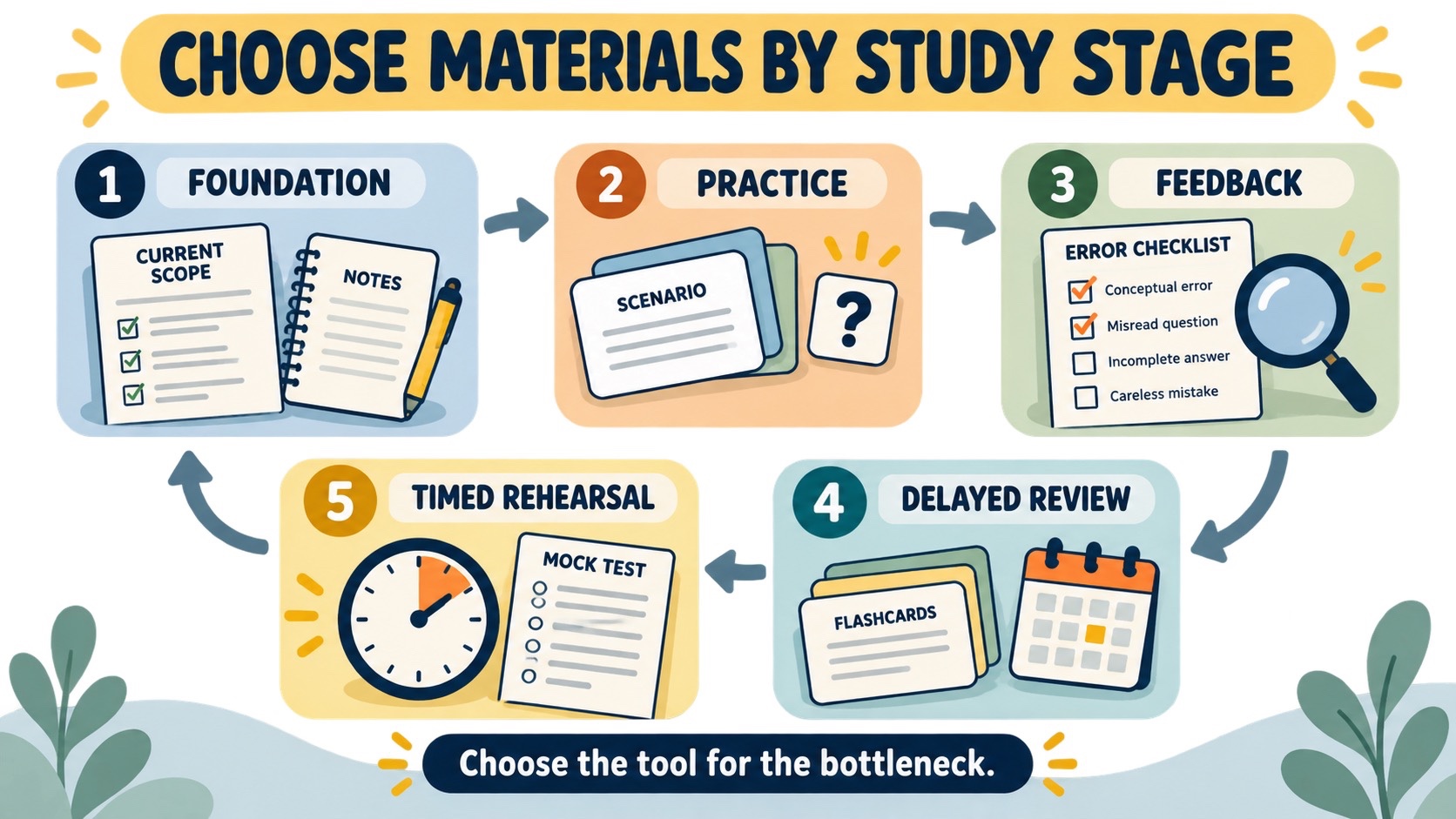
Choose materials by study stage
Foundation stage
Start with the current official scope and a concept path. Learn one small topic, close the notes, explain it in your own words, and answer a few scenarios. Add short flashcards after understanding the distinction. At this stage, a full mock can make you feel lost without telling you what to repair, so keep practice small and diagnostic.
Active-practice stage
Move to mixed domain practice, confidence tagging, and an error log. Study a weaker area, add a few questions from stronger areas, and schedule a return. Use flashcards for the exact confusion that appeared in practice. When a rationale changes your understanding, turn that reasoning into a short prompt you can retrieve later.
Final-rehearsal stage
Add longer timed blocks and full mocks when you can learn from the result. Review pacing, flagged questions, domain patterns, and the difference between a knowledge error and a reading or decision error. Leave time after every mock for repair and a second attempt with different scenarios. A mock taken without review is mainly a number.
Where 2027 fits
The BACB has published 2027 transition and requirements resources describing changes to BCBA eligibility and maintenance requirements beginning January 1, 2027. Those documents should be checked separately if your application timing is near the transition. They are not a reason to label the current BCBA exam blueprint a “7th edition.” Study materials should keep two checks separate: current examination content, and current certification-eligibility rules.
Connect free website study with app review
A website and an app can support different moments in the same study system. The website can be the discovery layer: free theory, definitions, question previews, resource guides, and explanations that help you decide what to study. The app can be the practice layer: Today tasks, section practice, flashcards, audio review, progress, and a return queue for concepts that need another look.
A simple loop is: discover a concept on the website, practice it with a short set, save the error or uncertainty, review the reasoning in the app, return after a delay, and then test the idea in a mixed set. Keep full mock exams as a separate website destination if that matches your product structure, while the app carries the daily learning habit.
ABA Study Online’s BCBA learning path, free BCBA questions, free ABA resources, and mock-exam library can support the website side of that loop. The ABA Study Online app can carry the daily review across practice, flashcards, audio, and progress.
Build your next study block around one clear job
Explore the free ABA Study Online materials first, then use the independent app when you want a more consistent practice, flashcard, audio, and progress-review loop. The app is not an official BACB product and does not guarantee certification or a passing result.
FAQ
What are the best BCBA exam study materials?
The best set depends on your current need. A useful stack normally includes the current official scope, clear concept explanations, original practice questions, a way to review errors, and timed rehearsal when you are ready. Choose the smallest connected set that supports your next study action.
Do I need a BCBA study guide?
A study guide can help organize concepts, but it is not the only useful material. If you already understand the theory, you may need more application practice and feedback instead. Use a guide to repair explanations, not to replace retrieval and scenario reasoning.
Should I use flashcards or practice questions first?
Use explanations first when the concept is new. Then use flashcards for concise retrieval and practice questions for application. If you can define a term but cannot choose the best response in a scenario, increase application practice rather than adding more definition cards.
Are commercial BCBA prep materials official?
Usually not. Independent guides, apps, question banks, and mock exams should be described as independent unless the BACB identifies them as official. The current BACB Handbook and TCO remain the authority for official requirements and exam boundaries.
Does 2027 mean I need a new BCBA exam study guide edition?
Do not assume that. The BACB’s 2027 resources describe eligibility and maintenance changes. Check the current BACB requirements and transition guidance for your application timing, and separately verify that study content matches the current BCBA TCO.