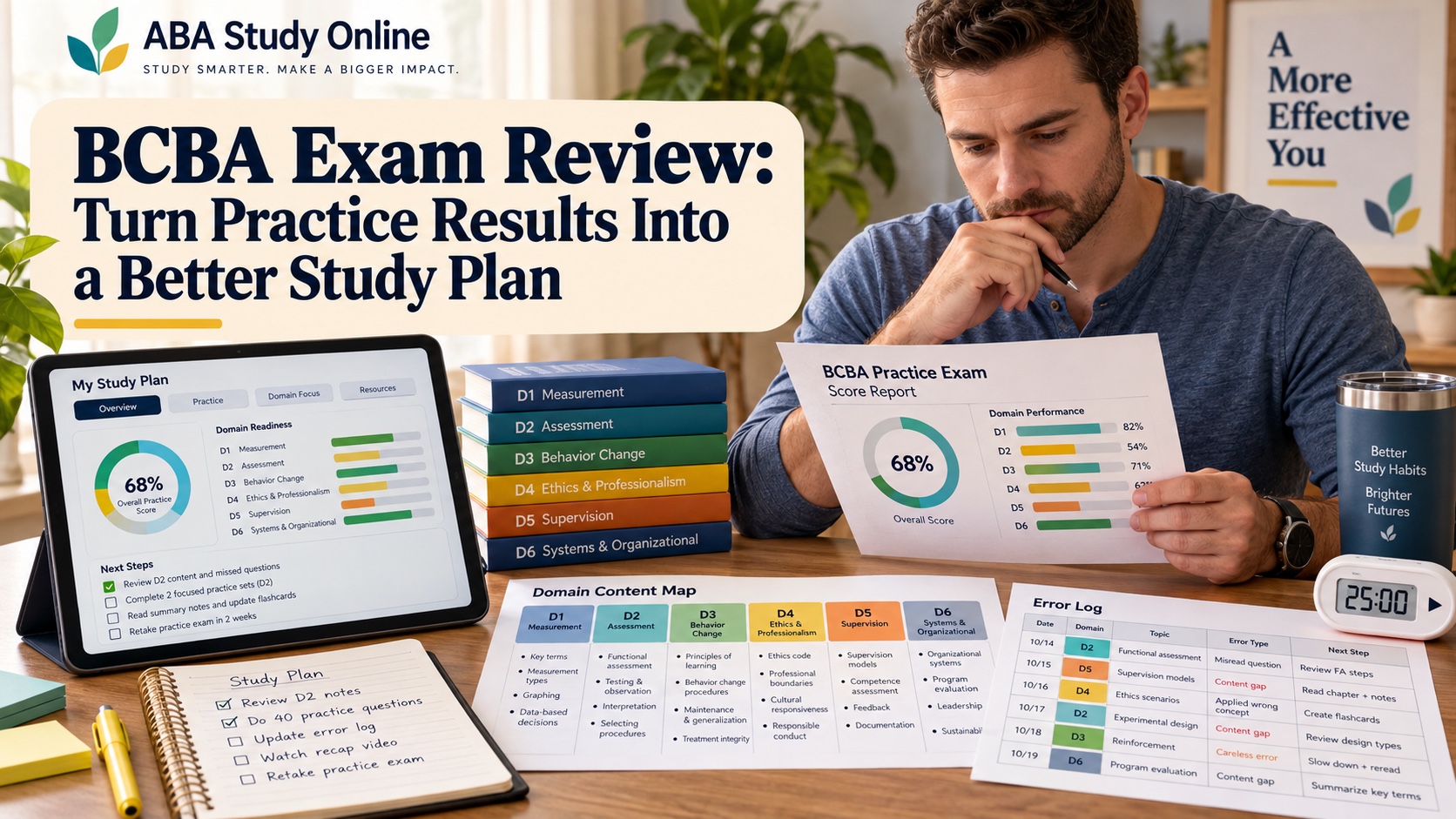
BCBA Exam Review: Turn Practice Results Into a Better Study Plan
A BCBA exam review should answer a practical question: what should I do next? Many candidates finish a practice set, see a percentage, feel encouraged or discouraged, and then start another set. That reaction is understandable, but a score alone does not tell you whether the problem was a missing concept, a misread stem, a calculation error, or difficulty applying a familiar idea to a new scenario.
The current BCBA Test Content Outline (6th ed.) is the map for examination content beginning in 2025. It contains 104 tasks across nine domains. The official examination has 175 scored questions plus 10 unscored pilot questions, 185 total, and four hours. Independent practice can help you learn, but its score is not a BACB result or a pass prediction.
Quick answer: what should a BCBA exam review do?
A useful review turns a practice result into four pieces of information: which domain or task was involved, what kind of error occurred, what source or explanation repairs the gap, and when you will test the repaired skill again. It is a small loop, not a judgment about your intelligence or your future examination result.
Start with the whole result, then zoom in. Note your overall percentage, timing, confidence, and domain pattern. If a practice set reports domain percentages, treat them as clues about that set. Question counts, wording, and difficulty vary across independent resources, so do not treat a single domain percentage as a direct measurement of your official readiness.
Read the result without overreacting
Separate three things that are often blended together:
- Outcome: the answer was correct or incorrect on this practice set.
- Confidence: you knew the answer, guessed, or changed your mind.
- Reason: the concept, application, reading, calculation, or process that produced the result.
A correct answer with low confidence deserves a review mark. A wrong answer with a good explanation may be repaired quickly. A pattern of wrong answers in different-looking scenarios may signal that the underlying concept is not yet flexible. Look for repeated patterns across several sessions before you decide that one domain is your permanent weakness.
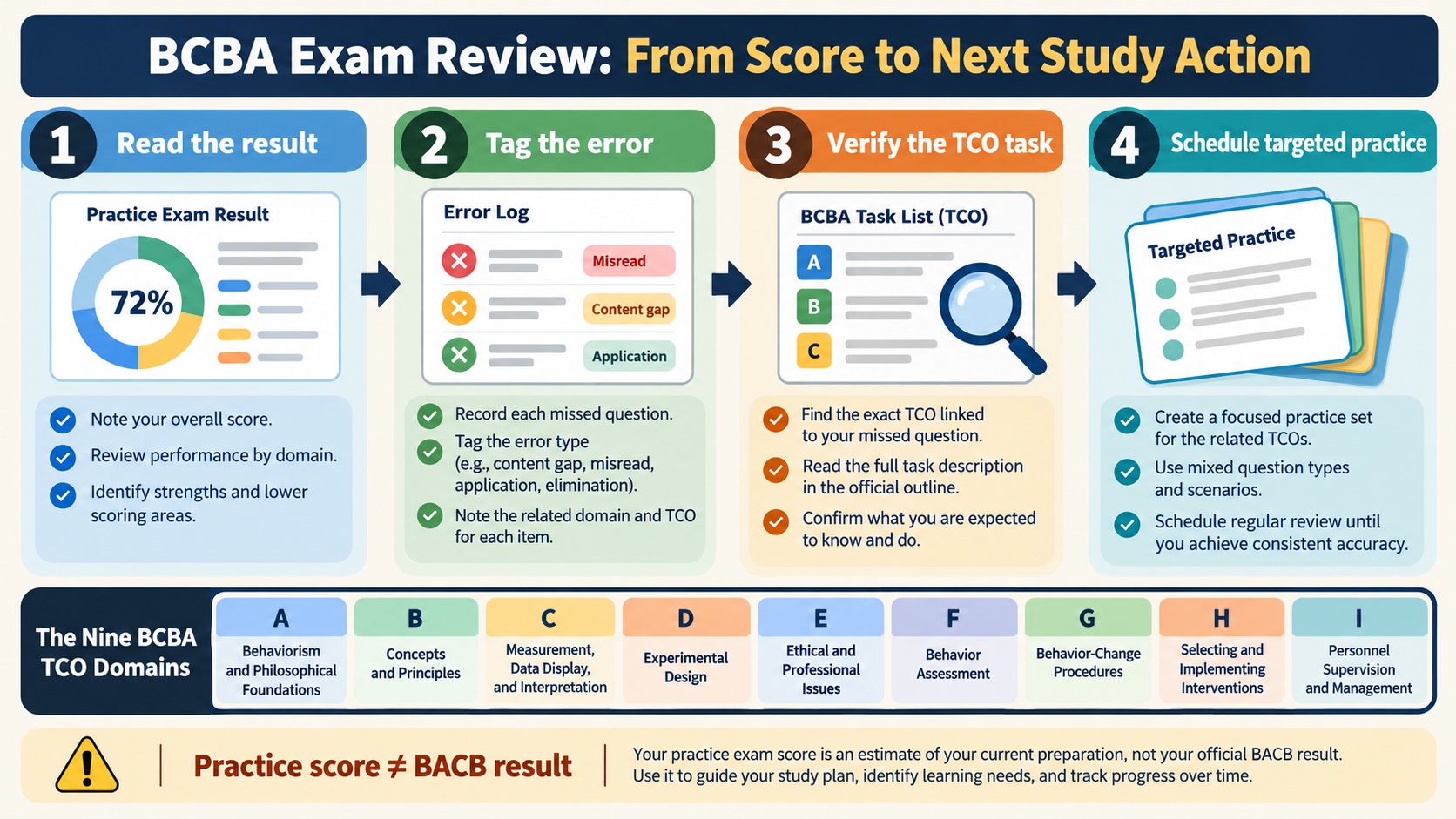
Tag the error
An error log is more useful when its labels lead to different actions. Try five simple tags:
- Misread: you missed a qualifier such as most appropriate, first, least intrusive, or based on the data.
- Content gap: you could not explain the term, principle, procedure, or ethical requirement.
- Application: you knew the definition but could not identify how it operated in the scenario.
- Calculation or display: you made an error with a measure, graph, percentage, trend, or design feature.
- Process: you rushed, lost time, changed a correct answer without evidence, or failed to review the full stem.
For example, if you selected extinction because a scenario mentioned a behavior decreasing, the problem may not be that you forgot the word. You may have skipped the question about what consequence was withheld or confused an outcome with an operation. The next action should be a discrimination exercise, not another page of definitions.
Connect the error to the TCO
Once an error has a tag, open the current BCBA TCO and locate the task that best matches the question. The nine domains are Behaviorism and Philosophical Foundations; Concepts and Principles; Measurement, Data Display, and Interpretation; Experimental Design; Ethical and Professional Issues; Behavior Assessment; Behavior-Change Procedures; Selecting and Implementing Interventions; and Personnel Supervision and Management.
Do not stop at the domain heading. Read the task verb. “Identify,” “describe,” “distinguish,” “select,” and “implement” ask for different kinds of performance. A study note that only defines a term may not repair a question that asks you to select an intervention from competing evidence. Write the task number or a short task label in your error log, then record the source you used for the repair.
Keep source roles clear. Use the TCO for examination content, the BCBA Handbook for eligibility and testing rules, the Ethics Code for professional responsibilities, and your training materials for depth and examples. The BACB states that it does not endorse specific study guides and that buying study materials does not guarantee a pass. That is a reason to verify a resource, not a reason to study without a plan.
Schedule targeted and mixed practice
Give a repaired gap a short targeted block. If the issue is a measurement distinction, answer several scenarios that require choosing frequency, rate, duration, latency, or percentage and explain the choice. If the issue is assessment, compare the purpose, data, and limits of the assessment procedures you are studying. If the issue is ethics, identify the stakeholder, responsibility, boundary, and next authorized action.
After targeted practice, return to mixed questions. A learner who only answers five identical items may recognize a pattern without being able to discriminate it in a longer scenario. Mix domains, vary the question order, and revisit the error after a delay. Keep one line in the log for the next check: “I can explain the task, choose it in a new scenario, and justify why the closest alternative is weaker.”
The BCBA learning path can hold structured concept review, while BCBA practice questions can provide application retrieval. Use the ABA Definition Search when one term needs a shorter explanation. These are independent study resources; they do not replace the current BACB sources or make a certification decision.
A simple weekly review can alternate purpose. On one day, repair a small group of content gaps. On another, practice mixed scenarios under a realistic time limit. Later, explain selected answers aloud without the answer key. This keeps review from becoming a cycle of rereading the same familiar page. It also gives you more than one kind of evidence: recall, discrimination, application, pacing, and explanation.
Common review mistakes
- Chasing the percentage: use the score to start analysis, not to declare readiness.
- Reviewing only wrong answers: mark uncertain correct answers and lucky guesses too.
- Studying a whole domain after one miss: identify the smallest task-level gap first.
- Ignoring qualifiers: copy the exact wording that changed the best answer.
- Using an old outline: confirm the current BCBA TCO and the source date before building a review map.
- Confusing practice with official results: an independent score cannot reproduce BACB equating or determine a pass.
FAQ
How often should I review BCBA practice questions?
Review each session while the reasoning is fresh, then revisit tagged gaps after a delay. The exact schedule should fit your available time, but every miss should lead to a source check and a later retry.
Should I study only the domains where I scored lowest?
No. Use low areas to prioritize repair, but keep all nine domains in rotation. The official examination covers the full content outline, and a small practice sample may not represent your overall understanding.
Does a practice score predict whether I will pass?
No. Practice sets differ in blueprint, wording, difficulty, and scoring. Use the result to plan learning and timing, not to claim an official probability or guarantee.