BCBA Exam Requirements: Eligibility, Application, and Exam Format
When people search for BCBA exam requirements, they may be asking three different questions: what makes them eligible to apply, what must happen before they can schedule an appointment, and what the current exam actually tests. Those steps connect, but they are not the same requirement. A degree alone does not create exam authorization, and knowing the test format does not replace the eligibility evidence the BACB reviews.
This guide organizes the current process in that order. It uses the current BCBA Handbook and Test Content Outline (TCO) as the source of truth, then explains where the January 1, 2027 eligibility transition fits. Requirements, fees, deadlines, and individual application decisions can change, so verify the live BACB documents before submitting anything.
Table of Contents
The three gates before a BCBA exam appointment
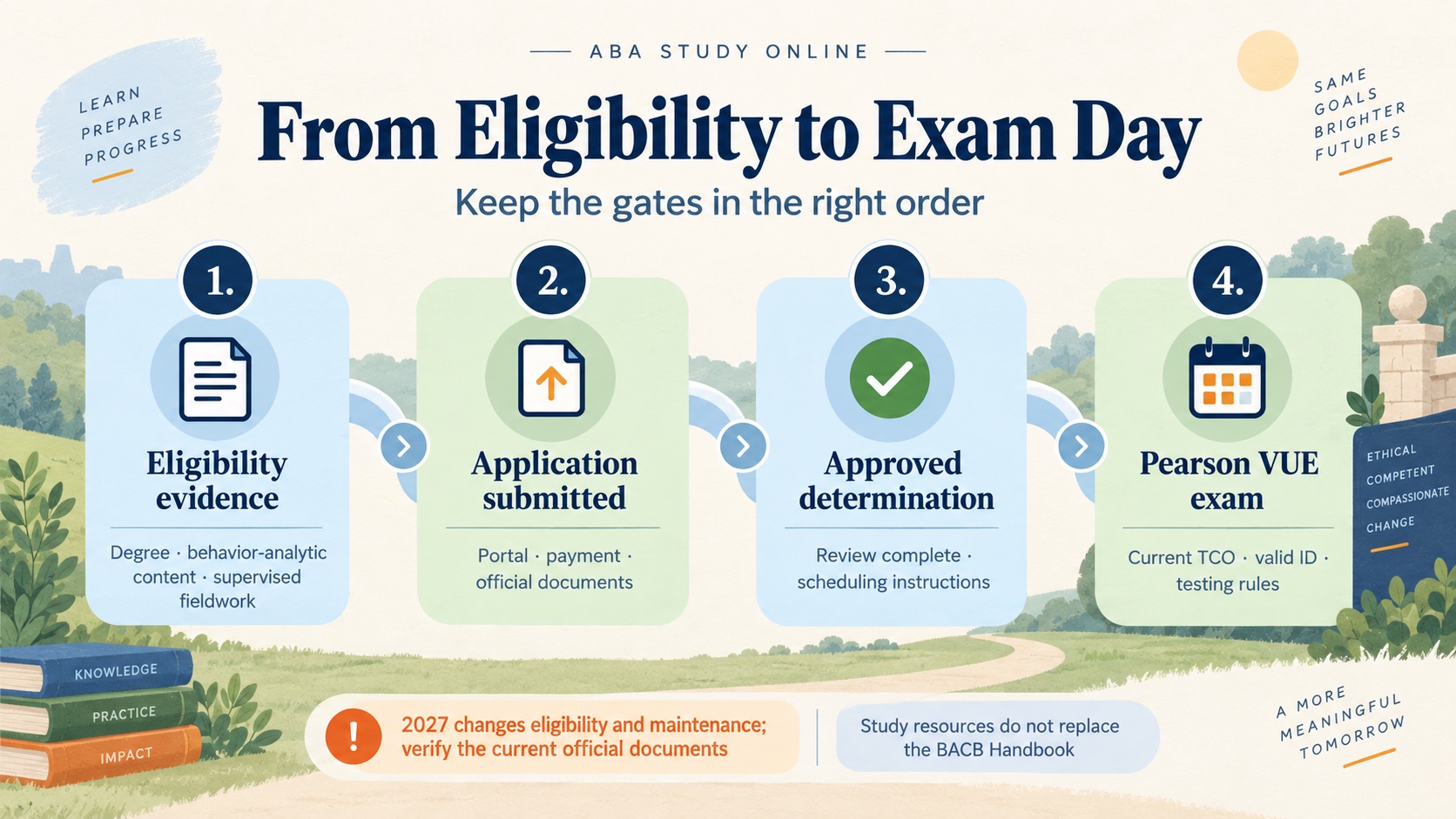
Think of the process as three gates:
- Eligibility gate: you meet the applicable pathway requirements for degree, behavior-analytic content, and supervised fieldwork.
- Application gate: you submit the BCBA certification application, payment, and required documentation through the BACB process, and the application receives an approved determination.
- Examination gate: after approval, you receive instructions to schedule with Pearson VUE and must pass the current BCBA examination.
This distinction prevents two frequent mistakes. First, a student may start studying for the exam while a missing transcript or fieldwork document still blocks the application. Second, someone may read a practice-test page and assume its question count or “passing score” is official. Use the BACB Handbook for eligibility and testing rules, the TCO for exam content, and independent practice materials only for learning and rehearsal.
The current BCBA exam blueprint
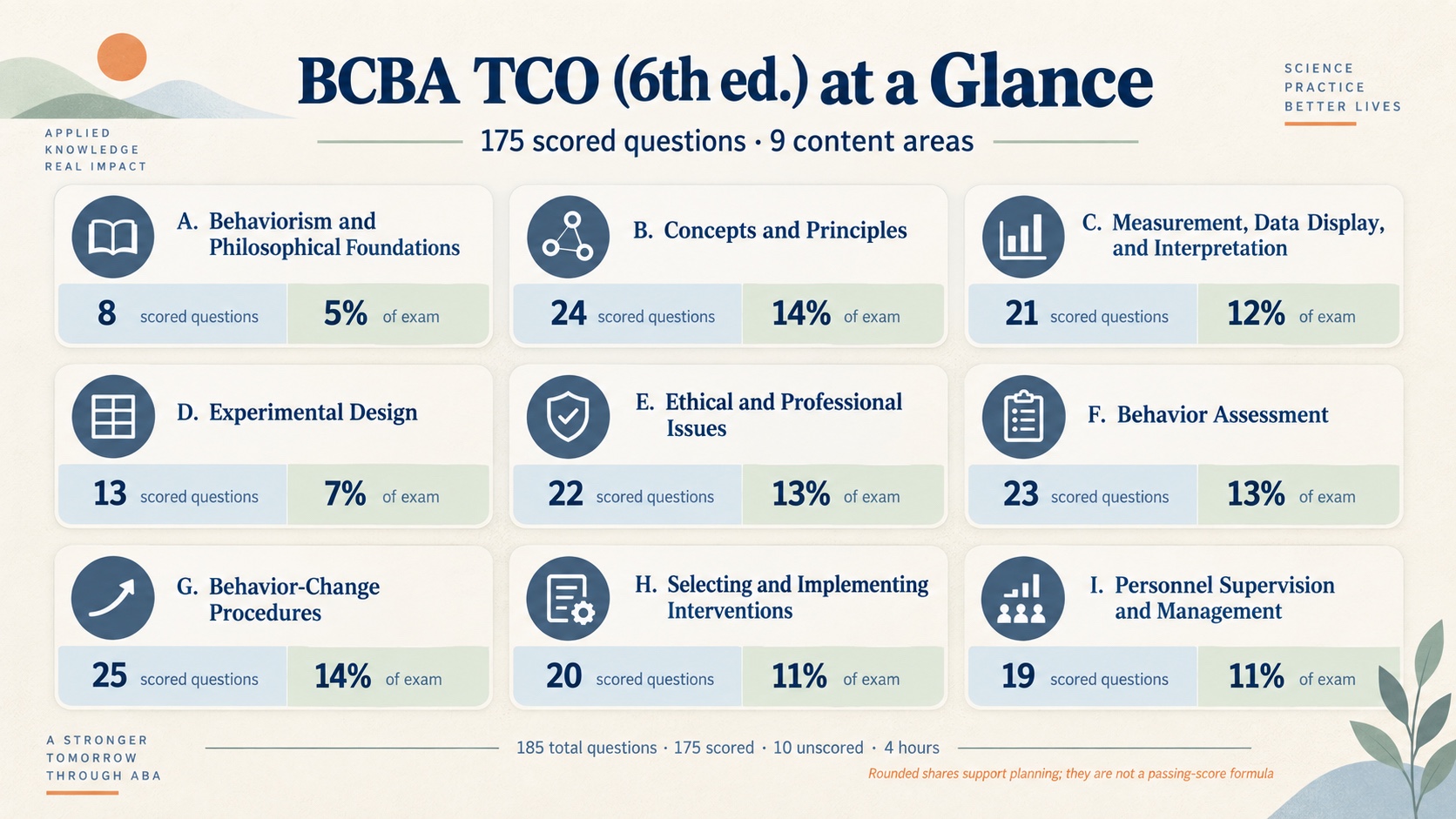
The current BCBA examination is based on the BCBA TCO (6th ed.), which went into effect January 1, 2025. The exam has 185 multiple-choice questions: 175 scored questions and 10 unscored questions. Candidates have four hours. Each question has four answer choices with one correct answer, and all questions are equally weighted. The TCO organizes the scored content into 104 tasks across nine content areas.
| Content area | Scored questions | Approx. share |
|---|---|---|
| A. Behaviorism and Philosophical Foundations | 8 | 5% |
| B. Concepts and Principles | 24 | 14% |
| C. Measurement, Data Display, and Interpretation | 21 | 12% |
| D. Experimental Design | 13 | 7% |
| E. Ethical and Professional Issues | 22 | 13% |
| F. Behavior Assessment | 23 | 13% |
| G. Behavior-Change Procedures | 25 | 14% |
| H. Selecting and Implementing Interventions | 20 | 11% |
| I. Personnel Supervision and Management | 19 | 11% |
The percentages are rounded planning information, not separate passing thresholds. The BACB reports an overall examination result. A sensible study plan gives extra time to weak, heavily represented areas such as Behavior-Change Procedures, Concepts and Principles, and Behavior Assessment, while still reviewing ethics, supervision, measurement, and design. Do not turn the blueprint into a promise about how many questions you personally will see in any one form.
Eligibility evidence you need to document
The June 2026 BCBA Handbook describes four current eligibility pathways. At a high level, each requires a qualifying degree, behavior-analytic content or the pathway-specific equivalent, supervised fieldwork, and a passing BCBA examination. The exact evidence depends on the pathway, so do not use a general internet checklist to decide that your degree or hours qualify.
For a typical pathway audit, gather:
- the qualifying degree information and official transcript requirements;
- the behavior-analytic coursework, program contact, or pathway-specific evidence;
- supervised fieldwork records, supervisor information, monthly documentation, and final verification forms;
- your current legal name and matching identity details across the Portal, application, transcripts, and testing appointment; and
- any accommodation, prior-history, ethics self-report, or other documentation the BACB asks you to submit.
Fieldwork is not simply a number of hours. The Handbook includes requirements for supervision, observations, activities, documentation, and audits. Keep records organized while you accrue hours so you can answer a future audit rather than trying to rebuild the record at application time. The BACB may update its Handbook, so use the current fieldwork section for the rules that apply to you.
Application approval and Pearson VUE scheduling
Once you believe you meet the applicable requirements, complete the BCBA certification application in your BACB Portal account, submit payment, and arrange for required official transcripts and supplemental documents to reach the BACB through the stated route. The Handbook says transcripts are official records submitted by the institution, not simply files uploaded by the applicant. Incomplete or inaccurate information can delay review.
After payment and all documents are received, the BACB reviews the application and issues a determination. If the application is approved, the Handbook says scheduling instructions for Pearson VUE generally arrive within 24–48 hours. The appointment is not scheduled by a study website. Check the authorization dates and appointment rules in your Portal and current Handbook, and bring the required valid identification to the testing center.
Fees, cancellation windows, testing locations, accommodations, and authorization details can change. Keep those details out of a permanent study note unless you also record the date and link to the live official source. Study for the exam using the current TCO, Ethics Code, and your training materials; the BACB does not endorse a particular commercial study guide or guarantee that buying one will produce a pass.
What the 2027 transition changes
The January 1, 2027 transition revises BCBA eligibility and maintenance requirements, including degree, coursework, fieldwork, continuing education, and ongoing supervision. The BACB’s 2027 document describes two pathways beginning in 2027 and says Pathways 3 and 4 are no longer offered under the 2027 eligibility requirements. The separate transition materials explain how to evaluate records and which forms apply.
That does not mean the BCBA examination automatically becomes a “7th edition” exam. The current official examination materials identify the BCBA TCO (6th ed.) as the examination content outline, effective January 1, 2025. A later edition should be treated as real only when the BACB publishes an official examination-content change. Keep the two questions separate: “Which eligibility requirements apply to my application?” and “Which TCO applies to my examination authorization?”
For the detailed transition checklist, read the BCBA learning path and compare the dedicated 2027 requirements resources. Do not infer your personal transition status from a social post or from the date printed on a study guide.
A practical requirements checklist
- Identify the pathway and the Handbook version that applies to your planned application date.
- Confirm the degree evidence and how your institution must submit official transcripts.
- Audit coursework or pathway-specific content against the official requirement, not a marketing summary.
- Audit supervised fieldwork records, supervisor qualifications, observations, and verification forms.
- Check Portal identity details, legal name, and any accommodation or history-review needs.
- Submit the application and payment, then send supplemental documents through the required official route.
- Wait for the determination before expecting Pearson VUE scheduling instructions.
- Study the current BCBA TCO and Ethics Code, and use independent practice questions only as practice.
- Verify fees, deadlines, location, identification, and appointment rules immediately before testing.
For concept review after your requirements audit, the BCBA practice questions and ABA glossary can support learning. They do not replace the BACB Handbook, a formal application determination, or Pearson VUE instructions.
Keep an evidence folder with the source document, the date you checked it, and the question it answers. For example, the Handbook can support a fieldwork or application rule, the TCO can support a study topic, and the current examination page can support testing logistics. This simple source map helps prevent an old PDF, a university summary, and a practice question bank from being treated as if they have the same authority.
It also helps to separate “I am eligible,” “my application is approved,” and “I am ready to test.” A person can be academically prepared but still waiting for document review. Another person can be approved but need a focused study plan. Your next action should match the gate you are actually in: repair documentation, check the Portal, schedule through Pearson VUE, or study a weak TCO domain.
BCBA exam requirements FAQ
How many questions are on the BCBA exam? The current exam has 185 multiple-choice questions: 175 scored and 10 unscored. Candidates have four hours.
Do I need to meet eligibility requirements before scheduling? Yes. You must meet the applicable eligibility requirements, submit the certification application and required documentation, receive an approved determination, and then follow the Pearson VUE scheduling instructions.
Does the 2027 change create a BCBA 7th-edition exam? The official 2027 materials describe eligibility and maintenance changes. They do not establish a 7th-edition BCBA examination. The current exam materials identify the 6th-edition TCO.
Is there a public percentage I must score to pass? The BACB does not present the rounded domain percentages as a passing formula. Use the current official examination information for result rules and do not treat a practice-test score as an authorization or guarantee.