BCBA Exam Prep: Build a Blueprint-Weighted Study Plan
Good BCBA exam prep is not just a larger pile of notes. It is a repeatable way to recognize the task a question is testing, apply the relevant behavior-analytic reasoning, eliminate distractors, and learn from the answer you missed—or almost missed. Your plan should be connected to the current BCBA Test Content Outline (6th ed.), but it should also make room for retrieval, scenario practice, and timed decision-making.
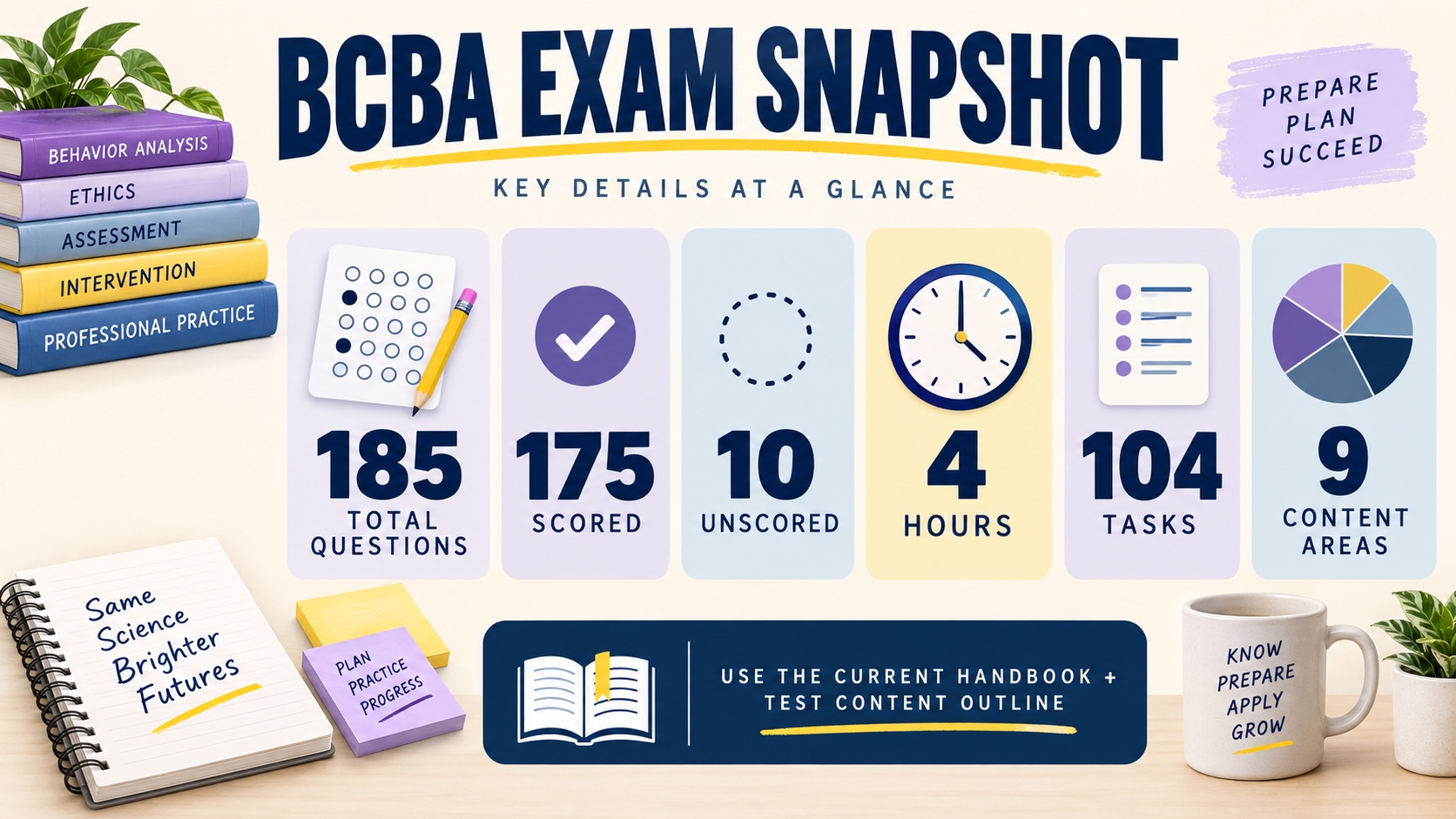
The current BCBA Handbook describes an examination with 175 scored questions and 10 unscored questions, four answer choices with one correct answer, and four hours to complete the test. The 104 tasks are organized into nine content areas with different rounded weights. That structure gives you a useful planning map. It does not give you a magic number of study hours, a domain-level passing score, or a guarantee that one mock-exam result predicts your certification outcome.
This guide turns the blueprint into an adaptable routine: start with a diagnostic, allocate practice by domain weight and personal error pattern, review rationales actively, and finish with mixed and timed sets. ABA Study Online’s free BCBA questions, mock preview, and app can be used as original unofficial practice destinations; always keep the current BACB handbook, outline, ethics code, and application instructions as the official source boundary.
Table of Contents
What effective BCBA exam prep is really training
The exam rewards more than recognition. You may know the definition of a functional relation and still hesitate when a scenario asks which evidence supports an interpretation, what a supervisor should do next, or which intervention is most consistent with the stated function and ethical context. Preparation therefore has two layers:
- Knowledge: concepts, principles, measurement, assessment, intervention, ethics, supervision, and design.
- Decision fluency: identifying the relevant facts, selecting the best answer, and explaining why the other options do not fit.
Reading is useful when it repairs a knowledge gap. It becomes less useful when it turns into a way to avoid retrieval. A strong session alternates between a short review, original questions, and a written explanation of the choice. The explanation is the part that shows whether you understand the relationship among the stimulus, behavior, consequence, measurement, or professional boundary in the scenario.
Use the blueprint as a map, not as a rigid script. Higher-weight areas deserve more practice time, but a candidate’s error pattern can justify extra attention to a smaller domain. If you repeatedly miss experimental-design questions, simply rereading a high-weight domain will not solve that specific problem.
Current BCBA exam structure and the 6th edition
The current official materials identify the BCBA Test Content Outline (6th ed.) as the examination boundary. The current handbook describes:
- 185 total questions: 175 scored and 10 unscored.
- Four hours: the stated completion time for the examination.
- Four answer choices: one correct answer for each question.
- 104 tasks: organized across nine content areas.
- Overall performance: the result is not described as a separate pass/fail result for each content area.
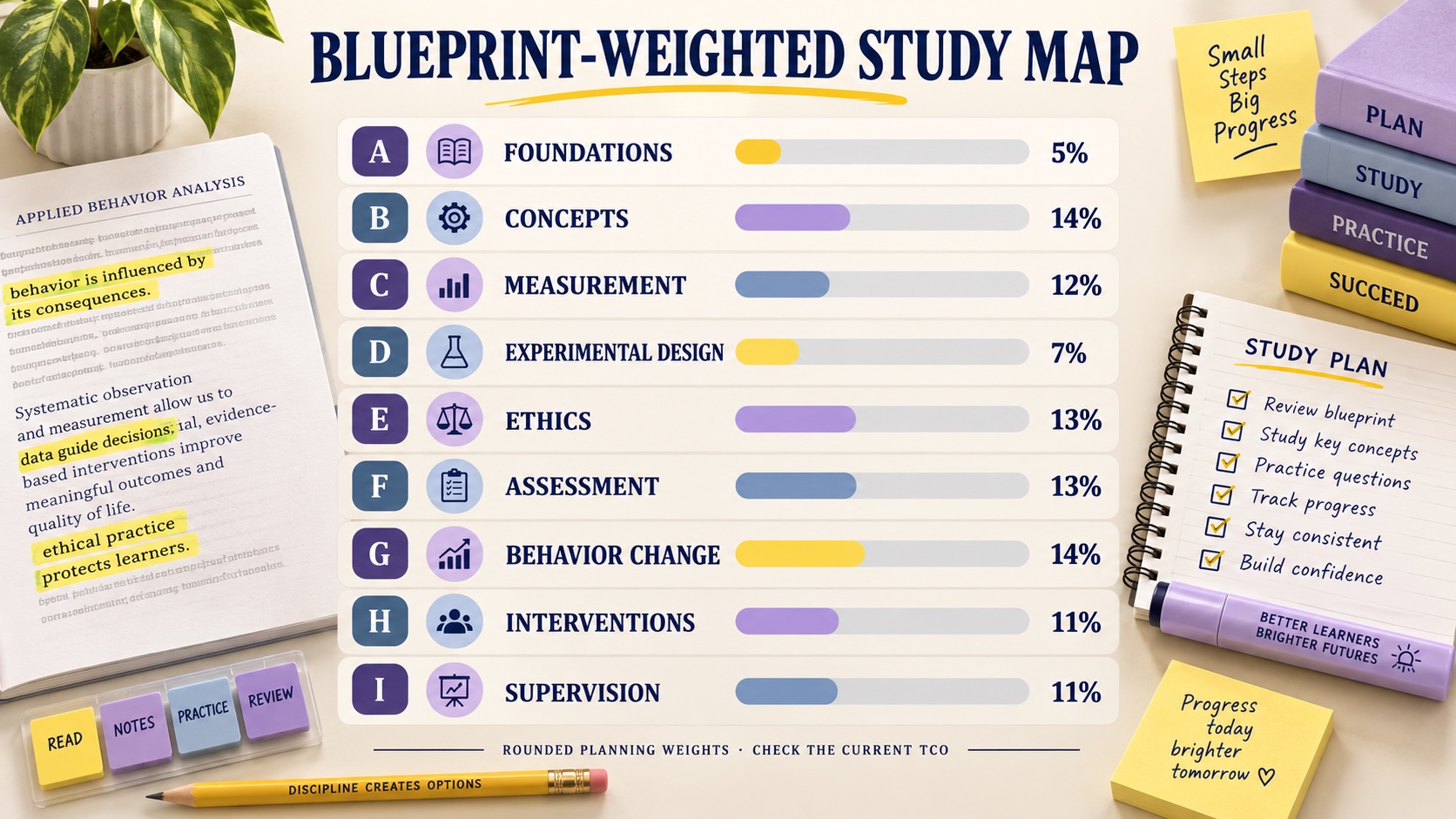
The rounded content-area weights are a practical way to decide how much of your study time should be spent in each part of the blueprint:
- A. Behaviorism and Philosophical Foundations — 5%.
- B. Concepts and Principles — 14%.
- C. Measurement, Data Display, and Interpretation — 12%.
- D. Experimental Design — 7%.
- E. Ethical and Professional Issues — 13%.
- F. Behavior Assessment — 13%.
- G. Behavior-Change Procedures — 14%.
- H. Selecting and Implementing Interventions — 11%.
- I. Personnel Supervision and Management — 11%.
The percentages are rounded planning signals, not a promise about the exact order or wording of your examination form. Use the official outline for the task descriptions. Use the Ethics Code for Behavior Analysts and your training materials to deepen the content; do not treat a third-party outline summary as a replacement for the current official documents.
Build a blueprint-weighted study plan
Begin with a diagnostic set before building a calendar. It does not need to predict your final score. Its job is to show where your reasoning is unstable. Mark each item as one of four types:
- Knowledge gap: you did not know the concept, definition, or rule.
- Discrimination gap: you knew the terms but confused two similar options.
- Application gap: you knew the rule but could not select it in the scenario.
- Process gap: you misread, rushed, changed a sound answer, or failed to use the evidence in the stem.
Next, give each content area two numbers: its blueprint weight and your current error signal. A simple weekly allocation might start near the official weights, then move one or two study blocks toward the domains with repeated application or discrimination errors. This keeps the plan anchored to the exam without pretending that every candidate needs the same schedule.
Each study block should have one job. For example, a Concepts and Principles block might review motivating operations for fifteen minutes, complete a short scenario set, and end with a one-paragraph explanation of why the distractors fail. A Measurement block might compare data displays, identify what a measure captures, and practice choosing a defensible interpretation from a small scenario. The block is complete when you can explain the decision, not when a timer says that the page is finished.
Use practice questions as a review loop
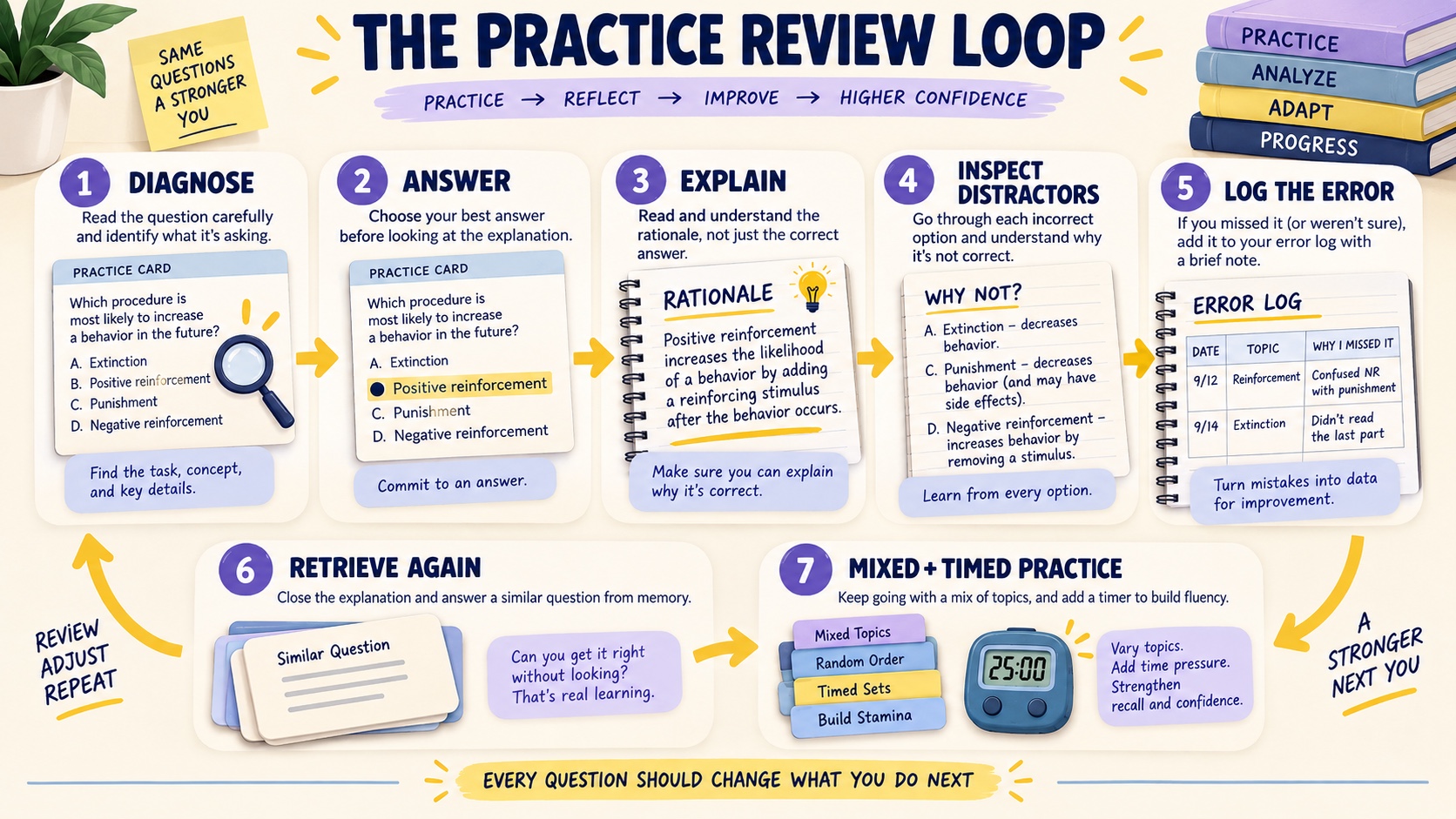
Doing more questions helps only when each question produces information. A useful review loop has seven moves:
- Predict the task. Before looking at the choices, name the decision the scenario seems to require.
- Choose and commit. Select one answer under a reasonable time limit. Avoid turning every item into an open-book search.
- Justify the answer. Write one sentence using the evidence in the stem, not a phrase such as “it sounds right.”
- Inspect every distractor. Ask what fact, assumption, or professional boundary makes each alternative weaker.
- Classify the error. Add the item to a knowledge, discrimination, application, or process column.
- Repair the gap. Read a targeted note, revisit a Theory Block, draw a comparison, or ask a supervisor or instructor about the distinction.
- Retrieve later. Revisit the same distinction in a new item after a delay. Immediate recognition is not enough evidence of durable learning.
Rationales should do more than reveal the correct letter. They should explain the functional relation, measurement logic, design decision, ethical boundary, or supervision responsibility that makes one option best. If a rationale cannot explain why the distractors fail, the item may not be giving you enough learning value for the time it takes.
When you use a third-party question bank, check the edition label, source boundary, rationale quality, and correction process. The BACB states that it cannot endorse specific study guides or preparation materials. A site’s claim that its questions are “exactly like the exam” is marketing language, not official access.
An adaptable eight-week rhythm
Eight weeks is an example structure, not a universal prescription. Extend it if your diagnostic shows broad gaps or if your available study time is small. Compress it only when you can preserve review quality and still leave time for mixed, timed work.
- Week 1 — Diagnose and organize. Complete a manageable mixed set, create an error log, and gather the current handbook, TCO, ethics code, and training notes. Do not spend the entire week rewriting every definition.
- Weeks 2–3 — Build foundations. Rotate through high-weight concepts, measurement, assessment, and ethics. Use short sets and rationale writing to expose discrimination gaps.
- Weeks 4–5 — Apply and compare. Add behavior-change procedures, intervention selection, experimental design, and supervision scenarios. Increase mixed-domain sets so you must identify the relevant task without a topic label.
- Week 6 — Repair the error log. Re-test recurring misses with new scenarios. If a concept is still unstable, return to the explanation and make the distinction visible in your notes.
- Week 7 — Practice under time. Use longer mixed sets. Practice pacing, flagging, and returning to uncertain questions without allowing one difficult item to consume the block.
- Week 8 — Rehearse and taper. Complete a full-length practice experience only if you can review it carefully. Use the results to choose final repair topics; do not replace review with a last-minute flood of new resources.
At the end of each week, answer three questions: Which domain improved? Which error type repeated? What is the next smallest study action? This creates a feedback loop that can adapt to work, supervision, family responsibilities, or a changing examination appointment.
Common preparation traps
Trap 1: Studying by page count
Finishing a long chapter does not prove that you can apply its ideas. Pair reading with retrieval and explanation. A shorter focused session can reveal more than a passive afternoon.
Trap 2: Using old-edition materials without checking the boundary
Older notes may still contain useful behavior-analytic concepts, but they should not be treated as a current map of the examination. Verify the edition, task wording, ethics source, and handbook rules before building your plan around them.
Trap 3: Chasing a single mock score
A practice score is a snapshot of one set under one set of conditions. Review the item-level pattern, including questions you guessed correctly. A correct answer with weak reasoning is a future error signal.
Trap 4: Ignoring ethics and supervision because they feel familiar
Familiar vocabulary can hide difficult application decisions. Practice identifying the people affected, the professional responsibility, the evidence, and the action that stays within scope.
Trap 5: Treating every product claim as official
Original preparation material can be useful without being BACB material. Look for transparent edition labeling, explanations, error reporting, and a clear statement that the resource is unofficial.
A practical study scenario
Imagine that Alex spends two weeks reading a review book and highlighting definitions. On a mixed diagnostic, Alex recognizes many terms but misses questions that require comparing measurement choices, identifying the function supported by data, or selecting the next ethical action. The score is frustrating, but the error pattern is useful: the main problem is application and discrimination, not an absence of every concept.
Alex changes the next week’s routine. Each day begins with a short targeted review, followed by ten original scenario questions. For every missed item, Alex writes the evidence in the stem, explains why the selected option was tempting, and names the feature that makes the best answer stronger. Two days later, Alex completes a new mixed set without topic labels.
By the end of the week, the notebook contains fewer copied definitions and more comparisons: direct versus indirect measurement, function-based versus topography-based reasoning, threats to internal validity, and the difference between a plausible intervention and one supported by the scenario. The plan is not suddenly easy. It is simply producing better information about what to do next.
For a similar practice rhythm, you can start with ABA Study Online’s free BCBA questions, use the clearly labeled free mock-exam preview to sample mixed practice, and return to the BCBA Theory Blocks when a rationale exposes a concept gap. The ABA Study Online app is designed for repeatable review across short sessions, while the separate mock-exam area is reserved for focused website practice products. These are original, unofficial study resources; they do not reproduce official BACB questions or guarantee a certification result.
FAQ and official sources
How long should I study for the BCBA exam?
There is no single official number of weeks or hours for every candidate. Use a diagnostic to identify the breadth and type of your gaps, then choose a schedule you can sustain. Extend the plan when the error log shows unstable application or repeated discrimination errors.
Is the BCBA exam based on the 6th edition?
The current BACB materials identify the BCBA Test Content Outline (6th ed.) as the current examination outline. Recheck the handbook and official outline when you schedule because candidates test under the current edition that applies to their authorization and appointment rules.
How many practice questions should I do?
Choose a volume that leaves enough time to review rationales and repair errors. Ten carefully reviewed questions can be more useful than a large set whose answer explanations you never inspect. Increase the set length as you approach mixed and timed practice.
Are BCBA mock exams helpful?
They can be useful for pacing, mixed-domain retrieval, and identifying recurring errors. A mock is only as useful as its item quality and review process. Do not treat one mock score as an official readiness decision or pass prediction.
Does ABA Study Online provide an official BCBA exam?
No. ABA Study Online can provide original educational explanations, practice questions, and clearly labeled mock-exam products or previews. It should not be represented as BACB-endorsed, official exam content, or a source of guaranteed results.
For current boundaries, read the BACB BCBA Handbook, the BCBA Test Content Outline (6th ed.), the BACB’s test-content-outline page, and the examination-information page. The BACB’s BCBA examination resources are the best place to check for current application, preparation, and examination updates.