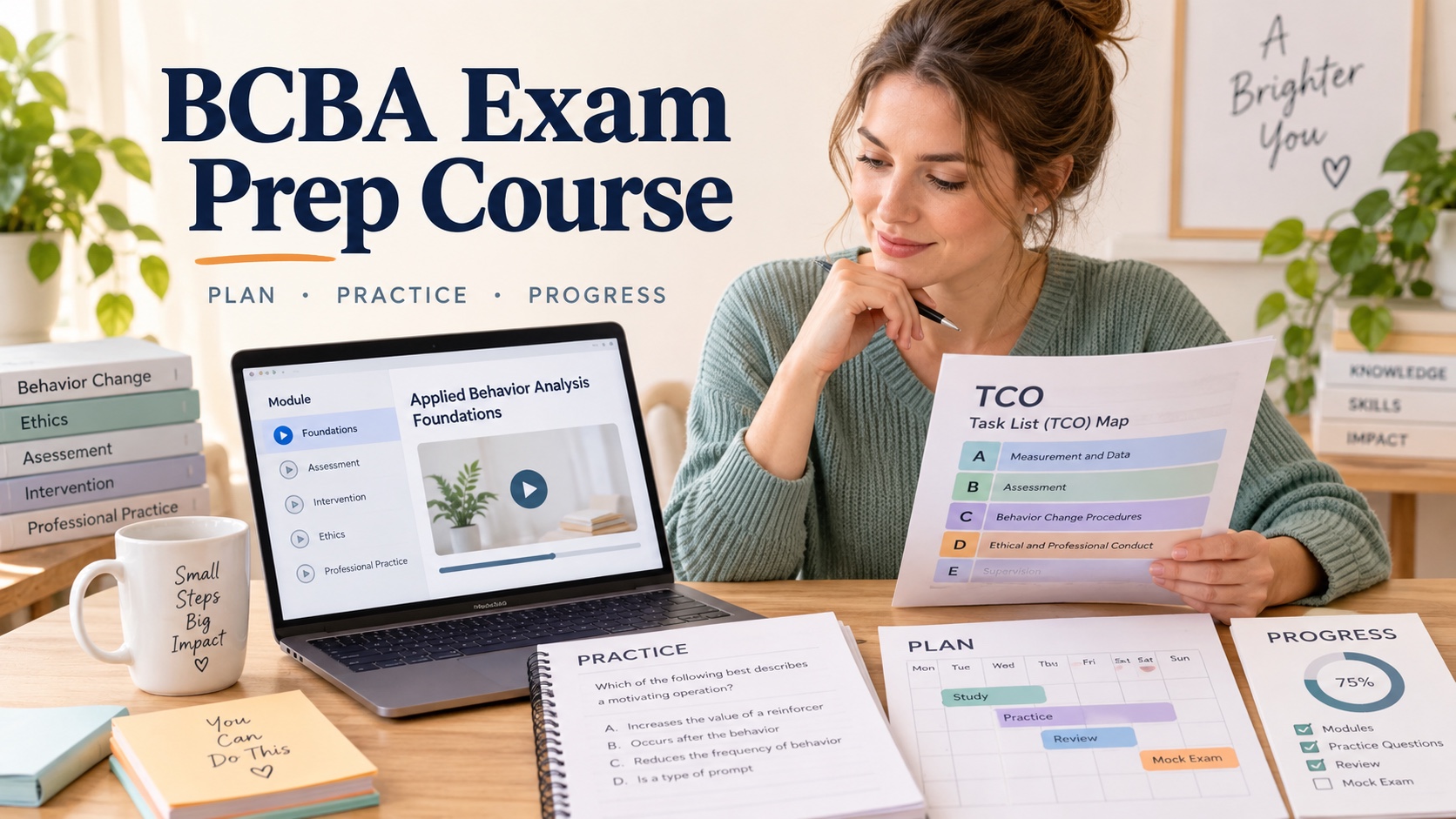
BCBA Exam Prep Course: How to Choose the Right Format
Choosing a BCBA exam prep course is not only a question of price or the number of videos included. You are choosing a learning system: what you will study, how you will practice decisions, how someone—or something—will show you what to repair, and how the course will fit around work, fieldwork, or graduate school.
This guide gives you a practical comparison framework for live, self-paced, practice-heavy, and app-supported prep. It starts with the current BACB boundary, then checks curriculum mapping, teaching, practice questions, feedback, schedule, and trust signals. The BACB’s current BCBA Handbook, BCBA Test Content Outline, and Examination Information remain the authority for certification and exam rules. A commercial course is a study aid, not a BACB endorsement or a passing guarantee.
Table of Contents
Start with the official BCBA boundary
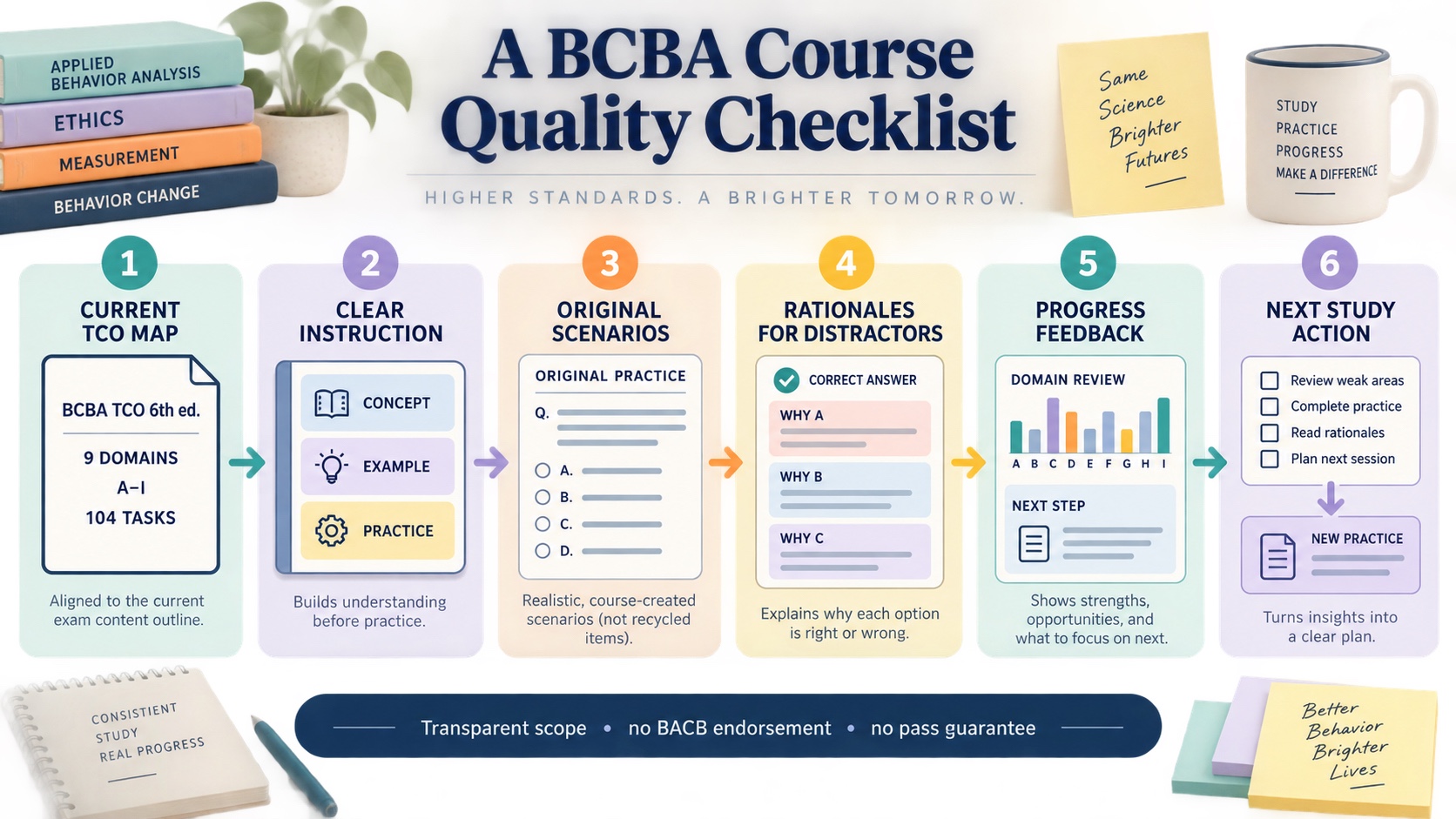
The current BCBA examination is based on the BCBA TCO, 6th edition, beginning in 2025. The TCO describes 104 tasks across nine domains and identifies 175 scored questions. The BACB Examination Information page lists 185 total BCBA questions and four hours of testing time. A prep course should explain which document it uses for content mapping instead of treating a generic “task list” label as enough evidence.
The exam uses multiple-choice questions with four possible answers and one correct answer, delivered through computer-based testing at authorized Pearson VUE locations. The BACB uses multiple forms and equated scoring. That means a course may help you practice pacing and decision-making, but a course percentage is not an official score and should not be marketed as a guaranteed prediction.
The official Handbook recommends reviewing the TCO, the Ethics Code for Behavior Analysts, and materials gathered from training. It also makes clear that the BACB cannot endorse specific study guides or guarantee that purchasing a study product will lead to a pass. Use those statements as a filter: a trustworthy course is transparent about its scope, update date, authorship, and limitations.
Compare the main course formats
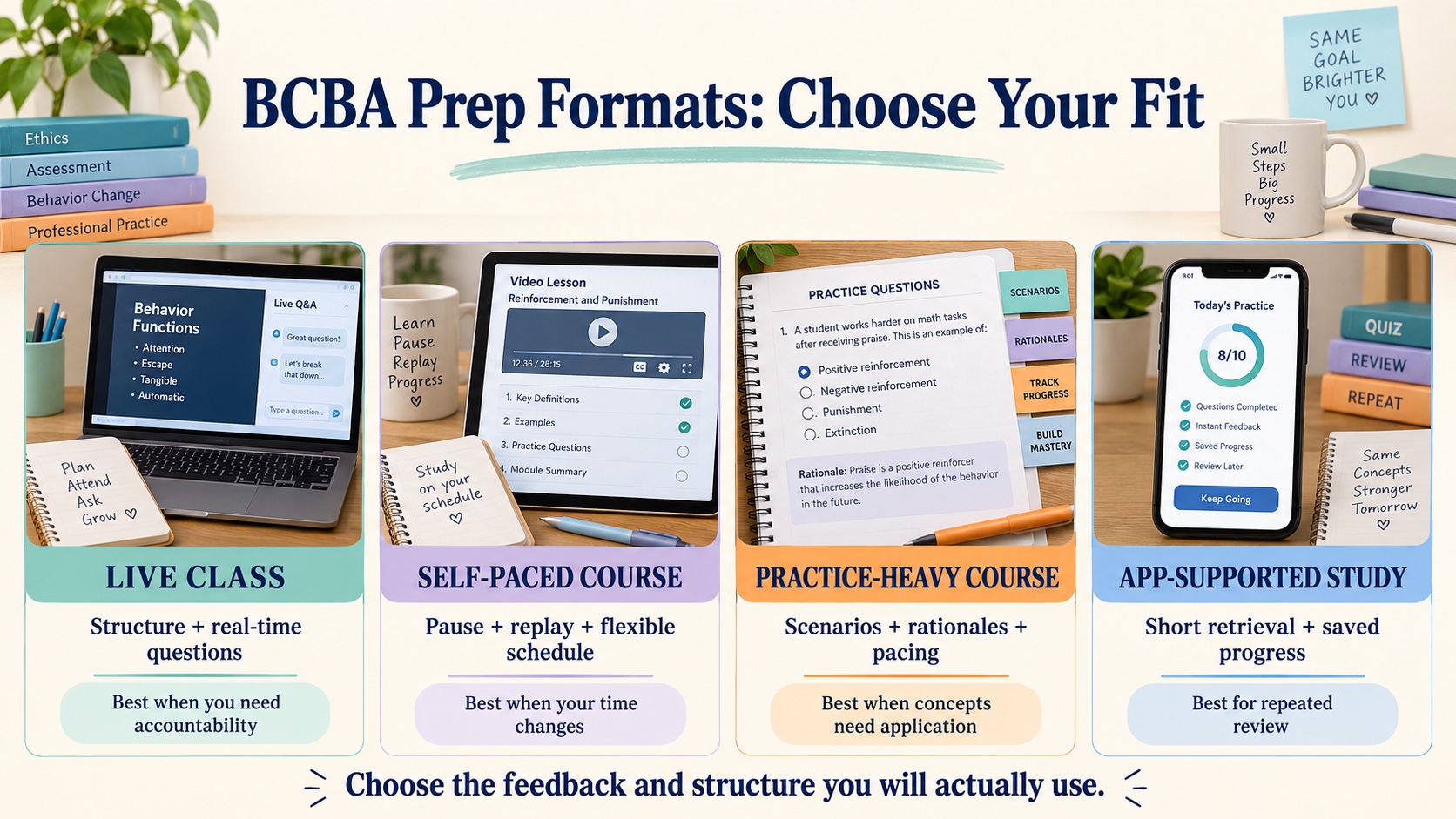
Live classes or a bootcamp
Live instruction can be useful when you need external structure, real-time questions, and a calendar that keeps your preparation moving. It may also help you hear how an experienced instructor distinguishes similar concepts. Before enrolling, check what happens when you miss a session, whether recordings are included, how questions are handled between classes, and whether the schedule assumes more weekly time than you actually have.
Self-paced video or reading course
Self-paced material works well for a variable schedule or for learners who want to pause, replay, and revisit a difficult domain. Its weakness is often passive completion. A long playlist can feel productive while leaving you unable to choose an answer in a new scenario. Look for retrieval prompts, worked examples, practice checkpoints, and a clear next step after each module.
Practice-test course
A practice-heavy course is valuable when you already know the basic vocabulary and need to improve application, discrimination, pacing, or error review. It is a poor substitute for instruction if every missed answer produces only a letter and a short definition. Check whether the questions are original, whether each explanation addresses the distractors, and whether the set is mapped to the current TCO.
App-supported study
An app can make short, repeated retrieval easier. You might use a domain set during a break, save a confusing question, listen to a review, or return to a weak area after a later session. The benefit comes from the loop around the questions, not from the device itself. Look for progress information that tells you what to do next instead of turning every session into a single score.
Check curriculum and TCO coverage
A credible course should let you see how its lessons and practice connect to the nine TCO domains: behaviorism and philosophical foundations; concepts and principles; measurement, data display, and interpretation; experimental design; ethical and professional issues; behavior assessment; behavior-change procedures; selecting and implementing interventions; and personnel supervision and management.
You do not need a separate course lesson for every tiny label to make a useful plan. You do need enough detail to find gaps. Ask whether the course names tasks or domains, distinguishes knowledge from application, and shows where ethics, cultural responsiveness, data interpretation, assessment, and supervision appear. A course that promises “full coverage” without a visible map is asking you to trust a slogan.
Also separate exam content from eligibility. Coursework, fieldwork, supervision, application documents, and maintenance requirements belong to other BACB resources. A course can help you study examination content without deciding whether you personally meet certification requirements. If a sales page blends those questions into one promise, verify each claim against the current Handbook.
Evaluate practice and explanations
Practice questions are where a prep course proves whether it teaches decisions or only presents information. Look for scenarios with a clear decision point, relevant cues, plausible distractors, and explanations that identify the underlying distinction. Good feedback should help you answer a new question later, not merely tell you that an option was wrong.
Check how the course handles measurement and data. A strong set asks learners to choose among frequency, rate, duration, latency, interval procedures, or product measures when the scenario requires a specific dimension. It can ask what a graph shows without turning every graph into a trend exercise. The course should explain units, observation windows, and environmental constraints when those details change the answer.
Look for the same care in assessment, intervention, ethics, and supervision. The best answer may depend on assessment purpose, client-informed goals, cultural variables, procedural integrity, consent, confidentiality, competence, role boundaries, or feedback to a supervisee. A course that uses familiar acronyms without explaining the conditions for selecting them is not giving you enough transfer practice.
Finally, find out what happens after a miss. Ideally you can tag the TCO area, record confidence, see why distractors fail, and receive a next action such as reviewing a concept contrast, working a graph, or retrying a new scenario later.
Match the course to your study situation
If you are early in preparation, start with a diagnostic rather than buying the longest course immediately. You want to learn whether your main gap is vocabulary, application, measurement, data interpretation, ethics, or pacing. If you are close to the exam, a calendar, mixed-domain practice, and timed rehearsal may matter more than another full lecture series.
If you work full time, a flexible course with short sessions and saved progress may be more realistic than a live schedule. If you repeatedly postpone study, the structure of a cohort or scheduled check-in may be worth more than extra content. If your course notes are strong but your practice results are unstable, prioritize explanations and error tracking rather than more reading.
Set a budget that includes the time required to use the product. A lower-cost course that you actually complete can be more useful than an expensive library you never open. Before paying, read the access period, refund terms, update policy, device requirements, and whether practice questions remain available when a course changes.
Questions to ask before enrolling
- Which BCBA TCO edition and date does the course use?
- Can I see the domain or task map before purchasing?
- Who writes and reviews the lessons, questions, and explanations?
- Are the questions original, and does the course clearly reject claims of access to secure BACB items?
- How are incorrect and low-confidence answers reviewed?
- Does the course include application, data, ethics, assessment, intervention, and supervision—not only definitions?
- What happens if the BACB updates an official document?
- How much weekly time and what access period does the course assume?
- Does the provider promise a pass, a score, or BACB endorsement?
The last question is a useful trust check. Realistic preparation can improve understanding and practice performance, but no independent course controls the examination, your eligibility, your study consistency, or the score-setting process.
Use a free-first practice path
If you want to compare your needs before committing to a paid course, begin with a small, deliberate study block. Use the official TCO as the boundary, answer a short set of original questions, tag your confidence, and write down one distinction you need to repair. Then decide whether you need instruction, more practice, a schedule, or a better review system.
ABA Study Online can support that first step with the BCBA learning path, BCBA practice questions, and the ABA Study Online app for structured review across short sessions. These are educational study resources—not the BACB, not official exam content, and not a pass guarantee. Use them as a low-risk way to find your next study action before choosing a larger prep commitment.
FAQ and official sources
What should a BCBA exam prep course include?
Look for a current TCO map, clear instruction, original scenario-based questions, explanations for correct and incorrect choices, ethics and role-boundary coverage, progress feedback, and a practical study schedule.
Is a BCBA practice-test course enough?
It depends on your gap. Practice can be enough for targeted application and pacing work when you already understand the concepts. If you cannot explain why the distractors fail, add instruction and concept repair instead of taking longer tests.
How long should BCBA exam preparation take?
There is no universal timeline. Use the exam date, your available weekly time, training background, practice patterns, and error log to build a schedule. A course should help you plan honestly rather than promise that everyone can finish in one fixed number of days.
Can a prep course guarantee that I will pass?
No responsible course can guarantee that. The BACB does not endorse specific study guides, and purchasing preparation materials does not guarantee a pass. Verify current rules with the BACB and use practice results to adjust your study.
Sources checked for this guide: Behavior Analyst Certification Board, BCBA Handbook; BCBA Test Content Outline (6th ed.); BACB Examination Information; and public course/practice pages used only to identify recurring market features, not to establish official rules.