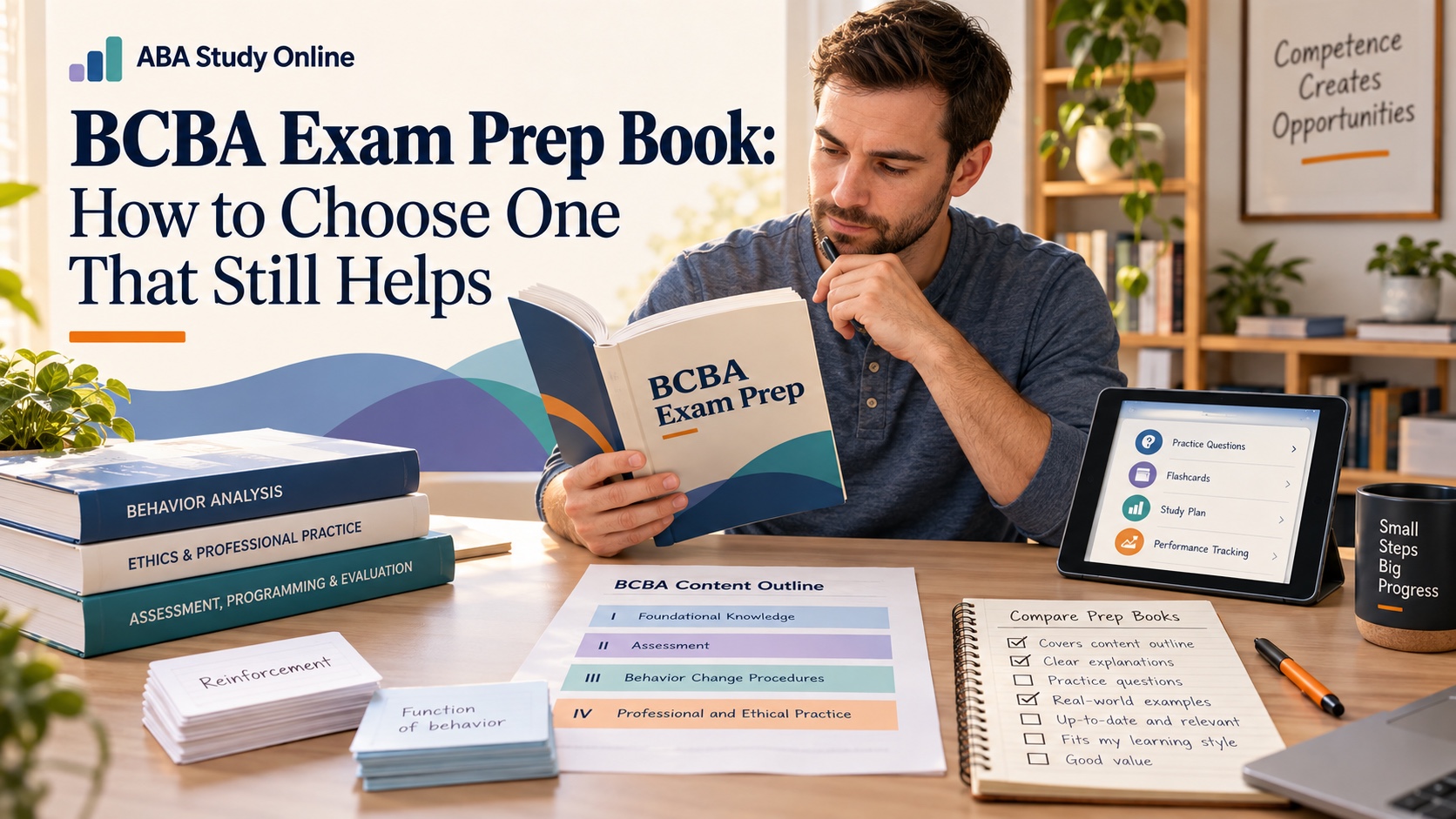
BCBA Exam Prep Book: How to Choose One That Still Helps
A BCBA exam prep book can organize a large amount of material, but the cover and question count do not tell you whether the book is a good fit. A useful choice should map to the current official content, explain concepts clearly, include applied practice, show where its claims come from, and fit the way you actually study.
The BACB remains the authority for eligibility, examination policies, and the applicable content outline. A commercial book is an independent study aid. It is not a BACB endorsement, a source of official secure questions, or a guarantee that you will pass. Use the book to support a current-source study system rather than replacing the source.
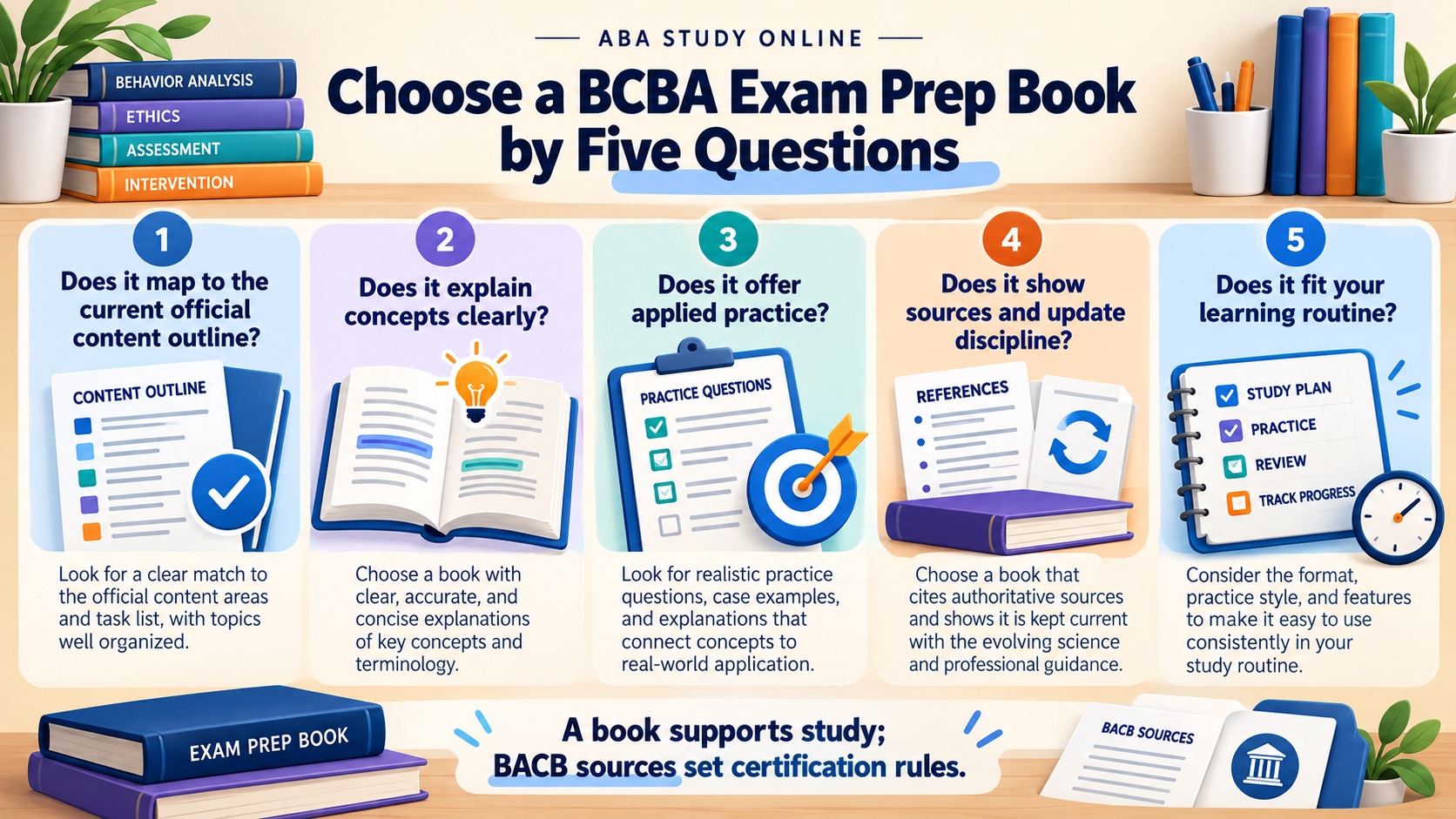
Five questions to ask
- Does it map to the current official content outline? Look for a clear relationship between chapters and the current content areas or task list. If the book uses an old map, treat it as background reading and verify every current boundary.
- Does it explain the concept? A glossary can help with first exposure, but exam preparation also needs examples, contrasts, and decision rules. You should be able to explain why an answer is correct, not just recognize a phrase.
- Does it offer applied practice? Look for scenarios that require measurement selection, data interpretation, assessment reasoning, behavior-change decisions, ethics, supervision, or professional judgment. A long list of isolated definitions is not a complete practice method.
- Does it show sources and update discipline? Check publication date, cited references, correction notes, and whether the author explains how changes are handled. A book that never says how it stays current deserves extra verification.
- Does it fit your routine? Consider page length, accessibility, print or digital format, practice style, note-taking, and whether you can return to weak topics. The best book is one you can use consistently.
Different kinds of prep books
A comprehensive review book may give you a broad explanation and a structured sequence. A concise outline book may work better after you already understand the concepts. A question-heavy workbook may be useful for retrieval and pacing but weak for first learning. A reference text may explain the science deeply without being organized as an exam-prep product.
These formats are not competitors in every learner’s routine. You might use one book for a first pass, a question bank for applied practice, and a digital tool for spaced review. The important step is to assign each resource a job and check that the jobs cover your actual gaps.
Think about the point in your preparation before you choose. Someone learning the vocabulary may need a patient explanation and examples. Someone who can define the terms but freezes on scenarios may need mixed practice and detailed rationales. Someone returning after an unsuccessful attempt may need a diagnostic error system rather than another complete reread. The same book can be helpful for one job and inefficient for another.
Check the practice quality
Before buying a practice-heavy book, inspect a sample. Does the question provide enough facts to choose an answer? Are the distractors plausible but distinguishable? Does the rationale identify the decisive feature and explain why the alternatives fail? Does the book separate a correct answer from a lucky guess?
Be cautious with language such as “identical to the real exam” or “guaranteed pass.” Independent publishers do not have permission to reveal secure examination content simply because their questions use familiar terminology. A practice book can be valuable without making that claim.
Keep the book current
Write the source date on the inside cover. Compare the book’s organization with the current BACB content-outline index and handbook. Separate stable concepts from time-sensitive rules: reinforcement and measurement logic may remain useful, while eligibility, application, fees, scheduling, and transition details must be checked against the current official page.
If your exam timeline crosses a transition, ask how the book handles it. Do not assume that a title mentioning a new edition automatically means that every chapter reflects the current requirements. Use the official source for the final decision.
Fit the book into a study routine
Use a simple cycle: preview one content area, read a short section, close the book and retrieve the idea, answer an applied scenario, explain the rationale, and log what needs repair. A book becomes less useful when it is only highlighted once. It becomes more useful when its explanations change how you solve the next question.
Keep an error log with four labels: concept gap, discrimination gap, data/graph gap, and reading or pacing gap. Return to the book only for the relevant repair. This prevents a large book from turning into an endless reread of material you already know.
Use sample pages before committing when possible. Check whether the layout is readable, whether examples are concrete, and whether the explanations avoid unsupported shortcuts. A visually attractive book can still leave you with the same unanswered question: what fact in the scenario should control the decision?
Cost is part of the decision, but it should be connected to use. A book that sits unopened is not a good value, while a modest resource that you revisit, annotate, and combine with practice may be. Compare the time it saves, the gaps it addresses, and the quality of its feedback. Do not pay more simply for a larger page count. Also check whether a digital copy has accessibility features and whether your notes remain available for later review across devices.
Before you buy, write the one problem the book must solve. That sentence makes the comparison more concrete and reduces impulse purchasing when several books look similar on the shelf or online right now too, clearly.
Build a study route
ABA Study Online can complement a prep book with the BCBA learning path, BCBA practice questions, and app-based retrieval when you want shorter sessions. Use the book for explanation and structure, the website for free concept review, and the app for repeated practice. Keep the current BACB sources beside all three.
FAQ
What is the best BCBA exam prep book?
There is no single best book for every learner. Choose by current content alignment, explanation quality, applied practice, source transparency, and fit with your routine.
Can a prep book replace the BCBA Handbook?
No. The handbook and current BACB pages control certification requirements and examination policies. A book is independent study support.
Should I buy a book or use an app?
Many learners benefit from both. A book can provide a stable explanation and map, while an app can support retrieval, mixed practice, and progress tracking. Choose based on the gap you need to solve.