BCBA Exam Passing Score: Why There Is No Simple Percentage
If you search for the BCBA exam passing score, you will quickly find percentages, “how many questions can I miss?” estimates, and forum discussions about scaled scores. The safest answer is more precise: the BACB establishes a passing standard through a criterion-referenced process, equates different examination forms, and reports results using a scaled-score system. That means you should not treat an old percentage or a fixed number of correct answers as a universal current rule.
The current BCBA Handbook describes the examination as pass/fail. The BACB Examination Information page explains that the number of questions required to pass can vary with the examination form and level of difficulty, and that the raw number of questions answered correctly is not reported. Your study plan should therefore focus on the current content outline, accurate reasoning, and performance across content areas—not on chasing a single unofficial cutoff.
Table of Contents
What is the short answer about the passing score?
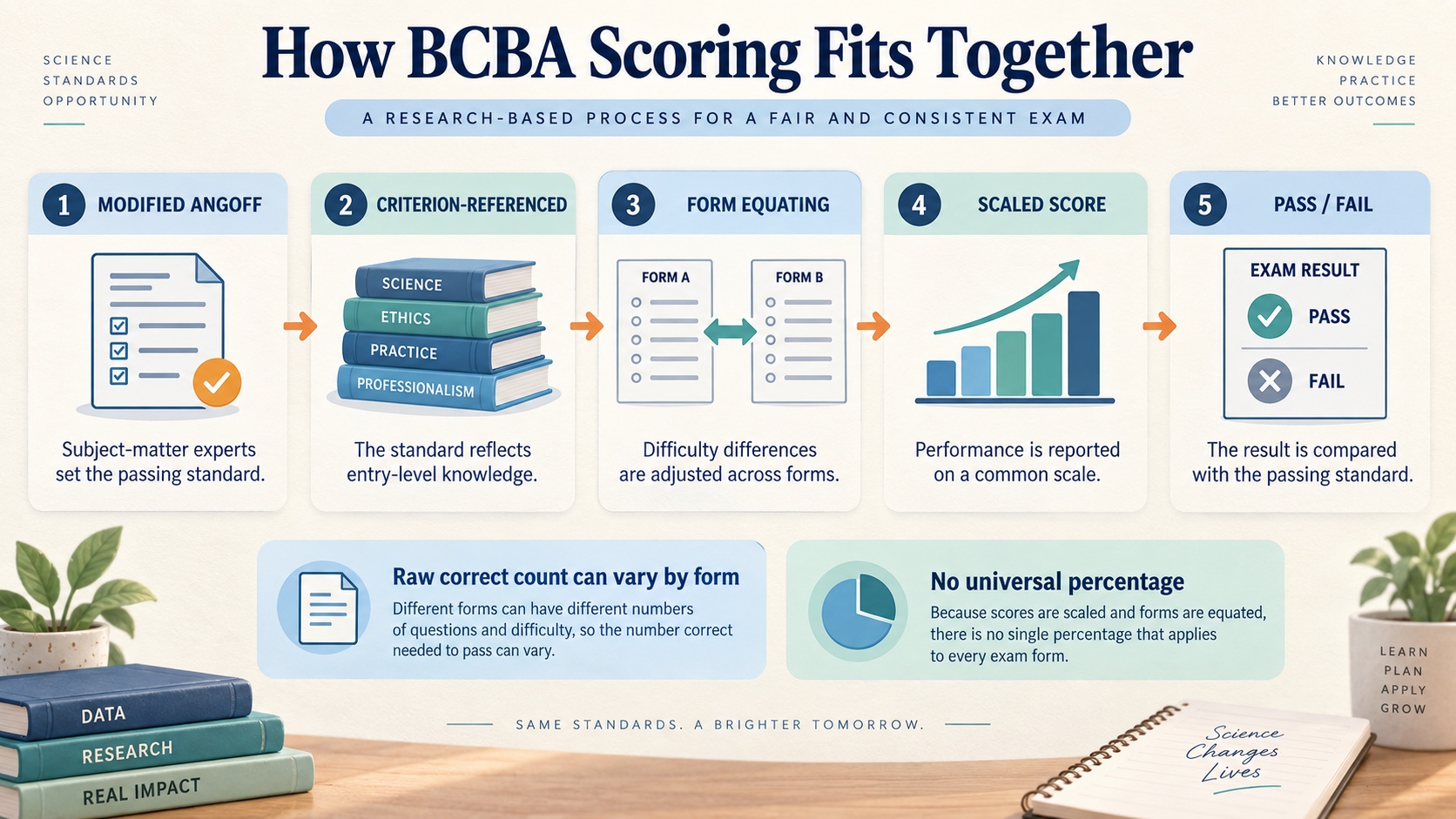
There is not a reliable universal percentage or raw-question number that you can apply to every current BCBA examination form. The BACB sets the passing score for a base examination form using the modified Angoff method. A panel of BACB-certified subject matter experts judges the knowledge expected of an entry-level behavior analyst, and the recommended standard is approved by the BACB Board of Directors.
The examination is criterion-referenced. Your result is based on whether your performance meets the established standard, not on whether you score higher than the people testing on the same day. The BACB then uses psychometric equating so that forms with different levels of difficulty can be compared. Because the forms are not identical, the raw number of questions required to meet the standard can vary.
This is why a statement such as “you need exactly 77 percent” or “you can miss exactly 37 questions” should be treated as historical or unofficial unless it is tied to the current official information for the examination form and score report in question.
How does BACB scoring work?
Four ideas are easy to mix together: the passing standard, form equating, scaled scores, and the score report.
- Passing standard: subject matter experts use the modified Angoff method to establish what entry-level competence means for the examination.
- Examination form: each candidate receives a form drawn from the BACB’s question pool. Forms are designed to assess the same current content but are not identical item-for-item.
- Equating: statistical procedures adjust for differences in form difficulty so the passing standard remains comparable across forms.
- Scaled score: the number of questions answered correctly is mathematically transformed onto a reporting scale. The scale lets the BACB compare results across forms; it is not the same thing as a raw percentage.
Scaling does not make the examination norm-referenced. The BACB describes the process as criterion-referenced: the standard is set against the knowledge expected for the credential, not against a quota of candidates who are allowed to pass. Scaling is a reporting and comparison tool, not a curve that moves because a particular testing group did well or poorly.
What does the current exam format tell you?
The June 2026 BCBA Handbook describes a four-hour, computer-based examination with 185 multiple-choice questions. Of those, 175 are scored and 10 are unscored. Each question has four possible answers and one correct answer. The time also includes the terms and conditions, navigation tutorial, load time, and review time.
Those numbers help you plan pacing, but they do not tell you the number you must answer correctly to pass. The 10 unscored questions are included in the examination experience, but candidates do not know which questions they are. You should answer every question carefully and manage time according to the official testing instructions rather than trying to identify unscored items.
The current BCBA Test Content Outline is the 6th edition. The 2027 changes announced by the BACB concern certification eligibility and transition requirements. They should not be turned into a claim that the BCBA passing score is now based on a “7th edition” unless the BACB publishes that specific examination change. Always check the current handbook, content outline, and examination information page when the transition affects your application timeline.
Is the passing score the same as the pass rate?
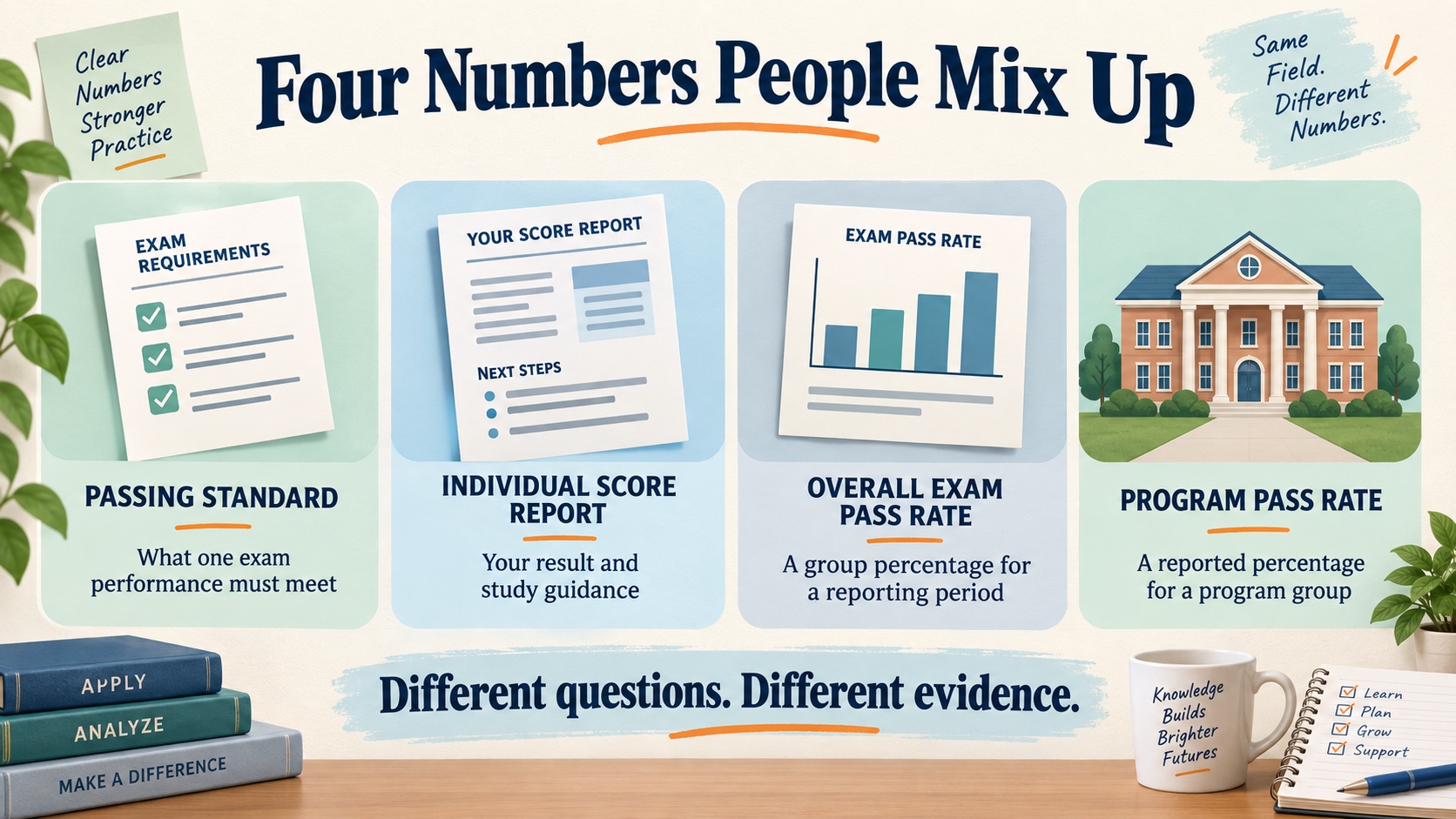
No. These terms answer different questions:
- Passing score: the standard an individual examination performance must meet.
- Individual score report: the result and, for a failed BCBA examination, performance information that can guide future study.
- Overall examination pass rate: the percentage of candidates who passed during a reporting period. It describes groups, not your required score.
- Program pass rate: the percentage reported for candidates associated with a university program or verified course sequence, subject to the BACB’s reporting rules. It is not the same as the examination passing standard.
A group pass rate can change because of the candidates, preparation pathways, retake mix, and reporting period. It does not mean that the BACB changes the individual passing standard to let a certain percentage of candidates through. Conversely, a program with a high reported pass rate cannot guarantee that every student will pass, and a lower group rate does not tell you the exact result you would receive.
How should you use a score report?
If you pass, the BACB generally gives you notice that you passed rather than a detailed diagnostic report. If you fail, the score report is designed to help you identify areas for further study. The current BCBA Handbook says you can obtain a copy through your Pearson VUE account, and the BACB Examination Information page explains that BCBA and BCaBA reports include the percentage of questions answered correctly and the total number of questions within each primary examination content area.
Use that report as a study map, not as a reason to disclose examination content. Do not reconstruct, post, or share confidential examination questions. Instead, compare the content-area information with the current BCBA Test Content Outline. For each weaker area, ask:
- Can I define the concept accurately without relying on a memorized phrase?
- Can I identify the relevant variables in a new scenario?
- Can I explain why the best answer fits and why the alternatives do not?
- Can I apply the concept to measurement, assessment, intervention, ethics, or supervision when the question requires it?
How should you plan study without a fixed percentage?
Set a performance target that is more informative than an unofficial cutoff. Build practice sets that follow the current content outline, rotate topics instead of studying one section in isolation, and record the reason for each error. A useful study record has four columns: content area, decision point, error pattern, and next practice action.
For example, if you miss a measurement question, do not write only “review measurement.” Write whether the difficulty was selecting a dimension, interpreting a graph, distinguishing a count from a rate, or matching a data display to the question. Then practice a new scenario that tests the same decision. The goal is transferable reasoning, not reproducing a familiar mock-exam answer.
Use the ABA Study Online BCBA learning path to organize concepts and the BCBA practice area to create mixed retrieval opportunities. Practice scores can be useful trend data, but they are not BACB score reports and should not be marketed as a guarantee of passing.
Which passing-score myths should you avoid?
- “There is one permanent percentage.” Historical percentages may describe an older standard or a particular form. They should not replace current BACB information.
- “The exam is graded on a curve.” The BACB describes a criterion-referenced process, not a pass quota based on the performance of the testing group.
- “185 questions means I can calculate the exact number I need.” The current format includes 175 scored and 10 unscored questions, but the form-specific passing requirement is not a simple public raw-count formula.
- “A program’s pass rate is my probability of passing.” Program statistics describe a reported group and do not account for every difference between you and that group.
- “A 2027 eligibility update automatically means a new scoring edition.” Eligibility transitions and examination scoring changes are different announcements. Check the official source for each claim.
- “Sharing remembered exam questions helps everyone study.” BACB examination content is confidential. Use concepts, official outlines, and original practice scenarios instead.
BCBA passing-score FAQ
What percentage do I need to pass the BCBA exam? The BACB’s current scoring explanation does not support using one universal raw percentage for every form. The passing standard is established through a criterion-referenced modified Angoff process and reported through scaled scoring.
How many BCBA questions can I miss? There is no reliable public raw-question number to apply to every form. The number correct required can vary with form difficulty, and the BACB does not report the raw correct count.
Is the BCBA exam passing score 400? Online discussions may mention particular scale numbers, but do not use an unofficial number as a universal raw-score or percentage rule. Read the current BACB scoring explanation and your official report.
Does a high mock-exam score guarantee that I will pass? No. A mock exam can reveal practice trends, but it is not the BACB examination form, scoring process, or certification decision.
What happens if I fail? The current BCBA Handbook says the retake application becomes available in the BACB portal within 48 hours and that you must wait 30 days before retaking the examination. Use the score report and current content outline to build a targeted study plan, and do not disclose confidential exam content.