BCBA Exam Pass Rate: How to Read the Latest BACB Data
If you searched for the BCBA exam pass rate, you probably want a direct answer: How hard is the exam, what percentage of candidates pass, and what should you do with that information? The latest BACB annual data currently displayed for 2025 report a 51% first-time pass rate and a 23% retake pass rate for the BCBA examination. Those figures describe groups of candidates tested in that year; they are not a passing guarantee, a personal probability score, or a substitute for reading the current BCBA Handbook and Test Content Outline.
The useful question is not “Can a statistic tell me whether I will pass?” It cannot. A better question is “What population does this statistic describe, and how can I use it to build a calmer, more evidence-informed study routine?” This guide separates the official datasets, explains the trend, and shows how to use a practice result without treating it as an official prediction.
Table of Contents
What the BCBA exam pass rate means
A pass rate is the percentage of candidates in a defined group who passed an examination during a defined reporting period. For example, BACB’s annual data table separates BCBA candidates who took the exam for the first time from candidates who were retaking it. That is already more useful than a single headline number because the two groups have different histories with the exam.
Three labels should stay attached to every number you read:
- Year: a 2025 statistic describes the reporting period used by BACB; it is not automatically the rate for the next exam administration.
- Candidate group: first-time candidates and retakes are reported separately.
- Dataset: the overall annual exam report is not the same thing as a university or Verified Course Sequence program report.
The pass rate also does not tell you the passing score as a percentage of questions. BACB examination decisions use the current examination policy and scoring process. Do not turn a group-level pass rate into a claim such as “you need to get 51% correct.” That is not what the statistic means.
The latest BACB BCBA pass-rate trend
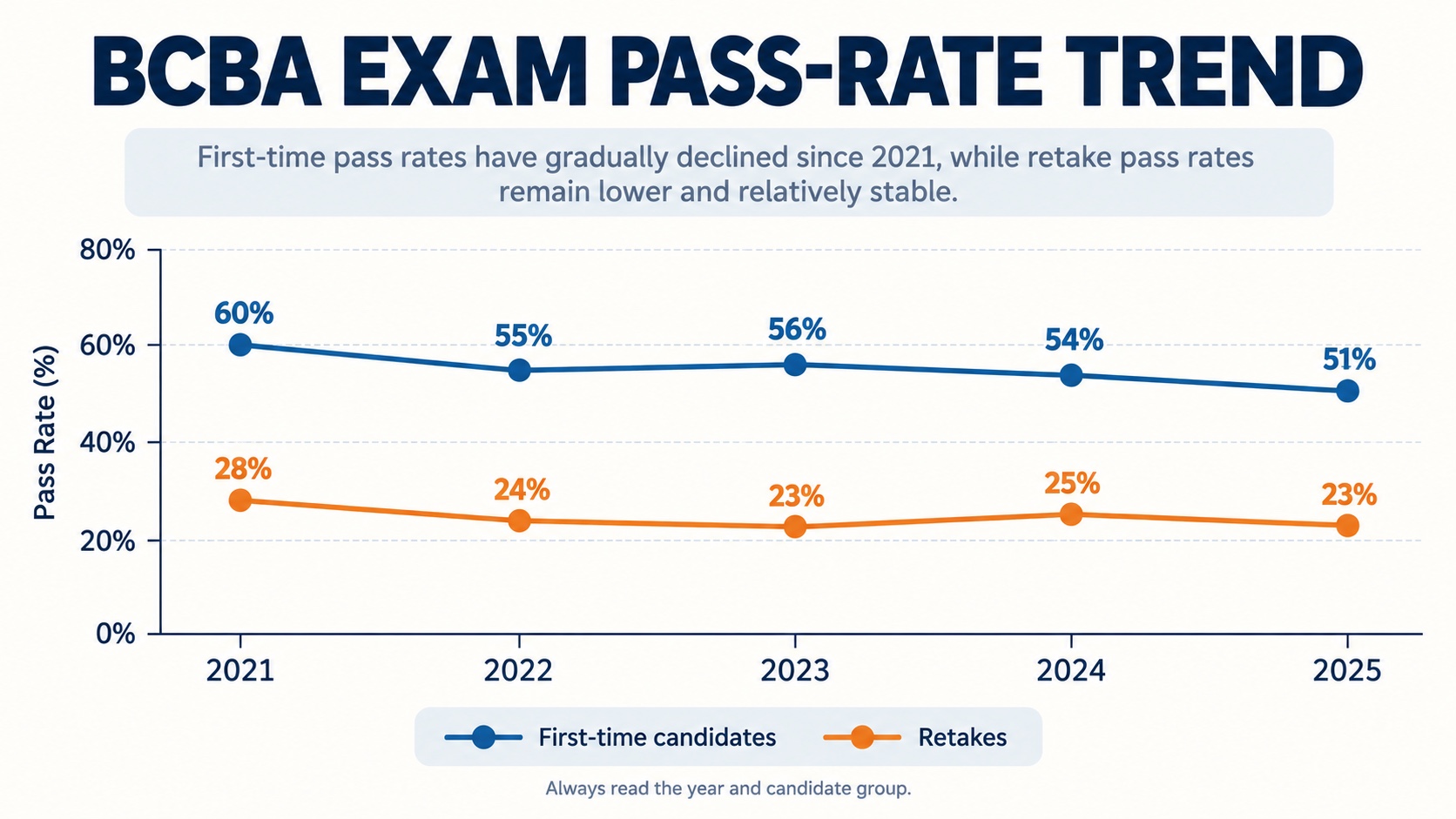
BACB’s current examination information page displays the following BCBA testing history:
| Year | First-time candidates | Retakes |
|---|---|---|
| 2021 | 60% | 28% |
| 2022 | 55% | 24% |
| 2023 | 56% | 23% |
| 2024 | 54% | 25% |
| 2025 | 51% | 23% |
The first-time rate moved from 60% in 2021 to 51% in 2025, while the retake rate moved from 28% to 23% over the same displayed period. That is a description of the published data, not an explanation of why the numbers changed. Candidate mix, application pathways, exam content, testing volume, preparation patterns, and other conditions can affect a reporting year. The table cannot prove that one specific study method caused a change.
The 2025 table also reports 9,955 first-time BCBA candidates and 13,196 retakes. Those sample sizes help you understand the scale of the report, but they still do not turn a population statistic into an individual forecast.
Notice the difference between a rate and a count. A 51% rate summarizes the share that passed among the first-time group; it does not mean that every content area had the same performance, that every testing appointment had the same difficulty, or that half of every preparation class should pass. A count tells you how many people were included, while the rate tells you the proportion within that group. Both labels belong in your notes when you quote the number.
First-time candidates versus retakes
It is tempting to read the gap between 51% and 23% as a judgment about ability. That would be too simple. A retake group is not a random copy of the first-time group. It may include people rebuilding knowledge after an unsuccessful attempt, people testing under different personal circumstances, and people whose preparation time or access to supervision changed. The report does not tell you each candidate’s reason for testing again.
For a first-time candidate, the 51% figure is a reminder to prepare broadly and use the current content outline rather than relying on familiarity with a few popular topics. For a retake candidate, the 23% figure is not a verdict. It is a reason to diagnose the previous attempt carefully: Which content areas were weak? Did the problem involve concept discrimination, application, pacing, reading accuracy, or anxiety? What evidence shows that the study approach changed?
A practice test can help you answer those questions only if you review it. A score without an error log is just a mood. Record the content area, the task or concept, why the selected answer looked attractive, what evidence supports the correct answer, and what you will do differently next time. Keep official exam results and practice results clearly separate.
Why university program reports are different
BACB also publishes pass-rate reports for first-time BCBA and BCaBA examination candidates connected to university training programs and Verified Course Sequences. That report is useful when comparing training options, but it should not be merged with the annual overall exam table.
The university report has its own scope. BACB says the 2024 report includes eligible programs with at least six first-time candidates in that year; programs below that threshold are not reported in the ordinary way. The report identifies the program, modality, number of first-time candidates, and percentage passing. A small cohort can produce a high or low percentage that should be read with its candidate count and reporting notes.
BACB specifically recommends that readers evaluate each program’s rate on its own and not compare a program pass rate directly with the overall examination pass rate. The populations, inclusion rules, and purpose of the reports differ. If you are researching a university, ask about curriculum, supervision, student support, cost, schedule, and outcomes together rather than choosing a program from one percentage.
How to use pass-rate data in your study plan
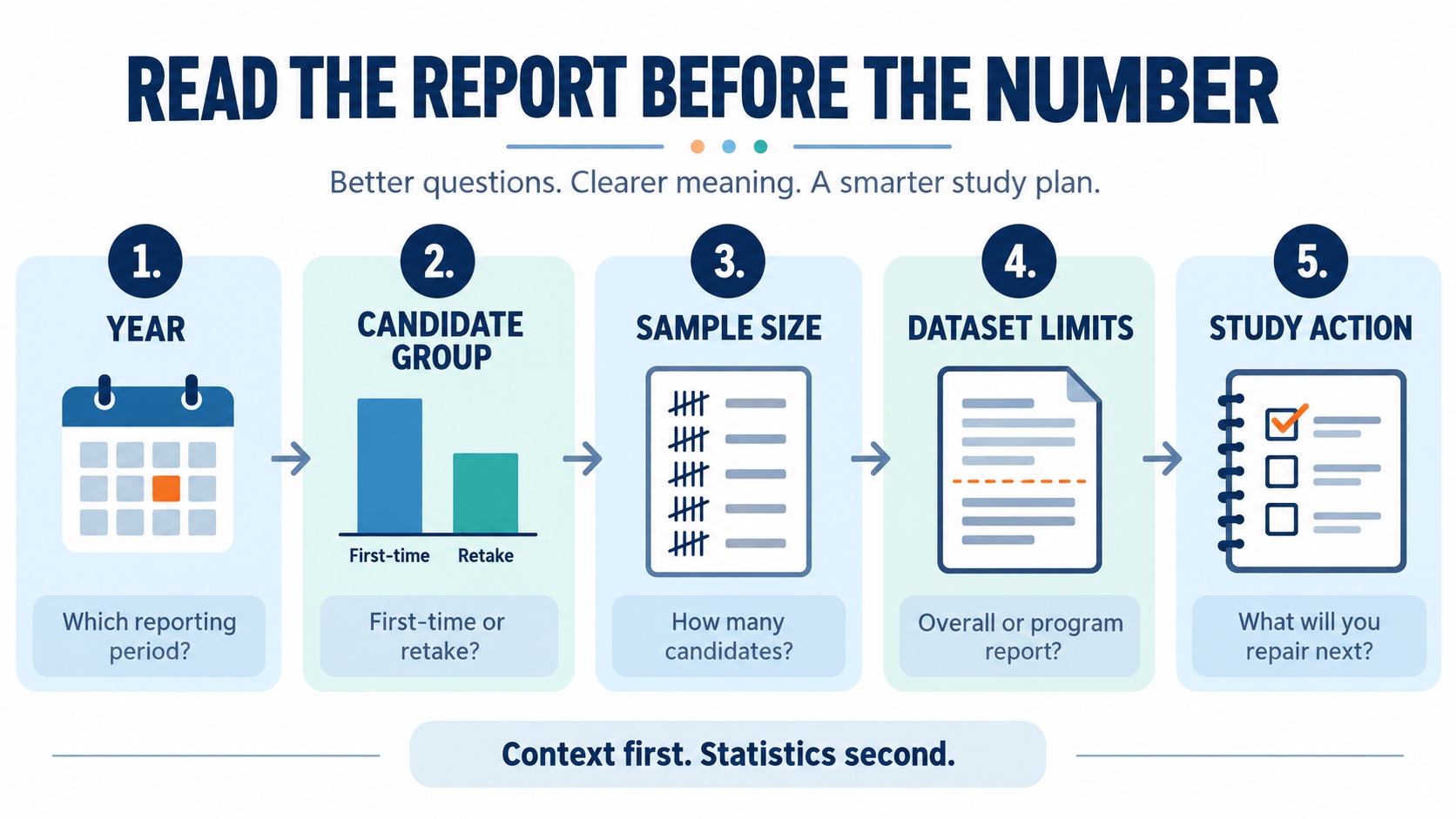
Use the statistic as context, then move to evidence that is closer to your own learning. A practical plan can follow five steps:
- Anchor to the current official sources. Start with the current BCBA Handbook and Test Content Outline. Pass-rate articles can age quickly, while the source documents define the exam framework.
- Map content before drilling questions. List the current content areas and mark each one as new, developing, or ready for retrieval practice. This prevents a high-interest topic from consuming the whole schedule.
- Use mixed practice. After focused review, mix concepts and application scenarios. The goal is to recognize the relevant principle when the question does not announce its topic.
- Review errors by cause. Separate knowledge gaps from misread stems, distractor errors, calculation mistakes, pacing problems, and overconfident guesses.
- Re-test after repair. Return to the same skill later with new questions. Improvement should appear in the explanation quality and transfer, not just in remembering an answer.
If you are using the ABA Study Online BCBA learning hub, keep the official outline as the map. Original BCBA practice questions and the BCBA mock-exam path can support retrieval and review, but they are educational practice, not BACB exam results or a prediction tool. Use the ABA glossary when a term is blocking your explanation.
A simple weekly review can make the data actionable without making it frightening. At the start of the week, choose two or three content priorities from your error log. During the week, alternate concept retrieval, applied scenarios, and explanation practice. At the end, review a small mixed set under realistic timing and write down what changed. If the same error returns, narrow the next lesson to the missing distinction instead of adding another full-length test.
What the statistics cannot tell you
A published pass rate cannot tell you whether you personally will pass, how many hours you need, which study provider is best, or whether a practice percentage maps to the official result. It also cannot establish that the exam is “easy” or “impossible.” Those conclusions require information the annual table does not contain.
Be cautious with pages that use an old rate without a year, mix first-time and retake data, quote a university report as the overall rate, or attach a pass guarantee to a practice product. A trustworthy explanation shows the reporting year, the population, the source, and the limits.
The most constructive interpretation is simple: the exam deserves organized preparation, and your next action should come from your own evidence. Read the current sources, measure your understanding with original practice, investigate errors, and adjust the plan. The statistic can provide context while the learning record provides direction.
FAQ and official sources
What is the latest BCBA exam pass rate?
BACB’s currently displayed 2025 annual data report a 51% pass rate for first-time BCBA candidates and a 23% rate for retakes. Always attach the year and candidate group to the number.
Is the BCBA pass rate the passing score?
No. A pass rate is the percentage of a defined group who passed. It is not the percentage of questions you must answer correctly.
Why are retake pass rates lower?
The published table describes the difference but does not establish one cause. Retake candidates have different histories and circumstances, so use the number as context rather than as a judgment about an individual.
Can I compare a university’s pass rate with the overall BCBA pass rate?
BACB advises against a direct comparison because the reports use different populations and reporting purposes. Read the program’s candidate count and report notes alongside the percentage.
Where should I verify the data?
Start with the BACB Annual Data Report, the Examination Information page, and the University Examination Pass Rates page. For current preparation scope, use the BCBA Handbook and the current Test Content Outline index.