BCBA Ethics Code: A Practical Guide to the Current Standards
The BCBA ethics code is easier to use when you treat it as a decision tool rather than a list of isolated rules. A strong answer to an ethics scenario usually begins with the client’s welfare, checks the behavior analyst’s role and competence, considers applicable law or policy, and ends with a documented next step.
This guide explains the current Ethics Code for Behavior Analysts in plain language. The Code applies to BCBA and BCaBA certificants and applicants, and it covers professional activities such as direct services, consultation, supervision, training, research, public statements, and professional communication. It is independent educational material, not legal advice, individualized ethics advice, or official BACB exam content.
Quick answer: The current Code gives behavior analysts a framework for protecting clients and stakeholders, practicing within competence, maintaining confidentiality, communicating truthfully, supervising responsibly, and handling research and public statements with care. When a scenario feels ambiguous, do not jump straight to the most forceful action. Identify the facts, the people affected, the relevant standard, the consultation or reporting path, and the documentation that makes the decision reviewable.
Scope boundary: The BACB Code is not a replacement for state law, licensure rules, employer policy, payer requirements, or a supervisor’s role. If rules conflict or the risk is urgent, the behavior analyst needs the appropriate qualified consultation and must follow applicable requirements.
How the current BCBA ethics code is organized
The Code currently in effect for BCBA and BCaBA applicants and certificants took effect January 1, 2022. The BACB ethics page advises readers to check for the current version and revision information. That matters for study content: a saved summary or older ethics chart should not be treated as the final authority when the source document has changed.
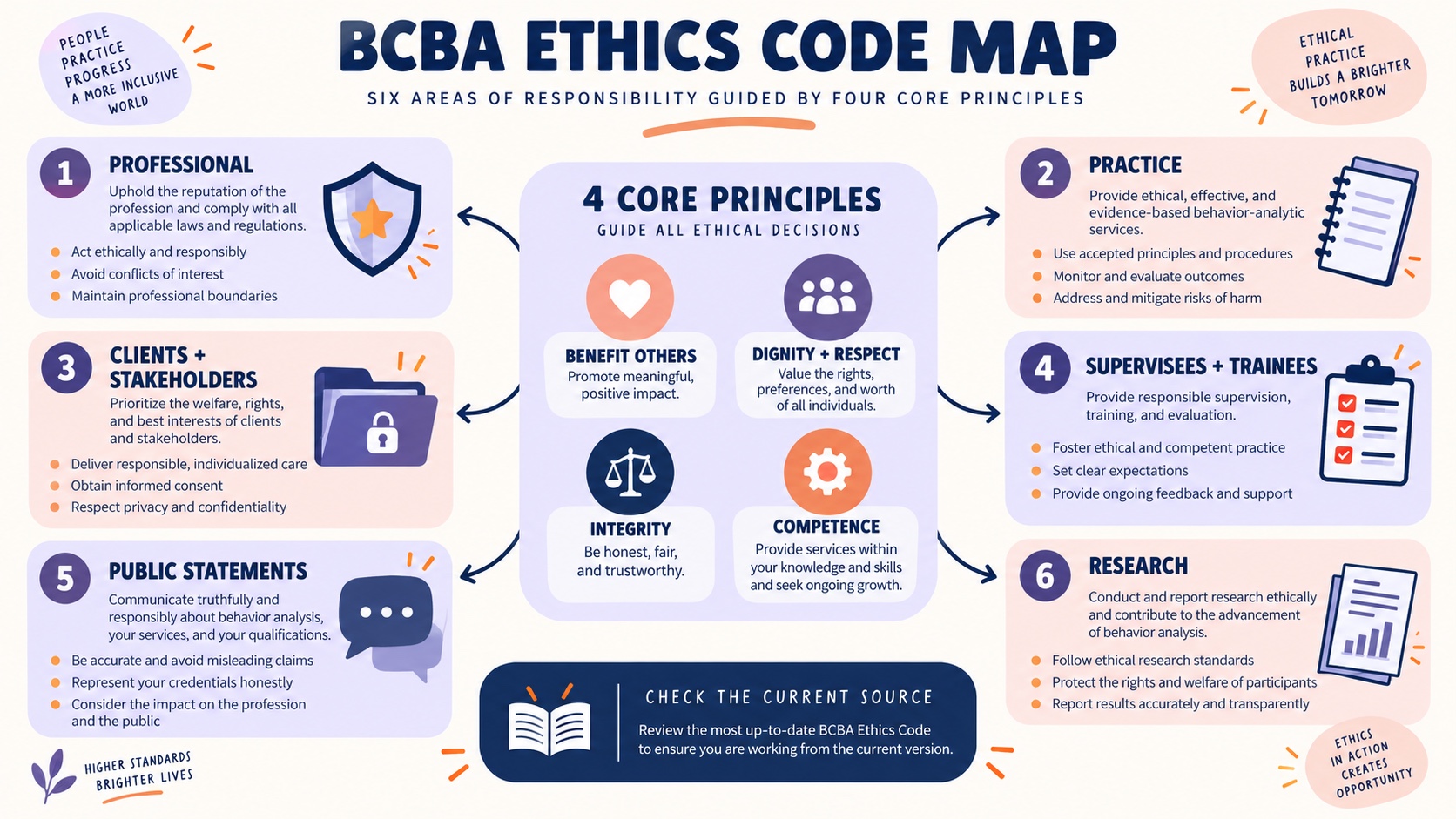
The document begins with an introduction, scope, core principles, and an application process. It then provides a glossary and six sections of standards:
- Responsibility as a Professional: truthful conduct, competence, professional responsibility, and appropriate relationships.
- Responsibility in Practice: how services are designed, delivered, documented, and protected.
- Responsibility to Clients and Stakeholders: client welfare, informed consent, communication, assessment, intervention, and continuity.
- Responsibility to Supervisees and Trainees: qualified supervision, training, feedback, evaluation, and continuity of supervision.
- Responsibility in Public Statements: confidentiality, truthful professional communication, advertising, and public education.
- Responsibility in Research: review, consent, data integrity, credit, documentation, and responsible publication.
This organization helps with both study and practice. Start with the section that matches the scenario, then read the connected standards and definitions instead of relying on a single keyword. For example, a social-media question may involve public statements, confidentiality, client rights, and truthful representation at the same time.
The four principles behind ethical decisions
The Code describes four foundational principles. They are not a shortcut that replaces the standards; they are a way to interpret the standards when several responsibilities appear together.
Benefit others
Put the welfare and rights of clients first, consider short- and long-term effects, identify conflicts of interest, and address factors that could cause harm. A choice that is convenient for a team or organization is not automatically the choice that benefits the client.
Treat people with compassion, dignity, and respect
Ethical practice includes how goals, procedures, communication, and disagreement are handled. Respect is not only a warm tone. It also means considering the person’s rights, context, culture, preferences, assent when relevant, and experience of the service.
Behave with integrity
Integrity shows up in accurate records, honest communication, correction of errors, transparent limits, and a willingness to address concerns. It includes not presenting an uncertain conclusion as if it were established fact.
Ensure your competence
Competence is maintained through education, supervision, consultation, self-monitoring, and knowing when a case exceeds current skills. A BCBA can be experienced and still need consultation for a new population, procedure, legal context, or research activity.
A practical ethics decision process
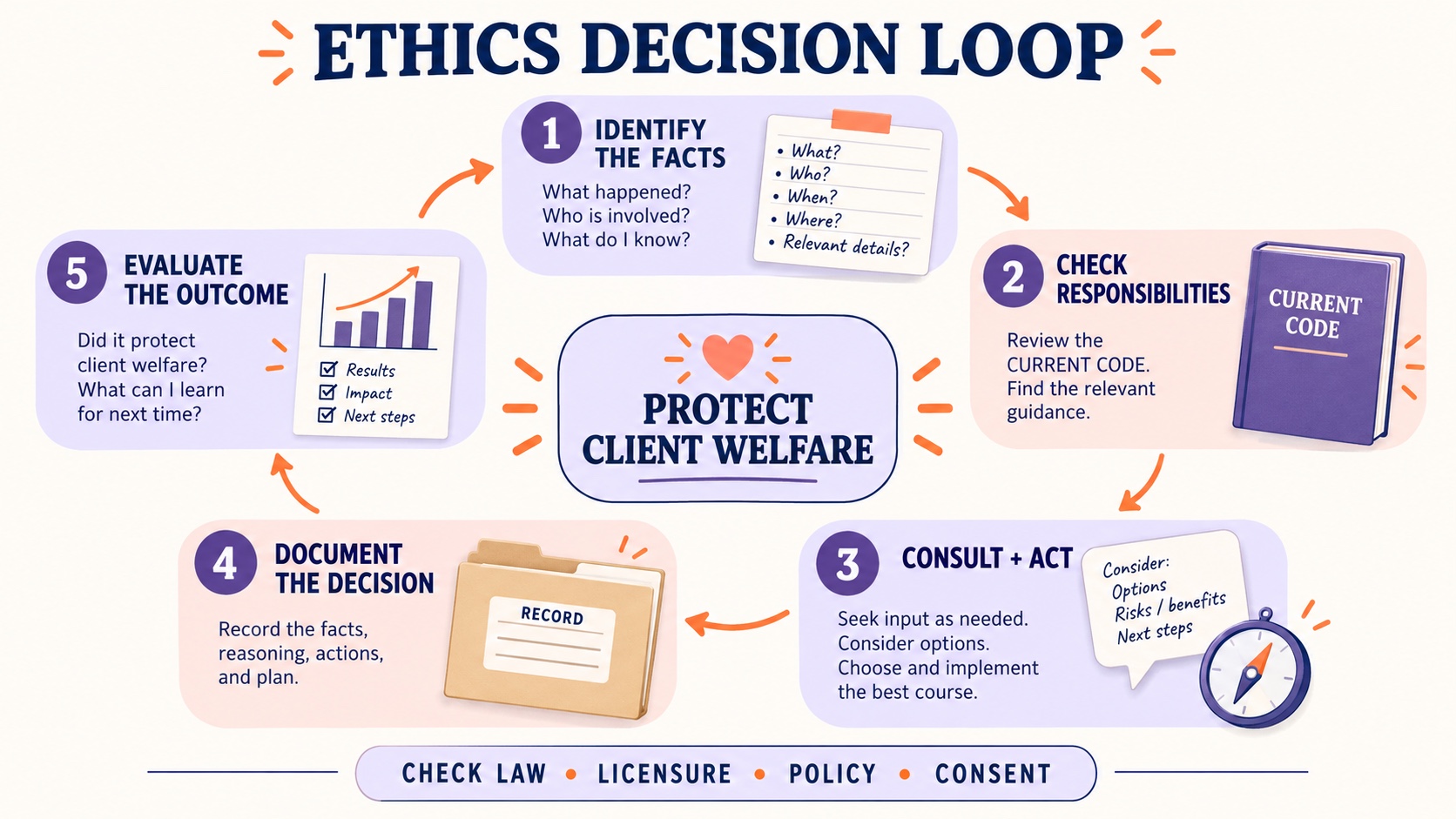
When a question asks what a BCBA should do first, use a process that makes the reasoning visible. This is a study method, not a substitute for the Code’s own application guidance.
- Describe the situation. Separate observable facts from interpretations, rumors, and emotionally loaded labels.
- Identify who may be affected. Include the client, stakeholders, supervisees, trainees, colleagues, and any person whose privacy or safety may be involved.
- Check the role and authority. Ask what the behavior analyst is responsible for, what the written plan says, and whether the requested action is within competence.
- Locate the relevant requirements. Check the Code, applicable law or licensure rules, employer policy, consent documents, and service agreements. Do not assume the Code is the only requirement.
- Choose the least harmful responsible next step. This might be consultation, correcting a record, pausing an unsafe change, obtaining consent, protecting information, or following a reporting process.
- Document the action and outcome. Record what was considered, who was consulted, what was decided, the due dates, and what happened afterward, while protecting confidential information.
The last two steps are where many exam answers differ. “Do nothing” is rarely adequate when there is a clear risk, but “immediately report everyone” may also skip a safer direct resolution or required internal process. Look for an answer that responds proportionally, protects the client, stays within authority, and creates a path for follow-up.
A worked scenario: pressure to change a plan
Imagine that a stakeholder asks a BCBA to remove a teaching step because the current plan takes more time than the team expected. The stakeholder wants a faster result and suggests that the BCBA simply change the procedure that day without discussing it with the client’s team.
A weak response would either make the change immediately or dismiss the stakeholder without learning what problem they are experiencing. A stronger response follows the decision process:
- Describe the request and the current data without assigning motives.
- Clarify the client’s goals, risks, preferences, consent, and the practical barrier behind the request.
- Review whether the proposed change is supported by assessment information, within the BCBA’s competence, and allowed by the relevant service and regulatory requirements.
- Discuss an evidence-informed modification with the relevant people rather than making an unreviewed promise.
- Document the concern, consultation, agreed next step, and a date to evaluate the effect.
The ethical question is not simply whether the stakeholder is right or wrong. It is whether the team is making a defensible decision that protects the client, respects the stakeholder, uses evidence, and remains accountable for the outcome.
Common BCBA ethics-code study errors
- Confusing the Code with state licensure law. BACB ethics requirements and state or local requirements can overlap, but they are not interchangeable.
- Memorizing a standard number without reading the situation. Ethics scenarios test the relationship among facts, roles, risk, consent, and follow-up.
- Treating confidentiality as an absolute ban on communication. The real question is what may be shared, with whom, for what purpose, and under which applicable requirement.
- Assuming supervision makes every action acceptable. Supervision supports responsible practice; it does not erase competence boundaries, consent, documentation, or client rights.
- Ignoring the outcome. A responsible decision includes checking whether the action worked and making a timely adjustment when it did not.
- Using old or unsourced summaries. Use the current BACB document and record the version or access date in your study notes.
A study checklist for ethics questions
Before choosing an answer, ask:
- What happened that can be observed or verified?
- Who is the client, who are the stakeholders, and whose rights could be affected?
- Is there an immediate safety, privacy, consent, or competence concern?
- Which Code section and glossary terms are most relevant?
- What other law, licensure rule, policy, or service agreement must be checked?
- Who should be consulted, and what action is authorized now?
- What should be documented, and when will the result be evaluated?
For BCBA study, connect ethics reasoning to the current BCBA Test Content Outline rather than studying ethics as a detached vocabulary list. The current BCBA Handbook identifies the Ethics Code for Behavior Analysts as a preparation resource and explains the current examination context. Use the BCBA Theory Blocks and free BCBA practice questions for independent practice, then return to the official source whenever a question depends on current requirements.
The BACB’s 2027 BCBA requirements transition is a separate requirements topic. Do not assume that a change to eligibility, fieldwork, or examination materials automatically changes the Ethics Code. Keep those source categories separate in your notes and verify the current BACB page when studying transition questions.
BCBA ethics code FAQ
Does the BCBA ethics code apply only during direct therapy?
No. The Code applies across professional activities, including consultation, supervision, training, management, research, public statements, and communication through writing or technology. The exact obligation depends on the situation and the applicable standard.
Is the Ethics Code for Behavior Analysts the same as a state ethics or licensure law?
No. A BCBA may need to comply with the BACB Code, state or local law, employer requirements, payer rules, and other professional obligations. Use the appropriate source for the question instead of treating one document as a universal replacement.
What should I do if two ethical responsibilities seem to conflict?
Clarify the facts, identify everyone affected, review the relevant standards and other requirements, seek appropriate consultation, choose a proportionate action that protects the client, and document the reasoning and outcome. Immediate safety or legal duties may change the order of those steps.
Is ABA Study Online’s BCBA ethics content official BACB material?
No. ABA Study Online provides independent educational explanations and practice materials. The BACB’s current Ethics Code, handbook, and ethics resources remain the authoritative sources for BACB requirements.