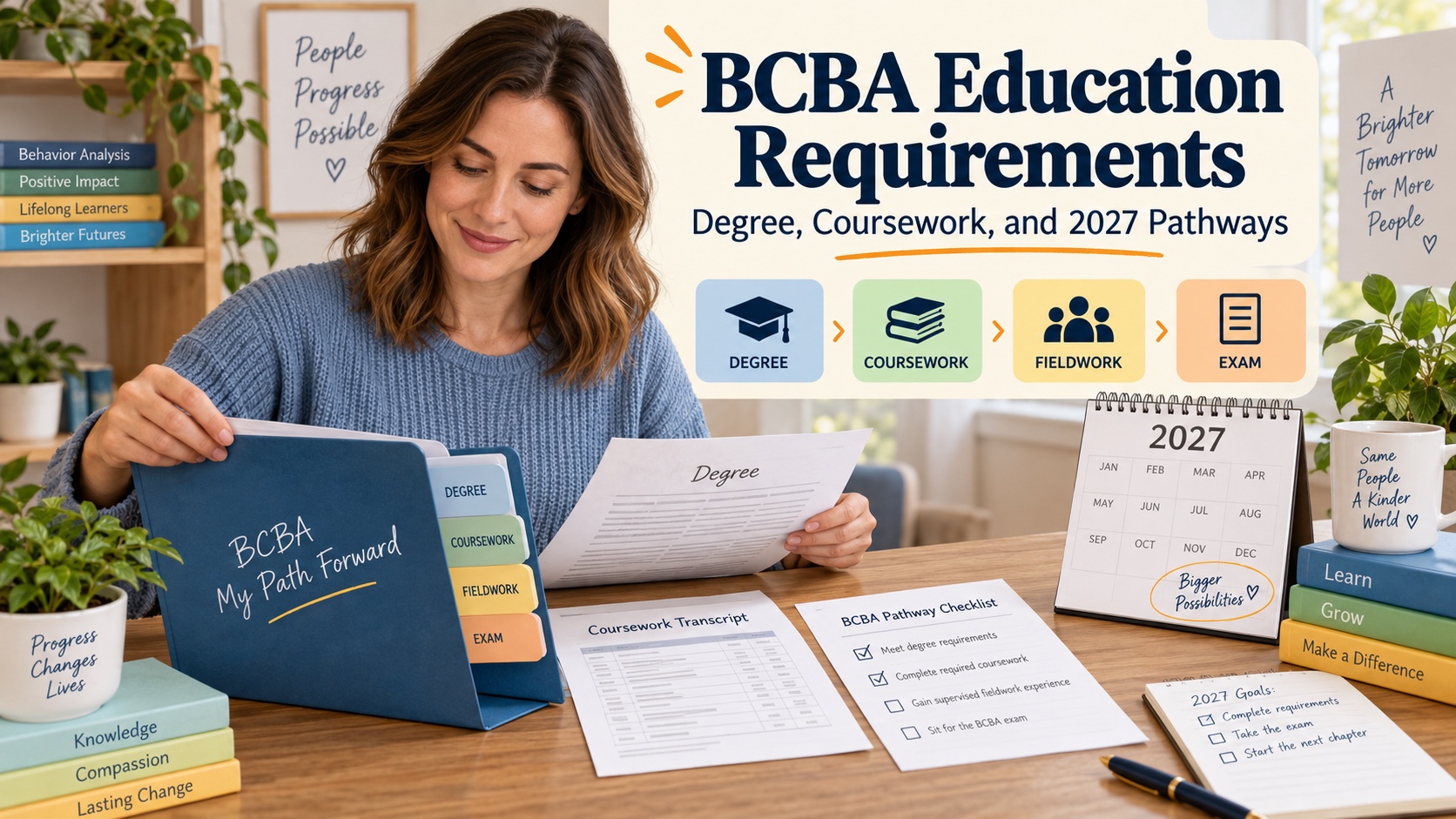
BCBA Education Requirements: Degree, Coursework, and 2027 Pathways
If you are researching BCBA education requirements, the first thing to remove from your checklist is the idea that “a master’s degree” is the entire answer. The BACB pathway also asks how the degree and behavior-analytic content fit the applicable route, how the fieldwork is documented, and which application-date rules control your file.
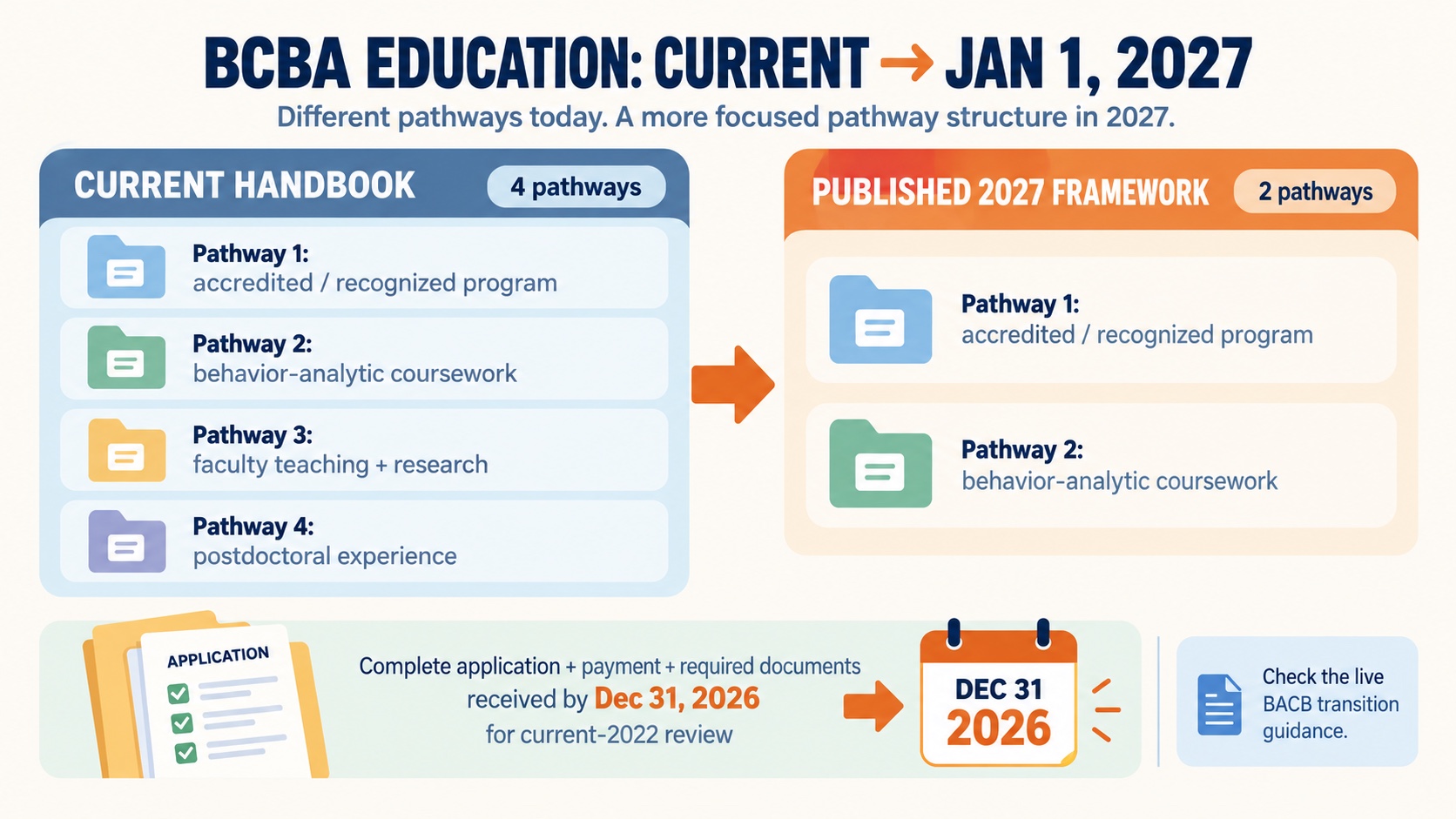
As of the official sources reviewed on September 27, 2026, the current BCBA Handbook describes four education/content pathways. The published framework beginning January 1, 2027 describes two pathways. That transition makes the date of your complete application important, but it does not make every degree, course, certificate, or university program automatically qualifying.
Table of Contents
Short answer: what counts as BCBA education?
BCBA education is pathway-specific. You generally need a qualifying graduate-level degree foundation plus the behavior-analytic content route that applies to your application, followed by supervised fieldwork, an application, and the BCBA examination. A master’s degree or a single ABA course does not, by itself, establish eligibility.
The right evidence depends on the route. A student in a qualifying accredited or recognized degree program may use the program and degree record to establish the education/content portion. A student using behavior-analytic coursework may need a master’s degree, qualifying course records, and the institution’s current Pathway 2 attestation. Other current pathways rely on faculty teaching and research or postdoctoral experience. Do not mix evidence from different pathways unless the current Handbook permits it.
The BACB is the authority for the individual eligibility decision. Its application-processing guidance states that it cannot determine whether a specific degree, coursework set, or training experience meets certification requirements outside formal review. A university advisor, supervisor, or mentor can help you organize evidence, but their opinion is not the same as a BACB application determination.
The current BCBA education pathways
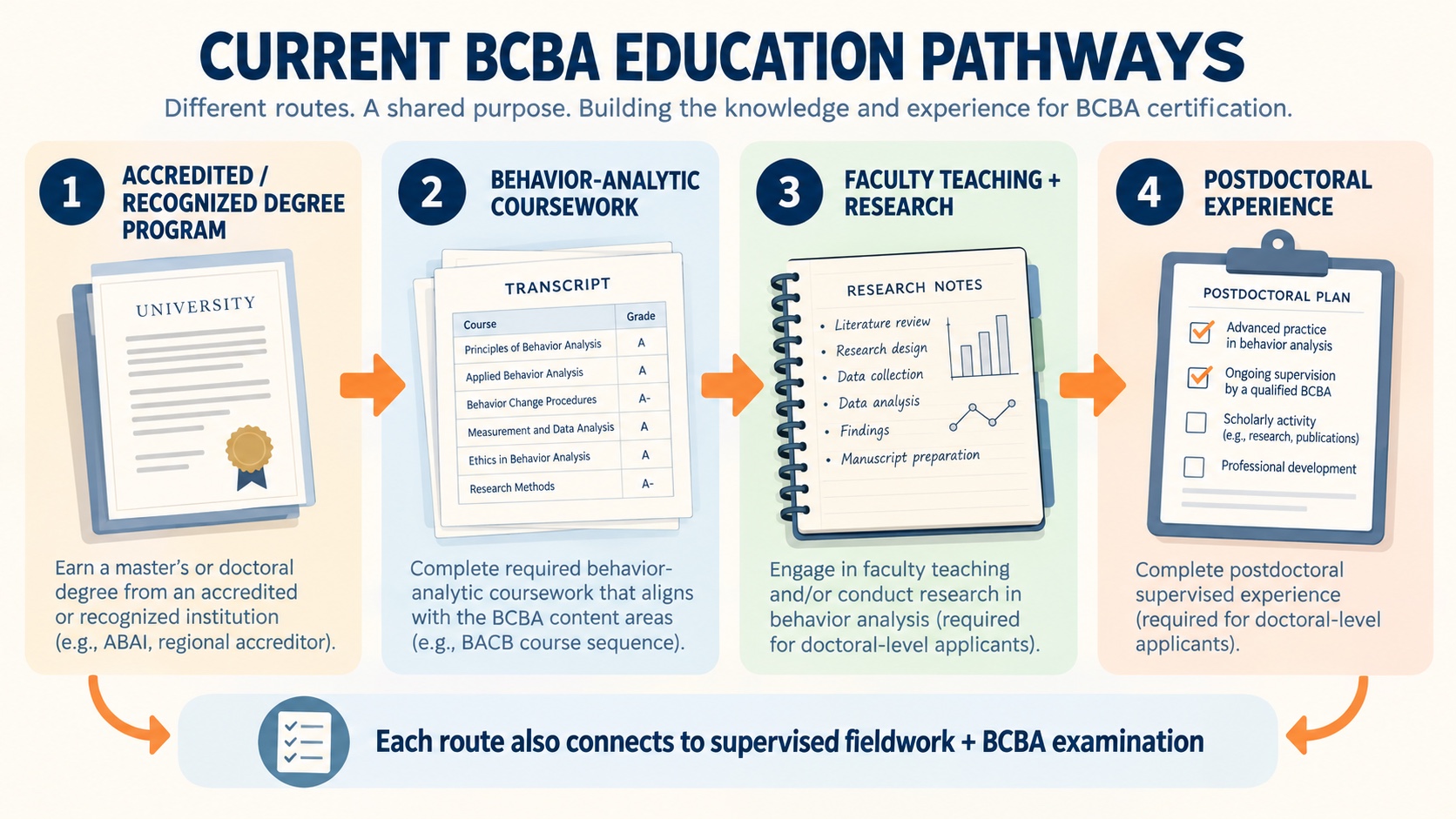
The current BCBA Handbook organizes eligibility into four pathways. All four are more than an education label: each also involves practical fieldwork and passing the BCBA examination. The education question is about which foundation and content evidence you will use.
- Pathway 1: accredited or recognized degree program. The degree and behavior-analytic content come through an APBA-accredited program or an ABAI-accredited or recognized behavior-analysis degree program in the categories named by BACB. Verify the program, degree level, and conferral timing—not just the university name.
- Pathway 2: behavior-analytic coursework. You have a master’s degree or higher and complete the required behavior-analytic coursework through the applicable institution and documentation process. Course titles alone are not enough; the current course structure, content, transcript, and attestation rules matter.
- Pathway 3: faculty teaching and research. The education/content evidence is connected to qualifying faculty teaching and research. This is a specialized route with its own experience and documentation conditions; do not treat a research assistant position as automatically meeting it.
- Pathway 4: postdoctoral experience. The route uses a doctoral degree and qualifying postdoctoral behavior-analytic experience and evidence. A doctorate alone is not the whole route, and postdoctoral work used for one requirement cannot simply be assumed to satisfy every other requirement.
Pathway 1 versus Pathway 2
Most education questions come down to the difference between an accredited or recognized degree program and a separate coursework route. Under Pathway 1, the program itself is central evidence. The program’s accreditation or recognition, degree level, and the dates connected to that status matter. A department page that says “ABA available” is not the same as the program status described by the BACB.
Under Pathway 2, the degree and behavior-analytic coursework are separate pieces. The current BACB university guidance says that the institution needs an authorized Pathway 2 Program Contact who can review the coursework and, when appropriate, submit the coursework attestation. Since January 1, 2026, the BACB-managed attestation process is part of the practical application workflow. A student should know which institution will attest, which records it will review, and when the attestation will appear in the BACB account.
This is why an “ABA certificate” can be useful educationally without answering the BCBA eligibility question. A certificate may document completion of a school’s classes, but the BACB still needs the applicable degree, course content, fieldwork, application documents, and exam. Ask for a pathway-specific crosswalk rather than relying on a marketing phrase such as “BCBA-ready.”
What changes on January 1, 2027?
The published 2027 BCBA Requirements describe two eligibility pathways: an accredited or recognized program route and a behavior-analytic coursework route. The faculty teaching/research and postdoctoral routes in the current framework are not part of the published 2027 eligibility structure. The 2027 document also gives new degree and coursework descriptions that must be read together with the 2027 BCBA Certificant Handbook.
BACB’s transition notice says a complete application—including payment and required documents—must be received by December 31, 2026 to be reviewed under the current 2022 requirements. That is a planning date, not a promise that an applicant who submits incomplete material by the deadline will be treated as complete. If your education record is close to the transition, build the application timeline from the official transition guide and the document versions required for your pathway.
The 2027 change also does not mean that a current degree suddenly becomes invalid or that a new exam edition automatically exists. Education eligibility, fieldwork, maintenance, and exam content are related but separate source questions. Use the current handbook or applicable transition document for your application date, and use the current BCBA TCO for exam study.
How to audit your degree and coursework record
Create an education audit before you start counting fieldwork hours. Write down the degree name, institution, degree level, conferral date, program status, transcript source, behavior-analytic courses, course descriptions or syllabi, likely pathway, and unresolved questions. Put the official BACB source beside each item. The goal is not to approve yourself; it is to make gaps visible before an application is submitted.
- Choose the date framework: record whether your complete application is intended for current-rule review or the 2027 framework.
- Name the pathway: do not use a mixed checklist that combines Pathway 1 program evidence with Pathway 2 attestation assumptions.
- Verify the program or coursework: check accreditation/recognition, institution, degree level, course content, and dates against the current BACB materials.
- Collect primary records: keep official transcripts, attestation evidence, program documentation, and the exact forms required for the pathway.
- Separate the next checkpoints: education evidence is not fieldwork evidence, application approval, or examination success.
For study after the education audit, ABA Study Online’s BCBA learning path and BCBA practice questions can support concept review. They do not evaluate a degree, submit an attestation, determine eligibility, or replace the current BACB Handbook.
Common BCBA education mistakes
- “Any master’s degree qualifies.” The degree is only one part of a pathway and must be read with content, fieldwork, and timing requirements.
- “A certificate equals BACB certification.” School completion and professional certification are different records issued by different authorities.
- “The university name is enough.” Program status, degree level, and conferral dates can matter.
- “A course title proves content.” Keep the course description, transcript, and pathway-specific review in view.
- “2027 means I should use every new rule now.” Match the rule set to your application date and official transition guidance.
BCBA education requirements FAQ
Do I need a master’s degree to become a BCBA?
The BCBA is a graduate-level certification, and the current and published 2027 pathways use a master’s degree or higher for the main eligibility routes. The exact program, content, fieldwork, and timing rules must come from the current BCBA Handbook and the framework that applies to your application.
Is a master’s degree in psychology enough?
Not automatically. A psychology degree may be part of a pathway, but the applicable behavior-analytic content, program status or coursework evidence, fieldwork, application, and examination requirements still have to be met.
Can a BCBA certificate program replace a degree?
A certificate of completion does not replace the degree requirement. It may be part of a coursework route, but verify the current Pathway 2 institution, attestation, content, transcript, and application rules before treating it as eligibility evidence.
What is the December 31, 2026 BCBA deadline?
BACB’s transition notice says a complete application with payment and required documents must be received by December 31, 2026 to be reviewed under the current 2022 requirements. Confirm completeness and the applicable document versions from the live BACB transition guidance.