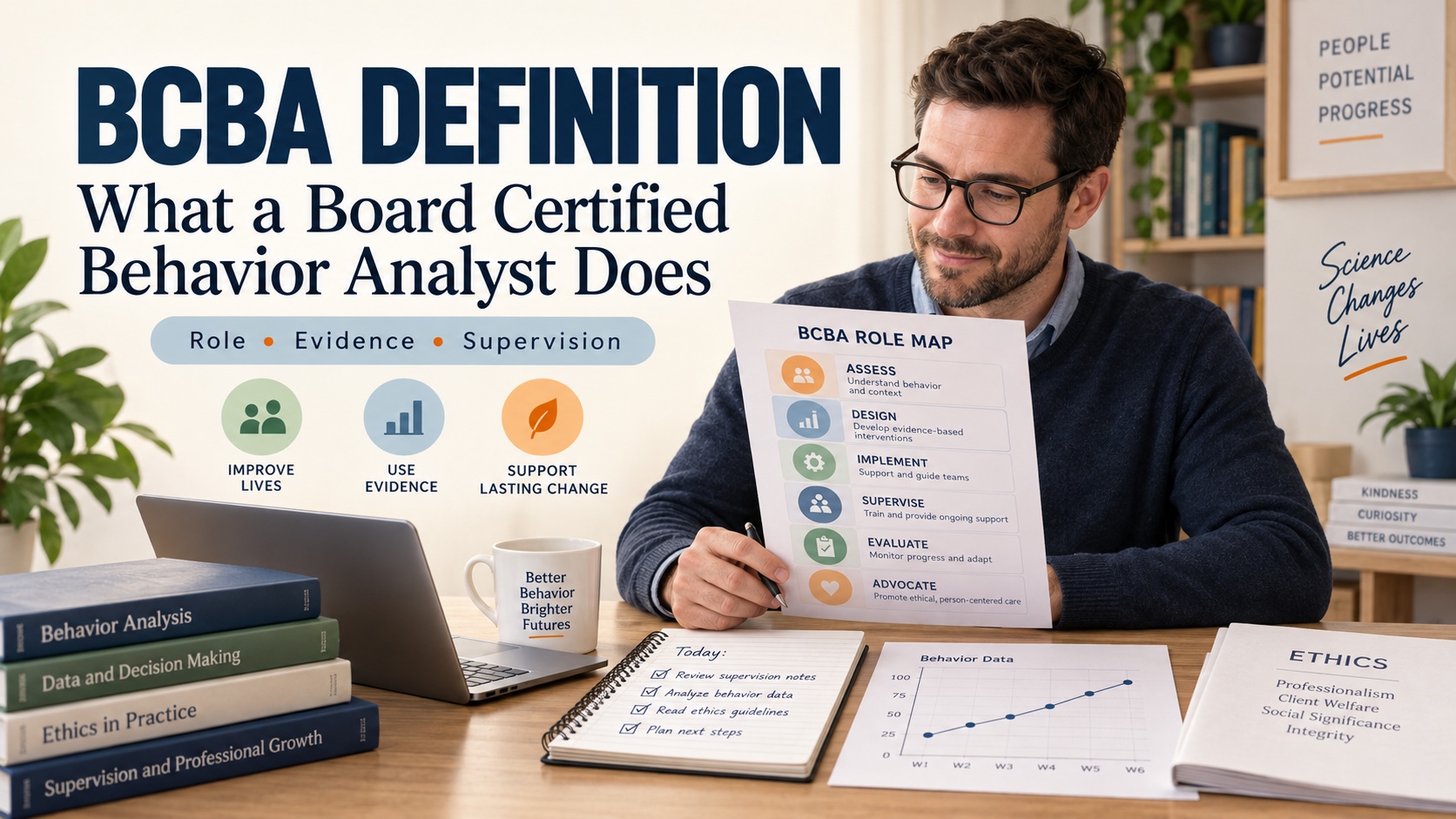
BCBA Definition: What a Board Certified Behavior Analyst Does
If you are looking for a BCBA definition, the short answer is this: BCBA stands for Board Certified Behavior Analyst. It is a graduate-level professional certification in behavior analysis issued by the Behavior Analyst Certification Board (BACB). A BCBA may practice independently in behavior analysis and may provide supervision for BCaBAs, RBTs, and other people who implement behavior-analytic services, subject to applicable rules and the professional’s scope of competence.
That definition is useful, but it is not the same as saying that every BCBA has the same job, holds a state license in every jurisdiction, or provides every type of service. The rest of this guide separates the credential from the workplace title, explains what the role commonly involves, and compares the BCBA level with BCaBA and RBT roles.
Table of Contents
What BCBA means
The letters describe a credential, not a diagnosis or a treatment brand:
- Board Certified: the person has earned and maintained a certification through the BACB’s requirements and processes.
- Behavior Analyst: the professional applies behavior-analytic concepts, measurement, assessment, intervention, and evaluation to defined problems and goals.
The BACB places the BCBA at the graduate level. Its public role description says that a BCBA is able to practice independently and provide supervision for BCaBAs and RBTs. “Able to practice independently” describes the certification level; it does not cancel a state’s licensure law, an employer’s rules, a payer’s requirements, informed-consent obligations, or the need to work within one’s competence.
It is also important to write the name correctly. BCBA is a certification abbreviation, while behavior analyst can be used more broadly in conversation. A person may work in a behavior-analytic setting without holding the BCBA credential, and a credentialed BCBA may work in different settings such as clinical services, schools, research, organizational practice, or supervision.
What a BCBA does
A BCBA’s daily work depends on the setting, client population, employer, and applicable regulation. Still, many BCBA roles involve a connected set of decisions:
- Define the target clearly. The BCBA helps a team describe observable behavior, meaningful skills, environmental conditions, and the outcome the learner or client is working toward.
- Review evidence. Data collection, direct observation, interviews, records, and assessment information can help the BCBA decide what is happening and what information is still missing.
- Design or oversee behavior-analytic procedures. The plan should connect the goal, the teaching or support procedure, the measurement system, and the criteria for changing course.
- Evaluate progress. A BCBA looks for patterns in the data, checks whether procedures were implemented as intended, and considers whether the result is meaningful in the person’s daily life.
- Coordinate with people around the service. Caregivers, teachers, technicians, other professionals, and the client or learner may each contribute information and decisions.
- Supervise and develop others. When the role includes supervision, the BCBA is responsible for a structured relationship, feedback, competency development, documentation, and the boundaries described in the current handbook and ethics requirements.
This is why the definition should not be reduced to “someone who works with autism.” Some BCBAs work with autistic people, but behavior analysis is a broader field. The accurate definition rests on the certification and the behavior-analytic role, not on one diagnosis, age group, or service setting.
What independent practice means
Independent practice is easiest to understand as a responsibility boundary. A BCBA can make professional behavior-analytic decisions at the BCBA level rather than needing a BCaBA or RBT to supervise the BCBA’s behavior-analytic work. That does not mean the BCBA works without collaboration, consultation, medical care, school coordination, or accountability.
Independence also does not mean “can do anything.” A BCBA should still:
- accept work only when the needed knowledge and skills are present or obtain appropriate support;
- follow the applicable Ethics Code and current BACB requirements;
- respect state or provincial regulation, employer policy, consent, privacy, and payer rules;
- use data and defensible reasoning rather than a one-size-fits-all protocol; and
- make the limits of the service understandable to the client, family, learner, and team.
BCBA vs. BCaBA vs. RBT
These credentials are related, but they are not interchangeable. The simplest comparison is about level and supervision:
| Role | Plain-language position | Supervision boundary |
|---|---|---|
| BCBA | Graduate-level behavior-analysis certification | May practice independently and supervise BCaBAs, RBTs, and other implementers within applicable rules |
| BCaBA | Undergraduate-level behavior-analysis certification | Provides behavior-analytic services under BCBA or FL-CBA supervision; may supervise RBT work in the roles allowed by current requirements |
| RBT | Paraprofessional behavior-analysis certification | Assists with behavior-analytic services under close, ongoing supervision from the responsible supervisor or coordinator |
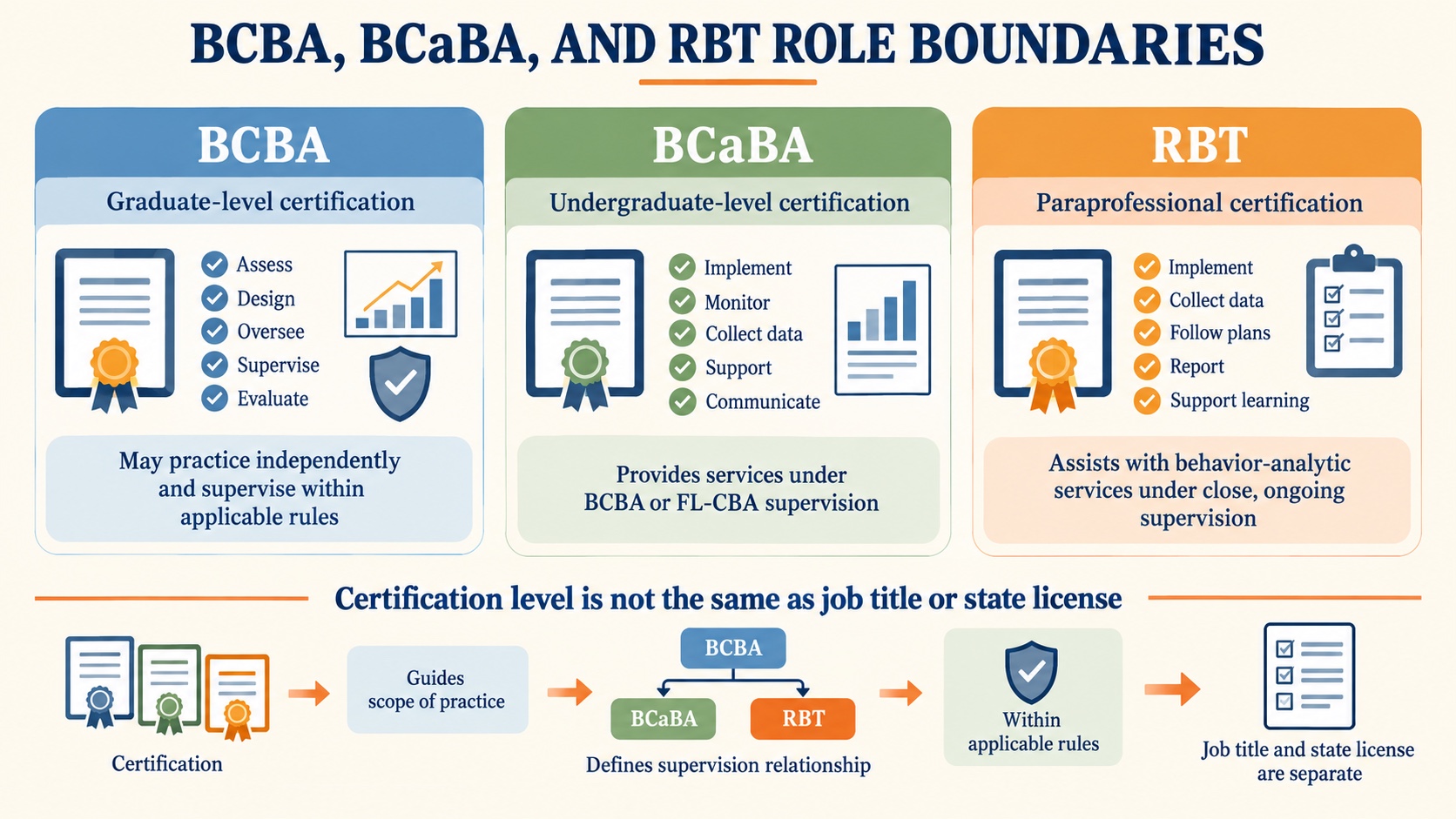
The comparison is a learning aid, not a substitute for the relevant handbook. Organizations may assign duties differently, and local law can add requirements. If a question, job posting, or service plan uses a title loosely, check the credential, the actual responsibility, and the supervision arrangement separately.
Certification, job title, and license
Three labels are often mixed together:
- Certification: the BCBA credential is awarded and maintained through the BACB’s certification system.
- Job title: an employer may call a position a clinical supervisor, behavior consultant, program director, or behavior analyst. The title alone does not prove BCBA certification.
- License or regulation: a jurisdiction may regulate who can provide services, use a title, bill, supervise, or work with a particular population. A BACB certification does not automatically answer every state or payer question.
The 2027 BCBA requirements transition is another reason to check the current official source before making a personal eligibility decision. A transition in requirements is not the same thing as a new “7th edition” definition of BCBA. For a personal pathway, use the current BACB handbook and transition guidance; for the meaning of the term, keep the definition and the role boundary separate.
How to study the BCBA role accurately
When a study question asks what a BCBA should do, start with four checks: What is the observable problem? What evidence supports the decision? What responsibility belongs at the BCBA level? What ethical, legal, or supervision boundary limits the response? This method is more useful than memorizing “BCBA equals supervisor.” Supervision is important, but a BCBA’s work also includes assessment, intervention logic, measurement, evaluation, collaboration, and professional judgment.
For structured study, use the BCBA learning path for theory blocks, the free BCBA practice questions for scenario reasoning, and the ABA glossary when a term needs a shorter definition. The ABA Study Online app can support repeatable review, but none of these independent study destinations replaces the current BACB source for certification decisions.
FAQ and official sources
What does BCBA stand for?
BCBA stands for Board Certified Behavior Analyst. It is a graduate-level certification in behavior analysis issued through the BACB.
Is a BCBA a therapist?
A BCBA may provide behavior-analytic services, but “therapist” is a broader everyday label and can refer to different regulated professions. Use the credential, service description, and local rules rather than assuming the terms are identical.
Can a BCBA supervise an RBT?
Yes, a BCBA may serve in an RBT supervision role when the current BACB requirements and applicable rules are met. The exact documentation and supervision obligations belong to the current RBT and BCBA handbooks.
Does a BCBA certification automatically equal a state license?
No. Certification and licensure are different systems. Check the relevant jurisdiction, employer, payer, and service rules before making a practice or hiring decision.