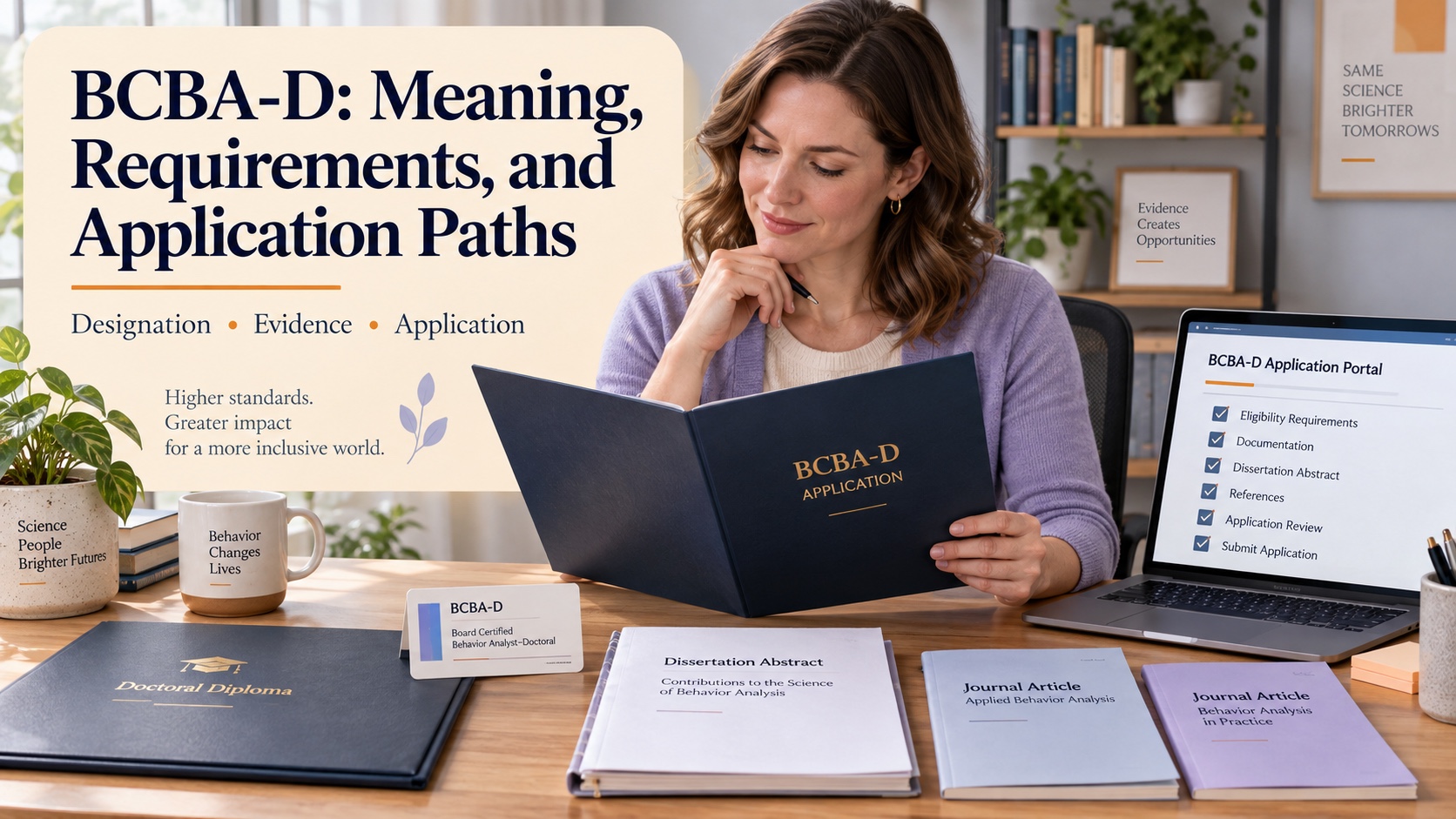
BCBA-D: Meaning, Requirements, and Application Paths
If you are searching for BCBA-D, the first distinction matters: the BCBA-D is a doctoral designation added to an active BCBA certification. It is not a separate certification, and the designation does not grant practice privileges beyond those attached to the BCBA. The current BACB Handbook says that BCBA-Ds function in the same capacity as BCBAs and must meet the BCBA maintenance requirements.
A doctoral degree by itself also does not automatically produce the designation. The current Handbook requires active BCBA certification plus one of three eligibility options. This guide explains those options, the evidence connected to each one, and the application boundary. It is an educational explanation, not an eligibility determination; the current BACB Handbook controls your application.
Table of Contents
What BCBA-D means
BCBA-D stands for Board Certified Behavior Analyst–Doctoral. In the BACB’s wording, it is a designation for a BCBA with doctoral or postdoctoral training in behavior analysis. Think of it as an additional notation on an existing BCBA credential, not as a second level of certification that replaces the BCBA.
That wording protects an important scope boundary. The designation can communicate that the BCBA has completed qualifying doctoral or postdoctoral education, but it does not create a new BACB examination, a separate license, or an automatic expansion of services. The BACB’s public BCBA page states that information applying to BCBAs also applies to BCBA-Ds, including supervision qualifications and requirements.
It is also useful to separate three ideas that are often blended together:
- Degree: an academic award from a university or other qualifying institution.
- BCBA certification: the BACB graduate-level certification with its own eligibility, examination, ethics, and maintenance rules.
- BCBA-D designation: the BACB designation added after an active BCBA meets one of the current doctoral or postdoctoral options.
Who can apply for BCBA-D
The threshold requirement is simple to state: you must be actively certified as a BCBA. The doctoral record is evaluated in addition to that active certification. This means a doctoral student who has not yet become a BCBA should not describe a future plan as an existing BCBA-D credential, and a person whose BCBA certification is not active should review the current BACB rules before planning an application.
The word active matters because the BCBA-D is not a stand-alone route around BCBA certification. A PhD, EdD, PsyD, or another doctoral award does not substitute for the active BCBA prerequisite. The doctorate also needs to fit the option being claimed: an ABAI-accredited doctoral program, a qualifying doctoral program with a behavior-analytic dissertation plus one additional evidence route, or the postdoctoral respecialization option.
Check program status carefully. ABAI accreditation applies to a specific program and degree level; it is not a label that automatically transfers to every department, campus, delivery format, or degree at a university. The ABAI accredited-program directory is a useful place to verify the program itself, while the BACB Handbook explains what transcript evidence the BCBA-D application requires.
The three current BCBA-D options
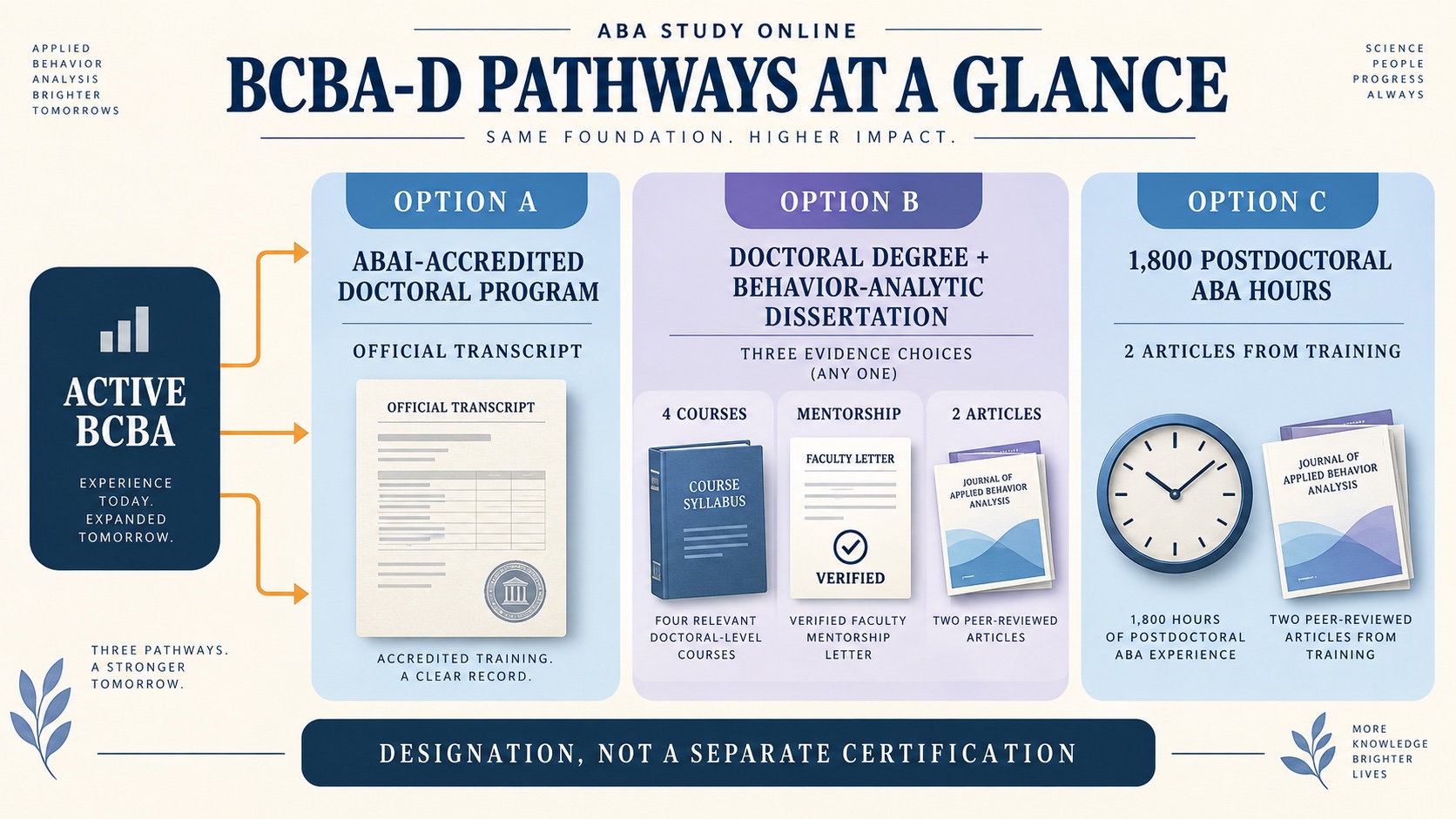
The current June 2026 BACB Handbook lists three options. Every option begins with active BCBA certification, but the supporting record is different. Do not select the route that sounds closest; select the route for which you can document every required element.
| Option | Core requirement | Evidence to plan for |
|---|---|---|
| A: ABAI-accredited doctoral program | Doctoral degree from a doctoral program accredited by the Association for Behavior Analysis International. | Official transcript showing the conferred doctoral degree and the qualifying program. |
| B: Nonaccredited doctoral program | Qualifying doctoral degree, behavior-analytic dissertation, and one additional route: doctoral coursework, qualifying mentorship, or publications. | Degree record and dissertation evidence, plus the documents for the selected additional route. |
| C: Postdoctoral respecialization | Qualifying doctoral degree, at least 1,800 postdoctoral ABA hours beyond BCBA-qualifying experience, ongoing behavior-analytic education under a qualified BCBA, and two qualifying articles. | Doctoral transcript, dissertation abstract, BCBA attestation for the postdoctoral experience, and copies of the publications. |
Option A: ABAI-accredited doctoral program
Option A is the most direct documentary route when the doctoral program itself is ABAI-accredited. The Handbook says the applicant demonstrates this requirement with an official transcript listing a doctoral degree conferred by an ABAI-accredited doctoral program. Confirm the program and degree level rather than relying on a university-wide description or a marketing phrase such as “ABA-related.”
Option B: nonaccredited doctoral program
Option B has two layers. First, the applicant needs a doctoral degree from a qualifying institution and a behavior-analytic dissertation. Second, the applicant needs one of three additional routes. The coursework route requires at least four behavior-analytic courses in the doctoral program of study. The mentorship route requires formal mentorship from a faculty member who held the BCBA credential and had completed the required 8-hour supervision training before the mentorship began. The publications route requires two published peer-reviewed journal articles that are behavior analytic in nature. The articles do not have to be experimental, and first authorship is not required.
Those alternatives are not interchangeable shortcuts. A dissertation abstract may support the dissertation requirement, but it does not prove four courses, a qualifying mentorship, or two published articles. Build a separate evidence folder for the additional route you intend to use.
Option C: postdoctoral respecialization
Option C is for a qualifying doctoral degree followed by a specified postdoctoral training experience. The Handbook requires at least 1,800 hours beyond the experience hours used to qualify for BCBA certification. The hours must be in applied behavior analysis during a postdoctoral fellowship or postdoctoral employment experience that includes explicit, ongoing education in behavior analysis under the supervision of a BCBA who met the supervision requirements in place at that time. The applicant also needs two peer-reviewed behavior-analytic articles produced as a product of that training experience.
That “beyond” clause is important. Hours already used to qualify for BCBA certification cannot simply be counted again as the postdoctoral respecialization experience. The BCBA-D application also asks for a BCBA attestation describing the supervised postdoctoral experience, so plan documentation while the experience is occurring rather than trying to reconstruct it years later.
How the BCBA-D application works
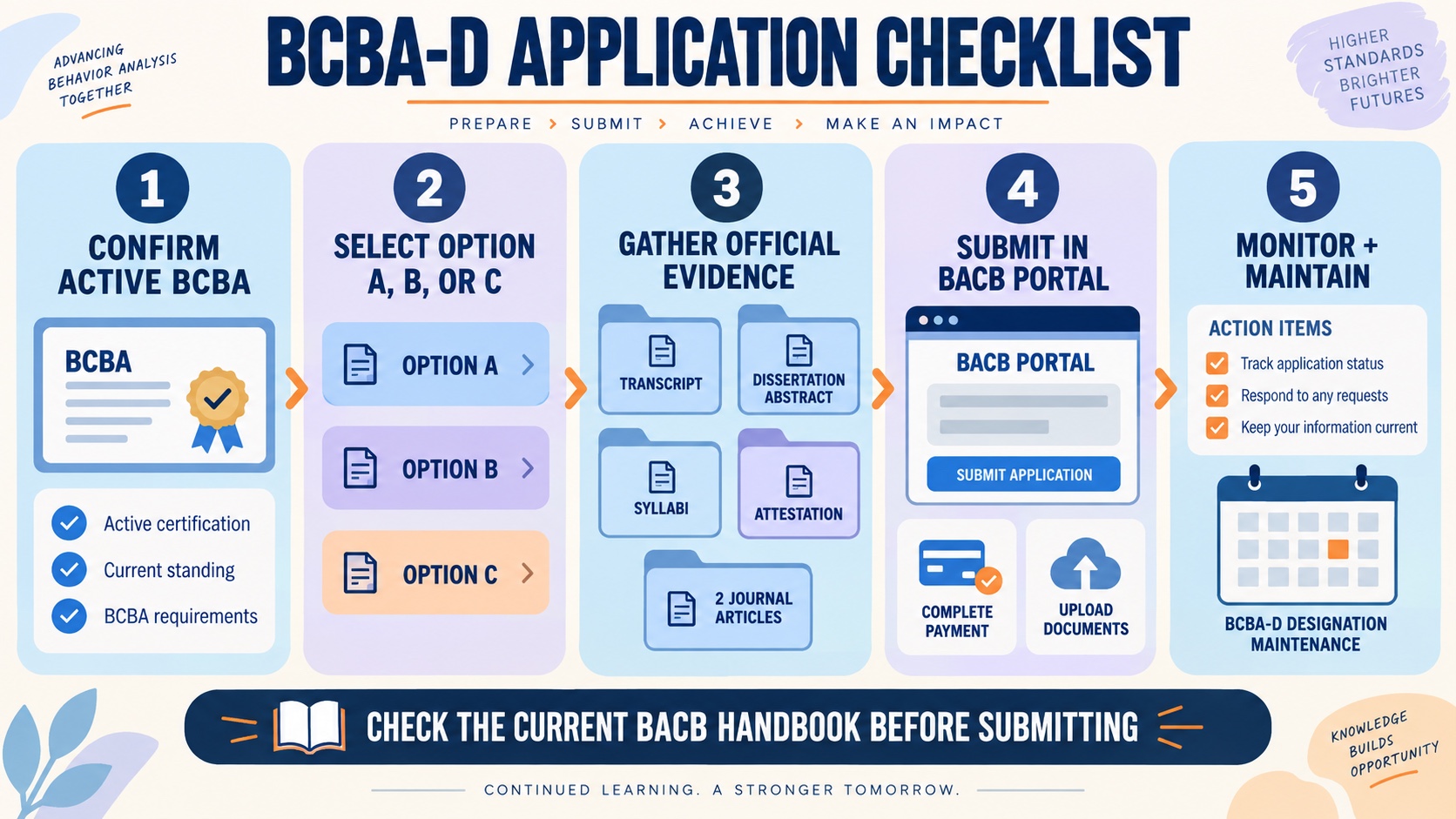
When you are currently a BCBA, the current Handbook directs you to complete the BCBA-D Designation Application in your BACB portal account. The application requires a fee and supplemental documentation. The exact portal steps, payment instructions, transcript destination, and processing information can change, so read the current Handbook immediately before submitting.
A practical sequence is:
- Confirm that your BCBA certification is active and choose the option you can document.
- Collect the exact degree, dissertation, coursework, mentorship, experience, or publication evidence for that option.
- Open the current BCBA-D designation application in the BACB portal and follow its payment instructions.
- Request official transcripts through the channel the BACB specifies; do not assume a student-uploaded scan replaces an official record.
- Check that names, dates, program descriptions, signatures, and publication records line up across every document.
- Monitor the portal and email for approval, feedback, or an action item. If the BACB asks for clarification, answer the specific evidence question rather than sending unrelated material.
The Handbook explains that an approved application updates the certification record and issues a new certificate while the certification number and recertification date remain the same. If an application is not approved, the BACB provides feedback and next-step information. Treat the Handbook’s current review windows and fees as date-sensitive rather than as permanent promises.
What BCBA-D changes—and what it does not
The designation changes how a qualifying doctoral or postdoctoral education record is represented on the BCBA credential. It does not create a separate BCBA-D examination or a new scope of practice under the BACB. It also does not automatically establish a state license, payer credential, employer promotion, university appointment, or permission to use a title in a way that conflicts with local rules.
Keep the 2027 BCBA transition separate from this question. The BACB’s 2027 eligibility material changes how future BCBA applicants may qualify, including the removal of some BCBA eligibility pathways. That is a separate certification-eligibility discussion. It should not be used to assume that the BCBA-D designation section has identical rules. For a 2027 application or a record that crosses the transition date, check the current BCBA Handbook and any BCBA-D-specific guidance before relying on an older plan.
After receiving the designation, the applicant remains responsible for the BCBA maintenance requirements and the current rules that apply to BCBA-D. The Handbook also explains that a person may discontinue the designation at recertification while retaining the original BCBA certification, subject to the applicable process.
Common BCBA-D mistakes
- Calling it a separate certification: the BACB says it is a designation, not a separate certification.
- Assuming every doctorate qualifies: the degree and the selected option must satisfy the current Handbook, and active BCBA certification is required.
- Confusing program recognition and accreditation: verify the specific ABAI program and degree level instead of relying on a general university claim.
- Counting the same hours twice: Option C’s 1,800 hours must be beyond the experience used to qualify for BCBA certification.
- Submitting a good story instead of matching evidence: the application is evaluated through transcripts, abstracts, syllabi, attestations, publications, and other records—not through a general explanation of your career.
- Using an old rule for a new application: handbook versions and transition rules are time-sensitive. Record the edition and update date you used.
A practical evidence checklist
Before opening the application, write the route at the top of a one-page evidence map: “Option A,” “Option B—coursework,” “Option B—mentorship,” “Option B—publications,” or “Option C.” Then list one document beside every requirement. If one item is missing, the next step is to clarify the rule with the BACB or your program mentor—not to assume that a similar document will be accepted.
For study support while you review the terminology, the BCBA learning path can organize broader concepts, free BCBA practice questions can support scenario-based retrieval, and the ABA Definition Search can clarify terms such as accreditation, certification, designation, fieldwork, and supervision. The free resources library can provide another independent study route. None of these destinations determines BCBA-D eligibility or grants the designation.
BCBA-D FAQ and official sources
Does a PhD automatically make someone a BCBA-D?
No. The person must be actively certified as a BCBA and must satisfy one of the current BCBA-D options with the required evidence. The doctorate’s subject, program status, dissertation, postdoctoral experience, and supporting documents all matter.
Is BCBA-D a higher certification than BCBA?
No. The BACB describes BCBA-D as a designation added to BCBA. It does not grant privileges beyond the BCBA certification, and BCBA-Ds must meet the BCBA maintenance requirements.
Can a non-ABAI-accredited doctorate qualify?
It may qualify through the current nonaccredited doctoral-program option or the postdoctoral-respecialization option, but the exact dissertation, coursework, mentorship, publication, experience, and evidence requirements must be met. Read the current Handbook before choosing a route.
Where should I verify the current rules?
Start with the BACB BCBA Handbook and the BACB BCBA page. For program status, check the ABAI accredited-program directory. The BACB sources control the designation decision.
For a broader BCBA study route, return to ABA Study Online’s BCBA Theory Blocks and keep the official Handbook beside your application checklist. A careful source check is more useful than a confident title when a doctoral designation depends on exact evidence.