BCBA Credentials: What They Mean and How to Check Them
When someone says they have BCBA credentials, the phrase can point to several different things: a graduate degree, behavior-analytic coursework, supervised fieldwork, a passed examination, an active certification, or a state license. Those pieces are related, but they are not interchangeable. A clear explanation starts by separating the preparation pathway from the credential itself.
The BACB’s current BCBA resources describe certification as a process that includes eligibility requirements, application, examination, ethics obligations, and ongoing maintenance. This guide gives you a practical map of those layers. It is educational information, not an eligibility determination; the current BCBA Handbook and the relevant licensing authority control decisions about a specific person.
Table of Contents
Short answer: what counts as a BCBA credential?
A BCBA credential refers to certification as a Board Certified Behavior Analyst through the Behavior Analyst Certification Board. A degree or transcript may help satisfy an eligibility pathway, but it is not itself a BCBA certification. A training certificate can document completion of a course, but it does not prove that the person is currently certified. A job title may describe an employer’s role label, but it does not substitute for verification.
For a current-status question, look for the person in the BACB Certificant Registry and then consider whether a separate state license or other jurisdictional authorization is required for the service being discussed.
The layers behind the credential
Education and coursework
Education is the academic layer. Depending on the pathway and the rules in effect, an applicant may need a qualifying degree and coursework that covers required behavior-analytic content. The exact degree, coursework, attestation, transcript, and institution rules belong in the current BCBA Handbook. Avoid reducing the requirement to “any master’s degree” or “an ABA class.” The details matter.
Supervised fieldwork
Fieldwork is the supervised practice layer. It is not the same as simply working in a setting where behavior analysis occurs. The documentation, supervision arrangement, timing, and activity requirements must match the applicable BACB rules. A person can have substantial experience and still need to document it through the correct pathway.
Application and examination
The application is the formal review step. The examination is a separate assessment step. Passing an examination does not mean that an application was complete before the exam, and submitting an application does not mean certification has already been granted. Keep the sequence clear when explaining someone’s progress.
Ethics and maintenance
Certification is not a one-time course badge. A BCBA must follow the applicable ethics requirements and maintain the certification under current BACB rules. Maintenance may involve renewal timing, continuing education, supervision-related obligations, and accurate records. The exact requirements can change, so a resource should always identify the handbook or official update it relies on.
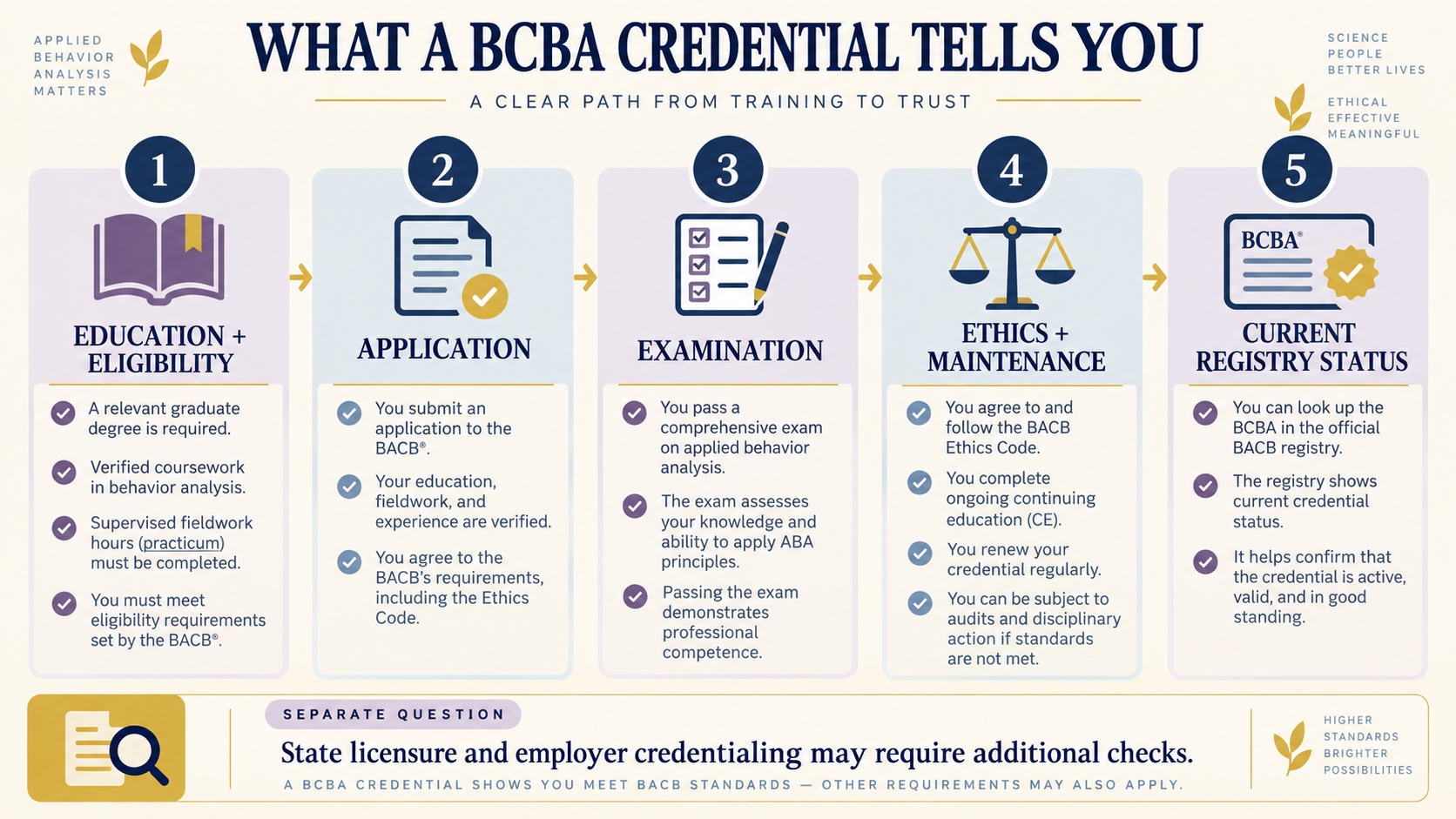
How the certification path fits together
A useful mental model is a sequence with checkpoints rather than a single credential switch:
- Choose and document an eligibility pathway. Read the current handbook and identify the degree, coursework, fieldwork, and documentation rules that apply.
- Complete the required preparation. Keep official transcripts, attestations, supervision records, and other documents organized while the work is happening.
- Submit the application. The BACB reviews the submitted materials according to its process. A general website cannot pre-approve a person’s specific file.
- Meet examination requirements. Use the current official examination information and prepare with clearly labeled, unofficial learning resources.
- Maintain the certification. Track renewal, continuing education, ethics, and supervision-related requirements that apply after certification.
This sequence also explains why broad “BCBA credentials” content should not promise a shortcut. A helpful study page can clarify concepts, organize notes, and support exam practice, but it cannot convert a study session into a certification decision.
Why active status matters
Credentials are time-sensitive. Someone may have passed an examination in the past, held certification previously, or completed the education and fieldwork layers without currently appearing as an active certificant. If the question is whether a person is currently certified, use current registry information rather than an old certificate image or résumé line alone.
Also keep certification separate from licensure. The BACB credential is a professional certification; a state or provincial licensing authority may impose additional rules before a person can practice, bill, supervise, or use a title in that jurisdiction. The right verification path depends on the purpose of the check.
Read a credential record in context
A registry result answers a narrow question: what certification status is associated with that record at the time you check it? It does not answer every question about competence, scope of practice, employer standing, insurance participation, or fit for a particular family. For a hiring or service decision, combine the status check with the organization’s normal credentialing process, references, and any jurisdiction-specific review.
The same caution applies to screenshots. A screenshot can be useful for an internal file, but it becomes stale as soon as a status, date, name, or registry display changes. Record the source, the date checked, and the question the check was meant to answer. That simple habit keeps a credential conversation precise.
What to watch for in the 2027 transition
The BACB lists January 1, 2027 changes affecting BCBA and BCaBA certification requirements, including degree, coursework, supervised fieldwork, continuing education, and ongoing supervision. That means a page written around an older summary can become misleading even when its general description sounds familiar.
For 2027 planning, do not copy a single requirement from a social post or a search snippet. Start with the BACB’s recent-and-upcoming-changes page, open the current BCBA Handbook, and check which transition rule applies to the person’s timeline. A 2026 applicant, a student finishing coursework, and an already certified BCBA may not be governed by the same transition question.
How to verify BCBA credentials
- Ask for the person’s full name as it appears in professional records and, when appropriate, the certification number.
- Open the official BACB Certificant Registry rather than relying on a third-party directory.
- Review the displayed certification status and date information carefully.
- Check whether the purpose of your question also requires a state-license lookup or employer verification.
- Record the date you checked. Status information is not permanently static.
If the result is unclear, contact the BACB or the relevant licensing authority. Do not infer active certification from a person’s degree, course completion, job title, or social-media bio.
Common misunderstandings
“A master’s degree means someone is a BCBA.”
A degree is one possible part of an eligibility pathway. It is not proof of certification.
“A passed exam is the same as an active credential.”
Exam history and current certification status are different questions. Use current official status information.
“A BCBA certification automatically answers the state-license question.”
Certification and licensure can overlap in practice but are issued and checked through different systems. Confirm the jurisdictional requirement.
“The 2027 change is one new exam edition.”
The BACB describes a broader set of requirement changes. Read the current transition materials instead of treating the update as a single vocabulary change.
FAQ and official resources
Where can I learn the exact BCBA requirements?
Use the current BACB BCBA Handbook and the BCBA certification page. The handbook is the appropriate starting point for pathway-specific document requirements.
How do I check whether a BCBA is currently certified?
Use the official BACB consumer resources and Certificant Registry. If you need a license check, also use the applicable state or provincial authority.
What is changing in 2027?
The BACB identifies changes to several BCBA and BCaBA eligibility and maintenance areas beginning January 1, 2027. Start with the official Recent and Upcoming Changes to BACB Requirements page.
Can ABA Study Online decide whether I qualify?
No. ABA Study Online can help organize learning and exam concepts, but the BACB and relevant licensing authority decide certification and licensure questions. Visit the ABA Study Online BCBA learning hub for educational resources.