BCBA Coursework: What Counts for Pathway 2 and the 2027 Changes?
If you are comparing BCBA coursework, the most important question is not whether a class has “ABA” in its title. The useful question is whether your degree, coursework sequence, institution, timing, transcript, and Pathway 2 verification can fit the BACB requirements that apply when you submit your application.
This matters even more during the 2026–2027 transition. The BACB has published a new 2027 framework with two eligibility pathways and a defined coursework map for Pathway 2. A program that sounds relevant may still need a closer audit before you enroll. This guide explains what to check, what changes on January 1, 2027, and how to keep coursework separate from fieldwork and exam preparation.
Table of Contents
Short answer: what BCBA coursework must connect to
BCBA coursework is the behavior-analytic education component of an eligibility pathway. It is not automatically satisfied by taking a few interesting ABA electives, watching online lessons, or buying a study package. Depending on the pathway and the year you apply, the BACB looks at the degree, the institution, the level and credit of the courses, the content covered, the timing of the coursework, and the documentation submitted with the application.
For a Pathway 2 candidate, a safe working checklist is:
- Degree: identify the master’s degree or higher that supports the route and confirm the institution is a qualifying institution under the rules that apply to your application.
- Institution: check whether the university has the authorized Pathway 2 Program Contact required for the current attestation process.
- Course level and credit: confirm that the courses are taken at the required graduate level and carry academic credit rather than being informal continuing education.
- Content: compare the actual syllabus and course sequence with the required behavior-analytic content areas, not just the marketing name of the program.
- Timing and grade: verify the applicable completion window, calendar-year rule, and minimum passing grade for the pathway and application year.
- Record: ask how the institution will issue official transcripts and, when required, submit the Pathway 2 Coursework Attestation.
This checklist does not make ABA Study Online or any other study site an eligibility reviewer. It gives you a way to ask a university precise questions and then compare its written answer with the current BACB handbook.
The current 2026 Pathway 2 check
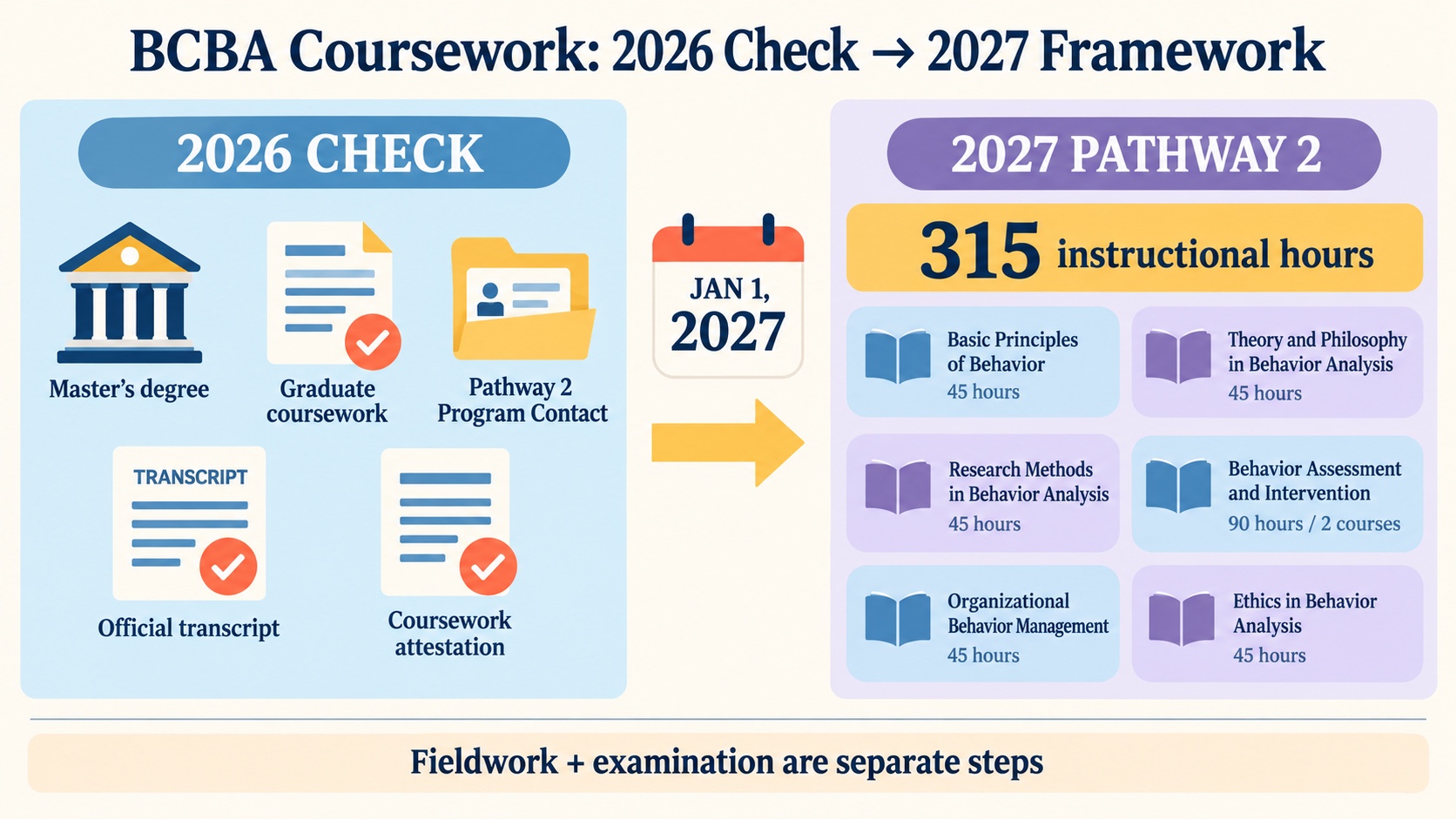
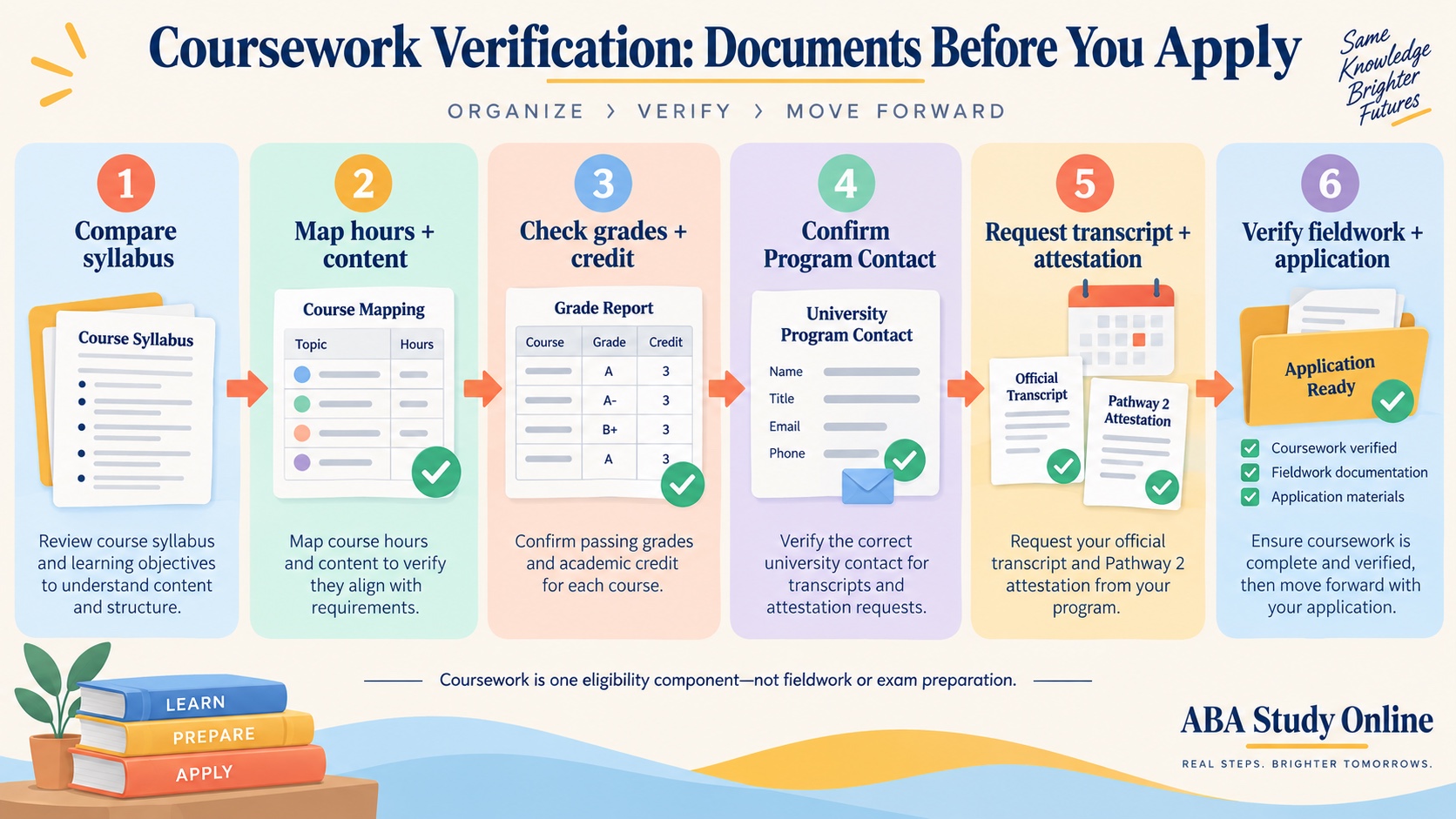
In 2026, Pathway 2 is not a self-declared list of courses. The BACB’s university guidance explains that students need a master’s degree and behavior-analytic coursework from an institution with an authorized Pathway 2 Program Contact. That contact reviews the student’s coursework and, when the requirements are met, submits a coursework attestation to the BACB. The student also requests official transcripts from each institution where qualifying coursework was completed.
The attestation change is especially important for people using older advice. The BACB says that, beginning January 1, 2026, it implemented a BACB-managed Pathway 2 Coursework Attestation System after ABAI discontinued its Verified Course Sequence system. A course sequence that was once described as “VCS” should therefore not be treated as the entire current application process. Ask the school how its current Pathway 2 Contact handles your record and whether an attestation can be placed in your BACB account.
When you contact a program, request answers to these questions in writing:
- Does the program currently have a Pathway 2 Program Contact registered with the BACB?
- Will the contact review my complete sequence, including coursework transferred from another institution?
- Which courses are considered graduate-level behavior-analytic coursework, and what academic credit do they carry?
- How does the program document the required content areas and grades?
- What transcript and attestation steps happen before I submit a certification application?
- Which requirements apply to my expected application year rather than to the year I start classes?
Do not accept “our classes prepare students for the BCBA exam” as an answer to all six questions. Exam preparation and eligibility coursework overlap in subject matter, but they are not the same claim.
The 2027 Pathway 2 coursework map
Beginning January 1, 2027, the BACB’s published BCBA requirements describe two pathways. Pathway 1 uses a master’s degree or higher from an APBA-accredited or ABAI-accredited or recognized behavior-analysis degree program. Pathway 2 uses a master’s degree or higher, behavior-analytic coursework, supervised fieldwork, and the examination. This article focuses on the coursework portion of Pathway 2, not the full eligibility process.
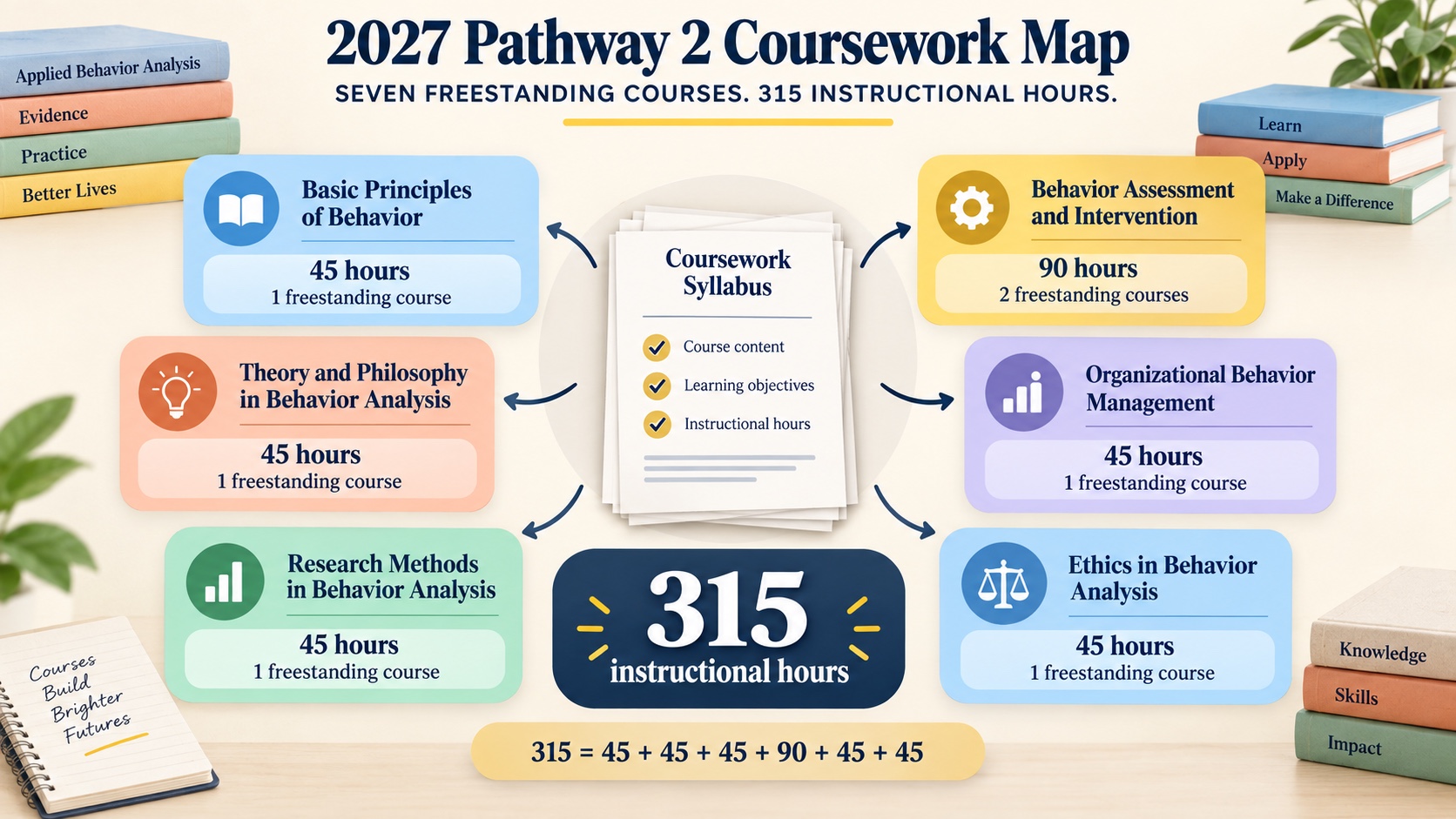
The 2027 Pathway 2 coursework table totals 315 instructional hours across six areas:
| Content area | Instructional hours | Course structure |
|---|---|---|
| Basic Principles of Behavior | 45 | 1 freestanding course |
| Theory and Philosophy in Behavior Analysis | 45 | 1 freestanding course |
| Research Methods in Behavior Analysis | 45 | 1 freestanding course |
| Behavior Assessment and Intervention | 90 | 2 freestanding courses |
| Organizational Behavior Management | 45 | 1 freestanding course |
| Ethics in Behavior Analysis | 45 | 1 freestanding course |
| Total | 315 | 7 freestanding courses in the published map |
The hour total is useful for an initial comparison, but it is not enough by itself. The source also says the coursework must be completed through a qualifying institution, at the master’s or doctoral level, with academic credit and a passing grade. The entirety of the coursework cannot be completed in less than one calendar year. “Seven courses” is therefore a planning shorthand from the published structure, not permission to combine unrelated classes or compress the sequence outside the rule.
The content descriptions also have practical implications. Research Methods is not just statistics; the published description includes measurement, data display and interpretation, single-case designs, intervention and program evaluation, and research ethics. Behavior Assessment and Intervention is not just a list of treatment techniques; the description includes assessment and intervention implementation and attention to client-specific cultural, contextual, and personal variables. When you compare syllabi, look for this level of substance.
Pathway 1 versus Pathway 2
The easiest way to avoid a coursework mistake is to identify your likely pathway before comparing course catalogs.
| Question | Pathway 1 | Pathway 2 |
|---|---|---|
| What anchors the route? | An accredited or recognized behavior-analysis degree program. | A qualifying master’s degree plus behavior-analytic coursework. |
| Does a separate course map matter? | The degree program’s accreditation or recognition is central. | Yes. The coursework must match the applicable content, hour, level, credit, timing, and documentation requirements. |
| What should a student verify? | Program status and the dates during which the degree was accredited or recognized. | Pathway 2 Contact, course sequence, official transcripts, and coursework attestation. |
| What remains outside this page? | Fieldwork, examination, application, and maintenance rules. | Fieldwork, examination, application, and maintenance rules. |
There are also later milestones to keep in view. The BACB university guidance describes a 2028 jurisdiction change for Pathway 2 Program Contacts, a 2029 degree-equivalency change for Pathway 1, and a 2032 change under which applicants must apply through Pathway 1. Those are future planning signals, not reasons to rewrite the 2027 coursework table as though Pathway 2 disappears in 2027.
Coursework, fieldwork, and exam preparation are different
A strong BCBA plan has three separate columns. Coursework is the structured academic learning requirement. Fieldwork is supervised practical experience in applied behavior analysis. Exam preparation is the study work used to understand and apply the content measured by the examination. A learner may work on all three at once, but one cannot be used as a vague substitute for another.
For example, a practice quiz about single-case designs can help you prepare for the BCBA examination. It does not create academic credit or appear on an official transcript. A university research-methods course may contribute to the coursework route. It does not, by itself, create supervised fieldwork hours. A fieldwork supervisor may help you apply assessment skills. That supervision does not automatically replace the required course sequence.
The BACB’s 2027 summary also describes fieldwork totals and supervision details. Keep those figures in a separate fieldwork plan and verify the current handbook forms before logging hours. Likewise, use the BCBA 6th-edition Test Content Outline to plan exam study, but do not call the TCO a Pathway 2 coursework syllabus.
How to audit a program before enrolling
Use this five-part audit during a program call or admissions review:
- Map the institution. Write down the school, department, degree, and the name of the current Pathway 2 Program Contact if you are considering Pathway 2.
- Map the courses. Put each course beside its content area, instructional hours, academic credits, delivery format, and planned term. Mark any area that is split across courses or shared with another department.
- Map the records. Ask how grades, official transcripts, transfer coursework, course substitutions, and completion dates will be documented.
- Map the transition date. Decide whether your expected application is under the 2026 process or the 2027 requirements. Do not assume that starting classes in one year determines the rule that applies to the application.
- Map the remaining route. Add separate lines for fieldwork, examination, application, and maintenance. This is where a seemingly complete “coursework package” often stops short of BCBA eligibility.
Keep a copy of the syllabus and the program’s written answer, but treat the current BACB handbook and requirements page as the final authority. If the school’s marketing page and its advisor’s answer conflict, ask for clarification before paying a deposit or assuming that a transfer credit will count.
Common BCBA coursework mistakes
- Choosing by title alone: “ABA,” “behavior,” or “special education” in a course title does not prove that it covers the required area.
- Confusing a VCS reference with current attestation: older program language may not describe the 2026 process.
- Counting continuing education as graduate coursework: CEUs and informal training do not automatically create academic credit or a transcript record.
- Ignoring freestanding-course structure: the 2027 table specifies one or two freestanding courses for each content area.
- Compressing the sequence: the published 2027 Pathway 2 requirements include a one-calendar-year rule for the coursework.
- Using exam prep as an eligibility shortcut: study materials can help learning without satisfying degree or coursework documentation.
- Forgetting the application year: rules, forms, and transition dates should be checked against the year you expect to submit.
BCBA coursework FAQ
How many hours of coursework are required for BCBA Pathway 2 in 2027?
The BACB’s published 2027 Pathway 2 table totals 315 instructional hours across six content areas. The largest block is Behavior Assessment and Intervention at 90 hours; the other five areas are 45 hours each. The hours must still be completed in the required course structure and documented through the applicable institution and application process.
Can any master’s degree be used with BCBA coursework?
Do not answer this from a course advertisement. The 2027 Pathway 2 summary describes a master’s degree or higher from a qualifying institution, plus the specified behavior-analytic coursework, fieldwork, and examination. Review the complete current BACB requirements for your application year and ask the university to confirm your degree and institution in writing.
Does a BCBA course need to be online or in person?
The important eligibility questions are the institution, level, credit, content, timing, grade, and documentation. Online delivery alone does not make a course qualifying, and in-person delivery alone does not prove that it is. Ask how the format fits the program’s transcript and attestation process.
What is a Pathway 2 Program Contact?
It is the authorized university contact who reviews a student’s behavior-analytic coursework and, when the requirements are met, submits the Pathway 2 Coursework Attestation to the BACB. The current BACB guidance says that an attestation must be in the applicant’s account before a Pathway 2 application can be completed under the 2026 process.
Is the BCBA Test Content Outline the same as BCBA coursework?
No. The Test Content Outline describes the examination content. Coursework eligibility asks whether your academic program and records meet the education requirements of the pathway. The two can inform one another, but neither document should be mislabeled as the other.
Will Pathway 2 disappear in 2027?
No. The published 2027 requirements include Pathway 2. The BACB’s university guidance identifies 2032 as the future point at which applicants must apply through Pathway 1. Check the current transition resources because later updates can affect planning.