BCBA CEUs: A Practical Guide to Planning and Verifying Your Credits
If you are searching for BCBA CEUs, you may be trying to do two jobs at once: find useful continuing education and make sure the credits will fit your recertification record. Those jobs overlap, but they are not identical. A certificate from a learning event is not automatically proof that every category requirement has been met, and an ACE Provider’s authorization is not the same as BACB endorsement of one specific event.
This guide gives you a practical planning system for the current cycle and a clear way to prepare for the 2027 transition. Because the applicable rule depends on your recertification date and the requirements in force for your cycle, use the current BCBA Handbook as the final authority.
Table of Contents
Short answer: how many BCBA CEUs do you need for renewal?
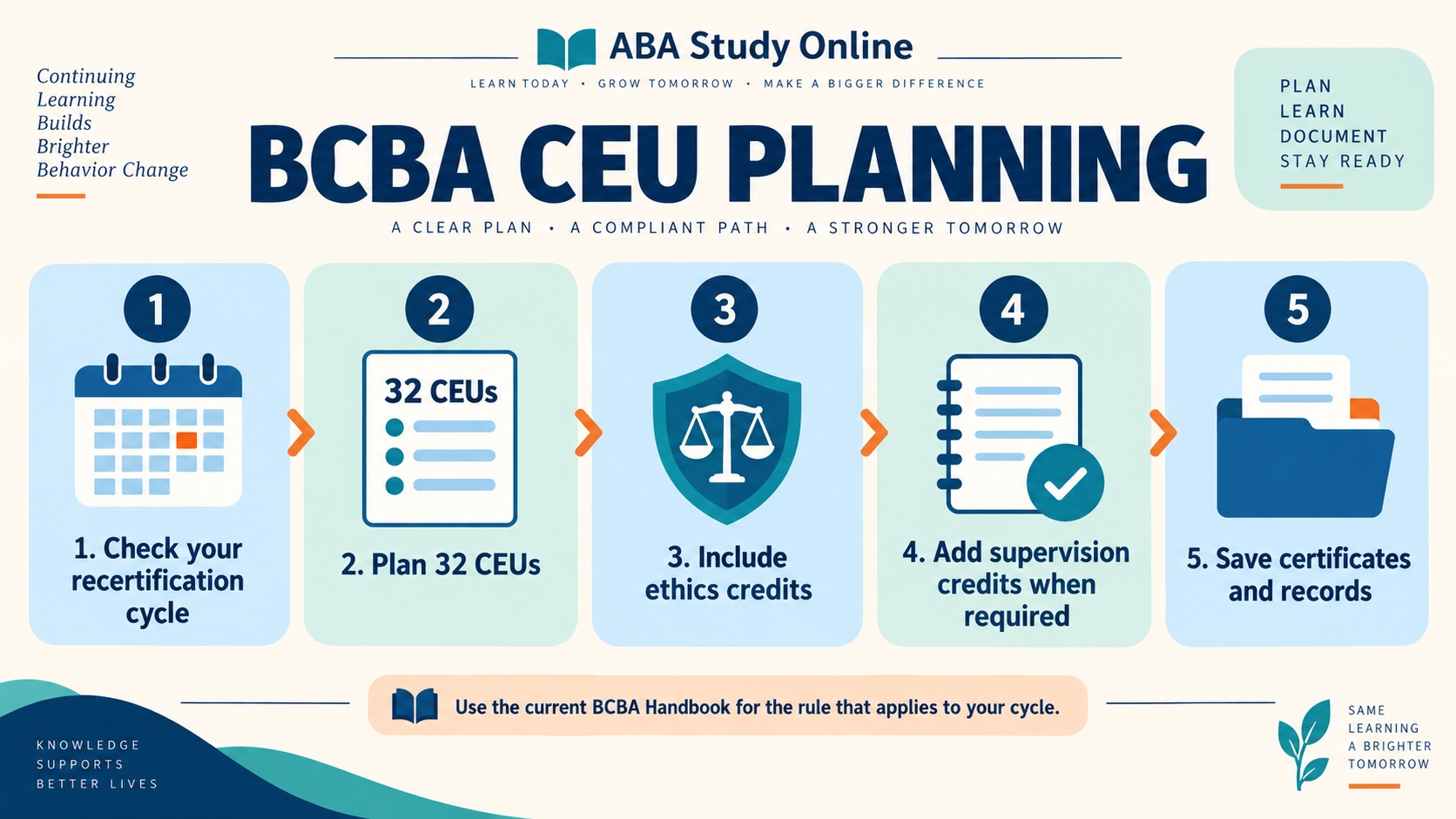
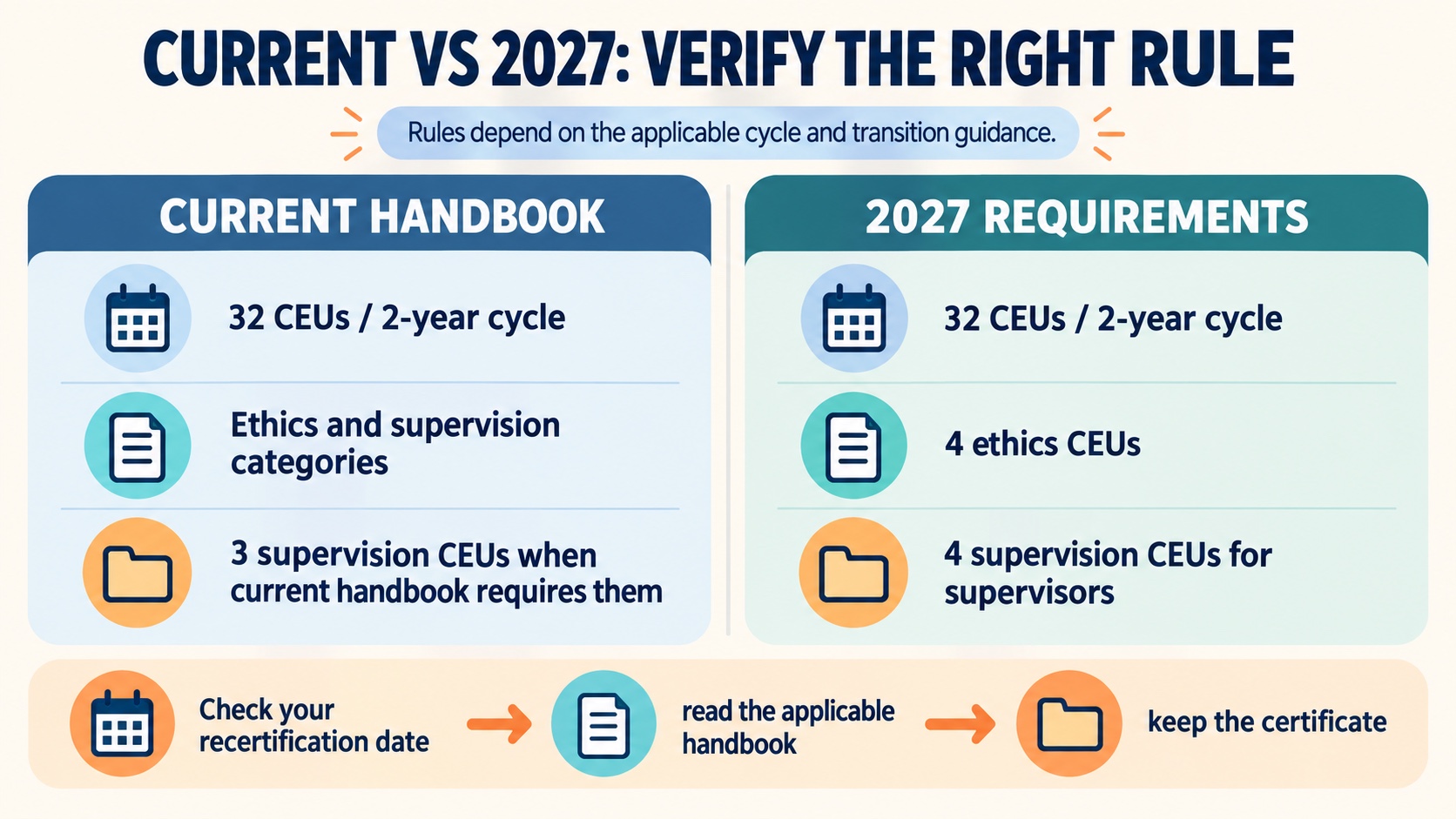
The BACB’s current BCBA maintenance materials describe a two-year recertification cycle with 32 CEUs. Category requirements sit inside that total. The 2026 BCBA Handbook states that ethics CEUs apply and that BCBAs who supervised relevant work during the cycle must obtain and enter supervision CEUs. The same handbook identifies 3 supervision CEUs for that current situation.
The BACB’s 2027 BCBA Requirements document describes a future maintenance rule with 32 CEUs per two-year cycle, including 4 ethics CEUs and 4 supervision CEUs for supervisors. Do not combine the 2026 handbook number and the 2027 number as if they were one timeless rule. First identify your recertification cycle, then read the handbook or transition guidance that applies to it.
“How many CEUs?” is therefore only the first question. Your planning record should also show the category, event date, provider status, certificate details, and whether a credit has already been used for another required category.
How to think about CEU categories
Start your spreadsheet or notebook with the full total, then create separate columns for general learning, ethics, and supervision when supervision applies to your role and cycle. This makes a common error visible: accumulating 32 interesting hours while discovering near the deadline that too few fit the required category.
Ethics continuing education is not just any webinar with the word “ethics” in its description. The BACB’s 2027 requirements document explains that qualifying ethics content relates to BACB ethics requirements and/or cultural or contextual responsiveness, connects to behavior-analytic practice or applied research, and focuses most of the event on ethics or cultural/contextual responsiveness. A short ethics mention inside a mostly unrelated event should not be treated as a full ethics CEU event.
Supervision CEUs have their own boundary. The current handbook describes behavior-analytic supervision content connected to effective supervision and the BACB Supervisor Training Curriculum Outline. If you did not supervise the relevant people or trainees during the cycle, do not assume that every supervision-themed event is required for you. If you did supervise, track the category deliberately.
How to verify an ACE Provider and event
The BACB’s ACE program exists to make continuing education available to BCBA and BCaBA certificants. An ACE Provider can be an individual or organization authorized under the ACE requirements. Before registering, use the ACE Provider Verification Registry to check the provider’s status rather than relying only on a badge, a search result, or an old screenshot.
Provider authorization still has an important limit. The BACB’s ACE materials state that authorization does not mean the BACB reviewed or endorsed the content of every event. The ACE Coordinator is responsible for making sure the event meets the requirements. Your job as a participant is to keep the event information and completion record that support your entry.
Before you pay, look for the event title, learning objectives, instructor or provider details, date, delivery format, stated CEU amount, category designation, and certificate process. If a page promises “official BACB approval” of a particular commercial course but cannot explain provider verification or documentation, pause and verify it.
The record-keeping system that prevents surprises
Make one folder for the active recertification cycle. For every event, save the registration confirmation, event description, learning objectives, certificate, date, provider information, and your CEU-category decision. A simple filename such as 2026-08-14-ethics-provider-event-title makes the folder searchable later.
Keep a running table with these fields:
- event title and provider;
- event date and number of CEUs;
- general, ethics, or supervision category;
- ACE Provider verification note;
- certificate file location; and
- remaining total and remaining category balance.
Review the table quarterly rather than waiting for the final month. The point is not to create paperwork for its own sake. It is to make missing certificates, duplicate entries, category gaps, or an unclear provider status visible while you still have time to fix the record.
Choose learning that is useful as well as countable
Compliance is the floor, not the whole definition of a good event. Compare the learning objectives with the work you actually do: assessment, treatment planning, data interpretation, staff training, caregiver collaboration, organizational systems, or ethical decision-making. A clear objective lets you decide whether the event is relevant before you register and helps you write a useful note afterward.
Also check the event’s completion rules. Some activities require attendance, a post-test, an evaluation, or a minimum score. Those details are part of the provider’s documentation process, not a reason to guess that a certificate will be issued later. If you cannot tell what evidence of completion you will receive, ask the provider before purchasing. That short question can prevent a stressful search for missing records at renewal time.
Ethics, supervision, overlap, and repeat events
Two cautions deserve their own line. First, the handbook says that an ethics CEU and a supervision CEU cannot be counted as both categories for the same credit. If an event touches both topics, choose the category that the applicable rule and event documentation support; do not double-count it just because the title contains both words.
Second, repeating the same CE activity does not create new or expanded knowledge or skills for BACB certification requirements. Keep a record of what you completed, but do not assume that taking an identical event again fills a new category balance.
These rules are why a content library and a CEU record should remain separate. A useful ABA article, podcast, flashcard set, or practice-question session can strengthen your knowledge without being a BACB CEU event. Treat learning value and credential documentation as two different labels.
What the 2027 transition changes
The BACB has published 2027 BCBA requirements and transition guidance. The change is broader than a new exam label: the 2027 requirements revise eligibility, coursework, fieldwork, continuing education, and ongoing maintenance rules. This article focuses only on CEUs, but your planning should still start with the transition date and the handbook that controls your situation.
For 2027 maintenance, the requirements document describes 32 CEUs in each two-year cycle, 4 ethics CEUs, and 4 supervision CEUs for supervisors. That does not mean every BCBA should immediately replace the number in an existing record. Check your recertification date, determine which requirements apply, and save the source version you used for the decision.
A simple BCBA CEU planning routine
- Mark the recertification date: write down the cycle end and the deadline for submitting your renewal.
- Read the applicable handbook: record the total, ethics rule, supervision rule, and any transition note that applies.
- Build a category-first calendar: schedule ethics and supervision learning early, then use general CE for the remainder.
- Verify before paying: check the provider registry and read the event documentation.
- Save the certificate immediately: enter the credit in your tracker while the event details are still easy to find.
- Audit quarterly: compare your total and category balances with the current source, not with a remembered rule from a prior cycle.
ABA Study Online can support concept review, question practice, and study organization through its app. It does not claim to issue BACB CEUs or ACE certificates. Use the app for structured review when you are studying between verified continuing-education events, and keep the official CEU record in your own documentation system.
FAQ and official sources
How many CEUs does a BCBA need?
The BACB’s current and 2027 materials describe 32 CEUs in each two-year recertification cycle, with category requirements inside that total. The ethics and supervision numbers can depend on the applicable rule and cycle, so verify the current BCBA Handbook.
Does an ACE Provider guarantee that every event is BACB approved?
No. ACE authorization allows a provider to offer qualifying learning CE under the ACE requirements, but the BACB does not endorse or individually approve every event. Verify the provider and keep the event documentation.
Can one CEU count for ethics and supervision?
The current BCBA Handbook says a CEU may be counted as either an ethics CEU or a supervision CEU, but not both. Follow the current source for your cycle and keep your category decision clear.
Official sources: Review the BCBA Handbook, BACB ACE Provider guidance, the ACE Provider Verification Registry, and the 2027 BCBA Requirements before making a renewal decision.