
BCBA CEU: What Counts as One Unit?
When someone searches for BCBA CEU, they may be asking a small but important question: what does one unit actually represent? The answer is not “one online course.” A CEU is part of the continuing-education record used to maintain BCBA certification, and the amount depends on the qualifying activity, its duration or official value, its category, and the documentation that supports the entry.
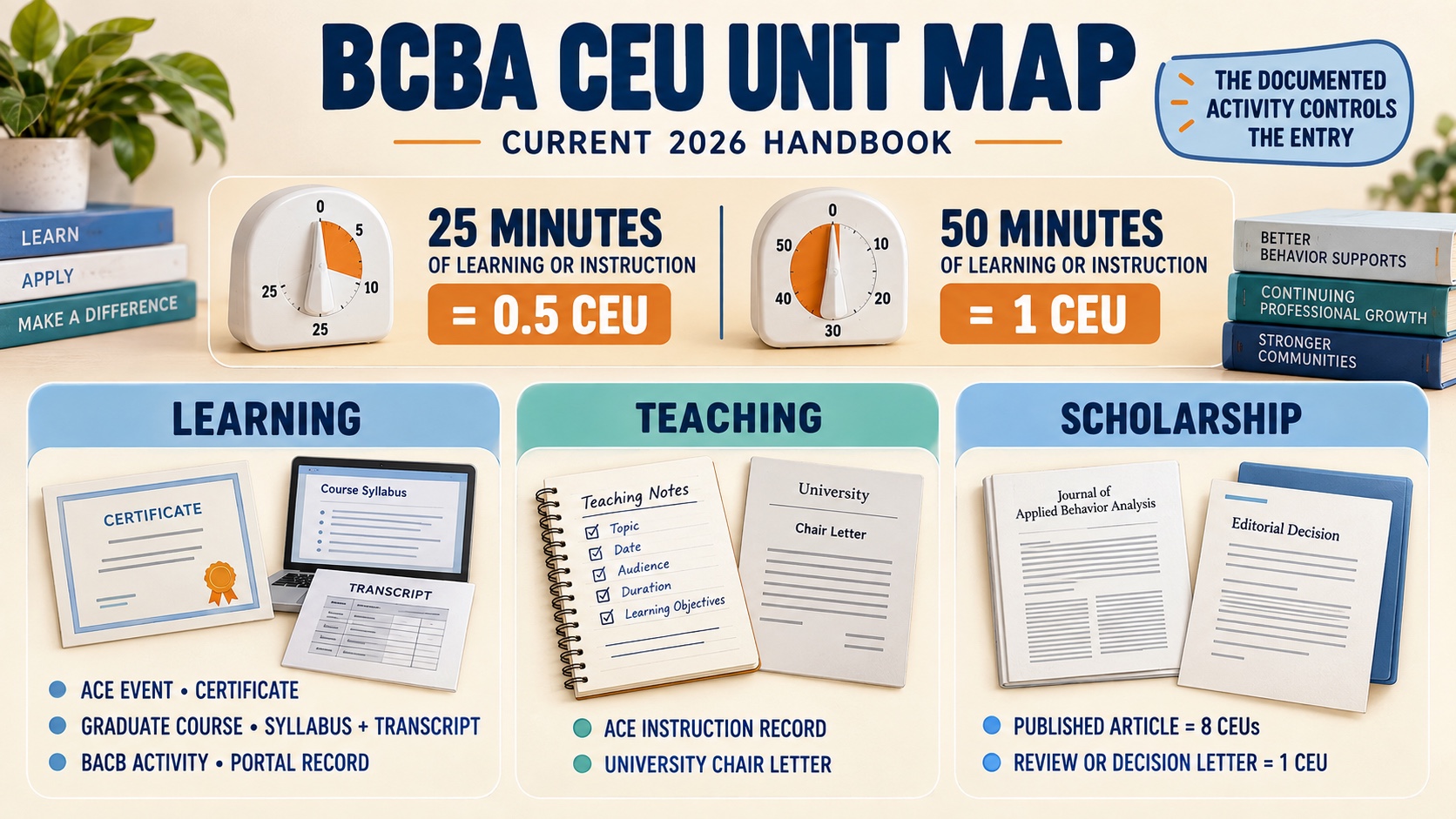
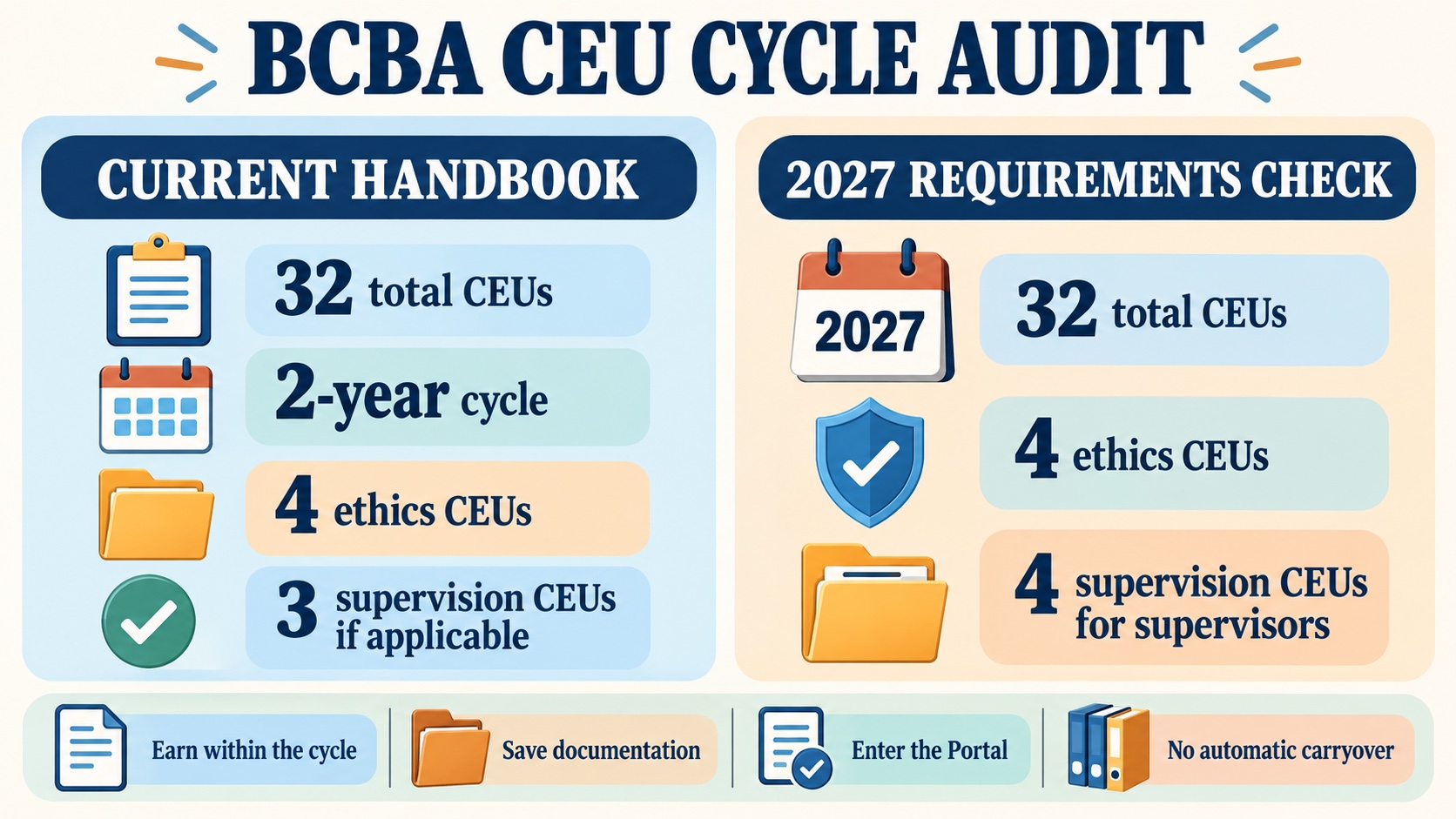
Under the current June 2026 BCBA Handbook, a BCBA needs 32 CEUs in a two-year recertification cycle, including 4 ethics CEUs and 3 supervision CEUs for applicable supervisors. For learning or instruction measured by time, 25 minutes equals 0.5 CEU and 50 minutes equals 1 CEU. The official 2027 requirements keep the 32-CEU total but list 4 supervision CEUs for supervisors, so this article keeps current and future rules in separate lanes.
Table of Contents
What a BCBA CEU means
A BCBA CEU is a documented unit of continuing education that supports maintenance of an existing BCBA certification. It is not an initial-certification requirement, an exam question, a university degree by itself, or a general label for anything related to applied behavior analysis. The BACB describes continuing education as activity intended to expand behavior-analytic skills beyond initial certification and help certificants stay current with developments in the profession.
That definition gives a CEU record four jobs:
- Identify the activity. What event, course, instruction session, graduate course, BACB activity, publication, or review produced the credit?
- Identify the amount. How many CEUs does the official activity record award?
- Identify the category. Is it general Learning, ethics, supervision, Teaching, or Scholarship under the route that applies?
- Preserve the evidence. What certificate, transcript, syllabus, journal record, or other documentation supports the entry?
A course certificate is evidence, not the definition of a CEU. A certificate that says “completed” but does not show the activity, date, provider, amount, or category may leave you with a record that needs clarification. Likewise, a study session can improve your knowledge without becoming a BACB CEU. Learning value and recertification credit are related, but they are not the same promise.
How many minutes make one CEU?
For time-based Learning and Teaching activities, the current BCBA Handbook uses this conversion:
- 25 minutes of learning or instruction = 0.5 CEU.
- 50 minutes of learning or instruction = 1 CEU.
This is why a “one-hour webinar” should not be judged only by its advertised clock time. Check what the provider records as learning or instruction time and what appears on the certificate. Breaks, networking, setup, optional browsing, and unrelated time should not be silently converted into credit. The official documentation is the starting point for the amount you enter.
For example, if a qualifying record states 75 minutes of learning, the handbook’s half-unit conversion supports a planning value of 1.5 CEUs. That arithmetic does not give a learner permission to inflate a record. If the certificate states a different approved amount, use the certificate and resolve the discrepancy with the provider before entering it. Do not create a homemade conversion when the activity documentation is incomplete.
Which activity types can produce CEUs?
The current handbook groups BCBA continuing education into three activity types: Learning, Teaching, and Scholarship. Each route has its own evidence. Thinking in activity types is useful because it prevents a learner from applying the rules for an ACE learning event to a university course or a peer-reviewed publication.
Learning
Learning can include attending behavior-analytic learning events offered by an Authorized Continuing Education, or ACE, Provider. The handbook also describes didactic behavior-analytic graduate courses completed with a passing grade and certain BACB certification activities as Learning routes. ACE event documentation may be a certificate, while university coursework uses items such as a syllabus and transcript; certain BACB activities are issued directly into the BACB Portal.
The route matters. A free article, podcast, flashcard session, conference conversation, or app lesson may be useful study support, but it does not become a Learning CEU merely because it teaches something. If an event is advertised as an ACE event, verify the provider in the BACB ACE Provider information and confirm the specific event record.
Teaching
Teaching may include a single instruction session for a Learning CE event or teaching a behavior-analysis university course at an accredited degree-granting university. The evidence is different from the evidence for attending. For a single instruction session, the handbook points to documentation from the ACE Provider showing the duration of the instruction. University teaching uses documentation such as a letter from the department chair.
Scholarship
Scholarship has specific routes rather than a general “I wrote something” rule. The handbook assigns 8 CEUs to publishing an article on behavior analysis in a peer-reviewed journal, with the final published article as documentation. It assigns 1 CEU to writing a review or decision letter for a behavior-analysis article submitted to a peer-reviewed journal, with confirmation from the journal, associate editor, or editor. Do not turn ordinary blog writing, a social-media post, or a private study note into Scholarship CEUs without checking the current criteria.
How to audit an event before counting it
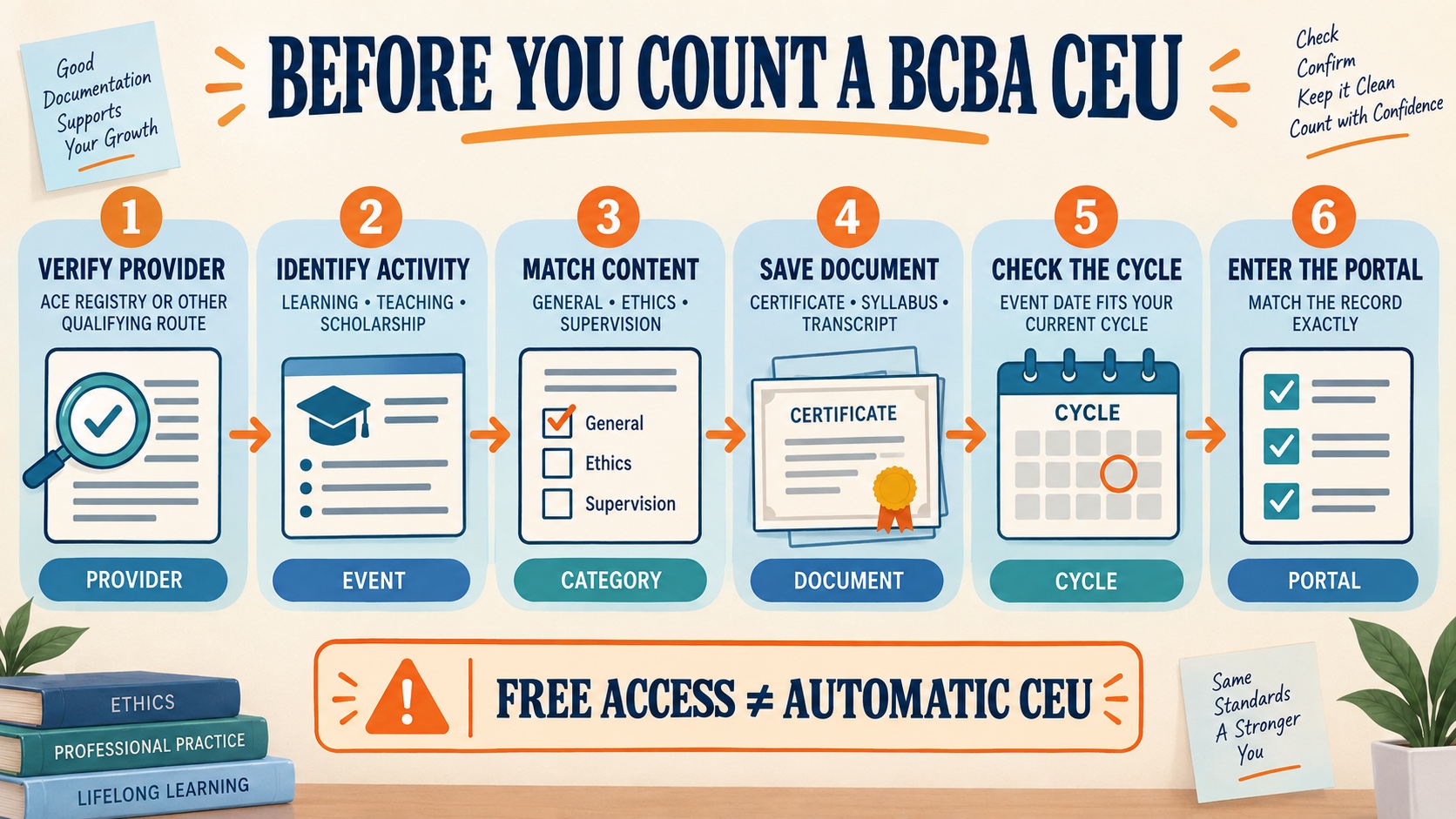
Before counting an event, slow down long enough to answer five questions. This is a planning checklist, not an individualized compliance determination.
- Who is responsible for the event? If it is presented as an ACE opportunity, check the current ACE Provider Verification Registry. ACE authorization allows a provider to offer certain Learning CE; it is not a blanket endorsement of every piece of content or every website statement.
- What kind of activity is it? Identify Learning, Teaching, Scholarship, a university course, or a BACB activity before choosing a Portal entry type.
- What is the actual content? Continuing education may address behavior-analytic practice, science, methodology, theory, or the profession, but it must go beyond a basic introduction to behavior-analytic techniques. A title containing “ethics” does not automatically make the event an ethics CEU.
- What document will prove it? Confirm the provider, event, date, amount, and category shown on the certificate or other supporting record. If the documentation is vague, ask for clarification before relying on it.
- Which cycle receives it? Match the event date to the two-year recertification cycle in which it was earned. Do not count the same activity twice or place it in a future cycle because the current one is already full.
For ethics CEUs, the current handbook says the event must relate to BACB ethics requirements and/or cultural or contextual responsiveness, connect to behavior-analytic practice or applied research, and be directly linked to behavior-analytic literature or established practice. Most of the event must focus on ethics or cultural/contextual responsiveness. A short ethics mention inside a mostly unrelated course does not qualify as ethics continuing education.
For supervision CEUs, the current handbook says that BCBAs who supervised the ongoing practice of RBTs or BCaBAs on record, or trainees pursuing BCBA or BCaBA certification, at any point during the cycle must obtain and enter 3 supervision CEUs. The content must be behavior-analytic and cover effective supervision practices described in the relevant BACB supervision materials.
How one CEU fits into the 32-CEU cycle
One CEU is a unit inside a larger maintenance plan, not a separate renewal. Under the current June 2026 handbook, a BCBA needs 32 CEUs within each two-year recertification cycle. Four of those must be ethics CEUs, and three supervision CEUs apply to the supervisors described by the handbook. The category amounts are included inside the total; they are not added on top of 32.
All CEUs must be earned within the cycle to which they are applied. The current handbook says missed CEUs cannot be made up after the recertification date during the reinstatement period, and CEUs exceeding the required amount cannot be applied to the next cycle. Enter CEUs into the BACB Portal as soon as supporting documentation is available, and make the Portal entry match the document exactly.
This is where a small tracker helps. If the total column says 28 but the ethics column says 4 and the supervision column says 3, you can see that four more general units are needed. If the total says 32 but the documentation column is empty, the number alone is not a finished record.
Current rules versus the 2027 framework
The BACB’s official 2027 BCBA Requirements keep the total at 32 CEUs per two-year recertification cycle. They list 4 ethics CEUs and 4 supervision CEUs for supervisors. The document also clarifies the ethics definition to include events related to cultural/contextual responsiveness when the content meets the stated behavior-analytic practice, applied-research, literature, and emphasis conditions.
Do not rewrite a current 2026 record as if it were already governed by the 2027 allocation. The applicable requirement depends on the cycle and transition guidance tied to the certification or recertification situation. Use the live BACB Handbook, the 2027 requirements page, and the Recent and Upcoming Changes page when the effective date affects your plan. This is a maintenance-rule change, not a “7th edition” of the exam content outline.
A worked CEU-record example
Imagine a fictional BCBA who attends a verified 50-minute behavior-analytic Learning event in May. The provider’s certificate identifies the event, date, and 1 CEU. The BCBA then teaches a 25-minute instruction session for a qualifying Learning event in July, and the ACE Provider supplies documentation for 0.5 CEU. These records are different activity types, but both have an amount and supporting evidence.
| Activity | Amount | Evidence to retain | Decision |
|---|---|---|---|
| 50-minute ACE Learning event | 1 CEU | Provider certificate | Enter as the documented Learning amount in the current cycle. |
| 25-minute instruction session | 0.5 CEU | ACE Provider instruction record | Enter under the documented Teaching route if the activity qualifies. |
| ABA Study Online app review | No automatic CEU | Study history only | Use for learning and retrieval; do not label it BACB CE credit. |
The example is intentionally ordinary. A record becomes safer when the learner can point to the provider or authority, the activity type, the amount, the date, and the evidence. It becomes weaker when the learner relies on a screenshot of a marketing headline or assumes that every minute spent reading is a CEU minute.
What does not automatically count?
- Every online course: online delivery does not establish ACE status, category fit, content quality, or documentation.
- Every certificate: a completion badge without the required activity details may not support the Portal entry you want to make.
- Every ethics mention: a brief reference to the Code inside a general course does not make the event ethics continuing education.
- Every study session: articles, podcasts, flashcards, mock questions, and app review can support learning without issuing BACB CEUs.
- Repeated activity: the current handbook says repeating CE activities does not provide new or expanded knowledge or skills and does not meet certification requirements.
- Unused extra units: extra CEUs cannot simply be carried into the next cycle.
A simple BCBA CEU tracker
Use one row for each activity and keep the tracker boring enough that you will actually maintain it. Record the event or activity title, provider or authority, date, activity type, CEU amount, category, cycle, documentation location, and the date you entered it in the BACB Portal. If one field is uncertain, mark the row “needs verification” instead of adding it to your completed total.
Review the tracker monthly rather than during the final week. Look at three separate numbers: total CEUs, ethics CEUs, and supervision CEUs if applicable. Save corrected certificates without deleting the original record, and never put your BACB password or private account details inside an article, spreadsheet shared with a provider, or study note.
Common questions
How many minutes is one BCBA CEU?
For the current handbook’s time-based Learning and Teaching conversion, 50 minutes equals 1 CEU and 25 minutes equals 0.5 CEU. Use the qualifying activity’s official documentation for the amount you enter.
Can a free event be a BCBA CEU?
It can be, but free access does not decide eligibility. Verify the provider or activity route, content, category, participation rules, date, and documentation.
Do ethics and supervision CEUs count inside the 32?
Yes. Under the current 2026 handbook, 4 ethics CEUs and 3 supervision CEUs for applicable supervisors are included within the 32-CEU total. The official 2027 framework lists 4 supervision CEUs for supervisors.
Can I carry a BCBA CEU into the next cycle?
No. The current handbook says CEUs exceeding the required amount cannot be applied to the next cycle, and missed CEUs cannot be made up after the recertification date during reinstatement.
Are ABA Study Online articles or app sessions BCBA CEUs?
Not automatically. They are independent study resources unless a separate, verified ACE or other qualifying activity is explicitly established with the required documentation. Do not enter ordinary website or app use as BACB CE credit.
Study links and official sources
For concept review, use the BCBA Theory Blocks, original BCBA practice questions, and the ABA Definition Search. The ABA Study Online app can support retrieval and spaced review. These links support learning; they do not issue BACB CEUs or ACE certificates.