Free BCBA CEUs? How to Check Whether a Resource Actually Counts
If you search for free BCBA CEUs, you may find articles, podcasts, webinars, videos, newsletters, and practice resources that cost nothing to access. That does not mean every free activity can be entered as a BCBA continuing education unit. The important question is not only “Is it free?” but “Is this a qualifying CE activity for my current recertification cycle, and can I document it?”
This guide gives you a free-first verification process. It explains the current BCBA CEU numbers, the difference between general learning and ethics or supervision CE, how ACE Provider status fits into the decision, and how the published 2027 requirements change the planning boundary. It does not label ABA Study Online content as CEUs or make an ACE-provider claim.
Quick answer: a free activity may count only if it meets the current BACB continuing-education requirements, is offered through an eligible provider or event structure, fits the type of CE you are claiming, occurs within your recertification cycle, and comes with the documentation you need. A free article, video, or practice quiz may be excellent professional learning while still not being a CEU.
Current BCBA CEU requirements
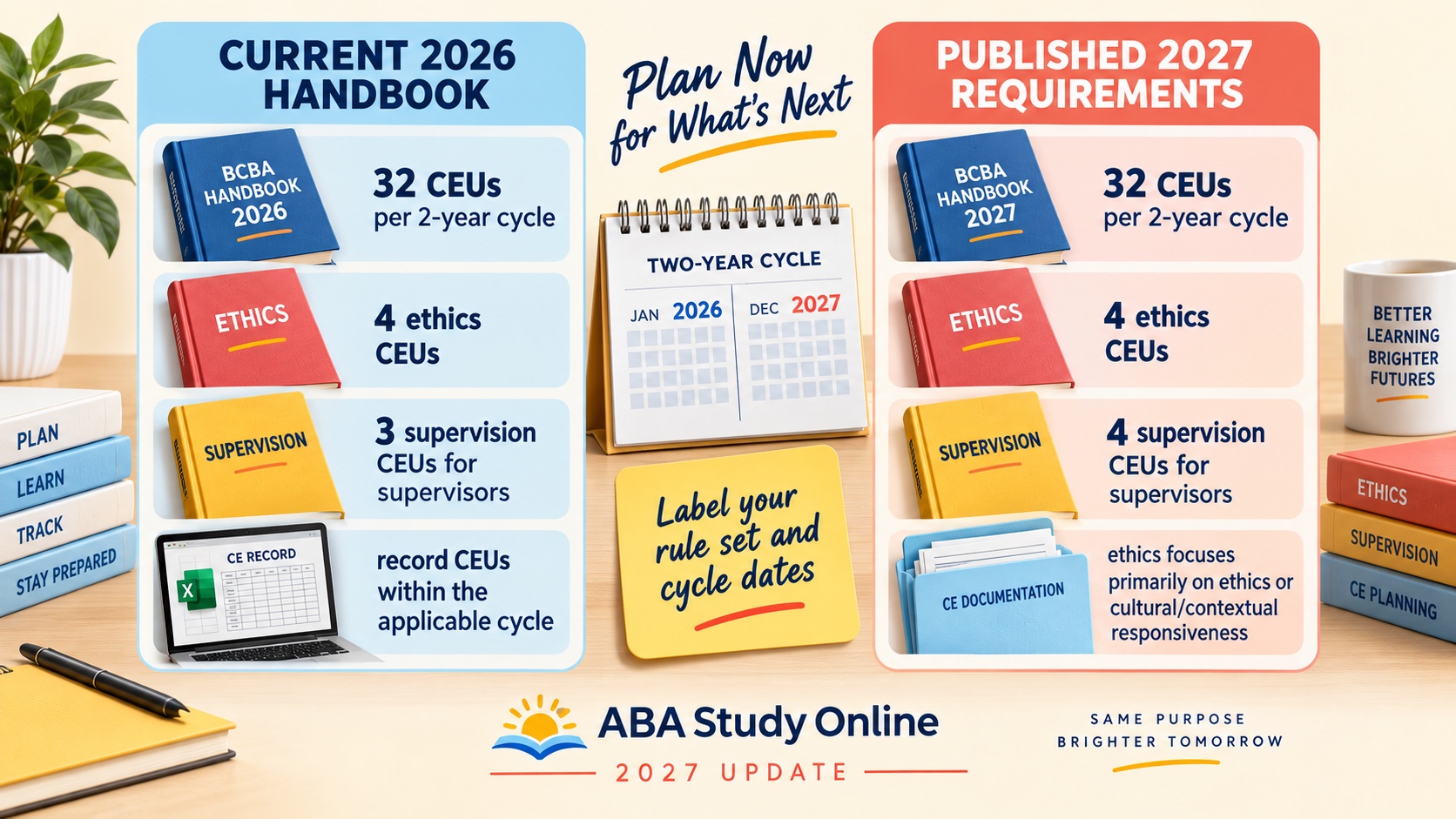
The current February 2026 BCBA Handbook requires 32 CEUs within each 2-year recertification cycle. It includes 4 ethics CEUs and 3 supervision CEUs for supervisors. The supervision requirement is conditional; if you are a supervisor, follow the current handbook and your certification circumstances. All CEUs must occur inside the cycle to which you apply them, and you should enter the activity with supporting documentation rather than waiting until the end.
That rule creates three separate checks:
- Amount: do you have enough CEUs for the cycle?
- Category: do the activities support general learning, ethics, or supervision as claimed?
- Evidence: can you show the provider, event, date, units, certificate, and other required records?
Free access solves only the price question. It does not automatically solve amount, category, or evidence. A good spreadsheet should have separate columns for the event name, provider, ACE verification, date, CE type, units, certificate location, cycle, and notes about any restriction.
How to check whether a free activity qualifies
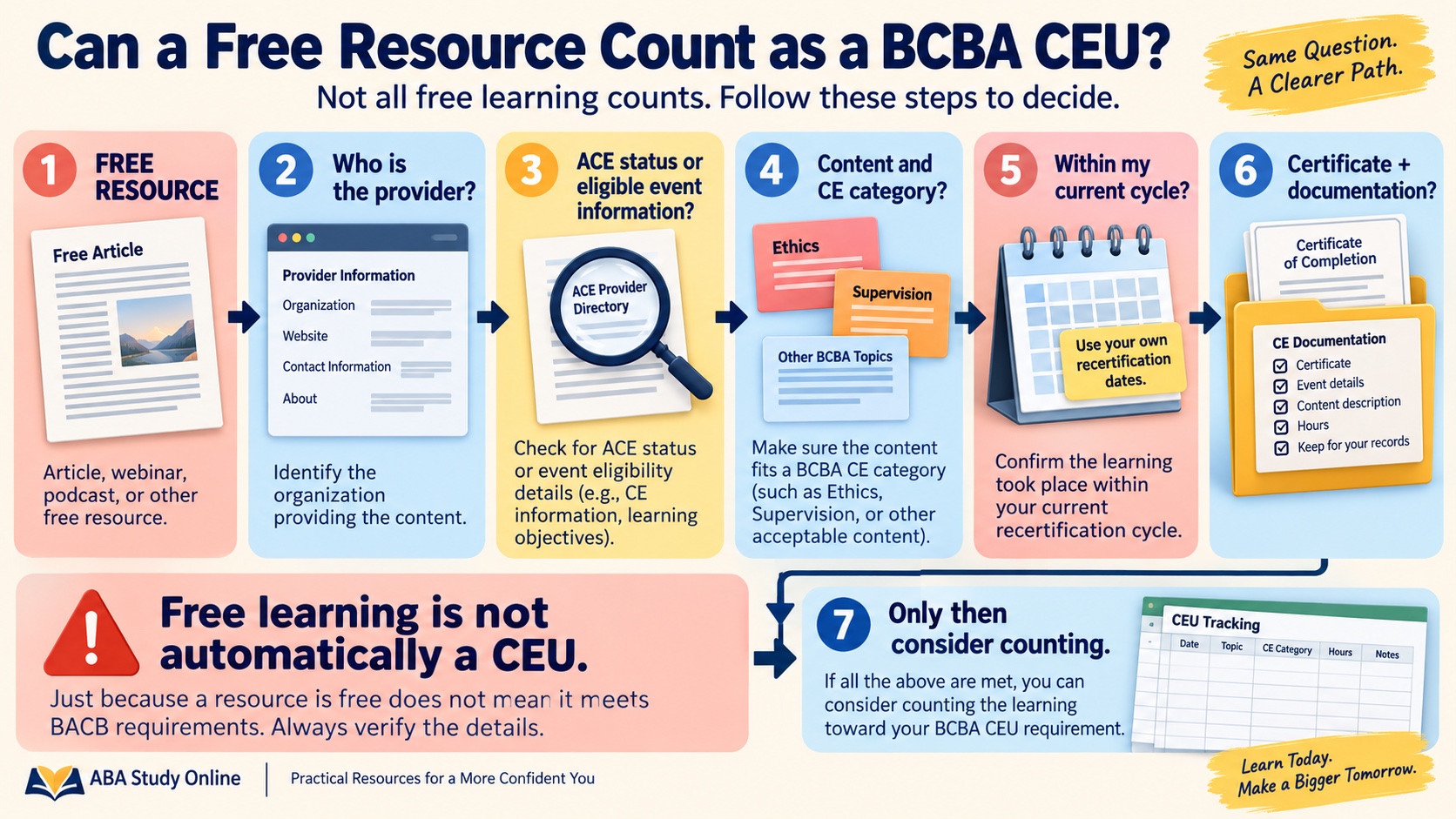
1. Identify the provider and event
Start with the organization or individual offering the activity. The BACB’s ACE program authorizes ACE Providers to provide Learning CE to BCBA and BCaBA certificants and professional development to RBT certificants. Search the current ACE Provider Verification Registry when the event claims ACE status. Do not rely on a logo copied into a social post, an old screenshot, or the phrase “BACB approved” without a current verification path.
2. Check what the activity actually promises
A legitimate event should tell you whether it offers CE, how many units are available, which audience it serves, the content area, the completion requirements, and how documentation is issued. If the page says only “free ABA training” or “watch this video,” treat it as learning until the provider gives clear current CE information.
3. Confirm the date and cycle
Save the event date and compare it with your recertification cycle. CEUs from the wrong cycle may not solve the current requirement, even if the topic is excellent. Do not assume that extra units roll forward automatically. The current handbook says all CEUs must occur within the cycle to which they are applied.
4. Save the documentation
Keep the certificate, completion record, event description, provider information, and any assessment or attendance evidence. Use a filename that includes the date and CE type. If a free webinar disappears later, your saved documentation gives you a clearer record to review before recertification.
Ethics and supervision CE
Ethics CE is not simply any event that mentions the word “ethics.” The 2027 BCBA requirements define ethics continuing education as events related to BACB ethics requirements and/or cultural or contextual responsiveness, connected to behavior-analytic practice or applied research and directly linked to behavior-analytic literature or established practice. Most of the event must focus on ethics or cultural/contextual responsiveness. A general lecture that spends one minute naming the ethics code is not automatically an ethics CE event.
Supervision CE is also a specific category. If you are subject to the supervision requirement, choose activities that actually address behavior-analytic supervision and the applicable current rules. Keep the course description and certificate showing the category. Do not count the same CEU as both ethics and supervision unless the current rules explicitly allow the treatment; the category decision belongs in your record before you submit it.
Free resources are particularly useful for discovering topics and preparing questions for a formal CE event. ABA Study Online’s free articles, glossary explanations, and practice activities can support learning, but they should not be represented as BCBA CEUs unless a separate current, verified CE arrangement exists.
Planning for the 2027 boundary
The published 2027 BCBA requirements keep the 32-CEU total for each 2-year cycle but change the category planning to 4 ethics CEUs and 4 supervision CEUs for supervisors. The same document clarifies that ethics content must primarily focus on ethics or cultural/contextual responsiveness and connect to behavior-analytic practice or applied research.
Do not mix the current 2026 handbook and the 2027 requirements into one unlabeled spreadsheet. Add an “application or recertification rule set” column and label the cycle. If a provider publishes an event before the transition and you plan to apply it after the transition, verify the category and documentation with the current source. Free content can help you learn what to ask, but it cannot remove the need to check the applicable rule set.
A free-first CE documentation workflow
- Learn for free first: use articles, podcasts, open webinars, and practice material to identify the topic you need.
- Find the formal event: look for current provider and event information, including any ACE verification.
- Classify before counting: record general, ethics, or supervision category only when the activity supports it.
- Complete the requirements: watch, attend, participate, or pass the assessment exactly as the provider states.
- Save evidence immediately: store the certificate and description with the cycle and date.
- Audit before recertification: compare totals, categories, dates, and documents against the current handbook.
What to record in your spreadsheet
Use one row for each activity instead of one row for each provider. Record the event title, provider name, current ACE verification if claimed, event date, completion date, number of units, CE category, cycle, certificate file, event description, and any assessment or attendance requirement. Add a short note explaining why you classified the activity as general, ethics, or supervision. This makes an audit easier and helps you notice a gap before the recertification deadline. If the provider changes the event page later, your saved description and certificate preserve the information you relied on when you counted the activity.
Common mistakes
- “Free means CEU”: price does not determine whether the activity qualifies.
- “A BACB logo means approval”: verify the current provider and event through the official route.
- “Ethics is any mention of the code”: most of the event must focus on qualifying ethics or cultural/contextual responsiveness content.
- “Extra units roll over”: check the current cycle rules before planning around surplus CEUs.
- “A certificate is enough by itself”: keep the event description, provider information, category, date, and supporting records.
- “2026 and 2027 requirements are interchangeable”: label the rule set and application or recertification period.
FAQ
Can free BCBA webinars count as CEUs?
Sometimes, but only after you verify the current provider, event, category, completion requirements, cycle date, and documentation. A free webinar without clear CE information should be treated as learning, not automatically counted.
Can free ABA Study Online articles count as BCBA CEUs?
Not automatically. Free articles and practice resources can support learning, but they should not be called BCBA CEUs without a separate, current, verified CE arrangement.
How many BCBA CEUs are required?
The current February 2026 handbook requires 32 CEUs in each 2-year cycle, including 4 ethics CEUs and 3 supervision CEUs for supervisors. The published 2027 requirements retain 32 total and list 4 ethics and 4 supervision CEUs for supervisors.
Do I need an ACE Provider?
Use the current BACB rules and provider information to determine whether the activity is eligible. If an event claims ACE status, verify the provider through the BACB’s official ACE resources rather than relying on marketing copy.
For free learning support, visit the BCBA learning path, free resources, and ABA glossary. These are educational links, not a CEU or ACE guarantee.