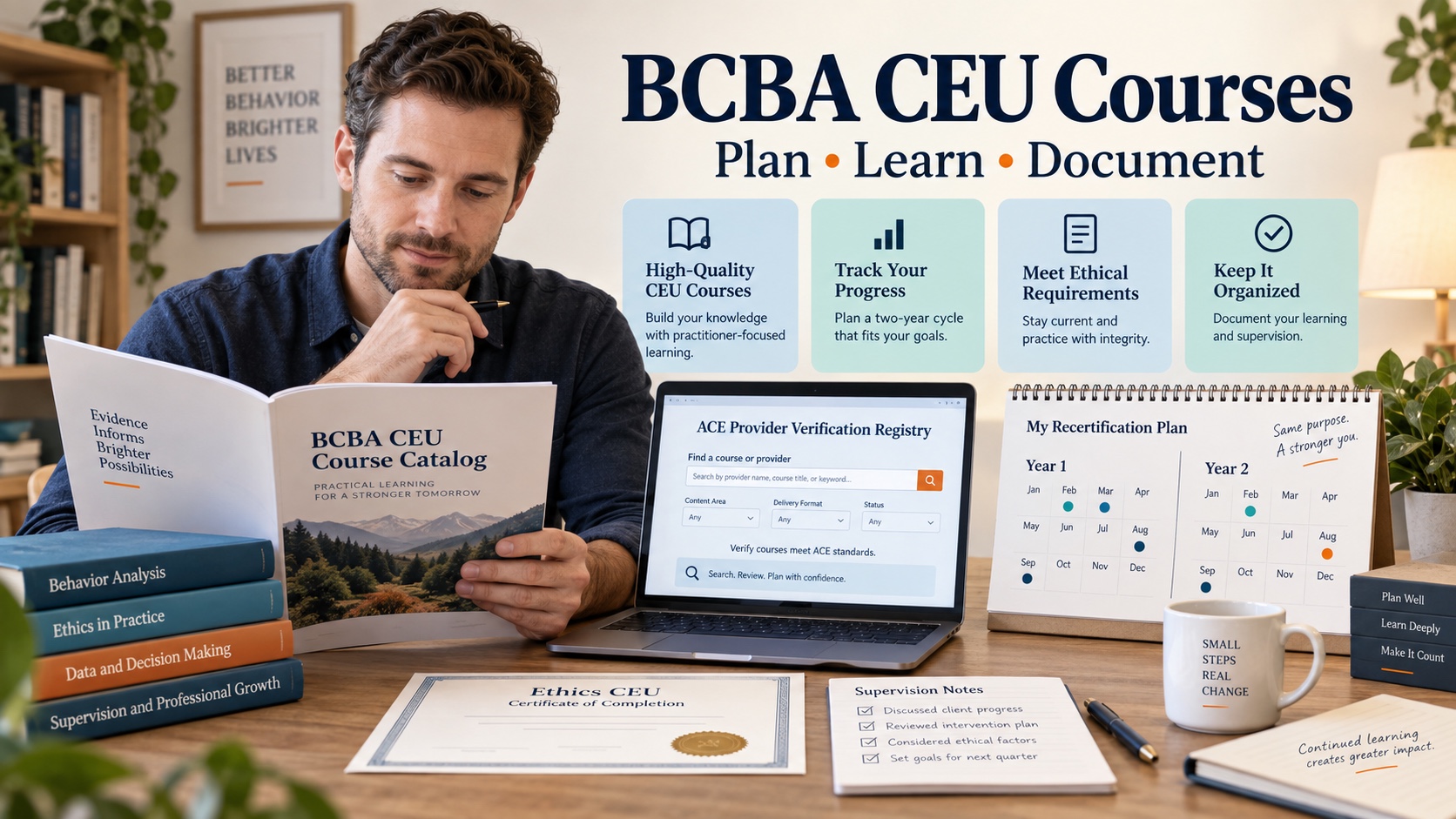
BCBA CEU Courses: How to Choose Courses That Fit Your Recertification Plan
Searching for BCBA CEU courses usually means you need more than a list of webinars. You need learning that is behavior-analytic, current, appropriate for your professional level, and documentable within your recertification cycle. You also need to know whether a course is general Learning continuing education, ethics continuing education, or supervision continuing education.
The practical rule is simple: verify the provider first, then evaluate the event. The BACB’s Authorized Continuing Education program authorizes ACE Providers to offer Learning CE to BCBA and BCaBA certificants, but ACE Provider status does not mean that BACB has endorsed or approved the content of every event. Your course plan should therefore combine the current BCBA Handbook, the event information, and the live ACE Provider Verification Registry.
Table of Contents
What makes a good BCBA CEU course?
A strong course is not defined by a colorful certificate or a long title. The current ACE materials describe Learning CE as behavior-analytic content that goes beyond a basic introduction, is designed for attendees with a behavior-analytic background, and reflects accurate, current practice. That gives you a useful quality screen before you think about the number of CEUs.
Look for a course page that tells you:
- Who it is for: a BCBA-level audience should not be asked to count a general introductory talk as advanced professional learning without checking the category and event description.
- What you will learn: objectives should describe observable learning rather than vague promises such as “become an expert.”
- Why it is behavior-analytic: the majority of the event should connect to behavior-analytic practice, research, methodology, theory, or the profession.
- How current it is: the presenter should identify current research, established practice, ethical expectations, and local context when those affect the topic.
- What documentation you receive: the certificate or completion record should give you enough information to enter the event accurately in your BACB account.
A course about a neighboring field can still be useful for your professional development, but usefulness and BACB Learning CE eligibility are not automatically the same. Ask how the course connects to behavior-analytic practice before assuming that the topic label does the work for you.
How many CEUs does a BCBA need?
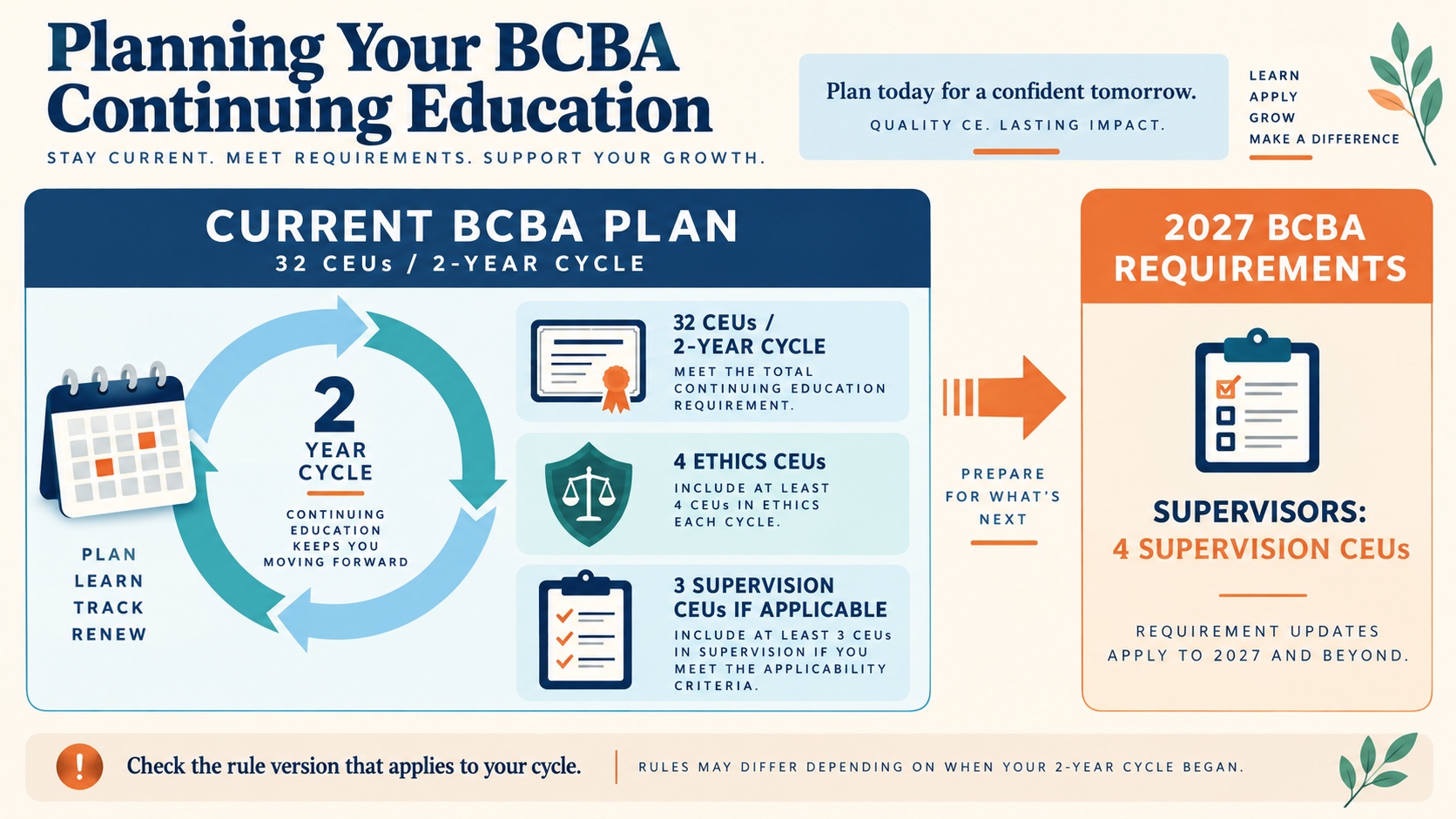
Under the current BCBA maintenance information, a BCBA completes 32 continuing education units within each two-year recertification cycle, including 4 ethics CEUs and 3 supervision CEUs if the supervision requirement applies. CEUs must fall within the cycle to which they are applied. Extra CEUs do not simply roll forward to repair a later cycle.
Think of the number as a planning frame, not a shopping target. Start with the recertification date in your BACB account, then identify the categories you still need. A two-hour general course can be a good choice when you need general Learning CE, but it does not automatically solve an ethics or supervision category gap.
How do ethics and supervision CEUs fit?
Ethics and supervision are not decorative tags that a course can add after the fact. The current BACB materials define ethics CE in relation to ethics requirements and/or cultural or contextual responsiveness, with a connection to behavior-analytic practice or applied research. Most of the event should focus on the ethics or cultural/contextual topic if it is offered as ethics CE.
Supervision CE should address behavior-analytic supervision and the responsibilities of supervisors. A course that mentions “good teamwork” for five minutes is not automatically a supervision CE course. Read the learning objectives and category description, and keep the certificate or event record that states the category.
One event may be valuable without fitting every category. If you need both ethics and supervision, select courses deliberately and check whether the same CEU may be counted in only one category under the applicable current rule. Do not double-count simply because the course has two interesting topics.
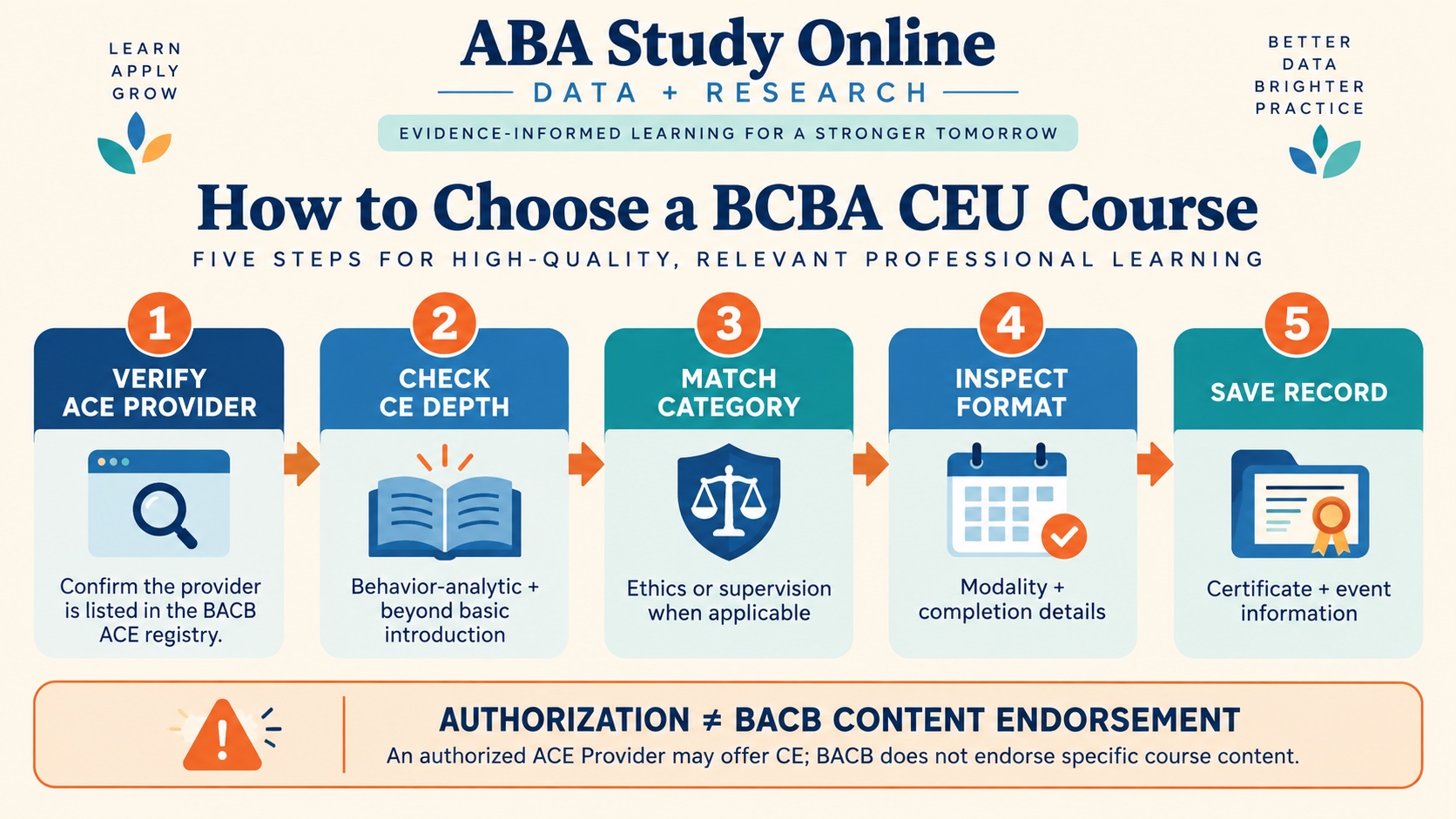
How do you verify an ACE Provider?
Use the BACB ACE Provider Verification Registry. Search by provider name, ACE Coordinator name, or provider number. Compare the result with the provider named on the course page, registration email, and certificate.
- Record the provider’s exact name. A course brand, a presenter name, and the legal organization may not be identical.
- Confirm current authorization. Check the registry close to registration and keep the event details with your record.
- Read the event category. Confirm whether the course is general Learning CE, ethics CE, or supervision CE, and whether the audience is BCBA-level.
- Check the learning format and completion rule. Know whether you must attend live, complete an assessment, participate in a discussion, or meet another event requirement.
- Save the documentation. Keep the certificate, title, date, modality, provider information, CE category, and any completion evidence together.
Authorization is a provider-level status. The BACB does not review or approve individual events offered by ACE Providers, and the registry says that provider authorization does not imply endorsement or approval of event content. That is not a reason to avoid ACE courses; it is a reason to evaluate the course itself and avoid marketing language that claims official BACB endorsement.
Can BCBA CEU courses be online?
Online delivery can be convenient, but “online” is not a complete quality or eligibility answer. Read the course’s event description and documentation instructions. Confirm the provider, intended audience, learning objectives, event duration, completion method, modality, and certificate details. A live online course and an on-demand recording may have different participation or completion requirements.
Also watch for content that is too thin to be a meaningful learning event. The BACB’s ACE changes explain that simply reading an article and completing a knowledge check may not count as an ACE event, while a journal club can qualify under applicable requirements. A course page that promises effortless credit without explaining the learning activity deserves a closer look.
What should you know about the 2027 requirements?
The BACB’s 2027 BCBA Requirements document says that BCBA maintenance still uses a two-year recertification cycle and 32 CEUs, but it states 4 supervision CEUs for supervisors rather than the 3-supervision-CEU figure in the current BCBA Handbook information. The same document also expands and clarifies the definition of ethics CE. These changes are scheduled for January 1, 2027, so do not backdate the 2027 number into a current 2026 plan without checking which requirements apply to your cycle and transition status.
The 2027 change is not a new “7th edition” of the BCBA exam content outline. The BACB’s 2027 requirements document identifies the BCBA Test Content Outline, 6th edition, as the exam basis that went into effect January 1, 2025. CEU course selection and exam blueprint editions are separate planning questions.
For a course plan that crosses the transition, keep a small change log: your recertification date, the date of each event, the category recorded, the rule version you checked, and the source page. Recheck the live BCBA Handbook and 2027 transition materials before submitting your recertification application.
What should you save after a course?
Use a simple folder or spreadsheet with one row per event:
- course title and provider name;
- event date and delivery modality;
- number and type of CEUs;
- ethics or supervision designation, if applicable;
- certificate or other completion documentation;
- the date you entered the event in your BACB account; and
- any note about the 2026/2027 transition rule you used.
Enter CEUs while the documentation is easy to find. If the provider changes its course page later, your record should still show what you completed, who offered it, when it occurred, and what category was represented. If the live handbook or your BACB account gives a different instruction, follow the current official instruction and resolve the discrepancy before you rely on the event.
For concept review before or after a course, use the ABA Study Online BCBA learning path. It can support learning and exam preparation, but its free materials are not automatically BACB CEUs and should not be presented as an ACE event without the required provider authorization and event process.
BCBA CEU course FAQ
How many CEUs does a BCBA need? Current BCBA maintenance information calls for 32 CEUs in each two-year recertification cycle, including 4 ethics CEUs and 3 supervision CEUs if applicable. The 2027 BCBA Requirements document states 4 supervision CEUs for supervisors beginning with the 2027 requirements, so check the rule version that applies to your cycle.
What makes a course ethics CE? Most of the event should focus on BACB ethics requirements and/or cultural/contextual responsiveness, connected to behavior-analytic practice or applied research. A brief ethics mention inside an unrelated presentation is not enough.
Are online BCBA CEU courses accepted? Online delivery is not the only deciding factor. Verify the ACE Provider, event format, completion requirement, category, and documentation against the current BACB materials.
Does BACB approve every course from an ACE Provider? No. ACE Provider authorization does not imply BACB endorsement or approval of a specific event’s content.
Is the 2027 change a new BCBA exam edition? No. The 2027 CE and certification changes are separate from the BCBA Test Content Outline, 6th edition, which the BACB identifies as the exam basis beginning January 1, 2025.