BCBA CEU Bundles: How to Compare Coverage, Categories, and Records
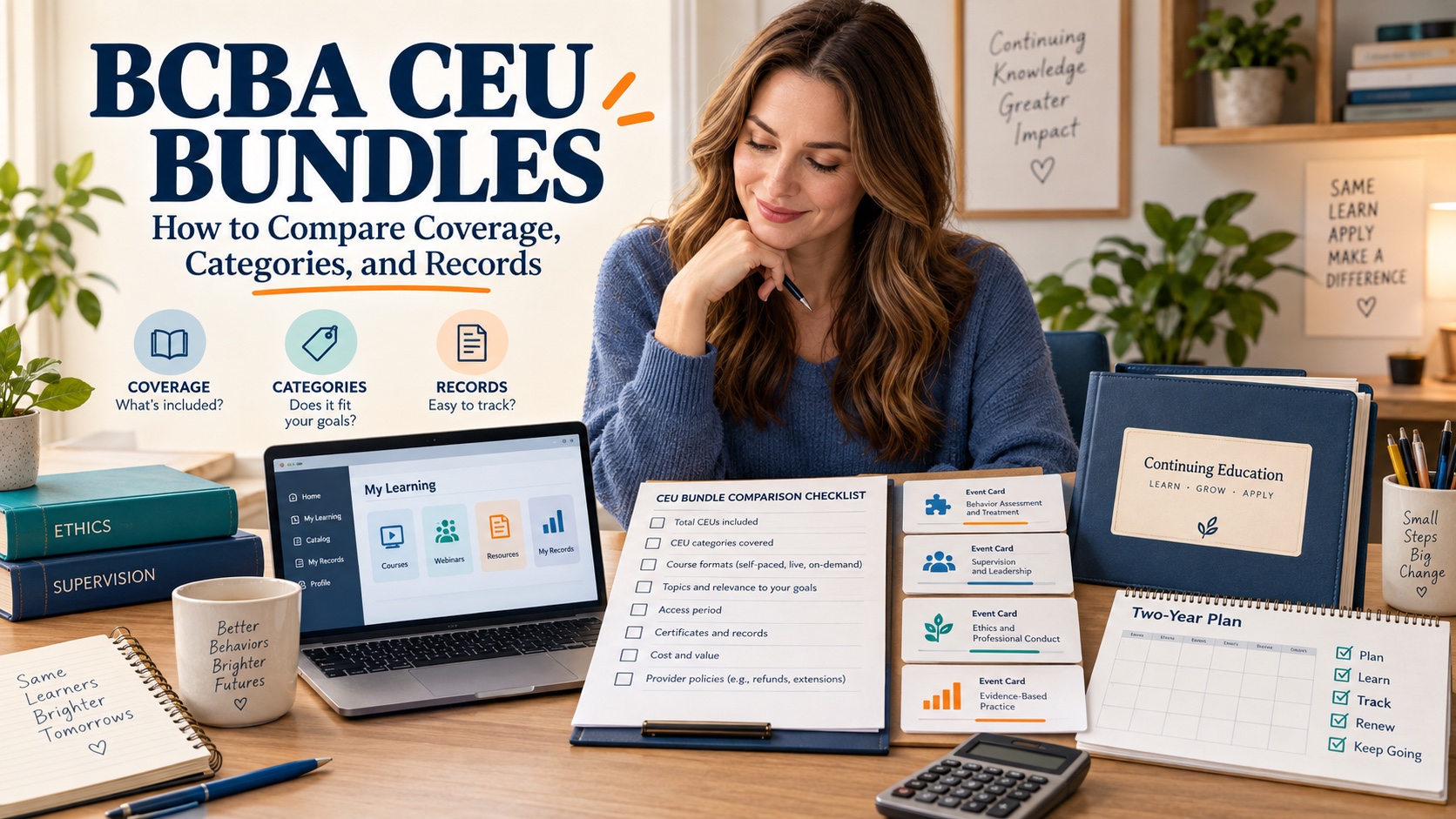
If you are searching for BCBA CEU bundles, you are probably trying to make continuing education simpler: one purchase, one dashboard, and a group of events that can help fill a recertification plan. That convenience can be useful, but a bundle is not a separate BACB activity type. Each event inside the package still needs to fit the rules that apply to your credential, certification cycle, category, and documentation.
The safest approach is to treat a bundle as a container, not a guarantee. Check the current BCBA Handbook, verify the provider and event details, and record completion evidence for each item. This guide gives you a practical comparison method without ranking providers or calling ABA Study Online articles, app lessons, or ordinary website content BACB CEUs or ACE events.
Table of Contents
What a BCBA CEU bundle is—and is not
A CEU bundle is usually a group of learning events sold or presented together. It may be organized around a topic, a price tier, a membership period, a number of hours, or a recertification deadline. The word bundle describes packaging. It does not by itself establish that the package is approved, that every event qualifies, or that the same number of units will apply to every BCBA.
Separate these five questions before you compare prices:
- Who provides the event? If the event is presented as BACB Learning CE, can you verify the provider in the current ACE Provider Verification Registry?
- What is the event? Does the listing identify the title, content, audience, learning time or official value, and completion standard?
- Which category does it support? Is it general learning, ethics, supervision, teaching, scholarship, or another activity that the Handbook describes?
- When will it be completed? Does the completion date fall inside the certification cycle to which you want to apply it?
- What evidence will you receive? Will the certificate or record show enough detail to support your entry in the BACB account?
A low price can be attractive, but a cheap package that contains duplicated content, an unclear provider, or events outside your cycle may be less useful than a smaller package with complete records. Compare the evidence and fit, not only the number printed on the sales page.
Start with the current CEU cycle
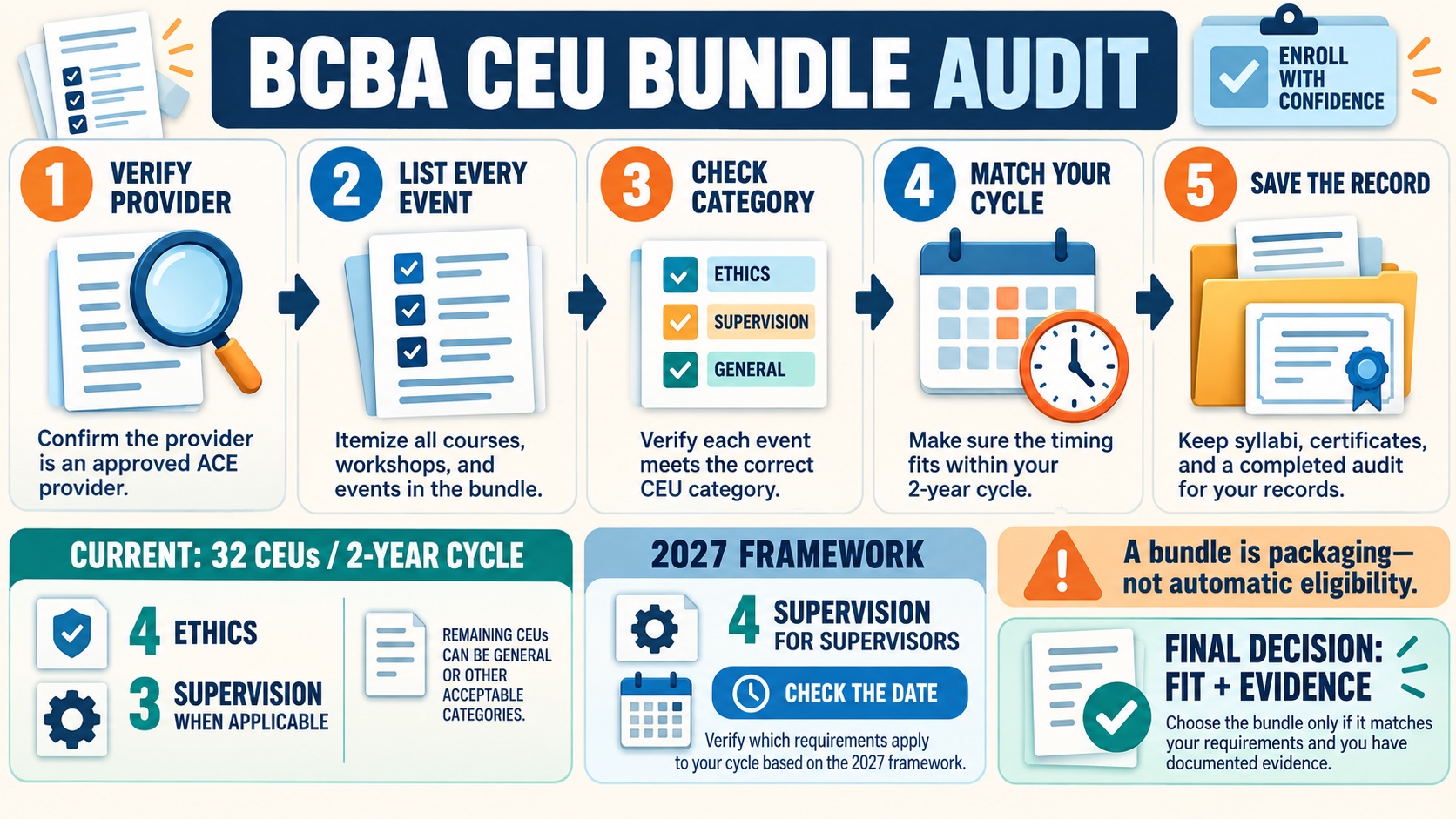
The current BCBA maintenance framework requires 32 CEUs in each two-year recertification cycle. It includes 4 ethics CEUs and, when the BCBA supervised the covered RBTs, BCaBAs, or BCBA/BCaBA trainees during the cycle, 3 supervision CEUs under the current Handbook. For time-based learning or instruction, the Handbook uses 25 minutes for 0.5 CEU and 50 minutes for 1 CEU. Some activities use their own official values and documentation rules.
Write down your own recertification start and end dates before opening a bundle. A purchase date is not necessarily a completion date. Access to a video is not necessarily participation, and a certificate issued later does not automatically move an event into the cycle in which you want to use it. If the seller’s calendar or dashboard does not make completion dates clear, ask before enrolling.
Keep the future boundary separate. The published 2027 BCBA Requirements keep the total at 32 CEUs and the ethics minimum at 4, but list 4 supervision CEUs for supervisors. That is a date-sensitive future framework. It should not replace the current Handbook rule for every person or every cycle. If your cycle crosses an implementation boundary, check the official requirements and your BACB account rather than guessing from a bundle page.
Audit every event inside the bundle
Open the bundle contents and audit each item as if it were being purchased separately. A useful event record includes the event title, provider, delivery format, learning time or official CEU value, completion date, category, certificate, and any instructions for entering the activity. If a package contains twelve short events, create twelve rows. Do not treat one order confirmation as proof that all twelve events were completed.
| Check | What to record | Why it matters |
|---|---|---|
| Provider | Name and current ACE verification status when presented as Learning CE | Provider authorization and event eligibility are separate from a marketing label. |
| Event | Title, topic, audience, format, and completion standard | A certificate should identify the activity you actually completed. |
| Value | Minutes, CEU amount, or official activity value | “Full bundle” is not a unit of measurement. |
| Category | Learning, ethics, supervision, teaching, or scholarship | Required categories need substantive coverage, not a convenient tag. |
| Date | Completion date and applicable cycle | Cycle timing determines where the activity can be recorded. |
| Evidence | Certificate, transcript, letter, or other required documentation | Keep the record that supports the BACB account entry. |
Also check whether the bundle contains repeated or overlapping material. Repeating a title, watching the same recording twice, or buying a package that combines several versions of one event does not automatically create additional usable CEUs. If the provider does not explain non-repeating activity rules or how duplicate completions are handled, place that question on your pre-purchase checklist.
Check ethics and supervision coverage
Category claims deserve more attention than their labels. The BACB’s current ethics guidance says ethics continuing education must relate to ethics requirements and/or cultural/contextual responsiveness, connect to behavior-analytic practice or applied research, and make ethics or cultural/contextual responsiveness the main focus. A general course that mentions an ethics code in one slide should not automatically be counted as an ethics event.
Supervision works the same way. First decide whether the supervision requirement applies to your role and current cycle. Then inspect the event’s content and documentation. A course with “supervision” in its title may discuss leadership, staff meetings, or business operations without meeting the supervision-CEU purpose you need. Ask whether the provider identifies the event category and the relevant learning focus.
Bundles can be helpful when they make category coverage easy to see. A strong package page might show separate ethics and supervision tabs, individual event values, instructor or provider information, completion records, and a clear cycle-planning view. A weak page may show one large total and leave the buyer to infer every category. When the details are missing, the correct next step is verification—not an optimistic assumption.
Bundle traps that can create record problems
“BACB” in the headline. A brand reference or a discussion of BACB rules is not the same as a verified ACE Provider or a qualifying event. Use the official ACE Provider page and the provider’s event documentation.
One certificate for an entire package. A combined certificate may be acceptable in some contexts, but it should still identify what was completed, when, for how long, and under which category. If it contains no event-level detail, ask the provider how the activities should be entered.
Access expiration mistaken for completion. A bundle that disappears after 90 days may be difficult to document later. Download or preserve the permitted records as soon as you finish an event, following the provider’s terms.
Future rules used as a sales deadline. A 2027 requirement can be relevant to planning, but it is not a reason to tell every current BCBA that an old cycle is invalid. Use the current rule that applies to your cycle and label future requirements as future.
Study content presented as CE credit. ABA Study Online’s theory explanations, practice questions, app activities, and free materials may support learning, but they are not automatically BACB CEUs. Use the BCBA learning path, practice questions, and app as study resources only unless a separate, verified ACE event is clearly identified.
Use a simple comparison worksheet
Before buying, create a small comparison table for the bundles you are considering. You can use these columns:
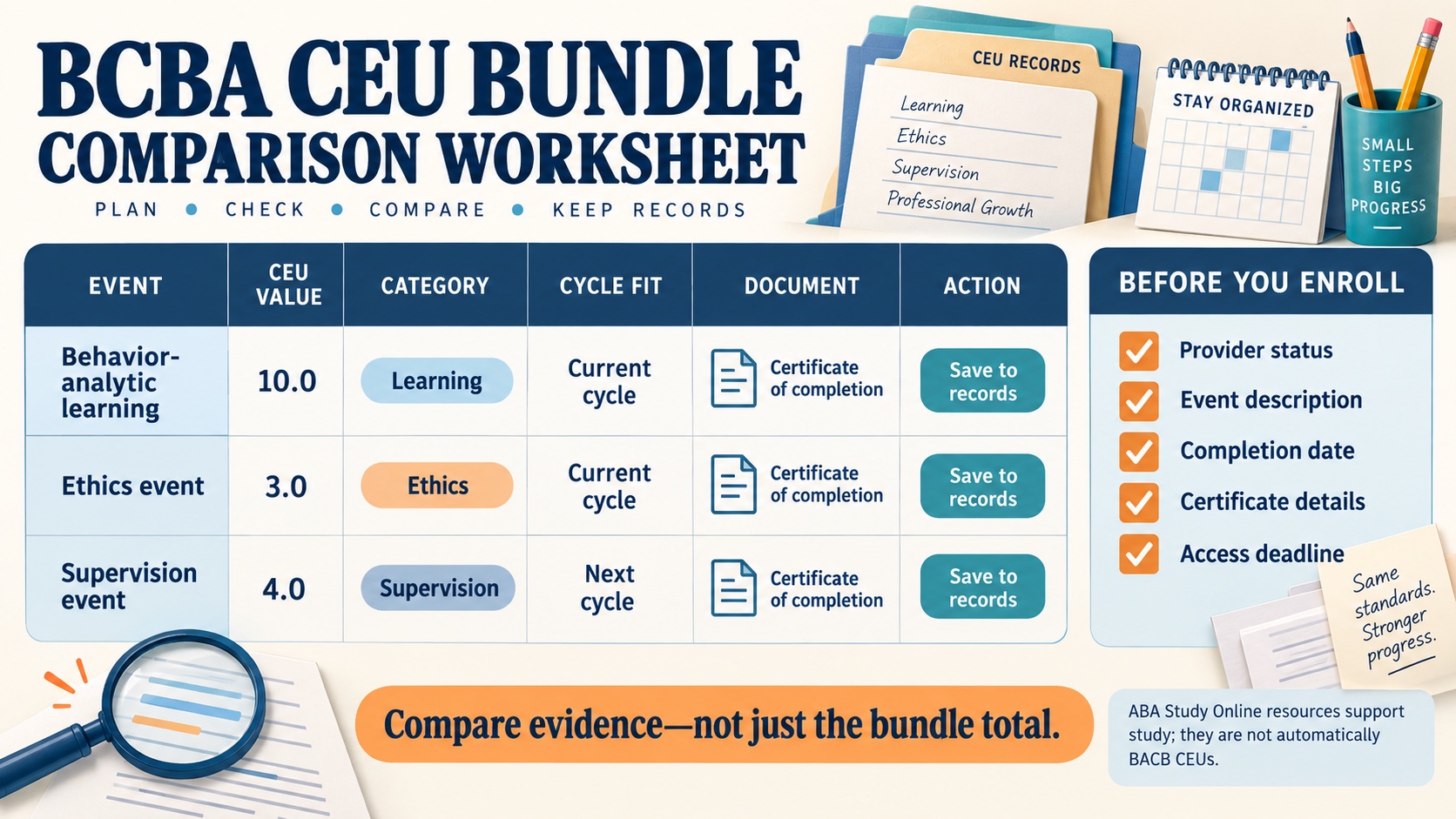
Do the comparison before you start the first event, not after the deadline is close. Save the public description, the provider-verification result, and the terms that explain access and certificates in a folder named for the current cycle. That creates a simple audit trail if the bundle page later changes. It also lets you spot a missing category early enough to choose a different event instead of discovering the gap during recertification.
- Bundle name and provider
- Individual event titles and values
- Current ACE verification or provider evidence
- Ethics and supervision items, if applicable
- Completion deadline and access period
- Completion date and cycle fit
- Certificate or documentation format
- Unanswered questions before purchase
Imagine that one bundle advertises 16 CEUs but lists only a total, a completion deadline, and a generic certificate. A second lists eight events with minutes, individual certificates, an ethics description, provider verification, and a cycle-friendly schedule. The second package may be easier to defend in your record even if its price per CEU is higher. The worksheet makes that difference visible without telling you which provider to choose.
FAQ and official sources
Do BCBA CEU bundles automatically count?
No. A bundle is packaging. Review each underlying event, provider, category, completion date, value, and supporting document under the current Handbook and your certification cycle.
How many CEUs does a BCBA need?
The current BCBA maintenance framework requires 32 CEUs in each two-year recertification cycle, including 4 ethics CEUs and 3 supervision CEUs for applicable supervisors. The published 2027 framework lists 4 supervision CEUs for supervisors, so check the date and rule that apply to your cycle.
Does an online bundle count differently?
Online delivery alone does not prove or disprove eligibility. Verify the provider, event, audience, category, learning time, completion record, and cycle date. For a broader online-event audit, see ABA Study Online resources and the applicable BACB source.
Can unused bundle CEUs roll into the next cycle?
Do not assume that they can. Check the current BCBA Handbook and your BACB account instructions for the rule that applies to your activity and cycle. Record the completion date before deciding where it belongs.
Are ABA Study Online articles BCBA CEUs?
Not automatically. The website and app provide independent learning and practice resources. They should not be represented as ACE events, BACB certificates, or recertification credit without a separately verified authorization and event record.