BCBA Certification Cost: Fees, Exam Expenses, and a Practical Planning Guide
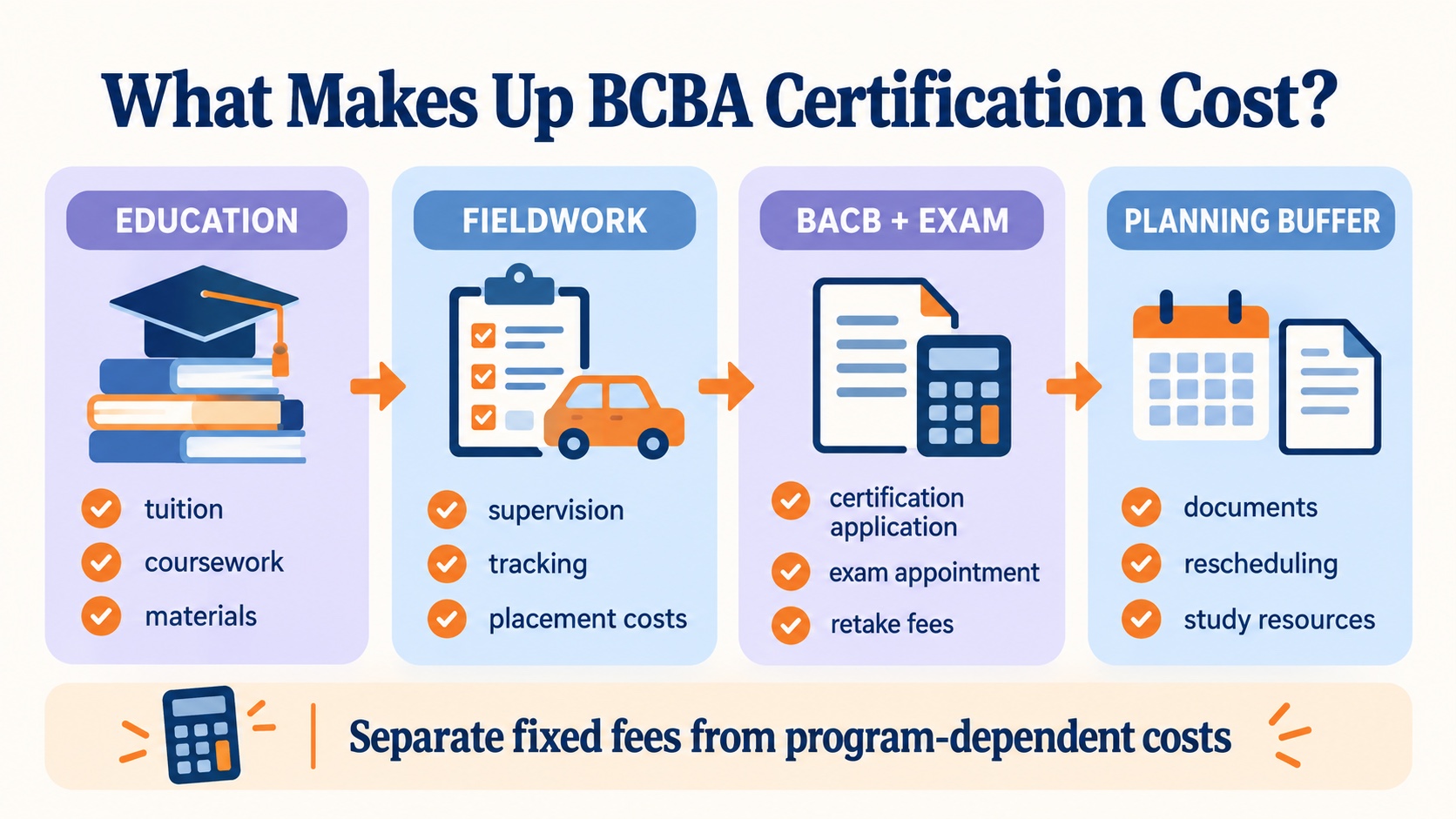
BCBA certification cost is not one universal price. The amount you spend depends on your graduate program, coursework, supervised fieldwork arrangements, study materials, location, and whether you need another examination attempt. Some charges are published by the Behavior Analyst Certification Board (BACB) or the testing provider; other expenses belong to the education and fieldwork path you choose.
A useful budget starts by separating those categories. This guide identifies the current published application and examination fees, explains which costs are variable, and shows how to build a realistic planning range without presenting an invented “total BCBA cost.” Always check the current BCBA Handbook and your program’s written fee schedule before paying.
Table of Contents
Published BCBA fees
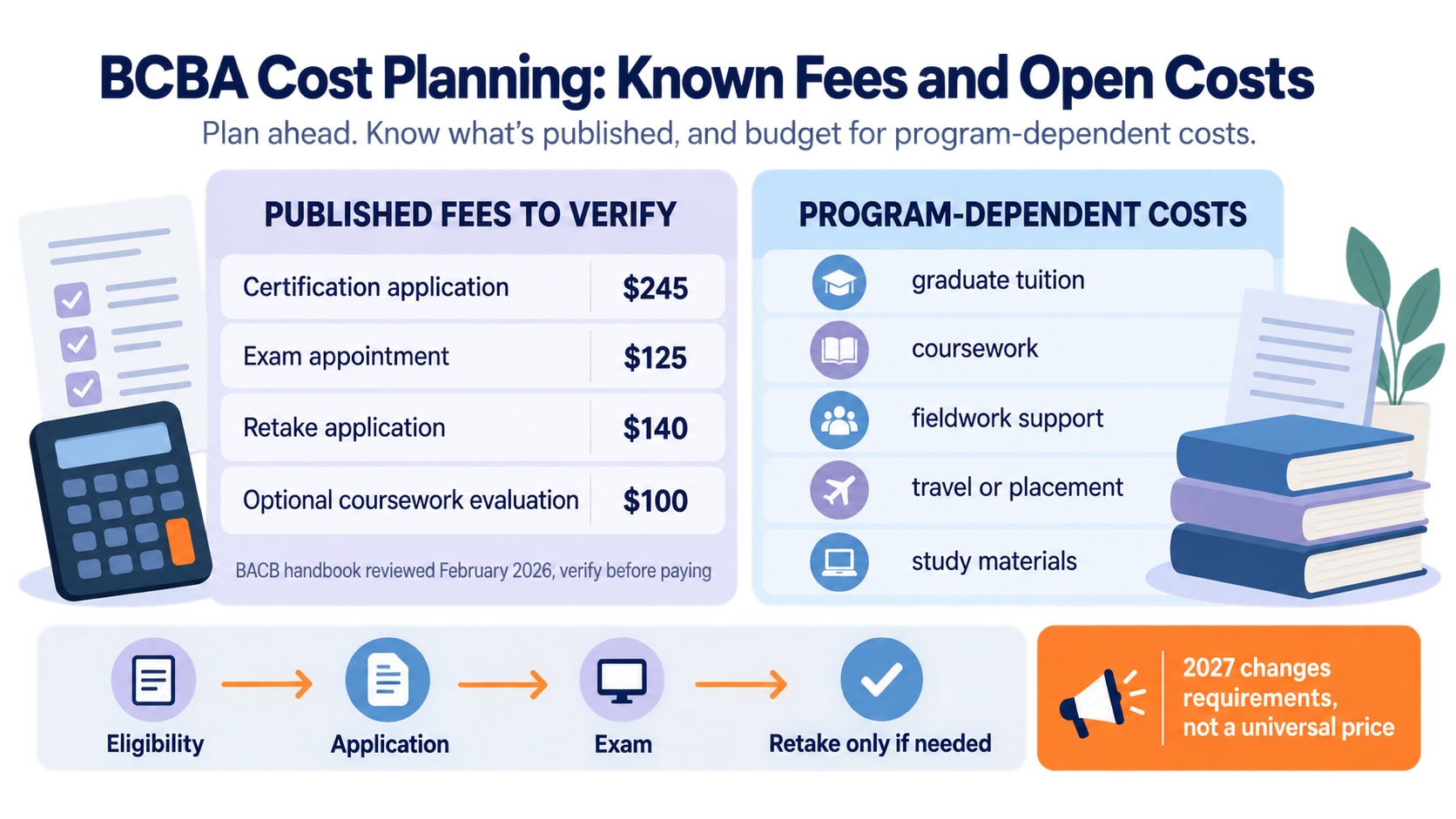
For the current fee snapshot used in this guide, the BCBA Handbook lists the following charges. BACB fees are nonrefundable and nontransferable, and the examination appointment is paid through Pearson VUE rather than folded into the BACB certification application.
- Certification application: $245. This is the application-processing fee for the initial BCBA certification application.
- Examination appointment: $125. This is paid to Pearson VUE when you schedule the BCBA examination after your application is approved.
- Examination retake application: $140. If you need another attempt, the retake application is a separate fee.
- Optional preliminary coursework evaluation: $100. This is not the same as tuition and is only relevant if you choose that optional evaluation.
If you are applying and taking the examination for the first time, the two basic published application-and-appointment charges total $370 before tuition, fieldwork, study materials, travel, or any optional evaluation. That number is a fee subtotal, not the cost of becoming a BCBA. If a retake is needed, the $140 retake application and another $125 examination appointment would add $265 for that additional attempt under the same published fee schedule.
Use the numbers as a checkpoint, not as a promise that every candidate will pay exactly the same amount. Fees can change, your application may require a different process, and your BACB account and current handbook control your case.
Costs that depend on your route
Graduate tuition and coursework
For many candidates, tuition is the largest part of the overall BCBA certification cost. It depends on the school, degree level, course load, residency or delivery format, transfer-credit policy, and whether the program is completed part time or full time. Some programs bundle books, learning platforms, or exam-preparation material into tuition; others list them separately.
Ask a program for a written estimate that distinguishes tuition from mandatory fees. Useful questions include: Does the quoted amount cover the full coursework sequence? Are there technology, enrollment, practicum, graduation, or transcript fees? What happens if a course must be repeated? Are fieldwork arrangements included, or must students find and fund them independently? A low advertised per-credit price can be misleading if required fees appear later in the enrollment process.
Supervised fieldwork
Fieldwork may involve supervision, documentation systems, travel, placement requirements, background checks, or time away from paid work. The BACB eligibility rules determine what the fieldwork must satisfy, but they do not create one universal price for every supervision arrangement. Some employers or training programs provide supervision as part of employment; other candidates arrange it separately.
Before counting a fieldwork offer as “free,” ask what is actually included. Confirm the supervisor’s role, the documentation process, the setting, the expected schedule, and any charges for supervision, assessment, materials, or missed appointments. Also consider the opportunity cost of unpaid or reduced-hours fieldwork. It may not appear on an invoice, but it still belongs in a personal budget.
Study materials and preparation
Study materials range from free notes and practice questions to paid courses, mock exams, printed tools, tutoring, and group review. Paying more does not guarantee a pass, and a free resource is not automatically current or accurate. Check whether a resource identifies the exam track, matches the current BCBA Test Content Outline, explains answers, and clearly separates independent practice from official BACB material.
ABA Study Online can support the preparation part of the journey through its BCBA learning resources and practice pathway, but it is not the BACB and does not issue certification. Use the BCBA learning hub to organize concepts and BCBA practice questions as preparation tools, then verify certification rules against current BACB sources.
Build a realistic budget
A simple four-column worksheet is more useful than a single headline number:
- Published fees: application, examination appointment, optional evaluation, and any retake charges that become relevant.
- Program costs: tuition, coursework fees, books, technology, transcripts, graduation charges, and required materials.
- Fieldwork costs: supervision, travel, placement-related charges, documentation systems, and the value of time away from other work.
- Contingency: replacement documents, rescheduling charges, a repeated course, additional study support, or a retake if one becomes necessary.
Put a source beside every estimate. For a school cost, link the program’s current tuition page or written quote. For a certification fee, link the current BCBA Handbook. For an employer or supervisor arrangement, keep the written terms. This makes the budget auditable and helps you spot a stale number before it becomes a payment decision.
It is also helpful to mark each item as required for my route, optional, or only if needed. The $100 preliminary coursework evaluation is optional. A retake fee is only relevant if another attempt is required. A printed study guide may be useful, but it is not a universal certification requirement. Separating these labels keeps a preparation purchase from looking like a BACB rule.
Plan for retakes without assuming one
Retake planning is not the same as predicting failure. It is a way to prevent an unexpected expense from disrupting the rest of your plan. Keep a small contingency line that shows the current retake application and examination appointment fees, then update it if the official fee schedule changes.
Also budget time. A retake can mean another study cycle, another appointment, travel, and a delay in the start of a role that requires certification. Review the official examination information for retake limits, appointment spacing, cancellation rules, and the deadline attached to your approved application. Do not rely on an older forum post for those details.
How the 2027 transition affects planning
The BACB’s 2027 BCBA Requirements change eligibility and maintenance rules beginning January 1, 2027. That transition matters to your education and fieldwork plan, but it does not create one universal “2027 BCBA certification cost.” The price still depends on your program, route, timing, and the official fee schedule that applies when you pay.
If you are close to the transition boundary, record two separate notes: the requirements framework for your application and the fee schedule you verified. The BACB says that a complete application, including payment and required documents, must be received by December 31, 2026 to be reviewed under the current 2022 requirements. That is a timing rule, not a reason to rush an incomplete application. Read the current transition guidance and make sure your documents are complete before relying on a deadline.
For a broader eligibility explanation, compare the current BCBA learning resources with the official 2027 requirements. Keep cost research and eligibility research connected, but do not let a fee article substitute for the handbook.
Cost-planning mistakes to avoid
- Using one internet total: a headline estimate may mix tuition, fees, and optional purchases from a completely different route.
- Confusing the application with the examination: the certification application and the Pearson VUE appointment are separate charges.
- Calling tuition a BACB fee: program pricing belongs to the school or provider, not to the certification board.
- Ignoring fieldwork logistics: travel, time, supervision terms, and documentation can affect the real cost.
- Using a 2027 summary as a current invoice: verify both the effective date and the current handbook before paying.
- Treating preparation as official content: practice tools can help you study but do not replace BACB requirements or guarantee a result.
BCBA certification cost FAQ
How much is the BCBA application fee?
The current BCBA Handbook lists a $245 certification application fee. Confirm the live handbook before submitting because official fees can change.
How much is the BCBA exam fee?
The current handbook lists a $125 examination appointment paid to Pearson VUE. This is separate from the $245 certification application.
Does the BCBA certification cost include a master’s degree?
No. Tuition and coursework are program-dependent expenses. A school’s tuition estimate should be reviewed separately from BACB and examination fees.
How much should I budget for a BCBA retake?
Under the current published fee snapshot, a retake application is $140 and another examination appointment is $125, for a $265 fee subtotal. Add any study, travel, or scheduling costs that apply to your situation.
Will 2027 make BCBA certification more expensive?
There is no single universal answer. The 2027 transition changes eligibility and maintenance requirements, while your total cost still depends on your education, fieldwork, timing, and the official fee schedule. Verify the requirements and fees separately.