
BCBA Career Options: Find a Work Setting That Fits
If you are researching BCBA career options, you may be imagining one familiar path: a clinical role supervising ABA services. That is one important path, but it is not the whole picture. BCBAs may work across service delivery, education, research, organizational consulting, health and community programs, or independent practice. The daily work changes with the population, employer, supervisor structure, data systems, and legal environment.
The BACB describes the BCBA as a graduate-level certification and an independent practitioner role. Certification is a professional credential, not a promise of a particular job, salary, license, or work setting. Use the current BCBA Handbook and local rules when you evaluate a specific position.
Table of Contents
Short answer: where can BCBAs work?
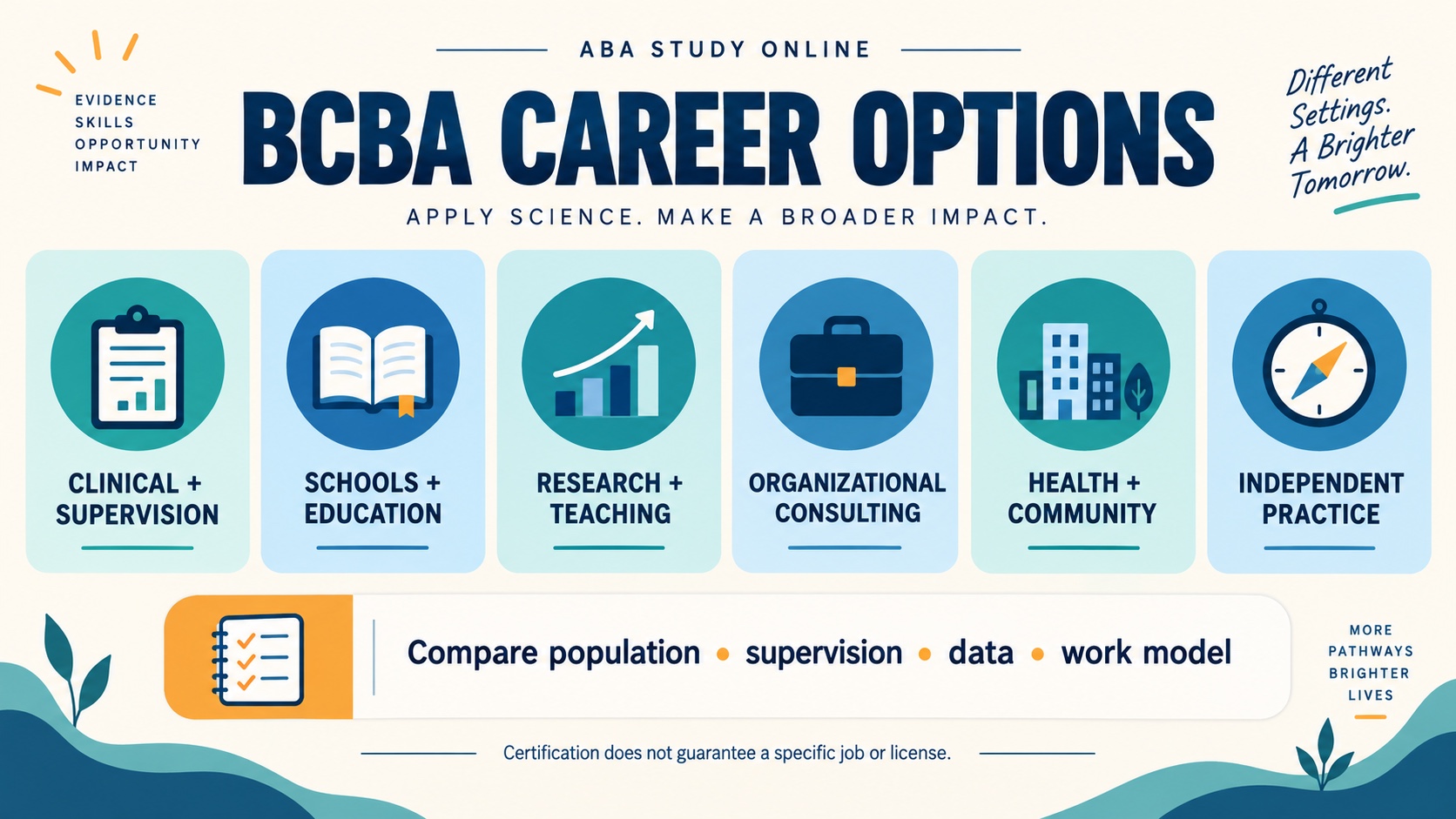
Common options include clinical services and supervision, schools and education, research and teaching, organizational behavior management or workplace consulting, health and community services, and independent or contract practice. These categories overlap. A BCBA in a clinic may train caregivers, supervise RBTs, analyze data, write reports, and coordinate with other professionals; a BCBA in a school may work on educational goals, staff support, and classroom systems.
Instead of asking which setting is “best,” ask which work model fits the kind of decisions you want to make each week.
Six common BCBA career settings
1. Clinical services and supervision
Clinical roles may involve assessment, treatment planning, data review, caregiver collaboration, staff training, and supervision of people implementing behavior-analytic services. Some employers focus on one population; others serve people across ages or support needs. Ask how much of the role is direct clinical decision-making, supervision, documentation, meetings, and travel.
2. Schools and education
School-based behavior analysts may collaborate with teachers, special-education teams, administrators, and families. The work can include classroom observation, behavior support planning, staff coaching, data systems, and consultation around educational access. The role is shaped by the school’s policies, student goals, schedule, and any state or district requirements.
3. Research and teaching
Research and teaching roles may include designing studies, evaluating programs, supervising student projects, teaching behavior analysis, or translating evidence into practice. These paths can be connected to universities, service organizations, training teams, or research partnerships. A BCBA credential may support the work, but a specific academic or research position can require additional degrees, publications, or experience.
4. Organizational consulting
Organizational behavior management applies behavior-analytic principles to workplace performance, training, safety, quality, and systems. A consultant may analyze workflow, define measurable outcomes, design feedback systems, and evaluate whether an intervention changes performance. The client may be a company or team rather than an individual receiving clinical services.
5. Health and community services
BCBAs may work in community programs, health-related services, adult services, public agencies, or nonprofit organizations. The work might involve behavior support, staff development, program evaluation, or coordination across a service network. Verify the role’s scope, funding rules, documentation expectations, and required licenses before accepting the job title at face value.
6. Independent or contract practice
Independent practice can offer more control over scheduling, services, and business decisions, but it also brings responsibility for contracts, documentation, supervision, referrals, ethics, billing, risk management, and local legal requirements. “Independent” does not mean working without professional standards or collaboration.
How responsibilities change by setting
The same credential can lead to very different weeks. One job may emphasize client-facing assessment and caregiver meetings. Another may emphasize staff training, data dashboards, or program evaluation. Some roles include supervision of RBTs or BCaBAs; others focus on consultation or research and have no ongoing direct-service team.
Read job descriptions for verbs, not only nouns. “Analyze,” “supervise,” “train,” “design,” “consult,” “document,” “present,” and “coordinate” reveal the work more clearly than “behavior analyst” alone. Ask what percentage of time is allocated to each responsibility and how success is measured.
Questions to compare before choosing
- Population: Who receives the service, and what needs or age range are common?
- Supervision: Who will supervise you, and whom might you supervise?
- Data: Which measurement, reporting, and software systems are used?
- Work model: Is the role on-site, hybrid, remote, travel-based, or contract?
- Collaboration: Which teachers, clinicians, caregivers, or administrators are part of decisions?
- Support: What onboarding, mentoring, caseload review, and professional development are available?
These questions help you compare two jobs with the same title. They also help you notice whether the role matches the kind of behavior-analytic practice you want to build.
Pay attention to the relationship between responsibility and support. A role that includes a large caseload, multiple supervisees, travel, or complex reporting should explain how consultation, scheduling, documentation time, and professional development are handled. The title may sound appealing, but the actual support structure often determines whether the work is sustainable.
Ask these questions before you accept the role, not after the first difficult month. Write them down before deciding.
Certification, licensure, and job claims
The BACB offers certifications at different experience levels and explains that BCBAs can independently provide behavior-analytic services and supervise others within their role. State licensure, employer policies, payer rules, and scope-of-practice requirements may add conditions. A BCBA certification should not be presented as automatic permission to practice in every location or setting.
Be careful with career pages that promise a specific salary, guaranteed employment, or a single “best” setting. Outcomes depend on geography, experience, employer, role design, licensure, and demand. Treat those claims as questions to verify, not as facts about every BCBA.
A practical career-research routine
- Write down the population and type of work you want to explore.
- Collect three job descriptions from different settings.
- Highlight the verbs and compare supervision, data, schedule, and collaboration.
- Speak with a professional who works in the setting, using respectful questions.
- Check the current handbook, local licensure information, and employer requirements before making a credential or job decision.
The best career option is often the one whose daily decisions fit your values, skills, and preferred way of collaborating. You do not need to choose a permanent identity from one job title. Start with a setting, learn what the work actually requires, and revise your plan as you gain experience.
FAQ and official sources
Can BCBAs work outside autism services?
Behavior analysis can be applied across settings and populations, but the role must fit the practitioner’s competence, employer requirements, ethics obligations, and applicable law. Review the actual position rather than assuming that every BCBA job has the same scope.
Can a BCBA supervise RBTs and BCaBAs?
The BACB identifies supervision of RBTs and BCaBAs as part of the professional infrastructure, subject to the relevant handbook and supervision requirements. A job description should explain the training, support, and documentation expected.
Does BCBA certification guarantee a job?
No. Certification demonstrates that the credential requirements have been met; it does not guarantee employment, salary, licensure, or a specific career path.
Official sources: Review the BCBA Handbook, BACB employer resources, consumer resources, and supervision and training guidance.