BCBA Assessment: What It Means in the 6th Edition Outline
When someone searches for “BCBA assessment,” they may be asking two related questions. What does a practicing BCBA assess, and what does the current BCBA exam expect a candidate to understand about assessment? The useful answer is not a list of tests. Assessment is a structured way to gather information, evaluate strengths and needs, understand environmental patterns, and decide what should happen next.
The current BCBA Test Content Outline (6th ed.) places Behavior Assessment in Domain F. It contains eight tasks and 23 scored questions. That makes assessment an important study area, but the outline is an exam blueprint, not a clinical protocol. This guide connects the study terms to a practical evidence-to-decision process without turning a general article into advice for a specific client.
Quick answer: BCBA assessment is the process of selecting and interpreting information that helps a behavior analyst understand a client’s strengths, needs, preferences, behavior patterns, and context. Depending on the question, the BCBA may review records, assess skills, conduct a preference assessment, collect descriptive data, or design a functional analysis. These methods do not answer the same question, and not every case requires every method.
Where assessment appears in the 6th edition outline
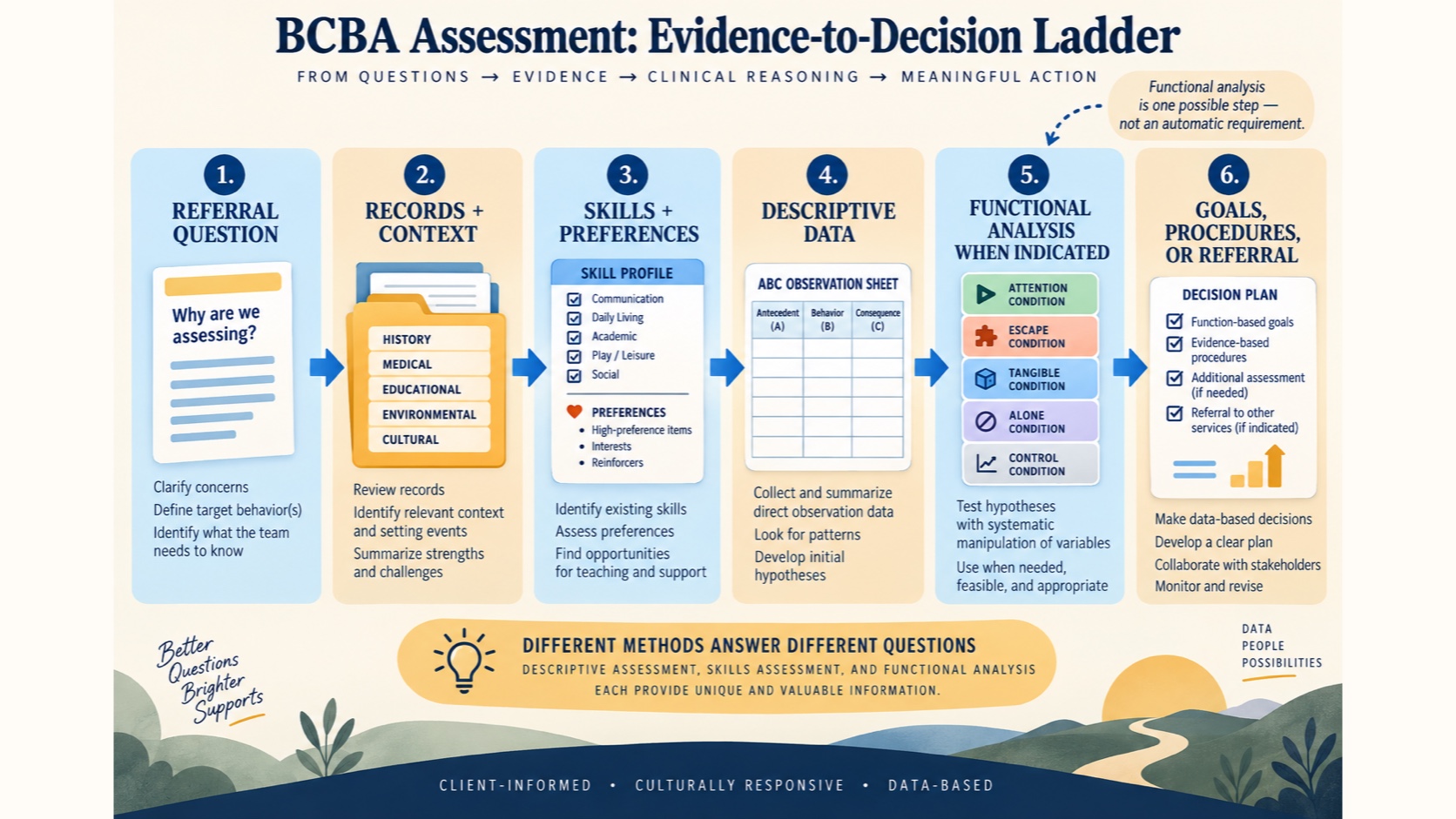
The 6th-edition outline contains 104 tasks across nine domains. Domain F, Behavior Assessment, has 23 scored questions. Its eight task areas ask the learner to:
- identify relevant information in records at the outset of a case;
- integrate relevant cultural variables into the assessment process;
- design and evaluate assessments of skill strengths and areas of need;
- design and evaluate preference assessments;
- design and evaluate descriptive assessments;
- design and evaluate functional analyses;
- interpret data to determine the need for behavior-analytic services or referral; and
- interpret data to prioritize socially significant, client-informed, and culturally responsive goals and behavior-change procedures.
One common study mistake is to treat the question count as if it were a clinical priority ranking. The 23-question weight tells you how the exam blueprint allocates scored content. It does not mean that one client’s assessment should be chosen by exam percentage, or that a domain with fewer questions is unimportant in practice.
The questions different assessments answer
Records and context help you understand the history surrounding the referral. Relevant information may include educational, medical, developmental, service, and prior intervention records. The point is not to collect every document. The point is to identify information that changes what you need to ask, observe, or refer.
Skill assessment asks what a learner can already do, under what conditions, and where performance breaks down. A useful assessment distinguishes a missing skill from a performance problem. If the learner can perform a response with a prompt but not independently, the next question is different from a situation in which the response has never been taught.
Preference assessment helps identify items, activities, or events that may function as reinforcers under particular conditions. A preference is not automatically a reinforcer. The learner’s behavior after a consequence gives you additional information about whether that consequence changes responding.
Descriptive assessment records events as they occur in the natural environment. ABC notes, scatterplots, direct observation, and other descriptive approaches can reveal patterns worth testing. A pattern is not the same as proof of a functional relation. “The behavior often followed a demand” is a descriptive statement; it is not by itself a conclusion that escape maintained the behavior.
Functional analysis arranges environmental conditions to evaluate whether changes in those conditions produce corresponding changes in behavior. This is different from simply observing what happens. A functional analysis can be highly informative, but the design, safety, setting, and professional responsibilities must be considered by qualified practitioners. A study article should teach the distinction, not tell a reader to run one independently.
A practical assessment decision ladder
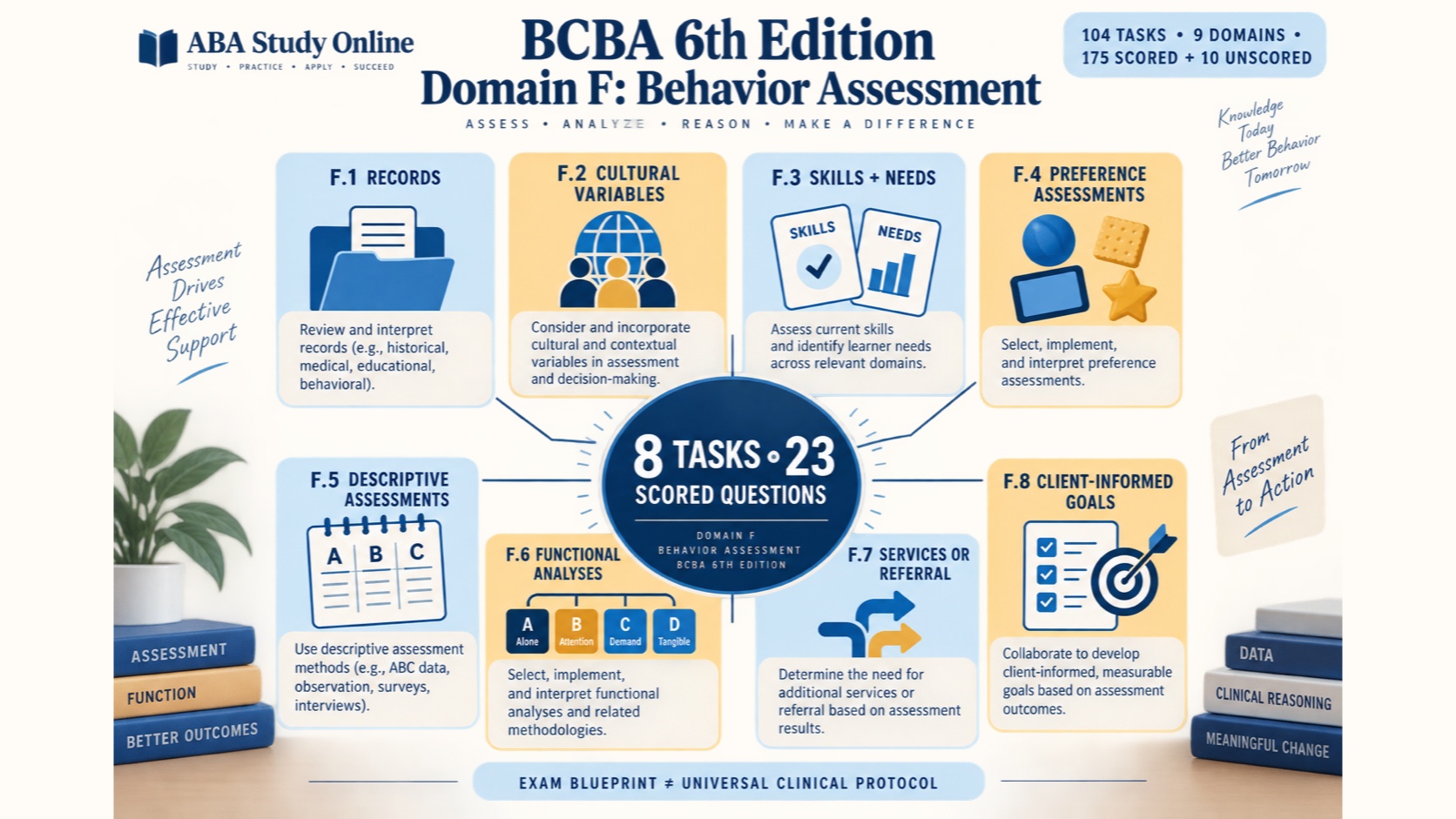
For study purposes, imagine the process as a ladder rather than a single test:
- Clarify the referral question. What decision is the team trying to make? A service-need question, a skill-teaching question, and a function question are not interchangeable.
- Review records and context. Identify history, current priorities, environmental variables, communication needs, and cultural variables that affect how information should be collected and interpreted.
- Assess skills and preferences when relevant. Determine what the learner can do, what supports performance, and what choices are meaningful before designing a teaching or reinforcement plan.
- Collect descriptive information. Define the target response, observe the context, and record antecedent and consequence events without smuggling conclusions into the data.
- Consider a functional analysis when the question and conditions support it. This is the point at which an experimental evaluation may be considered by a qualified professional, not an automatic step in every referral.
- Interpret and prioritize. Translate the evidence into goals and procedures that are socially significant, client-informed, culturally responsive, feasible, and within professional scope. Refer when the information points beyond the question or competence of the current team.
An original study scenario
Imagine a learner who rarely begins a classroom writing routine. A rushed conclusion might label the behavior “noncompliance” and jump to a consequence. A stronger assessment process asks what decision the team needs to make.
First, a record review shows that the writing task changed recently and that the learner uses a communication system. A skill assessment shows the learner can copy short words when the response is broken into smaller steps, but has difficulty starting from a blank page. A preference assessment identifies drawing and choosing the next topic as meaningful options. Descriptive observations show that the delay is longest when the instruction is broad and the materials are not visible.
These data do not prove a single function, and they do not justify a universal intervention. They do create a more precise next question: can the team improve initiation by clarifying the task, offering a meaningful choice, and teaching a smaller first response while measuring what happens? The team can then define the response, choose a feasible measurement method, and review whether the plan improves the behavior without removing dignity or choice.
For an exam question, the key is to match the method to the question. For practice, the key is to keep the observable data separate from the hypothesis and to let the next decision determine what information is needed.
How to interpret assessment information
Interpretation is more than spotting a pattern. Ask whether the data are valid enough for the decision, whether the observation represents the relevant context, and whether the people affected by the plan recognize the goal as important. A technically neat graph can still represent the wrong response or an unrepresentative setting.
Client-informed and culturally responsive assessment also changes the conversation. The team should consider communication preferences, family and community context, language, routines, and the learner’s experience of the goal. These variables are not decorative additions to a standard form. They can change how the referral question is understood, how consent and collaboration occur, and which outcomes are actually meaningful.
Finally, assessment can lead to referral. A BCBA should not treat every question as an invitation to provide every service. If the available information suggests a medical, educational, psychological, or other issue outside the current scope, the responsible decision may be consultation or referral alongside behavior-analytic support.
Common BCBA assessment mistakes
- Calling every observation an FBA conclusion: descriptive patterns are useful, but correlation is not automatically a demonstrated function.
- Using a functional analysis as a synonym for assessment: functional analysis is one assessment method among several.
- Skipping the referral question: collecting more data is not the same as collecting decision-relevant data.
- Confusing preference with reinforcement: a selected item still needs to be evaluated in relation to later behavior.
- Ignoring cultural and client priorities: a technically measurable goal can still be socially irrelevant or poorly matched to context.
- Turning Domain F into a pass formula: the 23-question weight guides study coverage, not clinical ranking or a score guarantee.
- Writing conclusions into the data sheet: record what occurred first, then state the hypothesis and level of confidence separately.
How to study the assessment domain
Build a small study grid with three columns: question, method, and decision. Put a scenario in the first column, select the assessment method that could answer it in the second, and write what the team would do with the result in the third. Then add one limitation or ethical consideration.
Use the BCBA Theory Blocks to review assessment vocabulary, BCBA practice questions to compare methods in scenarios, and the ABA Definition Search when terms such as descriptive assessment, functional analysis, or social validity feel too similar. The ABC Data Sheet can support objective observation practice, but a printable tool does not turn a study session into a clinical assessment.
BCBA assessment FAQ
What is included in a BCBA assessment?
It depends on the referral question and context. Study materials commonly discuss records, skill strengths and needs, preference assessments, descriptive assessments, and functional analyses. These methods answer different questions, and a qualified professional selects and interprets them for the case.
Is an FBA the same as a functional analysis?
No. Functional behavior assessment is a broader process that can include record review, interviews, direct observation, and other methods. A functional analysis is an experimental assessment in which environmental conditions are arranged to evaluate functional relations.
How many BCBA exam questions cover behavior assessment?
The current 6th-edition outline assigns 23 scored questions to Domain F, Behavior Assessment. The full exam also includes 10 unscored pilot questions, so the domain weight is a study-planning reference, not a personal score prediction.
Does every BCBA assessment require a functional analysis?
No. The appropriate method depends on the question, available information, safety, context, client priorities, and professional competence. The article’s ladder is a study framework, not a universal clinical sequence.