BCBA and ABA: What Is the Connection?
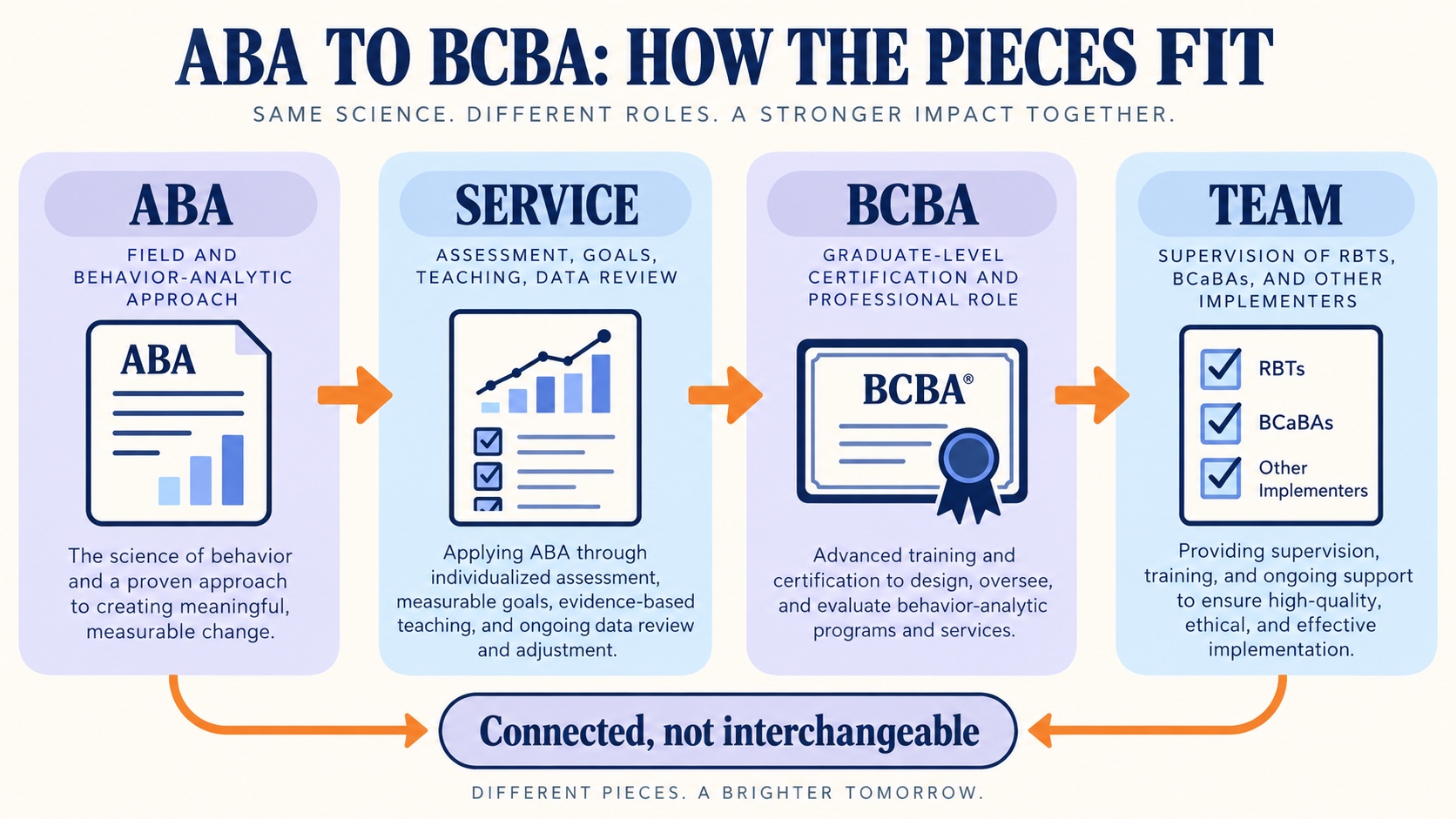
If you searched for BCBA ABA, you may be trying to understand whether they mean the same thing. They do not. Applied behavior analysis, or ABA, is a field and approach for understanding behavior and designing evidence-informed support. A Board Certified Behavior Analyst, or BCBA, is a professional who has earned a graduate-level BACB certification in behavior analysis and may provide behavior-analytic services within the rules that apply to the person’s role, setting, and jurisdiction.
That distinction makes the rest of the vocabulary easier. ABA describes the work and the science behind it. BCBA describes one qualified professional role that can assess, design, supervise, and evaluate behavior-analytic services. This guide maps the relationship without treating certification as a state license or promising that one credential authorizes every service or payer arrangement.
Table of Contents
Short answer: BCBA versus ABA
ABA is a discipline and service approach. BCBA is a BACB certification and professional role. A BCBA may use behavior-analytic concepts to evaluate needs, define measurable goals, design interventions, analyze data, collaborate with caregivers or teams, and supervise other people who implement parts of a plan. The exact scope of practice still depends on applicable law, employer policy, payer rules, competence, and the client’s needs.
One useful sentence to remember is: ABA is what the field does; a BCBA is one professional who is qualified to lead or provide parts of that work. The sentence is a learning shortcut, not a substitute for a current handbook or local regulation.
What ABA means
Applied behavior analysis focuses on behavior that matters in real life and on the environmental variables that influence it. In practice, a behavior-analytic team may define a target behavior in observable terms, collect data, look for patterns, teach a useful replacement skill, and review whether the plan is producing meaningful change. The goal is not simply to make a chart look better. The goal is to understand what is happening and support outcomes that matter to the person and the people involved.
For example, suppose a learner leaves a table when a difficult task begins. A careful team would not stop at the label “noncompliance.” It might describe when leaving occurs, what happens immediately before and after it, whether the task is too hard or too long, and which communication or break skill could be taught. Data and direct observation would guide the next decision. That example illustrates behavior-analytic problem solving; it does not by itself identify who may provide the service.
What a BCBA does
The BACB describes the BCBA as a graduate-level certification in behavior analysis. BCBAs are independent practitioners who can provide behavior-analytic services and supervise the work of RBTs, BCaBAs, and other professionals who implement behavior-analytic interventions. In a real service setting, a BCBA may be responsible for connecting assessment, goals, teaching procedures, data review, caregiver collaboration, supervision, and ethical decision-making.
“Independent practitioner” does not mean “free from every other rule.” A BCBA still needs to work within the current BACB handbook and Ethics Code, the limits of training and competence, applicable state requirements, employer procedures, payer documentation, and the service authorization. A BCBA certification also does not guarantee a particular clinical outcome.
How the ABA team fits together
BCBA
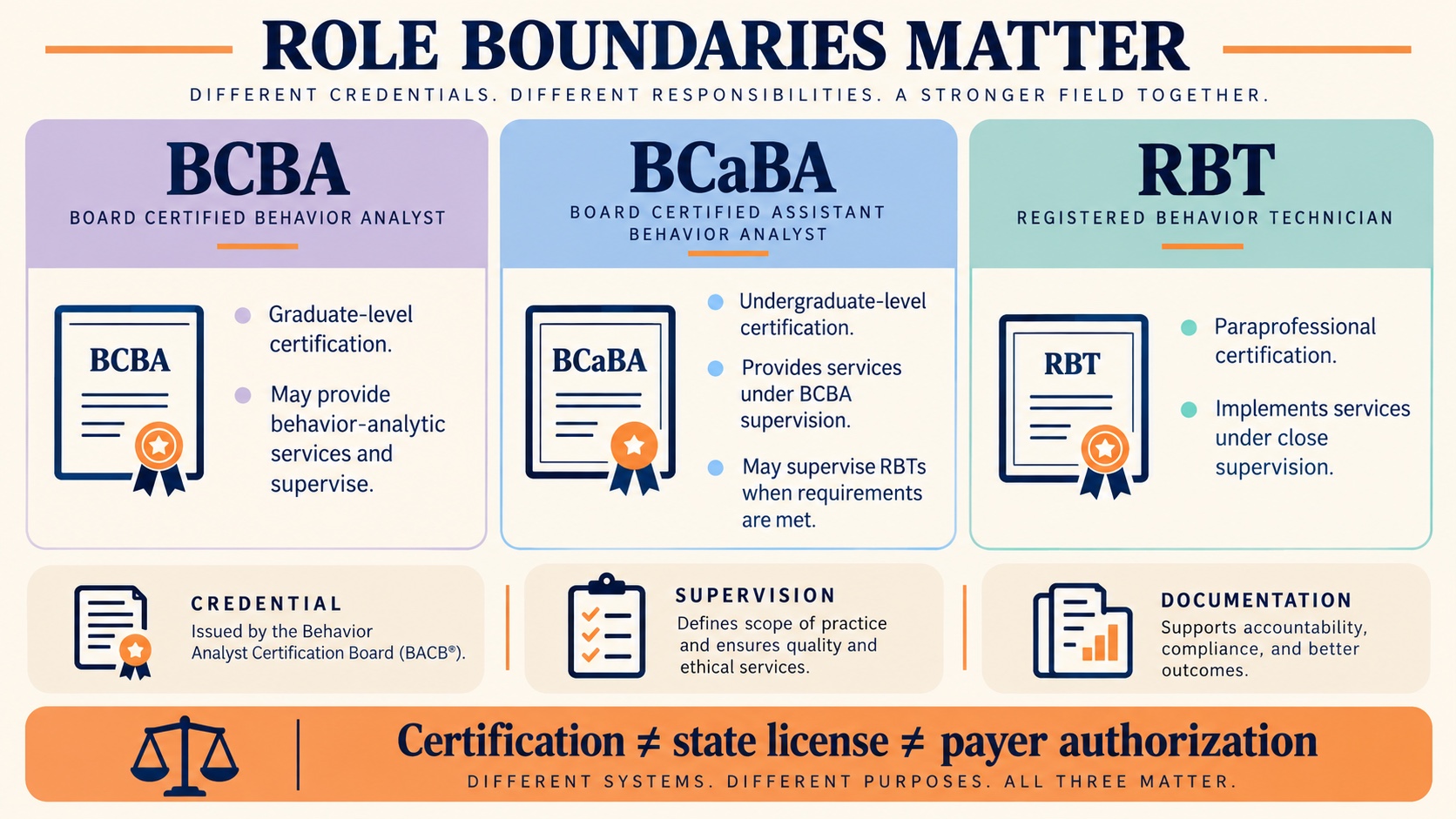
The BCBA often carries responsibility for assessment, behavior-analytic recommendations, intervention design, data-based review, and supervision. The role may include direct work with a learner or client, but it also includes coordination and oversight.
BCaBA
The BCaBA is an undergraduate-level BACB certification. BCaBAs may provide behavior-analytic services under BCBA supervision and may supervise RBT work when the applicable requirements are met. A BCaBA is not a second name for a BCBA, and the two credentials should not be merged in study notes or job descriptions.
RBT
The RBT is a paraprofessional certification for people who implement behavior-analytic services under close supervision. An RBT may practice important teaching and data-collection skills, but the RBT role is not the same as independently designing a comprehensive behavior-analytic program.
Team titles do not tell the whole story. Ask who is responsible for the assessment, who signs or approves the plan, who provides required supervision, and which organization or payer controls the documentation rules.
What to study if you are preparing for the BCBA role
Start with the difference between concepts, professional tasks, and implementation decisions. Concepts help you explain behavior and measurement. Professional tasks ask you to select, interpret, or evaluate procedures. Implementation decisions ask whether a plan is working for a particular person in a particular setting. Strong BCBA preparation connects all three instead of memorizing isolated definitions.
A useful study loop is to define the target in observable terms, identify the measurement that matches the question, describe the relevant environmental variables, choose the least intrusive effective teaching or behavior-change strategy, and decide what data would support a change. Then add the professional boundary: who can perform the task, what supervision is required, what consent or assent considerations apply, and which source should be checked before practice. This loop mirrors the way ABA knowledge becomes responsible service rather than just exam vocabulary.
For practice, compare short cases that use similar words but require different decisions. For example, “BCBA” may be the answer when the question asks who designs or supervises a program, while “ABA” may be the answer when the question asks which field or approach uses functional, measurable, data-based procedures. The distinction is small in wording but important in reasoning.
Important boundaries
- ABA is not a credential. People may study ABA, work in an ABA setting, or receive ABA services without all holding the same certification.
- BCBA is not automatically a state license. State laws may add licensure, registration, supervision, or title rules.
- Certification is not payer authorization. An employer or payer may require separate enrollment, documentation, or service approval.
- Supervision is a real responsibility. Delegating implementation does not erase the supervisor’s duty to meet current requirements and protect service quality.
- ABA is not a single technique. A plan should be selected from assessment, evidence, ethics, client priorities, and data—not from a label alone.
How to read the phrase in a job or course description
When a course, clinic, or job description says “BCBA ABA,” translate the phrase into a more precise question. Is it describing a BCBA exam-preparation track, an ABA service delivered by a BCBA, a supervision position, or a degree program in behavior analysis? Those destinations have different requirements and different evidence. A study course can explain concepts and provide practice questions, but it cannot grant BACB certification. A clinic may employ BCBAs and RBTs, but its team structure does not replace the BACB’s current rules. A university program may teach ABA content, but degree eligibility still depends on the pathway and date that apply to the student.
This translation habit helps prevent a common error: using one broad phrase as if it answered every professional question. Identify the activity first, then check the credential, supervision, legal, and payer source that governs it.
What to know about 2027 BCBA changes
The BACB has published 2027 BCBA requirements and transition guidance. The changes affect eligibility and maintenance planning, including the pathways available to people applying beginning January 1, 2027. That is a certification transition, not a redefinition of ABA and not a new meaning for the letters BCBA.
If you are planning a BCBA pathway, use the current BCBA Handbook and the official 2027 documents together. Check the degree, behavior-analytic content, supervised fieldwork, examination, and maintenance requirements that apply to your date and pathway. Do not rely on a short social-media summary or assume that a requirement for one certification level applies unchanged to another.
BCBA ABA FAQ
Is BCBA the same as ABA?
No. ABA is the field and service approach. BCBA is a professional certification and role within behavior analysis.
Does every ABA provider need to be a BCBA?
No. An ABA team can include different roles with different training and supervision requirements. The BCBA is the credentialed role responsible for the work assigned to that professional, not a label for every person on the team.
Can a BCBA work independently?
The BACB describes BCBAs as independent practitioners, but independence from BCBA supervision does not remove state, employer, payer, ethical, or competence boundaries.
Does the 2027 change create a new ABA certification?
No. The 2027 materials describe changes to BCBA eligibility and maintenance requirements. Use the official transition documents for the pathway and date that apply to you.