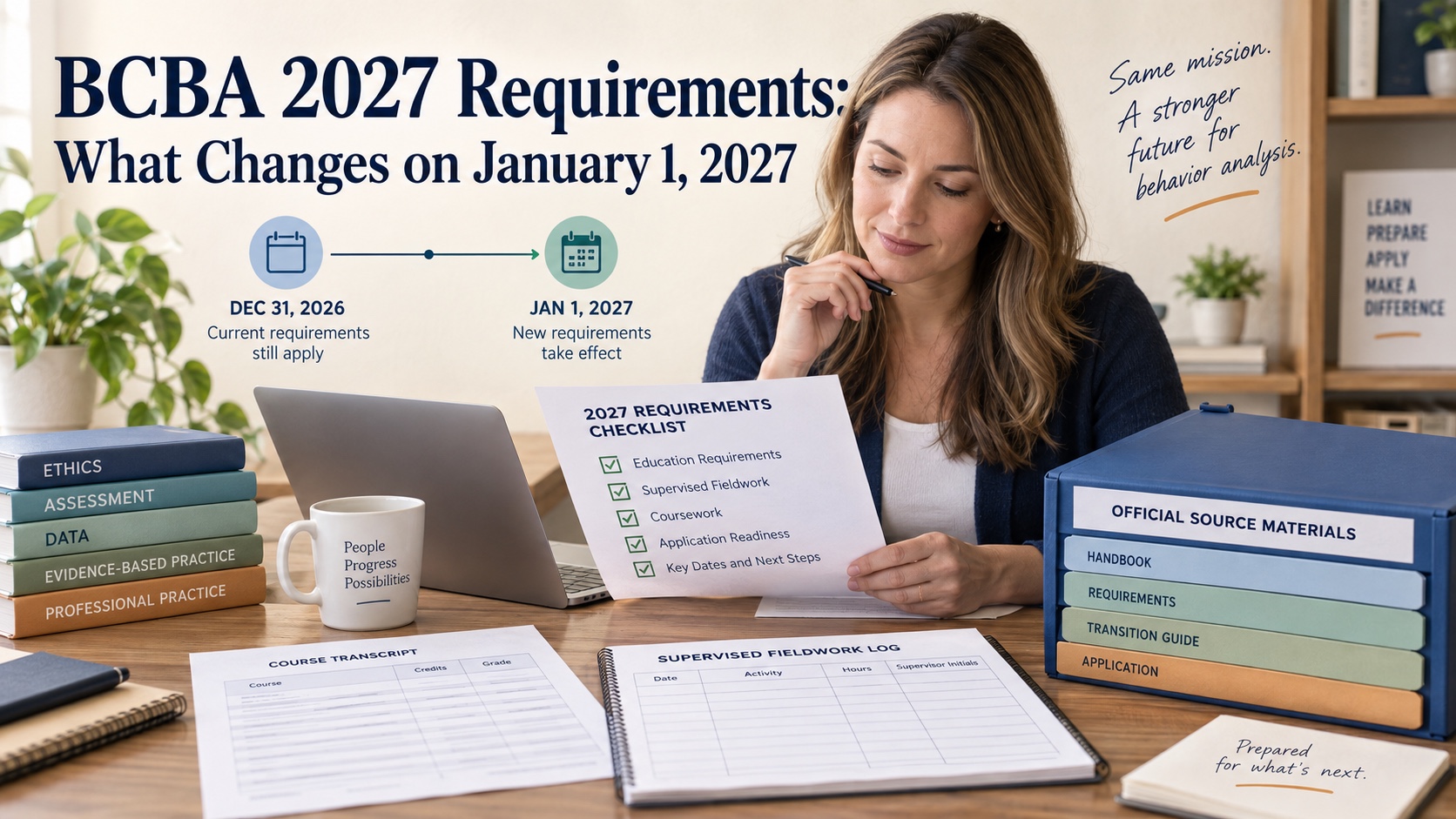
BCBA 2027 Requirements: What Changes on January 1, 2027
If you are searching for BCBA 2027 requirements, the most important question is not simply “What is new?” It is “Which requirements will apply to my application, and which documents should I verify now?” The BACB has published a transition date, new eligibility pathways, and guidance for applicants whose coursework was completed under the 2022 requirements.
This guide explains the official transition in plain language. It is a planning overview, not an eligibility decision. Your complete application, degree history, coursework, fieldwork records, and timing matter. Use the current BACB handbook and transition documents for the final interpretation of your situation. Also keep one distinction clear: a change to certification eligibility requirements is not automatically a new BCBA examination edition.
Quick answer: new BCBA certification eligibility requirements take effect January 1, 2027. The BACB says a complete application—including payment and all required documents—must be received by December 31, 2026 to be reviewed under the current 2022 requirements. Beginning in 2027, applicants may apply through two pathways: an accredited or recognized program pathway, or a behavior-analytic coursework pathway. The official transition guidance does not establish that the BCBA examination becomes a “7th edition” in 2027.
That date creates two planning questions. First, which rule set applies to your application timing? Second, if you apply under the 2027 requirements, which degree, coursework, fieldwork, and examination conditions must you document? Answer those questions from the official sources rather than from a study-app label, social-media summary, or an old checklist.
What changes on January 1, 2027
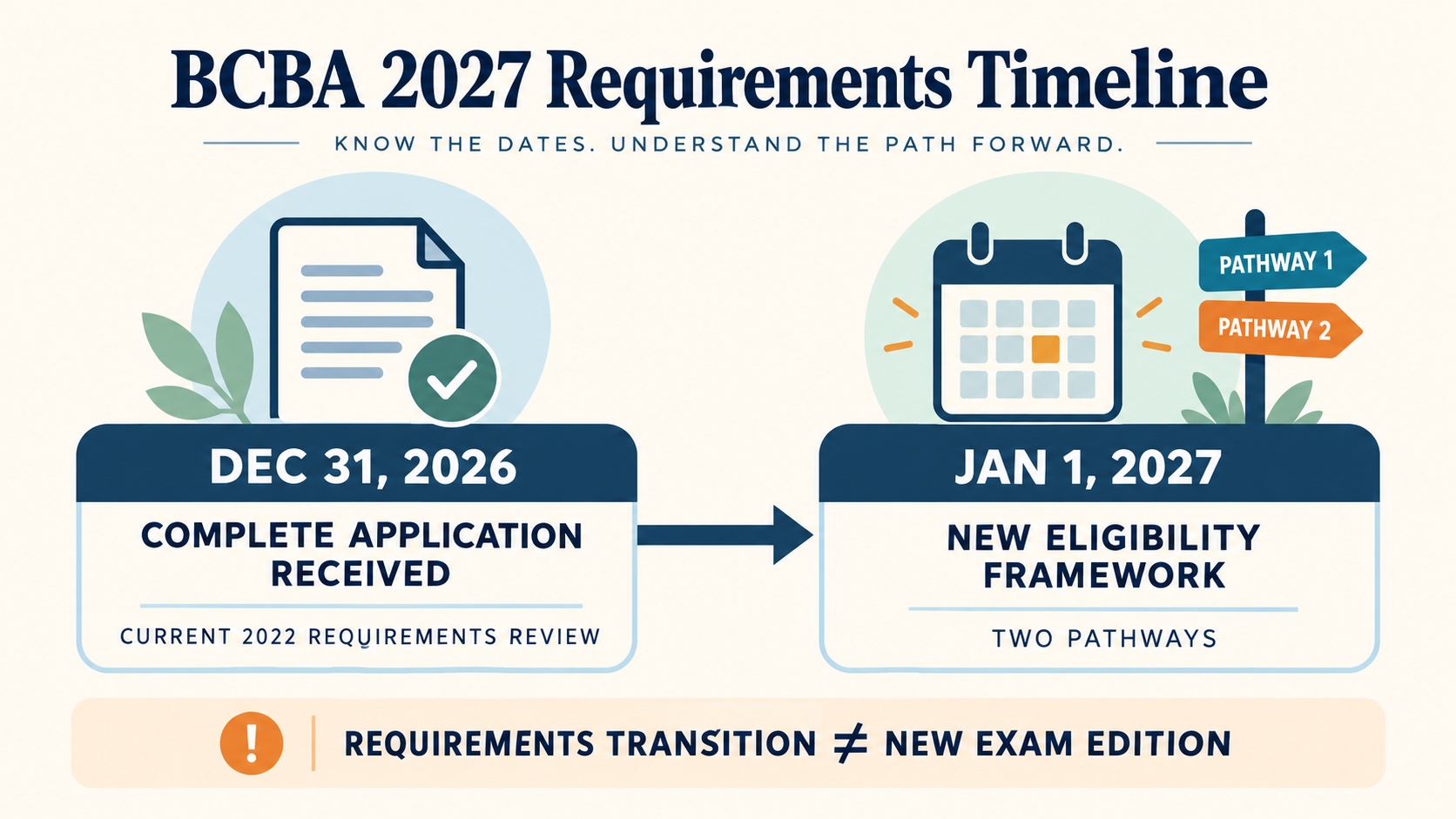
For applications reviewed under the current 2022 requirements, the BACB identifies December 31, 2026 as the date by which the complete application must be received. “Complete” matters. Sending a form before the deadline is not the same as having the required documents and payment received and ready for review. If your timing is close, read the BACB transition guidance and contact the appropriate official channel rather than relying on a general article.
For applications beginning January 1, 2027, the 2027 eligibility framework applies. The change affects certification eligibility and maintenance requirements. It should be studied separately from the current BCBA Test Content Outline used for examination preparation. A requirements transition can change how you document a degree or coursework without creating an examination “7th edition.” Check the current examination page for exam-specific information.
The two 2027 eligibility pathways
Starting January 1, 2027, the BACB describes two BCBA eligibility pathways. Both involve a graduate degree, applied behavior-analytic preparation as required by the pathway, supervised fieldwork, and passing the BCBA certification examination. The difference is how the degree program and behavior-analytic content are established.
- Pathway 1: accredited or recognized program. The degree comes from an APBA-accredited program or an ABAI-accredited or recognized behavior-analysis degree program under the categories described by the BACB. The program and degree details must be checked against the current official requirements.
- Pathway 2: behavior-analytic coursework. The applicant has a master’s degree or higher and completes the required behavior-analytic coursework, including the 2027 content and freestanding-course conditions where applicable.
The degree requirements for Pathways 1 and 2 do not change in the same way as the Pathway 2 coursework structure. That does not mean any graduate degree automatically satisfies the route. Review the degree date, program status, coursework records, and handbook language together. Your university advisor or program coordinator can help you locate transcripts and course descriptions; the BACB remains the authority for certification eligibility.
How Pathway 2 coursework changes
The transition guide keeps the total at 315 content hours while changing the way several areas are organized and named. The point is not only the number of hours. Some areas must be covered in freestanding courses, meaning the required content makes up the majority of that course.
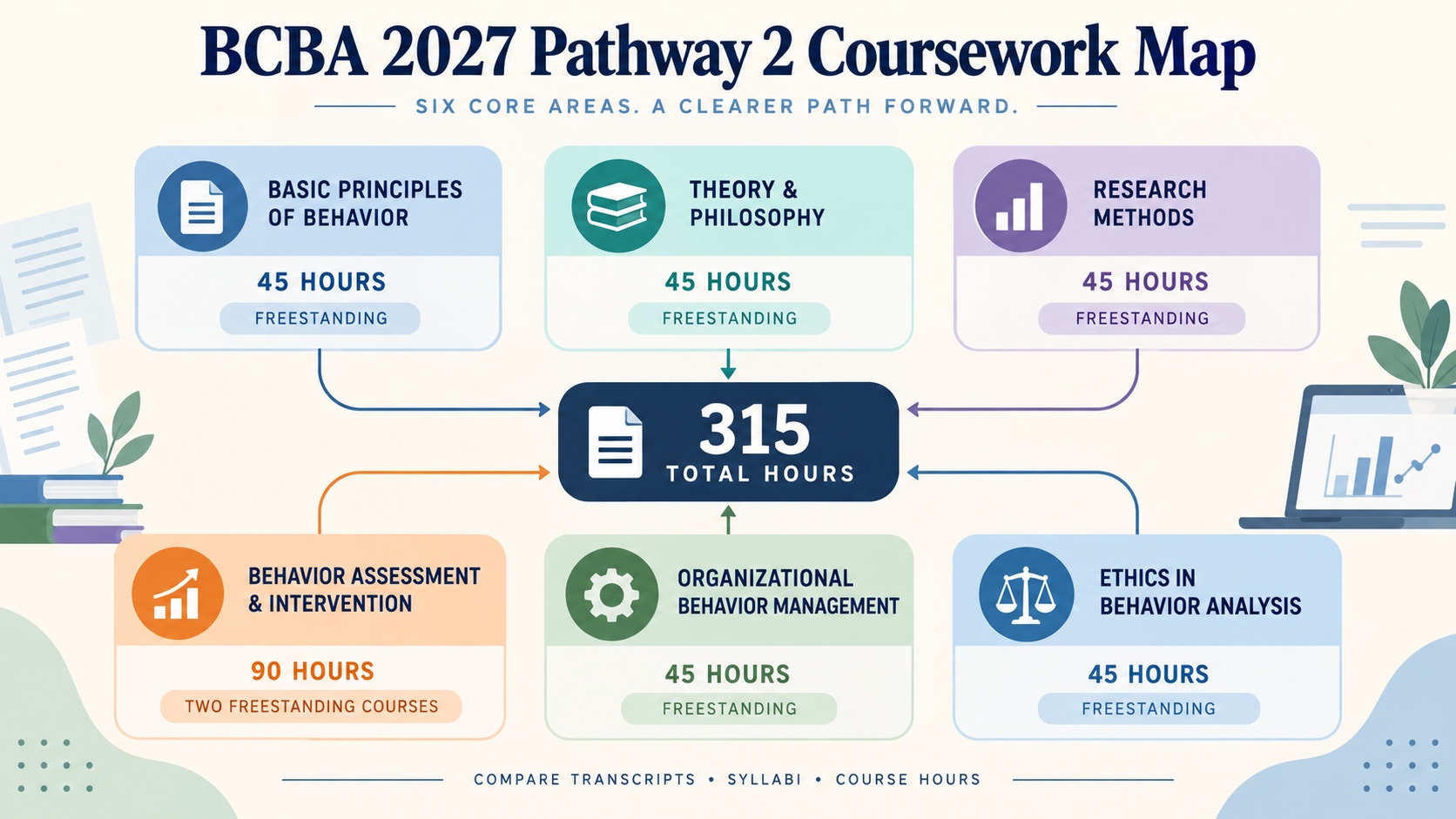
The official conversion table maps the 2022 content areas to the 2027 structure:
- Basic Principles of Behavior: 45 hours in one freestanding course.
- Theory and Philosophy in Behavior Analysis: 45 hours in one freestanding course.
- Research Methods in Behavior Analysis: 45 hours in one freestanding course.
- Behavior Assessment and Intervention: 90 hours across two freestanding courses.
- Organizational Behavior Management: 45 hours in one freestanding course; this area was previously described as Personnel Supervision and Management with 30 hours under the older framework.
- Ethics in Behavior Analysis: 45 hours in one freestanding course.
If earlier coursework combined assessment, intervention, supervision, or philosophical content in a way that does not match the 2027 structure, do not decide from the course title alone. Compare the transcript, syllabus, content hours, and freestanding-course requirement. The transition guidance specifically says that applicants with coursework under the 2022 requirements should review whether their prior work meets the 2027 requirements.
Fieldwork and examination boundaries
Coursework is only one part of the route. The 2027 pathways also require practical fieldwork in applied behavior analysis and a passing BCBA certification examination. The detailed fieldwork rules, supervision records, forms, and timelines belong in the current BCBA Handbook. Avoid treating a general “hours” number as sufficient evidence; the quality and documentation conditions matter too.
Examination preparation should use the current BACB examination information and BCBA Test Content Outline. The 2027 eligibility change does not authorize a study page to call the exam a 7th edition. If BACB later publishes a new examination outline or format, that official document should control the article update. Until then, separate “2027 requirements” content from the examination-version language used in study materials.
A transition-planning checklist
- Choose your likely application window: write down whether you are trying to have a complete application received by December 31, 2026 or expect to apply under the 2027 framework.
- Identify the pathway: ask whether your degree program fits the accredited or recognized program route, or whether you are documenting Pathway 2 coursework.
- Collect the records: gather the transcript, course syllabi, content-hour descriptions, fieldwork forms, supervision records, and degree or program information relevant to your route.
- Map the coursework: for Pathway 2, compare each area with the 2027 conversion table and check the standalone-course conditions.
- Verify fieldwork separately: use the current Handbook and your supervisor’s records rather than assuming coursework evidence also proves fieldwork compliance.
- Check the examination source: keep certification eligibility, examination content, and testing procedures in their own source sections.
- Recheck before submitting: use the current BACB pages on the day you prepare the application because transition requirements and forms can be updated.
Common BCBA 2027 mistakes
- Confusing a deadline with a started application: the official language refers to a complete application being received, including payment and required documents.
- Calling the change a 7th-edition exam: 2027 eligibility requirements and a test-content-outline edition are different topics.
- Matching course titles instead of course content: compare hours, syllabi, and freestanding-course conditions.
- Assuming all pathways are still available after the transition: the official guidance says Pathways 3 and 4 must be completed before January 1, 2027 if an applicant wants to use them.
- Using an old fieldwork checklist: confirm the current Handbook, forms, and supervision documentation.
- Treating a study guide as an eligibility determination: study content can help you organize, but the BACB source documents control the decision.
BCBA 2027 requirements FAQ
What is the BCBA 2027 requirements effective date?
The new eligibility framework takes effect January 1, 2027. The BACB says a complete application received by December 31, 2026 can be reviewed under the current 2022 requirements, subject to the official requirements and completeness conditions.
How many BCBA pathways are there in 2027?
The BACB describes two pathways beginning January 1, 2027: an accredited or recognized program pathway and a behavior-analytic coursework pathway. The details for degree, coursework, fieldwork, and examination must be reviewed in the current Handbook.
Does the BCBA exam become a 7th edition in 2027?
Not based on the eligibility transition alone. A new examination edition would require an official BACB test-content source. Keep the 2027 requirements article separate from the current examination outline and check official updates.
Do the 2027 coursework requirements still total 315 hours?
The official transition table retains 315 total hours for the mapped Pathway 2 coursework, while changing content names, standalone-course requirements, and allocations. Your own coursework must be compared with the official table and supporting documents.
Can I decide eligibility from this article?
No. Use this page to organize questions and records, then verify your route with the BACB Handbook, official transition guidance, program documentation, and—when needed—a qualified advisor or supervisor.
Where study content fits
Once your eligibility plan is clear, study resources have a narrower job. Use the BCBA study path to organize concepts, the BCBA practice questions to rehearse applied reasoning, and the ABA Definition Search when one term needs a cleaner explanation. These resources support learning; they do not replace the official application or eligibility review.
For the latest decision, return to the BACB’s official 2027 requirements page and current BCBA Handbook. Save the version and date of the documents you used so your planning notes do not silently rely on an older transition summary.