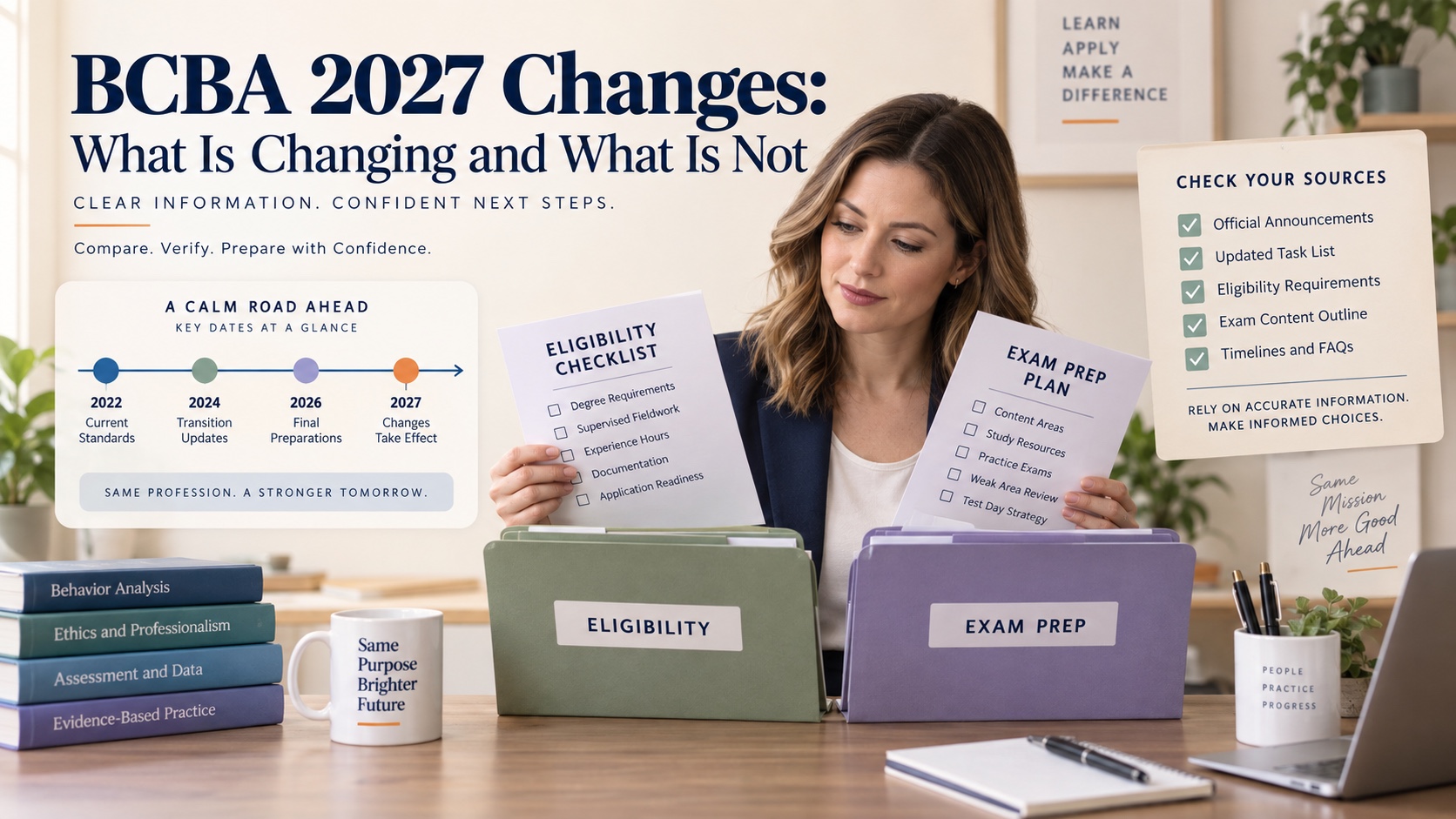
BCBA 2027 Changes: What Is Changing and What Is Not
The phrase “BCBA 2027 changes” can make several different updates sound like one event. The BACB has published changes to certification eligibility and maintenance requirements that take effect January 1, 2027. Those changes affect application timing, pathways, and coursework structure. They do not automatically mean that the BCBA examination becomes a “7th edition.”
This comparison guide separates the moving parts. You will see the transition date, the two 2027 pathways, the main Pathway 2 coursework changes, and the questions that still belong to the current Handbook or examination pages. Use it to organize your next verification step, not as a personal eligibility decision.
Quick answer: the major BCBA 2027 changes are an updated eligibility framework beginning January 1, 2027, two available pathways, and a revised Pathway 2 coursework structure. The BACB says a complete application received by December 31, 2026 can be reviewed under the current 2022 requirements. The transition is not, by itself, evidence of a 7th-edition examination.
That answer has a practical implication: use one checklist for eligibility and another for exam preparation. Mixing them is how an applicant can read a new coursework label and conclude—without an official source—that the exam has changed editions. Keep the two checklists beside each other, but do not merge them prematurely.
The 2027 change map
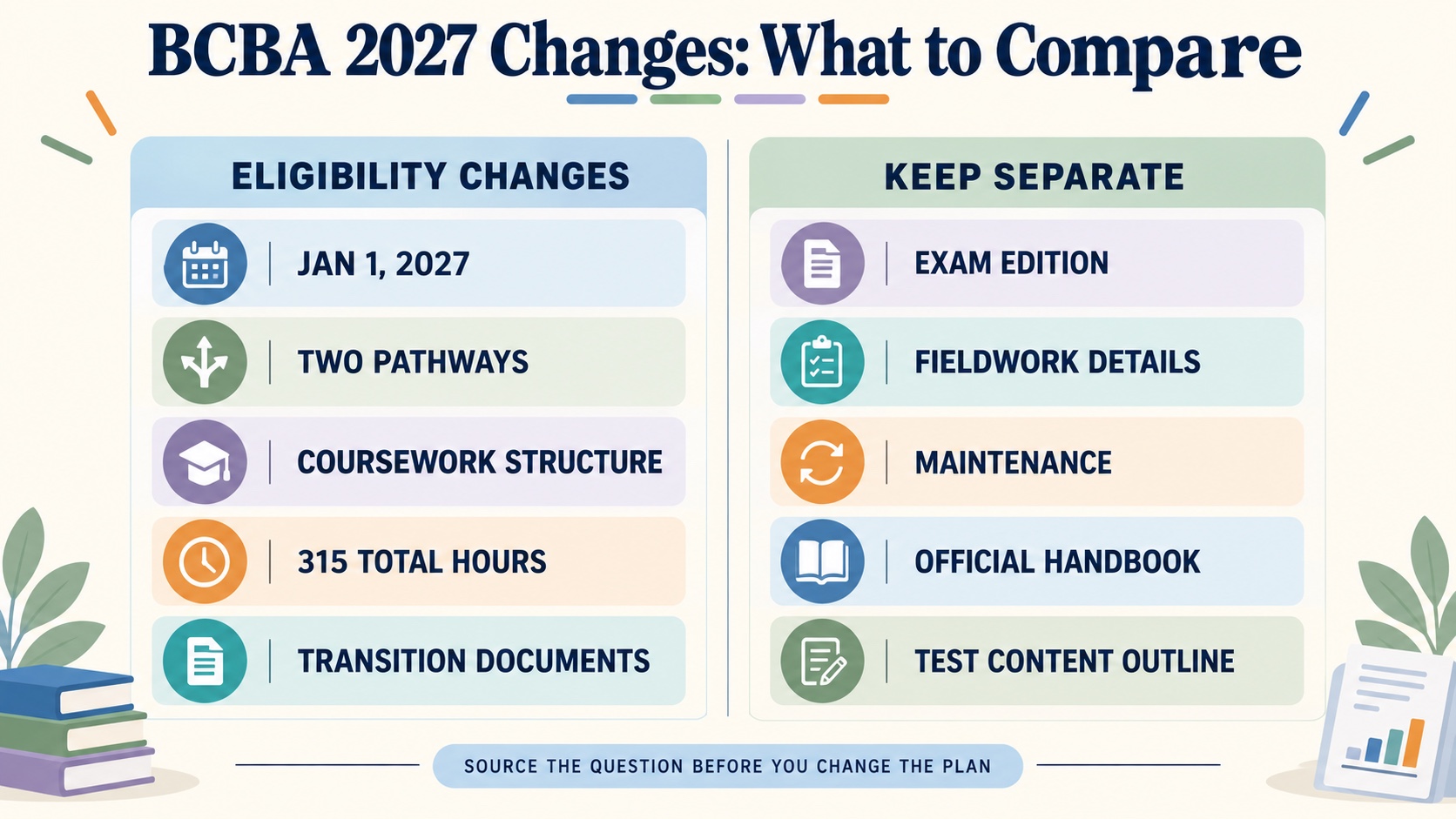
Think of the transition as four connected but distinct areas:
- Timing: January 1, 2027 is the effective date for the new eligibility framework. For current-2022 review, the complete application must be received by December 31, 2026, including payment and required documents.
- Pathways: beginning in 2027, the BACB describes an accredited or recognized program pathway and a behavior-analytic coursework pathway.
- Coursework: Pathway 2 keeps 315 total content hours but changes the organization, names, and standalone-course conditions of several content areas.
- Maintenance and records: the updated Handbook and official transition documents explain the details for certification maintenance, fieldwork, forms, and supporting evidence.
These areas overlap in a real application, but they should not be reduced to one social-media graphic or one outdated study guide. Keep the official requirements summary, Handbook, transition guide, and examination information in separate tabs in your planning folder.
The Pathway 2 coursework shift
The most visible academic change is the structure of Pathway 2 coursework. The official transition table retains 315 total hours while mapping older areas to new descriptions and freestanding-course conditions. A freestanding course means the required content makes up the majority of that course.
- Basic Principles of Behavior: 45 hours in one freestanding course.
- Theory and Philosophy in Behavior Analysis: 45 hours in one freestanding course.
- Research Methods in Behavior Analysis: 45 hours in one freestanding course.
- Behavior Assessment and Intervention: 90 hours across two freestanding courses.
- Organizational Behavior Management: 45 hours in one freestanding course.
- Ethics in Behavior Analysis: 45 hours in one freestanding course.
The comparison is not a recommendation to enroll in a course before reviewing your records. Check the transcript, syllabus, content hours, term, and freestanding-course status. If a previous course combined several areas, flag the mapping for review rather than assuming every hour transfers to every new category.
What remains a separate question
The examination edition: the eligibility transition does not announce a 7th-edition exam. Use the current BCBA Test Content Outline and examination information for test content, format, and procedures. Update the exam study plan only when BACB publishes an official exam-specific change.
Fieldwork details: the 2027 requirements page and Handbook control supervised-fieldwork conditions, documentation, and supervision records. Do not infer fieldwork compliance from coursework hours or from a generic “experience” checklist.
Maintenance: certification maintenance is related to eligibility but is not the same as initial application preparation. Check the relevant Handbook section and current BACB notices for maintenance and continuing requirements.
What does not change simply because the calendar changes? A study page does not become official because it adds “2027” to its title. A practice score does not become a BACB result. A course title does not become a compliant freestanding course because it sounds similar to a new category. A fieldwork log does not become complete because it contains a total number. Each of those conclusions still depends on the evidence and source that control the question.
This is also why a comparison article should not tell every reader to make the same purchase or enrollment decision. One applicant may need a transcript review, another may need a syllabus and course-hour audit, and another may need to clarify fieldwork documentation. The useful next step is the one that resolves the narrowest open question in your own record.
Keep two headings in your notes: eligibility evidence and exam preparation. Under the first, store pathway, degree, coursework, fieldwork, and application documents. Under the second, store the current test-content outline, study plan, practice results, and review notes. The separation makes future updates easier to apply without rewriting the whole plan.
Who needs to act
Everyone preparing for BCBA certification should check the official transition pages, but the urgency differs:
- Applicants near the 2026 boundary: verify that the application is complete, paid, and received by December 31, 2026 if you are relying on current-2022 review.
- Applicants applying in 2027: identify the 2027 pathway and compare degree, coursework, fieldwork, and examination requirements with the current Handbook.
- Pathway 2 applicants: audit the 315 hours and freestanding-course structure using transcripts and syllabi.
- Applicants considering Pathways 3 or 4: review the transition guidance because those pathways must be completed before January 1, 2027 if you want to use them.
- Current certificants: review maintenance changes separately from initial eligibility and keep using current official notices.
For example, if your application is planned for 2027 and your transcript shows a broad course that appears to combine principles, philosophy, and intervention, your next action is not to panic or count the same hours three times. Pull the syllabus, identify the content actually taught, compare it with the transition table, and ask for a review if the freestanding-course condition is unclear. That is the difference between noticing a change and responding to it accurately.
A source-routing checklist
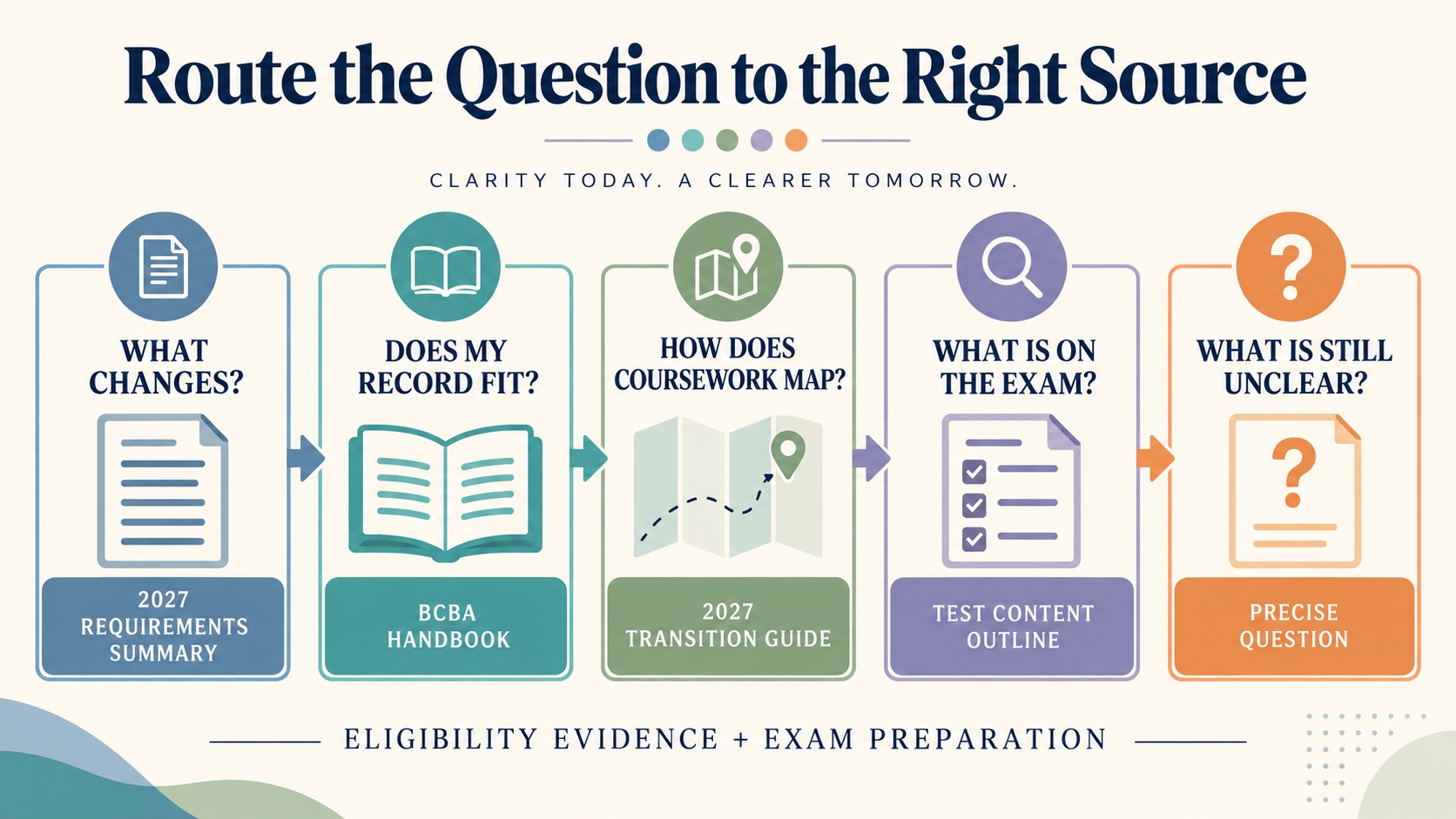
- “What changes in 2027?” Start with the BACB 2027 BCBA Requirements summary.
- “Does my record meet the rule?” Use the current BCBA Handbook and the transition guide.
- “How does my older coursework map?” Use the 2022-to-2027 conversion table and your syllabus evidence.
- “What is on the exam?” Use the current BCBA Test Content Outline and Examination Information pages.
- “What remains unclear?” Write one precise question for an advisor, supervisor, or official BACB channel.
Common misunderstandings
- “2027 means 7th edition.” Eligibility requirements and examination outlines are different source families.
- “My application was started before the deadline.” The official boundary refers to a complete application being received.
- “315 hours means every old course transfers automatically.” The 2027 structure also has freestanding-course conditions and revised content descriptions.
- “A requirements summary answers every fieldwork question.” Detailed records belong in the current Handbook and supervision documents.
- “One old checklist is enough.” Use current BACB pages and record the date and source version in your notes.
BCBA 2027 changes FAQ
What is the biggest BCBA change in 2027?
The answer depends on the applicant. The effective date, two-pathway framework, and revised Pathway 2 coursework structure are the major eligibility changes. Your own records determine which one requires the most action.
Do all applicants need to take new coursework?
Not automatically. Applicants should compare their education with the 2027 transition table and the current Handbook. Some prior coursework may fit; some may need additional evidence or further review.
Is the BCBA test changing in 2027?
Do not infer an exam-edition change from the eligibility transition. Check the official examination pages and current test-content outline for exam-specific updates.
Where should I start if my records are confusing?
Start with the official 2027 requirements summary, then compare your transcript and syllabi with the transition guide. Put any unresolved issue in a short question for your program coordinator, supervisor, or BACB channel.
Where study content fits
Once the requirements question is clear, the BCBA study path can organize concepts and the BCBA practice questions can rehearse applied reasoning. Use the ABA Definition Search for terminology. Those study resources support preparation; they do not determine eligibility, replace official forms, or announce exam changes.