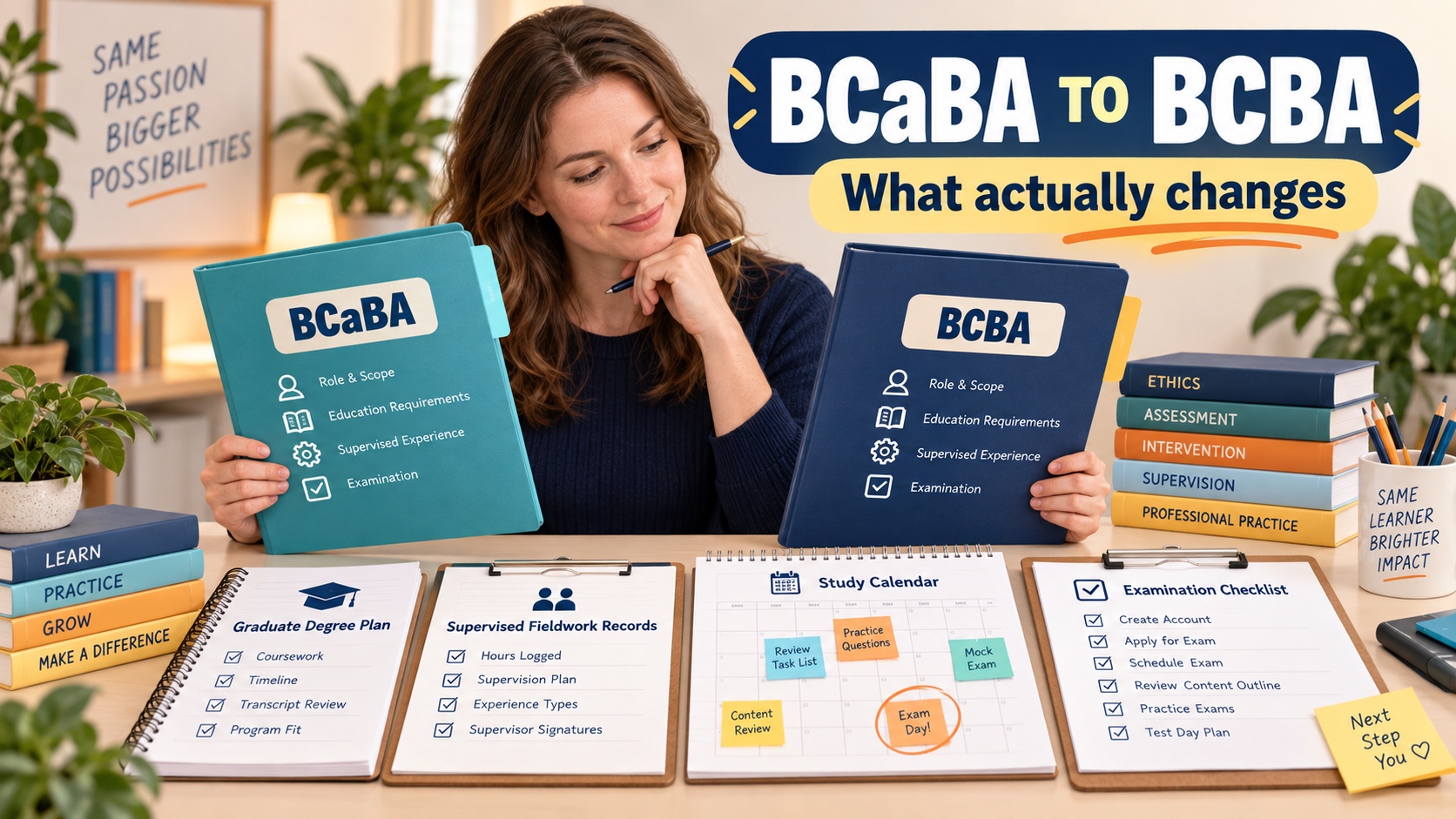
Can You Go From BCaBA to BCBA? What Actually Changes
If you are searching for a BCaBA to BCBA path, the short answer is yes: a person who holds or has pursued BCaBA certification can later pursue BCBA certification. But BCaBA certification does not automatically upgrade to BCBA, and the BCaBA credential is not a substitute for the BCBA requirements.
The practical question is not only “Can I move up?” It is “Which BCBA eligibility requirements will apply to me, which records might be useful, and what must I still complete?” This guide separates the two credentials, maps the transition, and marks the 2027 rule boundary. The current BACB Handbook and the requirements in effect when you apply control your individual case.
Table of Contents
The short answer: BCaBA is not an automatic BCBA upgrade
BCaBA and BCBA are separate BACB certifications. The BCaBA is an undergraduate-level credential. A BCaBA provides behavior-analytic services under BCBA supervision and may have responsibilities such as supervising RBT work when the applicable requirements are met. The BCBA is a graduate-level credential for independent behavior-analytic practice.
That difference creates the central rule for this search query: becoming a BCaBA can be part of someone’s professional history, but it does not turn a bachelor’s-level certification into a master’s-level certification. To become a BCBA, you must qualify through an applicable BCBA eligibility pathway, submit an application, and pass the BCBA examination. You should plan from the BCBA requirements themselves rather than treating BCaBA as a shortened application route.
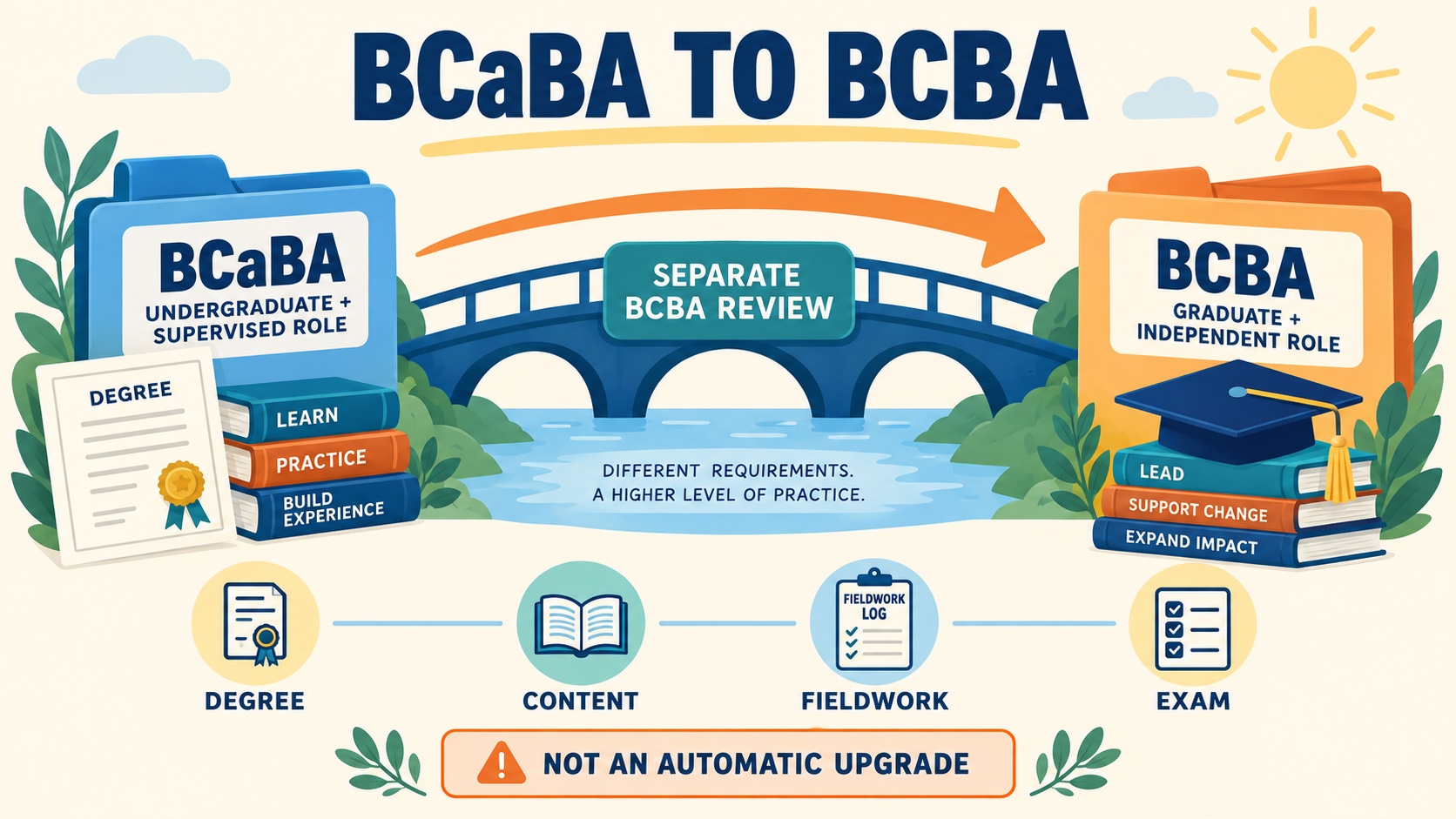
How BCaBA and BCBA are different
| Question | BCaBA | BCBA |
|---|---|---|
| Credential level | Undergraduate-level certification | Graduate-level certification |
| Practice relationship | Provides services under BCBA supervision | Independent behavior-analytic practitioner |
| Eligibility target | BCaBA degree/content, fieldwork, and exam rules | BCBA degree/content, fieldwork, and exam rules |
| Does the credential automatically convert? | No. BCBA eligibility must be established separately. | |
The table is a planning distinction, not a statement about the value of either role. BCaBA work can build applied experience, professional judgment, and familiarity with supervision. It simply does not remove the formal BCBA application requirements. Keep the credential names accurate when you describe your role to employers, clients, supervisors, and schools.
The BCaBA-to-BCBA path, step by step
1. Choose the BCBA eligibility framework that matches your application date
Start with the current BCBA Handbook, not an old forum answer or a course advertisement. The current June 2026 handbook describes the BCBA eligibility pathways and the supporting degree, behavior-analytic content, supervised fieldwork, and examination requirements. The framework that applies to you depends on when you submit the application and which requirements you have actually completed.
2. Meet the graduate-degree and behavior-analytic-content requirements
A BCaBA credential is not a graduate degree. Under the current BCBA framework, the common routes require a master’s degree or higher plus the applicable behavior-analytic content, or a qualifying accredited/recognized graduate program in which the content is built into the degree. Review the pathway language carefully: a bachelor’s degree and BCaBA coursework should not be described as satisfying the BCBA graduate-degree requirement.
If you are comparing graduate programs, check the exact pathway they support, the date their accreditation or recognition applies, and how they document behavior-analytic coursework. A program can be useful preparation without automatically making every student eligible. Keep transcripts, program information, and official attestations in the same record system.
3. Build BCBA-qualifying supervised fieldwork
BCBA fieldwork is a separate requirement. The work must be supervised and documented under the applicable BCBA rules, with the required hours, supervision, observations, activity mix, and forms. A person who worked as a BCaBA may already understand direct service, data, caregiver conversations, and team routines. That experience can be professionally useful, but do not label old hours as BCBA fieldwork without checking the supervisor arrangement, documentation, timing, and current BCBA criteria.
For an uncertain record, ask a qualified BCBA fieldwork supervisor or program advisor to review the actual documentation. The BACB’s fieldwork guidance places the activity decision with the supervisor and the applicable handbook. An online article, spreadsheet, or app cannot approve a fieldwork hour.
4. Apply for and pass the BCBA examination
After the education and fieldwork pieces are ready, submit the BCBA application through the BACB process and schedule the examination if approved. The BCaBA examination is not the BCBA examination, so passing one does not waive the other. Use the current BCBA examination information and the applicable test content outline when you build your study plan.
5. Keep your credential language accurate while you transition
Until BCBA certification is granted, do not present yourself as a BCBA. If you hold an active BCaBA credential, continue to follow its supervision and maintenance rules while you work toward BCBA eligibility. The June 2026 BCBA Handbook says a certificant may hold only one BACB certification at a time; when a higher-level certification is obtained, the lower-level certification expires after a 180-day period. That is a transition rule after the new certification is obtained, not an automatic upgrade before application and examination.
What your BCaBA experience may—and may not—carry over
Think in three columns: useful experience, records that require review, and requirements that remain separate.
- Useful experience: supervised practice, data-based decision making, caregiver or staff collaboration, ethical documentation, and learning how to receive feedback can prepare you for graduate study and BCBA fieldwork.
- Records that require review: prior fieldwork logs, supervision forms, observation records, activity descriptions, and dates may be relevant only if they satisfy the BCBA requirements and can be verified under the applicable rules.
- Requirements that remain separate: the BCBA graduate degree, BCBA behavior-analytic content, BCBA fieldwork standard, BCBA application, and BCBA examination cannot be replaced by the BCaBA title.
Avoid two opposite mistakes. Do not assume every BCaBA hour is unusable simply because it was earned under a different credential. Do not assume every BCaBA hour transfers simply because the work happened in an ABA setting. Compare the record to the BCBA handbook and ask the responsible supervisor or advisor for a documented decision.
How the 2027 BCBA changes affect planning
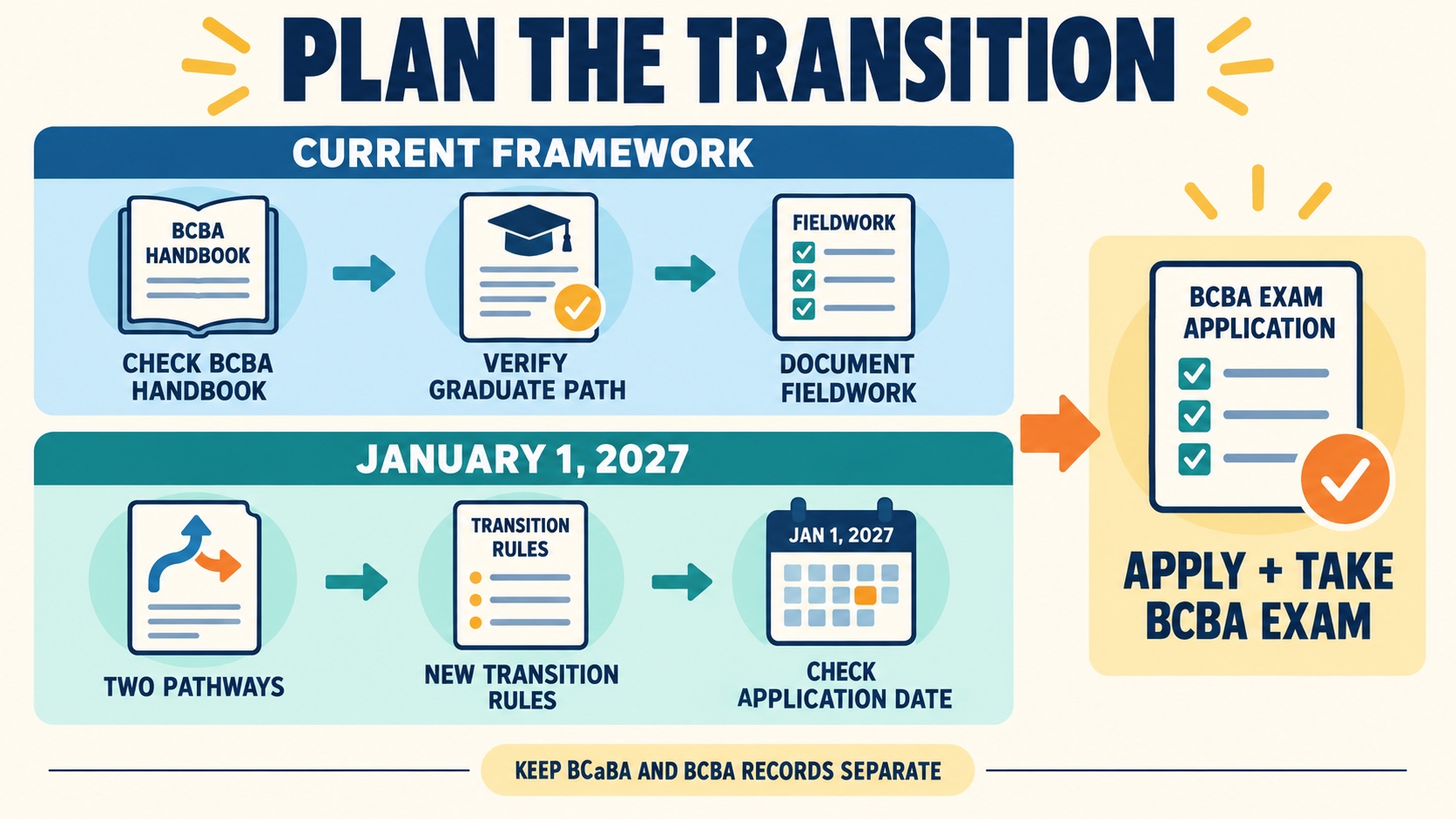
January 1, 2027 is an important boundary for anyone planning the move. The 2027 BCBA Requirements describe two pathways beginning on that date: an accredited or recognized program pathway and a behavior-analytic coursework pathway. The transition guidance also explains that pathways 3 and 4 will be discontinued for new applications after the transition. If you hoped to use one of those current pathways, the application and completion timing matters.
The 2027 changes are certification-requirement changes, not a new “7th edition” of the BCBA exam. Keep these documents separate in your notes: the BCBA Handbook, the 2027 eligibility requirements, the transition guidance, and the examination content outline. Before choosing a program or counting fieldwork, check the version date and the application date that controls your case.
A practical transition checklist
- Write down your intended BCBA application date and the country or jurisdiction where you reside.
- Identify whether your graduate degree will meet the current or 2027 pathway you plan to use.
- Ask your program or Pathway 2 contact how behavior-analytic coursework will be documented.
- Choose a qualified BCBA fieldwork supervisor before counting new hours.
- Keep BCaBA records and BCBA records clearly labeled instead of combining them in one unverified total.
- Track the BCBA fieldwork requirements that apply to your application date, including observations, supervision, activities, and forms.
- Use the current BCBA examination outline to organize study, then submit the application through the BACB process.
For concept review, you can use the BCaBA learning path, BCBA learning path, BCBA practice questions, and ABA glossary. These are study resources; they do not determine eligibility, approve fieldwork, or replace a supervisor, advisor, or BACB decision.
FAQ and official sources
Can a BCaBA become a BCBA? Yes. A BCaBA can later pursue BCBA certification, but the person must meet the applicable BCBA eligibility requirements and pass the BCBA examination. There is no automatic credential conversion.
Do I need a master’s degree after becoming a BCaBA? The BCBA is a graduate-level certification, so the applicable BCBA pathway requires a master’s degree or higher. Confirm the exact pathway and documentation rules in the current handbook and, if applying in 2027, the 2027 requirements.
Do BCaBA hours automatically count toward BCBA fieldwork? No automatic assumption is safe. Prior experience may be relevant, but hours must be reviewed against the BCBA fieldwork rules, supervision arrangement, records, and application timing. Ask the qualified supervisor or advisor who is responsible for the record.
Can I keep my BCaBA after I become a BCBA? The June 2026 BCBA Handbook says a certificant may hold only one BACB certification at a time. When a higher-level certification is obtained, the lower-level certification expires after a 180-day period. Check the current handbook for the process that applies when your status changes.
Where should I verify the transition? Start with the current BCBA Handbook, the BCaBA Handbook, the 2027 BCBA Requirements, and the BACB upcoming changes page. Use the document version and your application date when comparing guidance.
The clearest way to think about BCaBA to BCBA is “experience plus a new eligibility review,” not “automatic upgrade.” Your BCaBA background can help you prepare, but the BCBA degree, content, fieldwork, application, and examination requirements still deserve their own careful plan.