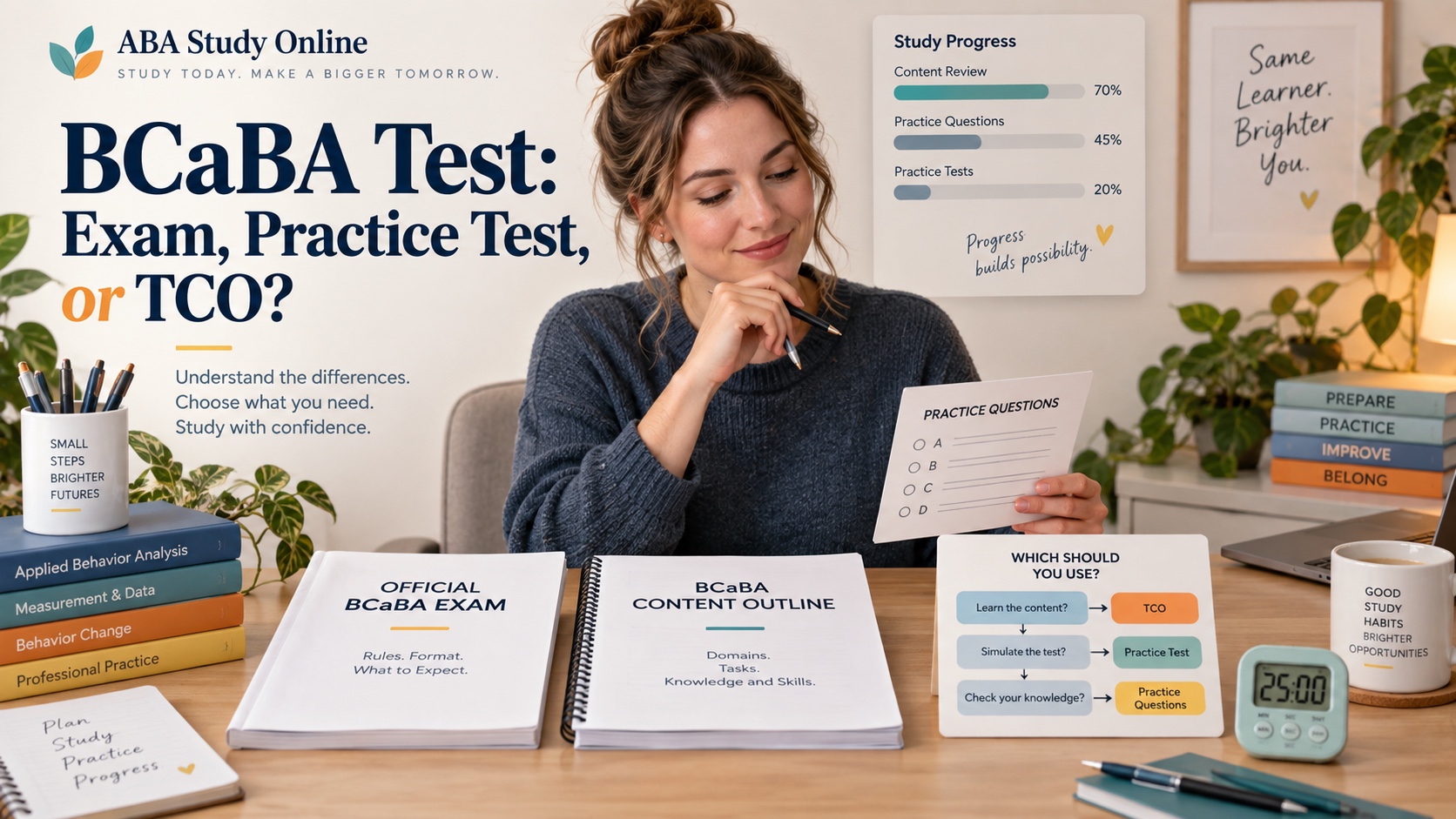
BCaBA Test: Exam, Practice Test, or TCO?
If you searched for BCaBA test, you may be looking for three different things. You may want information about the official BCaBA certification examination, a practice test to check your knowledge, or the current Test Content Outline (TCO) that tells you what to study. Those destinations are related, but they are not interchangeable.
This quick guide separates them first, confirms the current official exam snapshot, and then shows what an independent practice test can actually help you learn. The goal is simple: choose the right next step without mistaking a practice score for an official result.
What “BCaBA test” can mean
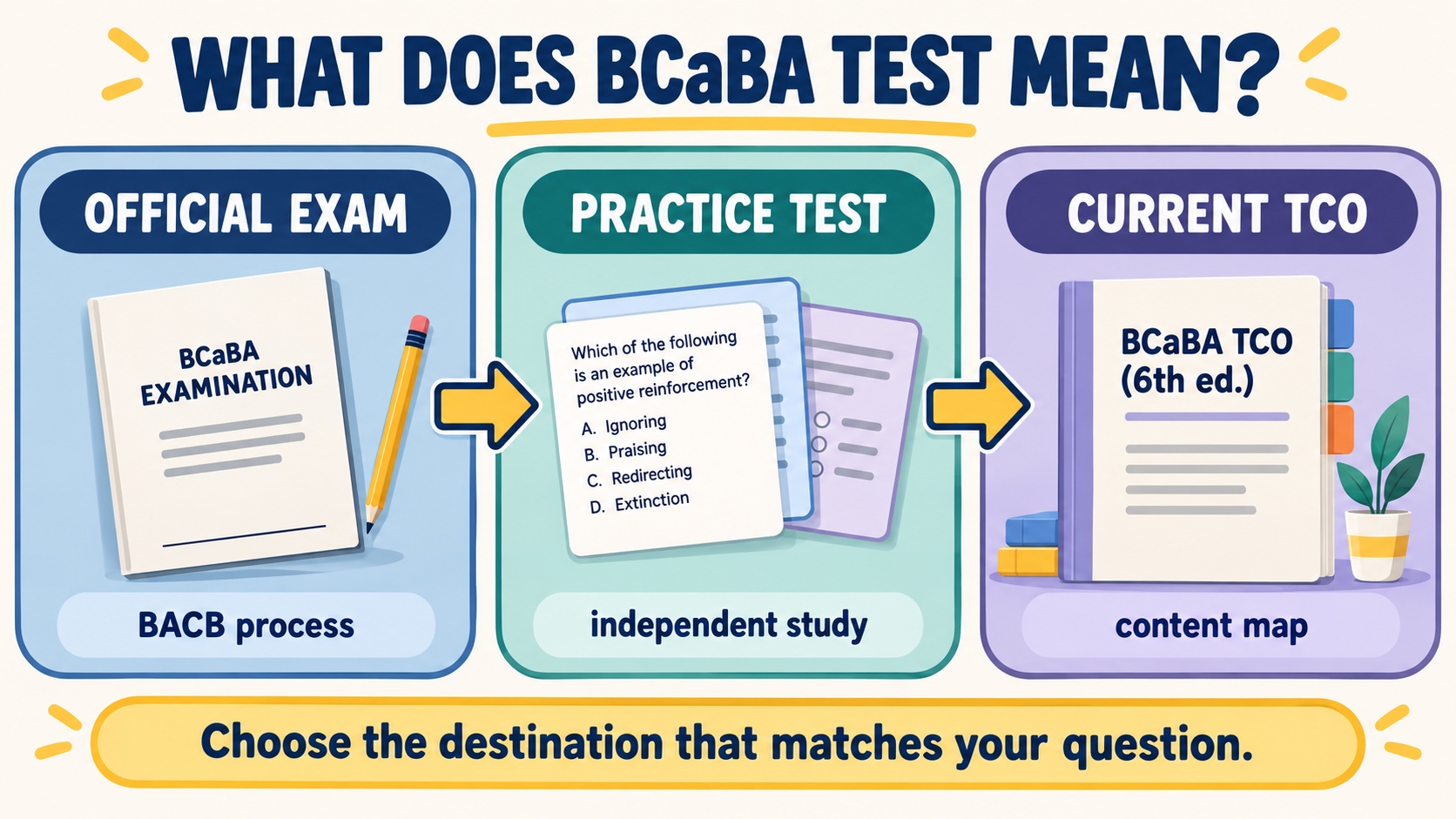
Use this three-part map before opening another study page:
- Official BCaBA examination: the high-stakes certification examination administered after you meet the applicable eligibility requirements, submit an application, receive approval, and schedule through the authorized testing process.
- Independent BCaBA practice test: an unofficial set of questions designed to help you retrieve concepts, apply them to scenarios, notice gaps, or practice pacing. Its score is a study signal, not a BACB decision.
- BCaBA TCO or blueprint check: the official content map used to see which domains and tasks your materials should cover. Reading the TCO is not the same as taking a test.
The wording can be confusing because practice providers often use “test,” “exam,” “mock,” and “quiz” as product labels. Look at the page’s purpose and source. If the page asks you to answer independent questions, treat it as practice. If it links to BACB eligibility, authorization, or scheduling information, it is describing the official process. If it is a PDF with domains and tasks, it may be the TCO rather than a question set.
The current official BCaBA examination
The current BCaBA examination is based on the BCaBA Test Content Outline, 6th edition, which became the examination outline beginning in 2025. The TCO describes 90 tasks across nine domains. It is the best source for checking whether study material is using the current content map.
The current BCaBA Handbook describes the examination as:
- 175 total multiple-choice questions: 150 scored questions and 25 unscored pilot questions.
- Four hours: the allocated exam experience includes the required instructions and review time described in the Handbook.
- Four answer choices: each question has four possible answers with one correct answer.
- Nine content domains: foundations, concepts, measurement, experimental design, ethics, assessment, behavior change, intervention development and monitoring, and supervisory relationships.
Those numbers describe the official examination, not every independent practice product. A practice set may be short, untimed, domain-specific, or intentionally diagnostic. That can make it useful, but it must not be advertised or interpreted as secure BACB content. The BACB recommends using the current TCO, Ethics Code, and materials from your training when preparing, and it does not endorse specific commercial study guides or guarantee that buying materials will lead to a pass.
Keep the examination process separate from the study process. Eligibility, application approval, authorization, scheduling, identification, testing-center rules, and result reporting come from the current BACB and Pearson VUE information. A practice website or app can help you learn; it cannot authorize you to take the certification examination.
What a practice test is useful for
An independent practice test is most useful when it changes your next study action. It can help you:
- retrieve a concept without looking at notes;
- apply a definition or principle to a new scenario;
- notice whether the problem is a knowledge, discrimination, application, or process error;
- practice reading a stem and comparing answer choices;
- build pacing gradually, once your reasoning is strong enough to review; and
- create a short list of concepts to revisit after a delay.
A score by itself is less informative than the pattern behind it. Suppose you answer a question about measurement correctly but cannot explain why the selected procedure fits the behavior’s dimension. That is not the same as confident mastery. Mark it for review. Likewise, a missed item caused by rushing needs a different repair from a missed item caused by confusing two reinforcement contingencies.
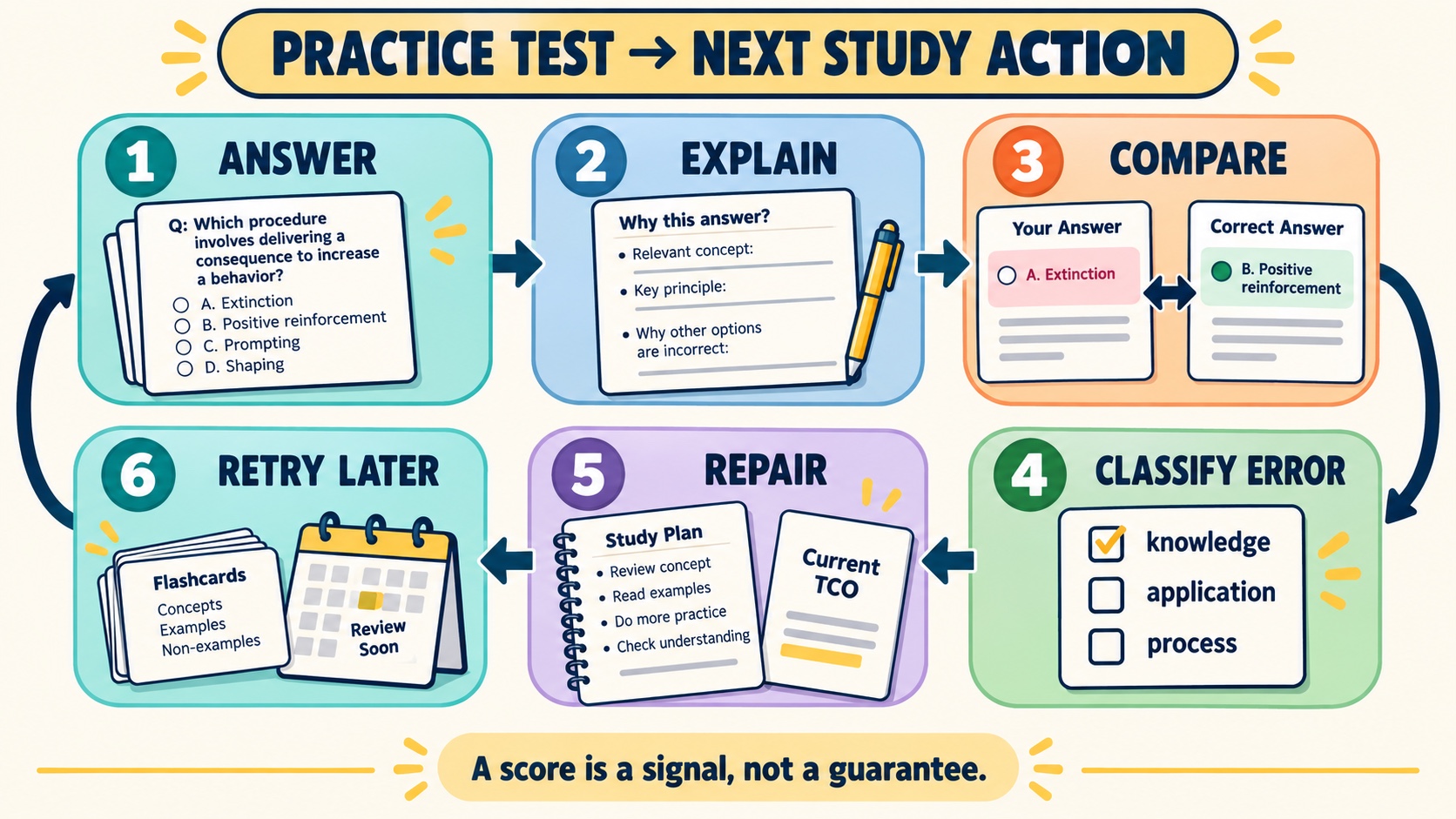
Use this compact review loop:
- Answer: commit to one choice before opening the explanation.
- Explain: state the evidence in the scenario that supports the choice.
- Compare: name the feature that makes each tempting distractor weaker.
- Classify: label the error as knowledge, discrimination, application, or process.
- Repair: return to a targeted explanation, TCO task, ethics source, or training note.
- Retry later: answer a new item about the same distinction without copying the original wording.
Choose the right next step
Match the question in your head to the destination you need:
- “What content is current?” Open the current BCaBA TCO and Handbook. Check the edition and the task language before trusting older notes.
- “How is the official exam administered?” Use the current BACB examination and Handbook information. Do not rely on a practice provider for eligibility or appointment rules.
- “Can I apply these concepts?” Use scenario-based practice with explanations. Start with a short set if you are still building the foundation.
- “Where am I making mistakes?” Use a diagnostic practice set, then review item-level reasoning instead of collecting another score.
- “Can I manage a longer session?” Add timed mixed practice after you have enough concept coverage to learn from the result.
- “How do I study every day?” Use a small repeatable loop—one concept, a few questions, an error note, and delayed review—rather than starting with the longest mock.
This order protects your time. A learner who needs a current blueprint should not begin by buying another question bank. A learner who already understands the terms but misses scenarios should not spend every session rereading definitions. The right test is the one that answers the question you currently need answered.
Common mistakes when searching for a test
Confusing “practice” with “official”
An independent practice set can be carefully written and still be unofficial. Look for transparent scope, rationales, edition labeling, and a clear statement of independence. Do not describe a commercial question as a real BACB item.
Using BCBA or RBT numbers
BCBA, BCaBA, and RBT examinations have different current outlines, question totals, and administration details. Check the track label on every resource before adding it to your study plan.
Treating one score as a forecast
One practice attempt reflects one set of questions under one set of conditions. Review uncertain correct answers as well as incorrect answers, and use repeated patterns to decide what to study next.
Calling 2027 a new exam edition
The BACB’s current BCaBA transition guidance separates certification-requirement changes from examination-content changes and states that there are currently no upcoming changes to the BCaBA examination or TCO. Recheck official guidance if your application timing is near the transition; do not label the current exam a “7th edition” without an official source.
FAQ
What is the BCaBA test?
It can mean the official BCaBA certification examination or an independent practice test. The official exam is the BACB assessment taken after eligibility and application approval. A practice test is a study tool and does not produce an official result.
How many questions are on the BCaBA test?
The current BCaBA Handbook describes 175 total questions: 150 scored questions and 25 unscored pilot questions. The current TCO describes 150 scored questions across nine domains and 90 tasks.
Is a BCaBA practice test the real exam?
No. A practice test is independent preparation content unless the BACB explicitly identifies a resource as official. It may help you learn concepts, apply reasoning, and review pacing, but it does not grant authorization or guarantee a passing result.
What should I study first?
Start by checking the current BCaBA TCO and Handbook. Then choose a short concept-and-practice loop that matches your weakest reasoning area. Add longer mixed or timed practice after you can explain your decisions.
Do the 2027 BCaBA changes replace the current test?
The current transition guidance says there are no upcoming changes to the BCaBA examination or TCO. Eligibility and maintenance requirements are a separate check. Use the official transition documents for application timing and the current TCO for exam content.
Sources and practice options
For official boundaries, start with the BCaBA Handbook, the BCaBA TCO (6th ed.), the BACB examination-information page, and the BCaBA 2027 transition guidance.
For independent study, you can explore ABA Study Online’s BCaBA learning path, BCaBA practice questions, clearly labeled free mock-exam preview, ABA glossary, free resources, and app review tools. These destinations support practice and review; they do not replace official BACB eligibility, examination, or scheduling information.
Ready to find your next BCaBA practice step?
Start with a clearly labeled independent practice set, review the reasoning behind each result, and turn the next gap into a focused study action. ABA Study Online is not a BACB product and does not guarantee certification or a passing result.