BCaBA Task List: A Current 6th Edition Study Guide
If you search for a BCaBA task list, you are probably looking for the examination content map that organizes what to study. The current BACB document is the BCaBA Test Content Outline (6th ed.). “Task list” is still common search language, but your study notes should name the current outline and keep it separate from the BCaBA Handbook, ethics requirements, and 2027 certification changes.
This guide shows how to use the current BCaBA outline as a practical study system. It summarizes the nine domains, turns outline verbs into study actions, and uses one applied scenario to show how measurement, assessment, intervention, ethics, and supervision connect. It is independent educational material, not official BACB examination content or a certification guarantee.
Quick answer: Use the BCaBA Test Content Outline (6th ed.) for examination content. It contains 90 tasks across nine domains and describes an examination with 150 scored questions and 25 unscored pilot questions. Build a separate domain map, practice the task verbs, and return to the current BACB source when a question depends on an edition, requirement, or application rule.
Important boundary: A Test Content Outline is not the complete BCaBA certification checklist. Use the current BCaBA Handbook for eligibility, application, fieldwork, examination procedures, and maintenance. Use the current 2027 requirements pages separately when planning a future application.
What the current BCaBA outline does
The BCaBA Test Content Outline (6th ed.) describes the knowledge and skills associated with entry-level BCaBA practice and the content represented on the examination beginning in 2025. It is a map, not a script. It does not tell you the exact wording of future questions, replace supervised experience, or authorize a person to practice outside the BCaBA role.
Before you download a resource labeled “BCaBA task list,” check:
- Does it identify the BCaBA track rather than BCBA or RBT?
- Does it name the 6th edition and current examination period?
- Does it link to the current BACB source?
- Is it being used for examination study, rather than presented as a handbook or clinical protocol?
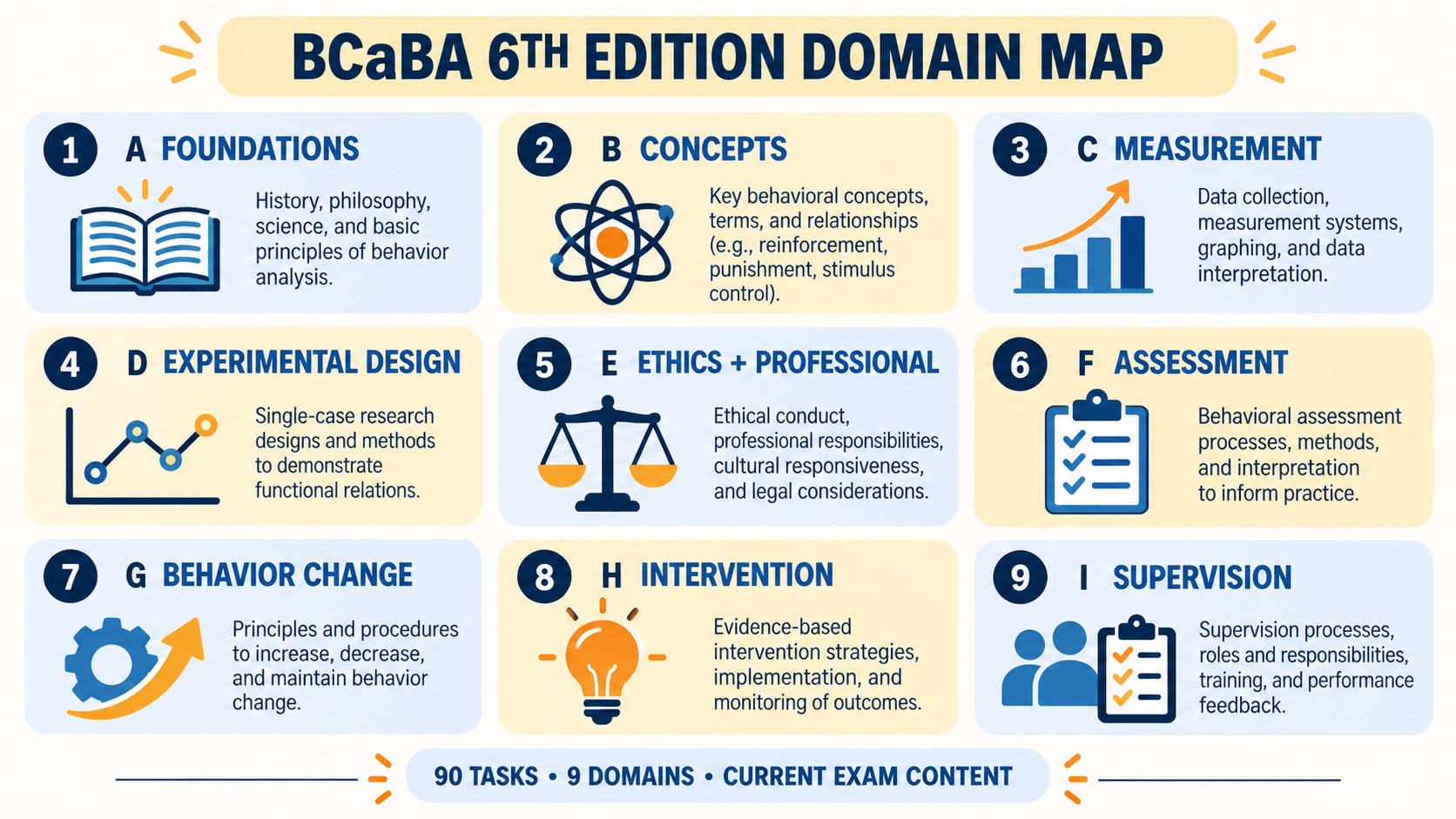
The nine BCaBA domains
The official outline organizes the BCaBA examination into nine domains. The percentages are useful for distributing review time, but they are not a prediction of the exact form you will receive.
A. Behaviorism and Philosophical Foundations — 10 questions, 7%
Review the goals of behavior analysis as a natural science, philosophical assumptions, radical behaviorism, distinctions among behaviorism and applied practice, and the dimensions of ABA. Practice explaining why a term matters for how a behavior analyst observes and reasons.
B. Concepts and Principles — 18 questions, 12%
Build comparison sets for behavior and response classes, stimulus classes, respondent and operant conditioning, reinforcement and punishment, schedules, stimulus control, generalization, motivating operations, verbal behavior, and generative performance. The useful test is whether you can discriminate similar contingencies inside a scenario.
C. Measurement, Data Display, and Interpretation — 20 questions, 13%
Connect measurement choices to the dimension of behavior being recorded. Practice reading data displays, checking whether a measure is comparable across conditions, and explaining what a level, trend, or variability change can and cannot support. Do not treat a graph as a conclusion without examining how the data were collected.
D. Experimental Design — 10 questions, 7%
Study the logic of single-case designs, functional relations, internal validity, replication, and ethical costs. For each design, write what is changed, what is measured, what comparison is available, and what alternative explanation remains plausible.
E. Ethical and Professional Issues — 18 questions, 12%
Review client welfare, professional conduct, informed consent, confidentiality, competence, supervision, documentation, and boundaries. Keep the current Ethics Code for Behavior Analysts as a separate source. Ethics questions often ask for a responsible next step, not a memorized phrase.
F. Behavior Assessment — 17 questions, 11%
Practice selecting assessment methods that fit the question, interpreting preference and skill information, and distinguishing observation from inference. Ask what evidence is needed before you choose a function hypothesis or intervention direction.
G. Behavior-Change Procedures — 22 questions, 15%
This is the largest BCaBA domain. Review reinforcement, prompting and fading, shaping, chaining, discrimination training, generalization, maintenance, extinction, token systems, and other behavior-change procedures. Explain the contingency, the teaching target, the expected future effect, and the risk of using the procedure without a plan.
H. Intervention Development and Monitoring — 20 questions, 13%
Connect assessment evidence to socially significant goals, intervention selection, treatment integrity, effectiveness, contextual fit, collaboration, and monitoring. A strong answer keeps the learner’s priorities and outcome data visible rather than choosing a procedure because it sounds sophisticated.
I. Supervisory Relationships — 15 questions, 10%
Study role clarity, feedback, performance support, supervision quality, ethical boundaries, and communication with supervisors and supervisees. Keep the BCaBA’s required supervision relationship visible in scenarios; independence is not the same as working without oversight.
Turn tasks into study actions
Outline verbs tell you how to practice. Use a different activity for each kind of task:
- Identify: create a term-to-example card and include one near-miss example.
- Distinguish: write a two-column comparison and explain the feature that changes the answer.
- Explain: teach the concept in plain language, then connect it to a data or teaching situation.
- Interpret: describe what the data show, what they do not show, and what should be checked next.
- Select: list the goal, evidence, contextual constraint, and role boundary before choosing a procedure.
- Implement or monitor: sequence the steps, identify the integrity check, and state what outcome would prompt review.
Use a small error log. For every missed or uncertain question, record the domain, task verb, concept, reason for the miss, and next practice action. “I need to study BCaBA” is too broad to plan from; “I confuse stimulus control and motivating operations in selection scenarios” is actionable.
A cross-domain BCaBA study scenario
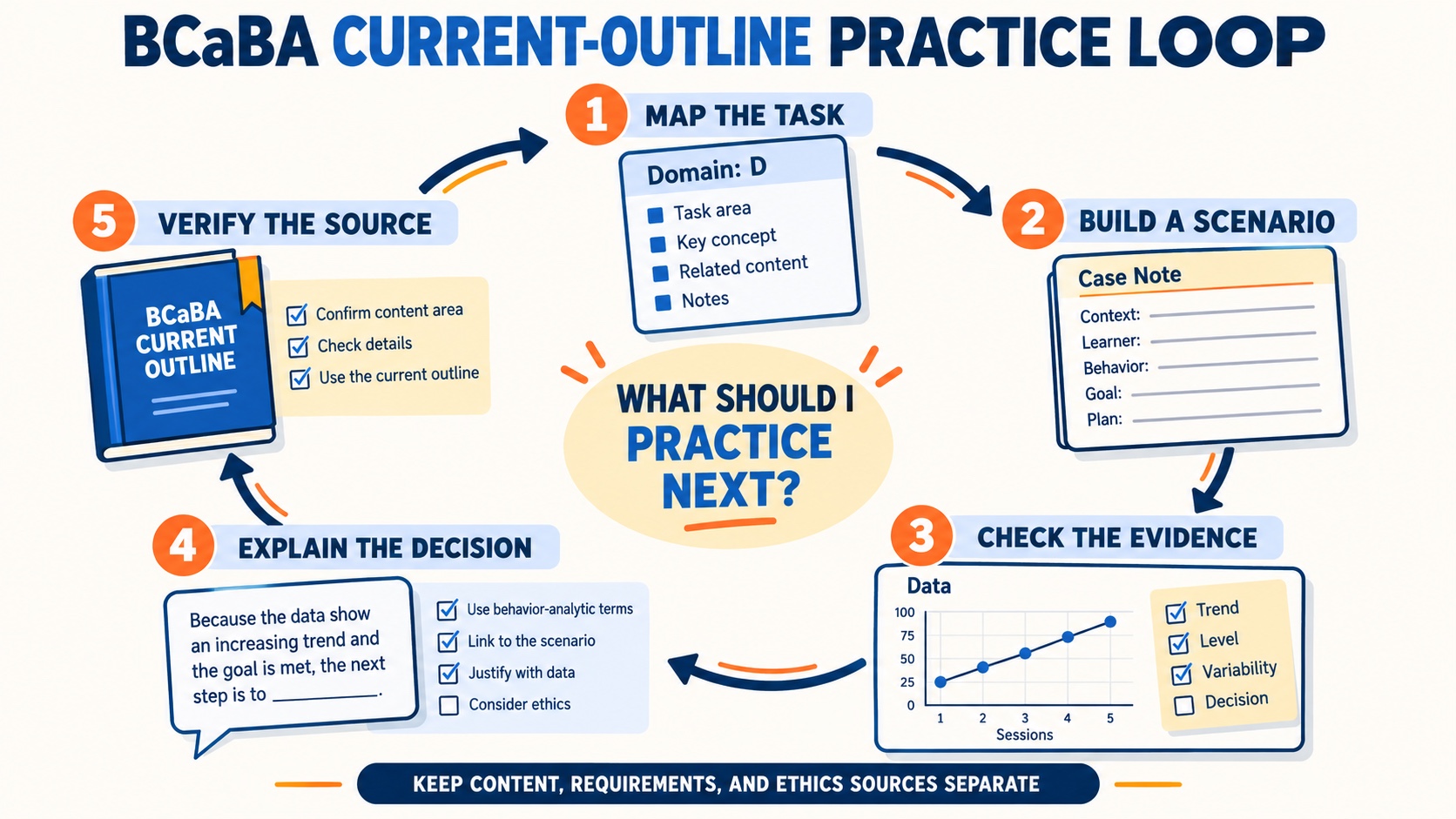
Imagine that a learner starts a communication response during teaching but rarely uses it with a second person or in a different setting. A BCaBA question could test several domains at once. First, identify the observable response and choose a measurement that captures independent use. Next, examine whether the teaching arrangement supports generalization and whether the intervention is being implemented as written. Then consider the learner’s priorities, the supervisor’s direction, and the data needed before suggesting a change.
The best study response is not a long list of procedures. It is a defensible sequence: describe the pattern, check the measurement, review the teaching and generalization arrangement, communicate within the supervisory relationship, and monitor the next outcome. That sequence links concepts, measurement, intervention, ethics, and supervision without pretending that one practice question replaces supervised experience.
A useful weekly rotation is to pair one content domain with one reasoning habit. For example, review concepts while practicing discrimination, measurement while practicing data interpretation, intervention while practicing selection, and supervision while practicing communication and role boundaries. End each session by writing one question you still need to verify in the outline or handbook. This keeps the study plan connected to the source instead of letting a long question list set the agenda.
Common BCaBA task-list mistakes
- Using the BCBA outline by default: a shared concept does not make the tracks interchangeable.
- Memorizing percentages as predictions: weights help distribute time but do not reveal the exact examination form.
- Studying terms without examples: discrimination and application require scenarios, not only flashcards.
- Ignoring measurement quality: intervention reasoning depends on what the data actually capture.
- Forgetting supervision: a BCaBA study answer must keep the supervision relationship and role boundary visible.
- Mixing exam content with 2027 requirements: verify the current TCO and handbook separately.
BCaBA task list FAQ
Is there a current BCaBA task list?
The current BACB examination document is the BCaBA Test Content Outline (6th ed.). “BCaBA task list” remains a common search phrase, but use the current outline name and edition in your study file.
How many domains are on the BCaBA outline?
The current BCaBA Test Content Outline (6th ed.) organizes 90 tasks into nine domains, from philosophical foundations through supervisory relationships.
Does the BCaBA outline tell me whether I can apply?
No. Use the current BCaBA Handbook and requirements pages for eligibility, coursework, fieldwork, application, examination procedures, and maintenance. The outline is an examination-content map.
Is ABA Study Online official BCaBA exam content?
No. ABA Study Online provides independent explanations, practice, and study tools. Use the current BACB documents for official examination and certification information.