BCaBA Task List 6th Edition: How to Use the Current Outline
If you search for the BCaBA task list 6th edition, you are usually looking for the examination content map used for current BCaBA preparation. The official document is called the BCaBA Test Content Outline (6th ed.). The word “task list” remains common in search results and study materials, but the current BACB page places BCBA and BCaBA under the Sixth Edition Test Content Outline, effective January 1, 2025.
This distinction matters because an outline, a handbook, and the 2027 certification-requirement pages answer different questions. This guide maps the current BCaBA outline, shows what its 90 tasks and 9 domains mean for study, and explains where to look when your question is about an application, examination rule, eligibility pathway, or future transition. It is independent educational material, not official BACB examination content or a certification decision.
Table of Contents
What the BCaBA 6th edition is called now
The BACB’s current task-list page labels the relevant section “Sixth Edition Test Content Outline — Effective January 1, 2025” and links to the BCaBA Test Content Outline (6th ed.). That is the source to save when your search begins with the older phrase “BCaBA task list.” Do not assume that a PDF is current simply because its filename contains “6th edition.” Check the track, the edition, the effective examination period, and the link back to the BACB source.
The 6th-edition outline describes the knowledge and skills represented on the BCaBA certification examination beginning in 2025. It is a content map. It does not replace supervised experience, tell you whether you meet an eligibility pathway, provide the exact wording of future questions, or authorize practice outside the BCaBA role. Those are different decisions governed by different documents and professional contexts.
There is also no reason to turn this keyword into an unsupported “7th edition” announcement. The current official material reviewed for this page identifies the BCaBA examination outline as the 6th edition. If the BACB publishes a later outline, use the document’s title and effective date as the source of truth rather than guessing from a blog title or a study-product label.
The current outline at a glance
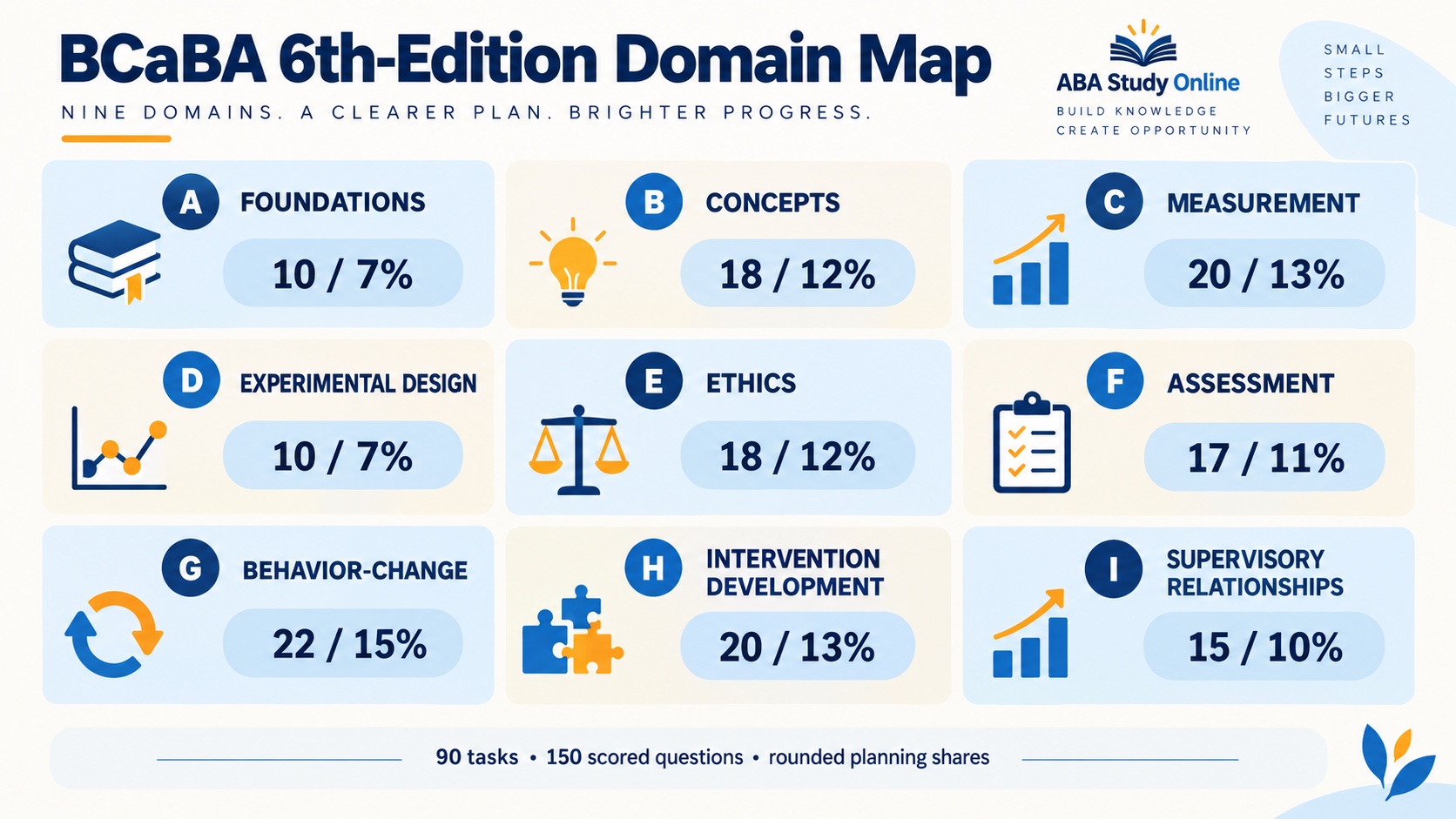
The BCaBA Test Content Outline (6th ed.) contains 90 tasks organized in 9 domains. The outline lists 150 scored questions in the examination structure and notes 25 unscored pilot questions. Domain percentages help you distribute review time, but they are not nine separate passing thresholds.
| Domain | Questions | Rounded share | Study emphasis |
|---|---|---|---|
| A. Behaviorism and Philosophical Foundations | 10 | 7% | Explain the assumptions and aims that shape behavior-analytic reasoning |
| B. Concepts and Principles | 18 | 12% | Discriminate contingencies, stimulus control, verbal behavior, and related concepts |
| C. Measurement, Data Display, and Interpretation | 20 | 13% | Match measurement and display choices to the behavior and decision |
| D. Experimental Design | 10 | 7% | Recognize single-case logic, variables, validity, and design comparisons |
| E. Ethical and Professional Issues | 18 | 12% | Apply role, confidentiality, competence, collaboration, and ethical boundaries |
| F. Behavior Assessment | 17 | 11% | Use records, goals, skill information, preference assessment, and functional assessment |
| G. Behavior-Change Procedures | 22 | 15% | Practice reinforcement, prompting, teaching, generalization, maintenance, and related procedures |
| H. Intervention Development and Monitoring | 20 | 13% | Connect goals, evidence, contextual fit, integrity, progress, and modification |
| I. Supervisory Relationships | 15 | 10% | Study supervision, performance expectations, feedback, training, and equity |
Use the table as a planning lens, not a shortcut. A question about intervention development may depend on assessment data. A supervision question may include ethical, cultural, or performance-management decisions. If you study only isolated domain labels, you may recognize the heading but still miss the reasoning required by the scenario.
How to read a task-list style outline
A task code is more useful when you read its verb as a study instruction. The code tells you where the content belongs; the verb suggests what you should be able to do with it.
- Identify or define: retrieve the term, then choose it in one clear example and one near-miss example.
- Distinguish: compare two similar ideas and write the feature that changes the answer.
- Describe or explain: state the concept in plain language, then connect it to a learner, data, or teaching situation.
- Develop or implement: sequence the procedure, name the relevant contingency or goal, and identify what must be monitored.
- Interpret or evaluate: state what the evidence supports, what it does not support, and what additional information is needed.
- Apply: combine the task with the scenario’s role, context, client priorities, and available evidence before choosing an action.
For example, “define a measurement dimension” and “select a measurement system given the behavior and observation logistics” are not the same study task. The first can begin with retrieval. The second requires a scenario in which you weigh the behavior’s dimension against what can realistically be observed and recorded. The outline becomes a practice design document when you respect that difference.
Build a study map from the task codes
Start with a copy of the official outline and make four columns in your own study file:
- Source location: record the domain and task code exactly as the BACB document shows it. This prevents a BCaBA task from quietly becoming a BCBA task in your notes.
- Plain-language target: rewrite the task as a question you can answer, such as “Can I choose a representative measure when observation time is limited?”
- Evidence or scenario: add a small example, graph, comparison, or decision case. Do not rely on a definition alone when the task uses a decision verb.
- Review signal: mark whether the problem was recall, discrimination, application, evidence interpretation, or role boundary. That label determines what you should do next.
Then practice in short loops. Read one task, close the source, explain the target aloud, answer a new scenario, and write why each tempting alternative is weaker. Return to the official outline when your wording drifts. This is especially important for domains that share vocabulary: a prompt, a discriminative stimulus, a motivating operation, and a reinforcement contingency can appear together without being interchangeable.
Use the domain percentages to schedule coverage, not to abandon smaller areas. One week might begin with measurement and behavior-change procedures because they represent substantial portions of the outline, then deliberately mix in ethics, assessment, experimental design, and supervision. The final review should include cross-domain items so you can recognize the controlling fact without being told the domain in advance.
Keep the outline separate from other BACB documents
The most common version error is treating every BACB document as if it answered the same question.
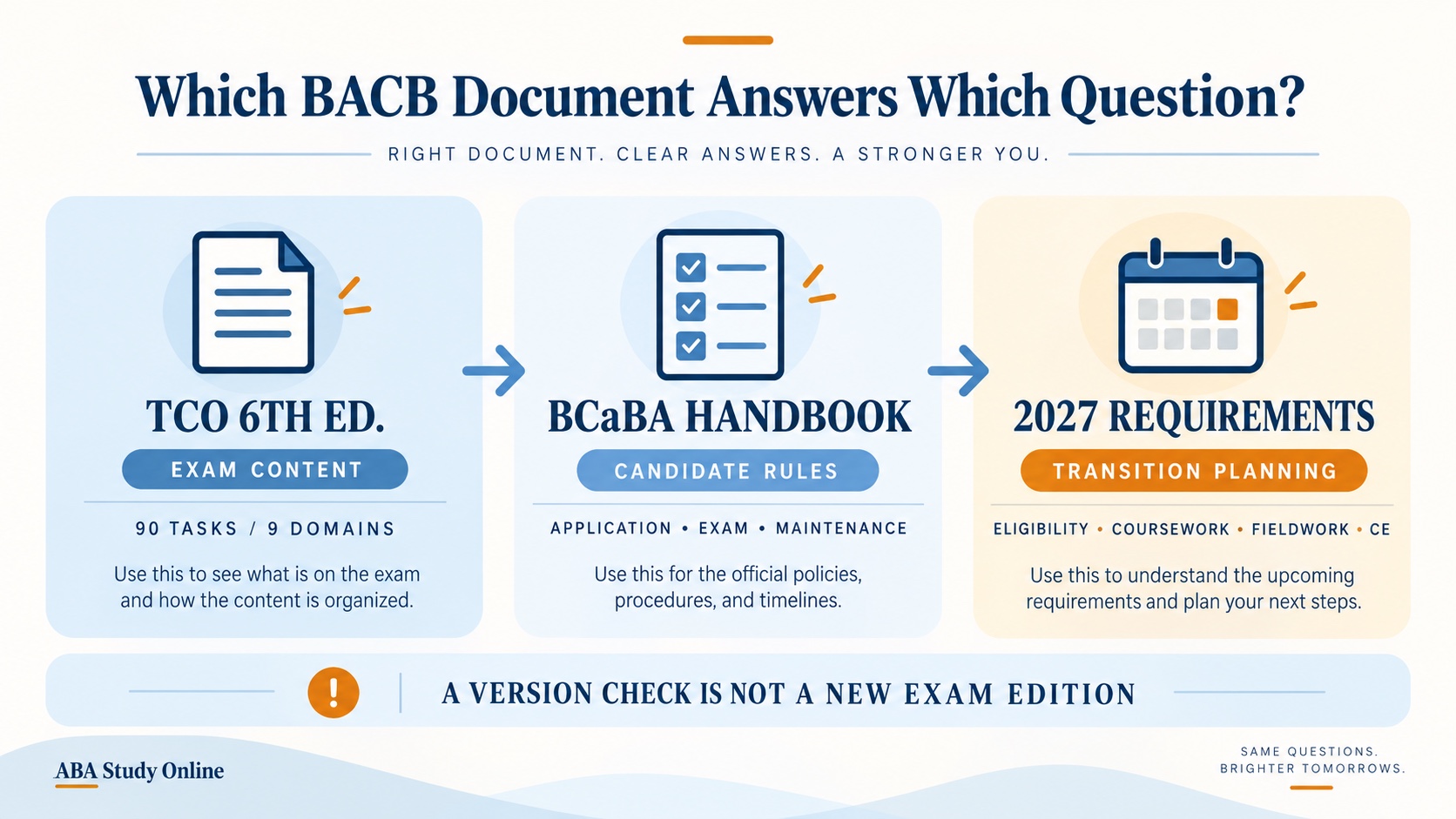
| Document | Use it for | Do not use it as |
|---|---|---|
| BCaBA Test Content Outline (6th ed.) | Current examination content, domains, task codes, and blueprint | A complete eligibility or maintenance checklist |
| BCaBA Handbook | Application, examination procedures, certification, maintenance, and candidate rules | A substitute for studying the domain tasks |
| 2027 requirements and transition guidance | Future eligibility, coursework, fieldwork, continuing education, and transition timing | Proof that a new 7th-edition examination outline has been published |
The BACB’s current 2027 information says significant BCBA and BCaBA certification-requirement changes take effect January 1, 2027. It also directs readers to separate requirements pages, transition guidance, and updated handbooks. That is important for application planning, but it should not be folded into the 6th-edition content map as if “2027” were the name of a new examination outline. Save the version and effective date for each source in your notes.
A practical BCaBA study block
Imagine a learner who uses a newly taught communication response with one instructor but rarely uses it with another person or in a different setting. A useful BCaBA study block does not jump directly to a favorite intervention. First, define the response and choose a measurement that captures independent use. Next, inspect whether the teaching arrangement provides opportunities for generalization and whether the written procedure is being implemented as intended.
That one scenario can touch measurement, assessment, behavior-change procedures, intervention monitoring, and supervision. Your notes should record the task code or domain for each decision, but the scenario should remain integrated. Ask: What exactly is being measured? What evidence is available? What goal is socially meaningful and client-informed? What can the BCaBA do within the supervisory relationship? What outcome would tell the team to continue, adapt, or seek additional guidance?
After answering, write a two-sentence rationale and one reason each distractor would be less appropriate. If you cannot explain the decision without repeating the answer choice, the task needs another example. This process turns the outline into active study instead of a checklist that only records whether a page was read.
Common 6th-edition mistakes
- Searching for an old filename: use the current BACB page and verify that the document is the BCaBA TCO, not the BCBA outline or an RBT task list.
- Mixing BCBA and BCaBA domains: both tracks use letters A through I, but the task counts and domain names are not interchangeable.
- Memorizing percentages as pass rules: the rounded shares guide coverage; they do not create separate domain cutoffs.
- Copying a third-party checklist as official: use summaries to organize review, but return to the BACB document for exact task wording.
- Putting 2027 in the wrong document: future requirements affect certification planning; they do not automatically rename the current examination outline.
- Studying only definitions: verbs such as implement, evaluate, and apply require original scenarios and evidence-based explanations.
FAQ and official sources
Is the BCaBA 6th edition still current?
The current BACB materials reviewed for this guide identify the BCaBA Test Content Outline (6th ed.) as the examination-content document beginning in 2025. Check the BACB source again when your examination date or application timeline changes.
How many tasks are in the BCaBA 6th edition?
The official outline contains 90 tasks organized into 9 domains. It lists 150 scored questions in the examination structure and 25 unscored pilot questions.
Does the task list tell me whether I qualify for BCaBA certification?
No. Use the current BCaBA Handbook and requirements pages for eligibility, application, fieldwork, examination procedures, maintenance, and transition rules. The outline is a map of examination content.
Are the ABA Study Online explanations official BACB materials?
No. ABA Study Online provides independent learning explanations and practice support. Keep the current BACB outline and handbook as the authority for certification and examination decisions.
- BACB BCaBA Test Content Outline (6th ed.)
- BACB Test Content Outlines for BACB Certifications
- BACB BCaBA Handbook
- BACB Examination Information
- BACB 2027 BCBA and BCaBA Requirements
For related study, use the BCaBA study path, practice with BCaBA questions, or check a term in the ABA Definition Search. These links support learning; they do not replace the current official documents.