How Much Supervision Is Required for a BCaBA?
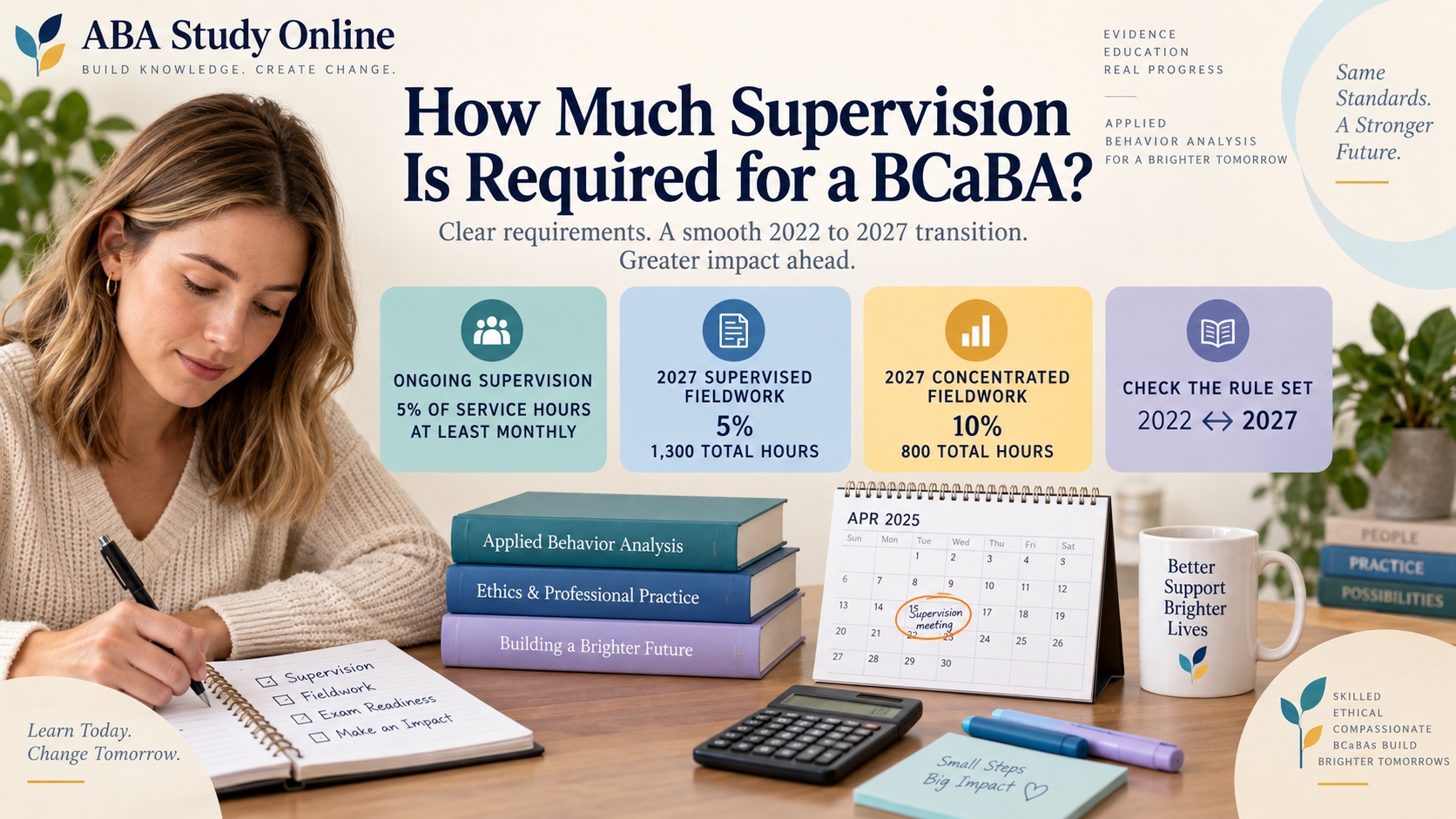
If you search “BCaBA supervision is required a minimum of,” the short answer is not one universal number. Under the 2027 rules, ongoing supervision after certification is at least 5% of behavior-analytic service hours, while supervised fieldwork also uses 5% and concentrated supervised fieldwork uses 10%. Those percentages describe different situations, so applying the wrong one can create a documentation problem.
The current answer also depends on when you apply and which requirements govern your fieldwork. The BACB’s 2027 transition guidance compares the 2022 and 2027 rules. Use the current BCaBA Handbook, your supervisor, and the official transition resources to confirm the rule set that applies to you.
This guide separates the contexts first, then shows how to think about the percentage, supervisory period, observation, and documentation requirements.
Table of Contents
The short answer by context
Under the 2027 BCaBA requirements, use this quick map:
| Situation | Minimum supervision percentage | Important companion rule |
|---|---|---|
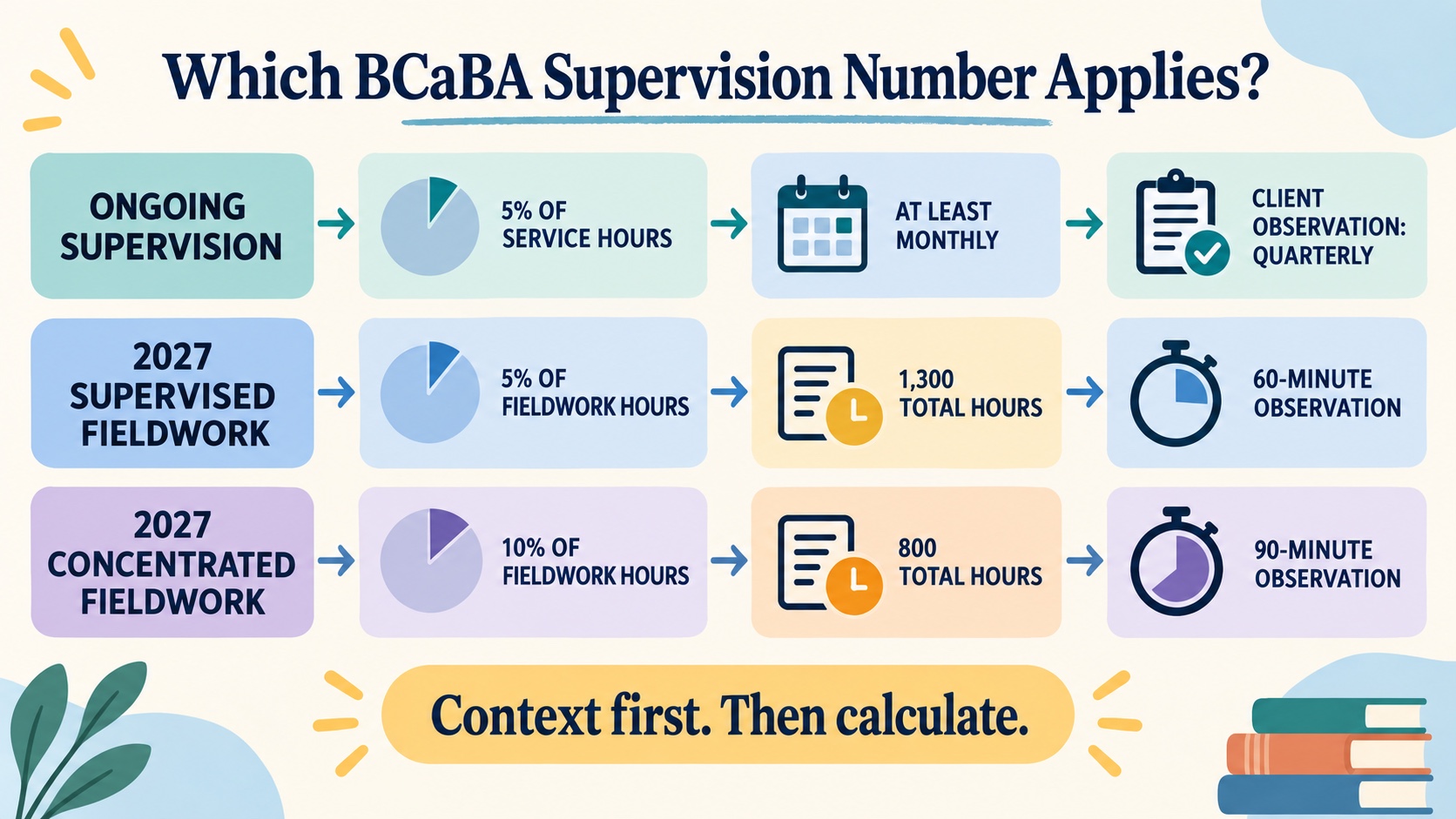
| Ongoing supervision after certification | At least 5% of behavior-analytic service hours | At least monthly; client observation once per quarter under the handbook summary. |
| Supervised fieldwork for BCaBA certification | 5% of fieldwork hours | 1,300 total hours; 20–160 hours per supervisory period; 60-minute client observation. |
| Concentrated supervised fieldwork | 10% of fieldwork hours | 800 total hours; 20–160 hours per supervisory period; 90-minute client observation. |
The table is an orientation, not a substitute for the full handbook. It also reflects the 2027 framework. If your application will be reviewed under the 2022 requirements, the applicable fieldwork details may be different.
Ongoing supervision after BCaBA certification
Ongoing supervision applies when you already hold BCaBA certification and are maintaining the ability to practice. The current handbook summary lists at least 5% of behavior-analytic service hours supervised, supervision at least once a month, and an observation of the BCaBA supervisee with a client once a quarter. The supervising person must meet the handbook’s qualification requirements, which are not satisfied merely because someone works at the same organization.
Do not convert the percentage into an automatic monthly meeting length without checking your actual service hours and the complete supervision section. For example, if the relevant service-hour total for a period is 80 hours, 5% is four hours. That calculation does not by itself tell you how those hours must be distributed, which activities qualify, how individual and group supervision are handled, or how the client observation must be documented. Those details come from the handbook and supervision arrangement.
A BCaBA without a qualified supervisor may be considered inactive under the current handbook language and may not practice or use the certification until the supervision record is corrected. Confirm status and reporting requirements through the BACB Portal and current handbook rather than relying on a workplace statement.
Supervised fieldwork before certification
Supervised fieldwork is the path used while you are acquiring experience toward BCaBA certification. Under the 2027 framework, supervised fieldwork requires 1,300 hours and at least 5% supervision. The fieldwork must also fit the supervisory-period range, observation requirement, individual-supervision requirement, unrestricted-activity requirement, supervisor qualifications, and documentation rules.
The percentage is calculated from the fieldwork hours in the relevant supervisory period. Suppose you accrue 40 fieldwork hours in a period. Five percent is two hours of supervision. That is a calculation example, not permission to schedule only one type of contact. You still need the required observation and must meet the handbook’s rules for what counts as supervised fieldwork and how individual versus group supervision is recorded.
Under the 2027 summary, the fieldwork period is a minimum of 20 hours and a maximum of 160 hours. At least 50% of supervised hours must be individual, and the client observation is a cumulative 60 minutes for supervised fieldwork. Check the official documents before treating a monthly spreadsheet as complete.
Concentrated supervised fieldwork
Concentrated supervised fieldwork uses a higher supervision percentage and a smaller total-hour requirement. Under the 2027 framework, it requires 800 total hours and at least 10% supervision. A 40-hour period would therefore produce a 4-hour supervision calculation before you check the other requirements.
The observation requirement also differs: the 2027 summary lists a cumulative 90-minute observation for concentrated supervised fieldwork. The same 20–160-hour supervisory-period range applies in the high-level requirements, and at least 50% of supervised hours must be individual. Label the fieldwork type on your tracking system so that you do not accidentally apply the 5% rule to a concentrated period.
The concentrated option is not simply “the faster version.” It changes the supervision percentage, total hours, and observation requirements. Discuss the choice with a qualified supervisor before accumulating hours.
Why the 2022 and 2027 numbers differ
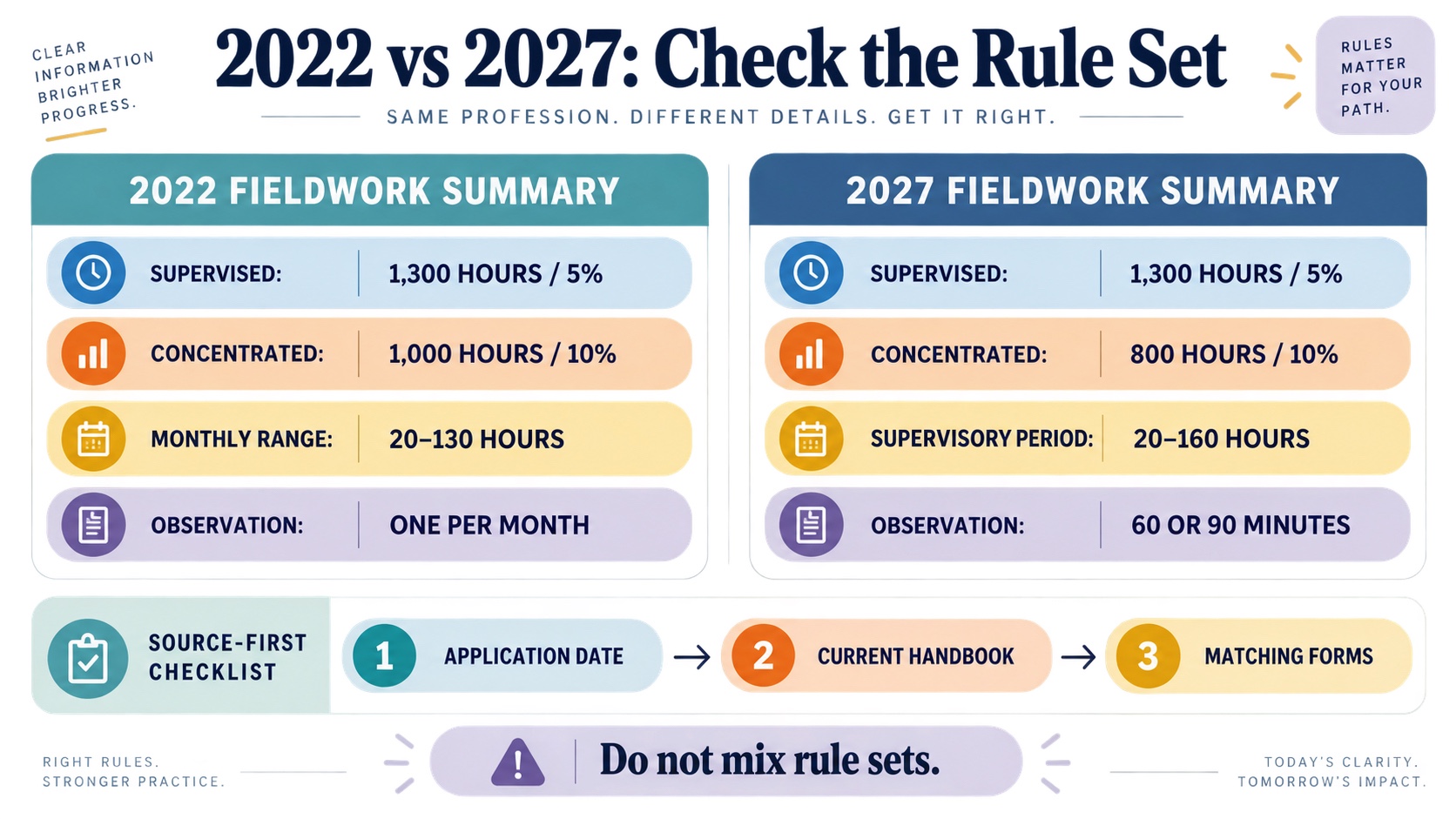
The BACB transition guide shows why older study notes can produce conflicting answers. For 2022 supervised fieldwork, the summary lists 1,300 hours and 5% supervision, with a 20–130-hour monthly range and one client observation per month. For 2022 concentrated supervised fieldwork, it lists 1,000 hours and 10% supervision, with the same 20–130-hour monthly range and one observation per month.
Under the 2027 summary, supervised fieldwork remains 1,300 hours at 5%, while concentrated supervised fieldwork changes to 800 hours at 10%. The supervisory-period range becomes 20–160 hours, and observations are expressed as cumulative minutes: 60 minutes for supervised fieldwork and 90 minutes for concentrated supervised fieldwork.
These are not interchangeable study facts. If you are close to the transition, identify the application date and the requirements under which your fieldwork will be reviewed. The BACB recommends planning carefully and, when appropriate, meeting both sets of requirements while keeping documentation systems that demonstrate which standard each record satisfies.
How to calculate the minimum
Use a four-step calculation habit:
- Identify the context: ongoing supervision, supervised fieldwork, or concentrated supervised fieldwork.
- Identify the rule set: 2022/current transition requirements or 2027 requirements, based on your application and documentation plan.
- Sum the relevant hours: use the hours that the handbook says belong in the percentage calculation for the period.
- Check the companion rules: frequency, observation, individual/group balance, supervisor qualification, and forms.
For example, 60 hours at 5% equals three hours; 60 hours at 10% equals six hours. The arithmetic is simple. The difficult part is choosing the correct denominator and showing that the activities, supervisor, observation, and documents meet the applicable handbook. Never use a calculator to replace that classification step.
What to document
Keep a current record of your fieldwork or service hours, supervision percentage, dates, supervision format, individual versus group time, client observation, supervisor identity and qualifications, activities completed, and any required monthly or final verification forms. If you are planning around 2027, keep the transition guidance and the handbook version used for your plan.
Review the record with your supervisor regularly rather than waiting until the application. A missing observation or a period that exceeds the allowed range can be harder to reconstruct later. If multiple supervisors or an organization are involved, confirm which form and responsibility applies to each arrangement.
A simple monthly review can prevent a small mismatch from becoming a large correction: compare the hours total, percentage calculation, observation note, and signed form before the next period begins. Save the source version alongside the record so you can explain why a particular number was used.
Common mistakes
Using 5% for every situation
Five percent applies to some BCaBA contexts, but concentrated supervised fieldwork uses 10% under the 2027 framework. Ongoing supervision and fieldwork also have different denominators and companion rules.
Mixing ongoing supervision with fieldwork
Maintenance supervision after certification is not the same as supervised fieldwork before certification. Label the record and use the corresponding handbook section.
Following an old 20–130-hour note
The 2027 fieldwork summary uses a 20–160-hour supervisory-period range. Check the application timing and current transition guidance before carrying an older note into a new plan.
Counting only meetings
Supervision is more than a calendar appointment. The applicable requirements may include observation, individual supervision, activities, documentation, and supervisor qualifications.
FAQ and official sources
What is the minimum BCaBA supervision percentage?
It depends on context. Under the 2027 framework, ongoing supervision after certification is at least 5% of behavior-analytic service hours; supervised fieldwork is 5%; and concentrated supervised fieldwork is 10%.
How often must a BCaBA receive ongoing supervision?
The current BCaBA Handbook summary lists supervision at least once a month and a client observation once a quarter. Follow the full handbook for all requirements.
How many hours of BCaBA fieldwork are required?
Under the 2027 framework, supervised fieldwork is 1,300 hours, while concentrated supervised fieldwork is 800 hours. The supervision percentages are 5% and 10%, respectively.
Do the 2022 and 2027 BCaBA rules use the same supervision details?
No. The transition guidance shows differences in the concentrated total hours, supervisory-period range, and observation format. Check the rule set that applies to your application.
Where can I verify the current rule?
Start with the BACB 2027 BCaBA Requirements, the BCaBA transition guidance, and the current BCaBA Handbook. Use your supervisor to review your individual plan.
For related study support, use the BCaBA learning resources and BCaBA practice questions as unofficial educational tools. They do not determine whether your fieldwork or supervision meets BACB requirements.