BCaBA Study Materials: Build a Complete Study Set
Good BCaBA study materials do not have to be expensive or enormous. They do have to work together. Start with the current official exam boundary, add explanations that help you understand the concepts, practice applying them to new situations, and keep an error log that tells you what to review next. That combination is more useful than collecting several books that all explain the same definitions.
The current BCaBA examination is based on the BCaBA Test Content Outline (TCO), 6th edition. The BACB Handbook also recommends reviewing the Ethics Code for Behavior Analysts and materials from your qualifying training. Independent guides, flashcards, question banks, videos, and apps can support that work, but they are not official BACB exam content and cannot guarantee a passing result.
Table of Contents
What belongs in a BCaBA study-material set?
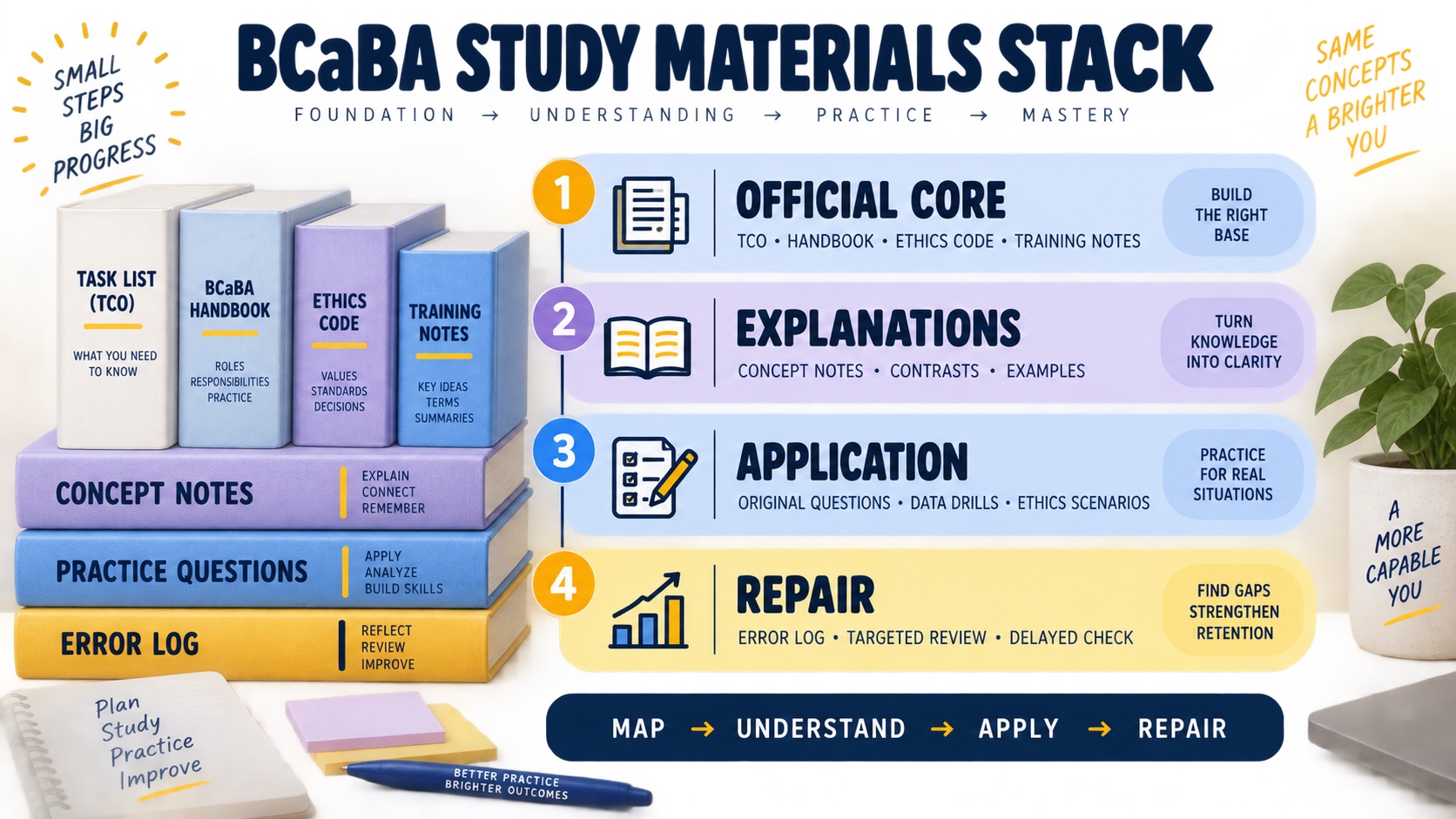
Think of your study set as five connected layers:
- An official map. The current TCO tells you which knowledge and skills belong inside the exam boundary.
- A source and rule layer. The Handbook, Ethics Code, and your training materials provide the context for professional responsibilities, eligibility, and role boundaries.
- An explanation layer. Plain-language notes, concept comparisons, examples, and diagrams help you move from a term you recognize to a distinction you can explain.
- An application layer. Original practice questions, short scenarios, graph-reading drills, and procedure-selection exercises test whether you can use the idea in a new situation.
- A feedback layer. An error log, spaced review list, and progress record turn a missed item into a specific repair task.
These layers answer different questions. The TCO answers “what should I cover?” A concept note answers “what does this mean?” A practice item asks “can I recognize and apply it?” The error log asks “why did I miss it, and what will I do differently next time?” If one resource claims to do all five jobs, inspect it carefully rather than assuming that its size proves its quality.
Start with the official core
Before downloading a new guide, open the documents that control the current boundary. The BCaBA TCO, 6th edition, organizes 90 tasks across nine domains. Its published distribution includes behaviorism and philosophical foundations, concepts and principles, measurement and data, experimental design, ethics, behavior assessment, behavior-change procedures, intervention development and monitoring, and supervisory relationships.
The TCO is not just a list of vocabulary words. Many tasks ask a candidate to identify, distinguish, select, interpret, or evaluate. When you make notes, copy the task verb into your study question. “Define” suggests retrieval. “Distinguish” suggests a comparison. “Interpret” suggests a data display or pattern. “Select” suggests that you need to compare possible actions against the facts in a scenario.
The Handbook supplies the exam context. The current public format describes 150 scored questions and 25 unscored questions, for 175 questions delivered in four hours. Each question has four possible answers with one correct answer, and the result is based on overall performance rather than separate pass marks for each domain. These facts are useful for planning, but they do not tell you which questions are unscored. Treat every question as worth careful attention.
Keep the Ethics Code in the same core folder as the TCO. Ethics questions are not an optional final-week topic. Ethical reasoning can appear when you review competence, confidentiality, consent, conflicts, documentation, supervision, or communication. Add your coursework notes as well, because training materials often provide the examples and terminology that make an abstract task easier to understand.
Add independent practice layers
Once the official core is clear, choose independent materials for the jobs they perform. A short, well-explained practice set can be more useful than a very large set with answer letters but no reasoning. Look for questions that use original scenarios, identify the relevant evidence, and explain why the distractors fail. Avoid anything that presents recalled, leaked, or reconstructed examination items as authentic.
Use several practice formats because the exam blueprint covers more than verbal definitions:
- Concept contrasts: Compare neighboring ideas such as frequency and rate, negative reinforcement and punishment, or discrimination and generalization. Write the feature that separates them.
- Data and graph drills: Decide what a display shows, what it does not show, and which additional information would be needed before making a claim.
- Procedure selection: Read the learner’s current behavior, the stated goal, and the constraints before choosing an intervention or teaching procedure.
- Ethics and role scenarios: Identify the responsibility, boundary, or consultation step supported by the facts. Do not answer from a vague sense that one option “sounds professional.”
- Flashcards: Use them for active retrieval, not as a substitute for application. Put a contrast, example, or “what would change the answer?” prompt on the back.
- Mixed and timed sets: Add them after targeted learning. A mixed set is useful when you need to practice switching among domains, while a timed block helps you rehearse pacing.
Your app can be one of these practice layers. A question session, flashcard review, progress view, or saved error list is valuable when it sends you back to a specific concept or source. The app should complement the website’s explanations and free material; it should not blur the boundary between independent study aid and official BACB content.
Match materials to your study stage
The same resource can be helpful at one stage and inefficient at another. Match the tool to the question you are trying to answer.
| Study stage | Main question | Useful materials |
|---|---|---|
| Orientation | What is included and what is current? | TCO, Handbook, Ethics Code, training outline, source-date checklist |
| Concept building | Can I explain the idea and its closest contrast? | Plain-language notes, comparison cards, glossary, worked examples |
| Application | Can I find the relevant evidence in a new case? | Original scenarios, data displays, procedure and ethics drills |
| Mixed practice | Can I switch domains without losing the decision rule? | Mixed question sets, timed blocks, rationale review |
| Repair and audit | What still needs attention before the next checkpoint? | Error log, weak-task list, targeted mini-set, source recheck |
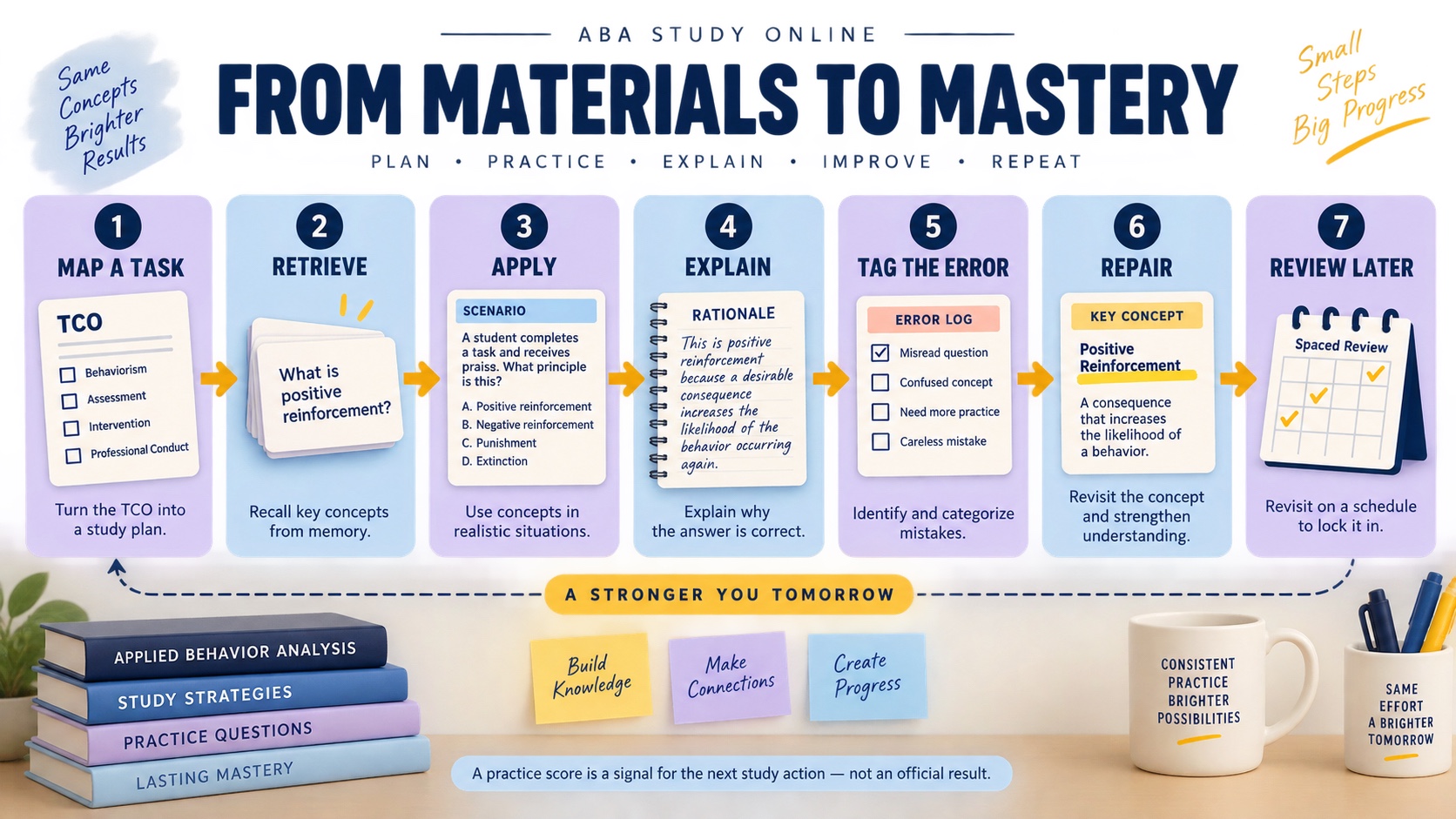
For example, if you miss a measurement question because you confused duration with latency, rereading an entire measurement chapter may be unnecessary. Write the two definitions, add one example of each, solve a small contrast set, and schedule a delayed check. If you miss an ethics scenario because you ignored a role boundary, return to the relevant source and write the boundary in your own words before trying another item.
How to audit a study resource
Use this checklist before making a resource part of your main set:
- Edition check: Does the resource identify the BCaBA TCO edition it follows? A title that only says “current” is not enough.
- Coverage check: Does it include measurement, data interpretation, assessment, ethics, intervention monitoring, and supervision as well as basic concepts?
- Reasoning check: Do explanations point to the evidence and address the distractors, or do they merely reveal the answer?
- Role check: Does the material keep BCaBA responsibilities, supervision, and consultation boundaries accurate?
- Source check: Are official links, source dates, and update limits visible? Can you tell which content is independent?
- Practice check: Does it make you retrieve and apply ideas, or does it encourage passive highlighting only?
Also separate “free” from “complete.” A free preview can be useful if it clearly states its scope. A paid resource can still be a poor fit if it is outdated, vague about the edition, or built around unsupported pass claims. The important question is not whether a material has a price tag; it is whether the material performs a clear study job honestly.
Common materials mistakes
Collecting before mapping. Buying several resources before opening the TCO makes it easy to study the same comfortable topics repeatedly while neglecting data, ethics, assessment, or supervision.
Confusing recognition with fluency. A familiar definition can feel easy until a scenario changes the relevant feature. Mix retrieval with examples, contrasts, and new cases.
Using a score as a diagnosis. A practice percentage is one observation from one independent set. Read the rationale, identify the error type, and choose the next repair task instead of treating the number as an official prediction.
Mixing the 2027 transition into the exam blueprint. The BACB has published changes to BCaBA eligibility and maintenance requirements beginning January 1, 2027. The published transition guidance separately addresses the examination and TCO. Do not label a resource “7th edition” simply because it discusses 2027 requirements. Recheck the current Handbook, TCO, and transition guidance before replacing study materials.
FAQ and official sources
What are the most important BCaBA study materials?
Begin with the current BCaBA TCO, the BCaBA Handbook, the Ethics Code for Behavior Analysts, and your qualifying training materials. Add independent explanations, original practice questions, data drills, and an error log that fit the tasks you still need to learn.
Are independent BCaBA practice questions official?
Usually not. Independent practice should be labeled as independent, use original material, and explain its scope. It should not claim to reproduce live, recalled, leaked, or official BACB questions.
Does the 2027 change mean I need a BCaBA 7th-edition study guide?
Not automatically. The 2027 transition changes certification eligibility and maintenance requirements, while an exam TCO is a separate document. The BACB’s transition guidance should be checked alongside the current Handbook and TCO before you change resources.
Can an app replace the official BCaBA materials?
No. An app can make retrieval, practice, and progress tracking easier, but it should be used alongside the current official documents and training materials. Use the ABA Study Online app as one practice layer, and use the BCaBA learning path, free BCaBA questions, and ABA glossary for connected explanations.