BCaBA Requirements: A Current Guide and 2027 Planning Checklist
BCaBA requirements are not just one checklist. They connect an education pathway, behavior-analytic coursework, supervised fieldwork, examination eligibility, application documents, and ongoing certification responsibilities. The right plan also depends on when your complete application will be received, because the BACB has published significant BCaBA requirement changes that take effect January 1, 2027.
This guide helps you organize the decision. It separates current requirement categories from Test Content Outline study, explains the 2027 transition boundary, and shows what to verify before you rely on a course, form, or fieldwork plan. It is independent educational material, not individualized certification advice or a guarantee that an application will be approved.
Quick answer: Start with the current BCaBA Handbook and identify your eligibility pathway. Then verify your degree, behavior-analytic coursework, supervised fieldwork, examination, application documents, and maintenance obligations. If you want to be reviewed under the current 2022 requirements, the BACB says your complete application—including payment and required documents—must be received by December 31, 2026. Applications reviewed under the 2027 requirements must meet the new rules that take effect January 1, 2027.
Version boundary: A BCaBA Test Content Outline tells you about examination content. It does not replace the BCaBA Handbook or the 2027 transition guidance. Keep requirements research and exam study in separate notes.
How the current BCaBA path is organized
The BACB describes the BCaBA as an undergraduate-level certification. BCaBAs provide behavior-analytic services under the supervision of a BCBA, and they may supervise RBT work within the applicable requirements. Your first planning decision is therefore not which study guide to buy. It is which eligibility pathway and supervision arrangement match your situation.
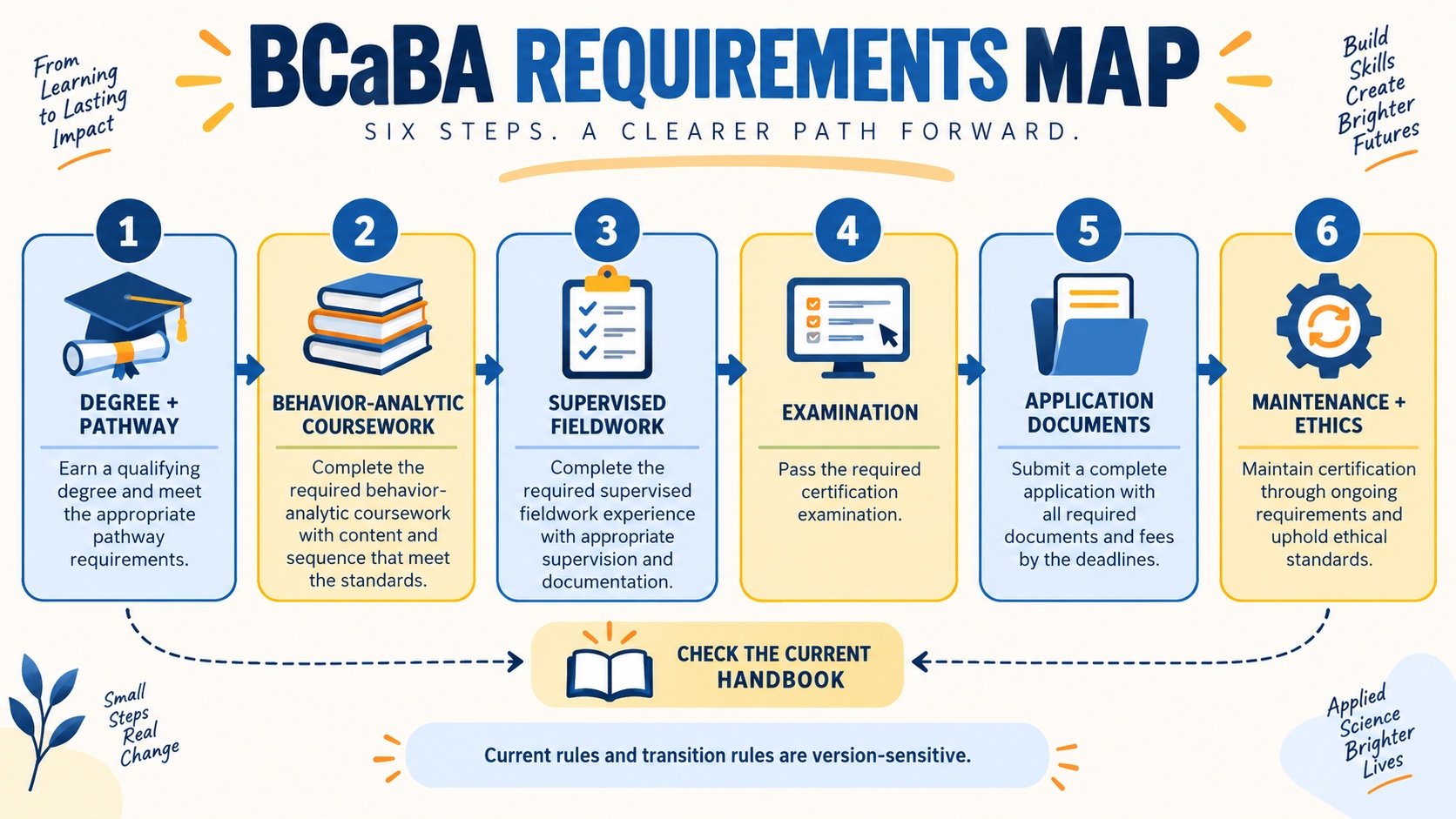
Degree and eligibility pathway
The official pathway materials identify two routes: an accredited-degree pathway and a coursework pathway. The exact degree history, accreditation timing, coursework documentation, and other eligibility details are source-sensitive. Record the degree title, institution, conferral date, and the pathway you are using before you ask whether a course or form counts.
Behavior-analytic coursework
Coursework is not simply “any psychology class.” The BACB identifies behavior-analytic content areas and documentation requirements. A program coordinator or advisor may help you map transcripts, but your planning file should still point to the current BACB requirements and the relevant handbook section. Save syllabi, course descriptions, attestation documents, and dates when they may be needed for review.
Supervised fieldwork
Fieldwork connects supervised experience with professional skill development. It is not only a total-hour target. You also need to verify the supervisor relationship, monthly documentation, final verification, required activities, and the rules in effect for the period you are accruing and applying. Use the current BCaBA Handbook, fieldwork forms, and transition guidance rather than a generic spreadsheet copied from another track.
Examination and application
The BCaBA Test Content Outline (6th ed.) describes examination content, while the handbook and examination pages explain application and testing procedures. Keep your study plan separate from your application checklist. A strong score on independent practice does not substitute for an eligibility document, and a complete application does not replace preparation for the examination.
Maintenance and supervision
Certification maintenance is its own planning stage. Keep the current rules for supervision, renewal, continuing education, status changes, and professional conduct in a separate maintenance file. The Ethics Code for Behavior Analysts also remains relevant to professional practice. Requirements may change even when your study materials still use older labels, so include a source-check date in the file.
What changes on January 1, 2027
The BACB’s 2027 BCaBA Requirements page and transition guide describe significant changes to certification eligibility and maintenance. The two eligibility pathways continue, but coursework requirements change in several important ways, including content descriptions, hour allocations, total required content hours, and freestanding-course expectations.
The transition guide compares the 2022 and 2027 coursework structure. Its high-level summary describes a move from 225 total hours under the 2022 structure to 270 total hours under the 2027 structure, with revised content groupings such as Foundations of Behavior Analysis, Methods of Behavior Analysis, Behavior Assessment & Intervention, Organizational Behavior Management, and Ethics in Behavior Analysis. Use the official table and handbook for the exact rule, credit conversion, and course documentation; do not plan from a screenshot or a third-party summary alone.
The transition date does not mean that every learner follows the same deadline. The important question is which requirements will be used to review your complete application. If your timeline is close to the boundary, ask your program coordinator, supervisor, or advisor to help you compare both sets of requirements and preserve the relevant evidence.
How to plan across the transition
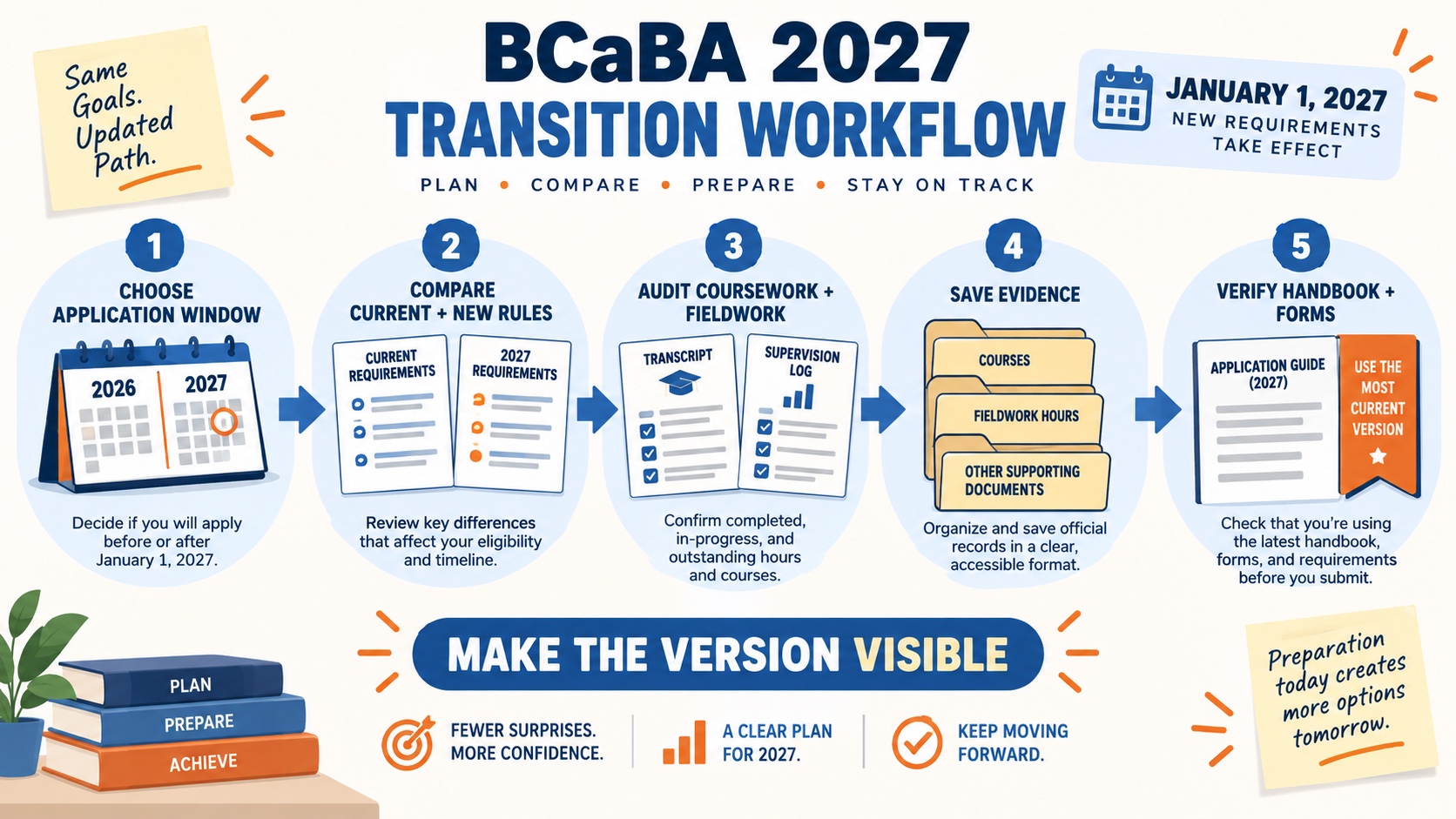
- Choose the intended application window. Write down whether you are planning for review under the current or 2027 requirements. Do not treat the exam date alone as the deciding date.
- Read the current BCaBA Handbook. Start with the eligibility and application sections, then open the transition guide linked by the BACB.
- Map your degree and coursework. List completed and planned courses, their dates, the content they cover, and the document that supports each claim.
- Audit fieldwork evidence. Confirm the supervisor, contract, monthly records, final verification, and any transition-specific form or requirement.
- Mark uncertain items. A question about course equivalence, accreditation, fieldwork, or application timing belongs in a qualified review conversation, not in a guess.
- Recheck before submission. Confirm the current handbook, forms, portal instructions, payment, and required documents before you submit.
Keep a version log with four columns: source name, version or update date, what it controls, and last checked. This simple habit prevents a common error—using a current handbook for one part of the plan and an older transition table for another.
Build an evidence folder before the deadline
Make the application plan auditable while you still have time to correct gaps. Store a transcript or degree record, course descriptions and syllabi, pathway notes, supervision agreements, fieldwork records, final verification materials, and copies of the forms you actually used. Name each file with its date and requirement version. If a document is missing, mark it as an open question and ask the appropriate coordinator or supervisor early. A folder full of screenshots is not the same as a complete application record, so keep the official source link beside the evidence it explains.
Requirements versus examination study
BCaBA requirements and BCaBA exam preparation overlap in vocabulary, but they answer different questions. Use the handbook and requirements pages to determine whether you can apply and maintain certification. Use the BCaBA Test Content Outline to decide what knowledge and skills to study for the examination.
For exam study, connect each domain to a practice action: define and discriminate concepts, interpret measurement and data displays, reason through assessment and intervention, and explain supervision and ethical decisions. The BCaBA Theory Blocks can support concept review, while free BCaBA practice questions can help you tag reasoning errors. Return to the BACB source whenever the question depends on a current requirement or edition.
Common BCaBA planning mistakes
- Planning from a BCBA checklist: BCaBA and BCBA pathways are related but not interchangeable.
- Counting course titles instead of verifying content: keep the syllabus and source mapping for each course.
- Using fieldwork hours as the only evidence: supervision quality, forms, timing, and required activities matter too.
- Confusing exam eligibility with exam preparation: an outline is not a complete application checklist.
- Waiting until late 2026 to read the transition guide: changes in coursework may affect what evidence you need to collect.
- Assuming a third-party “2027 guide” is official: check the title, date, URL, and exact claim against the BACB source.
BCaBA requirements FAQ
What are the basic BCaBA requirement categories?
Plan for an eligible degree pathway, behavior-analytic coursework, supervised fieldwork, the BCaBA examination, application documentation, and ongoing maintenance requirements. The exact rules depend on the current handbook and the requirement version used for your application.
What is the BCaBA 2027 transition date?
The new BCaBA requirements take effect January 1, 2027. The BACB states that a complete application for review under the current 2022 requirements must be received by December 31, 2026, including payment and required documents.
Do the 2027 changes create a new BCaBA exam edition?
Do not infer that from the requirements transition. Certification requirements and examination content outlines are separate source categories. Verify the current BCaBA Test Content Outline and the current requirements pages independently.
Can ABA Study Online confirm that my coursework or fieldwork qualifies?
No. ABA Study Online provides independent educational explanations and practice materials. Coursework, fieldwork, application, and maintenance questions should be checked against the BACB sources and discussed with the appropriate program coordinator, supervisor, or advisor.