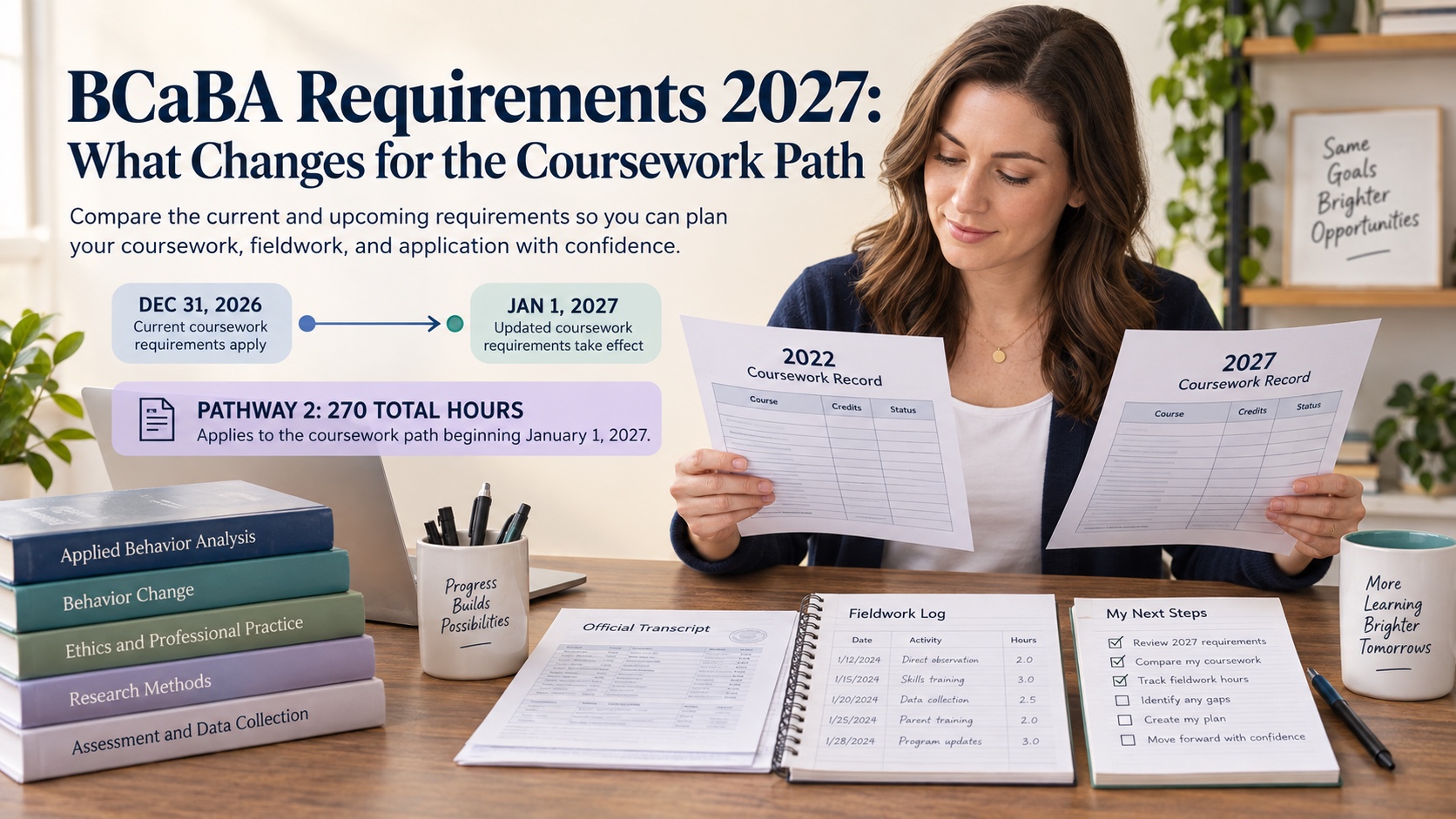
BCaBA Requirements 2027: What Changes for the Coursework Path
If you are searching for BCaBA requirements 2027, one number deserves special attention: the Pathway 2 coursework total changes from 225 hours under the 2022 table to 270 hours under the 2027 table. That is a BCaBA-specific transition point. It is not the BCBA 315-hour map, and it should not be replaced with a generic behavior-analysis checklist.
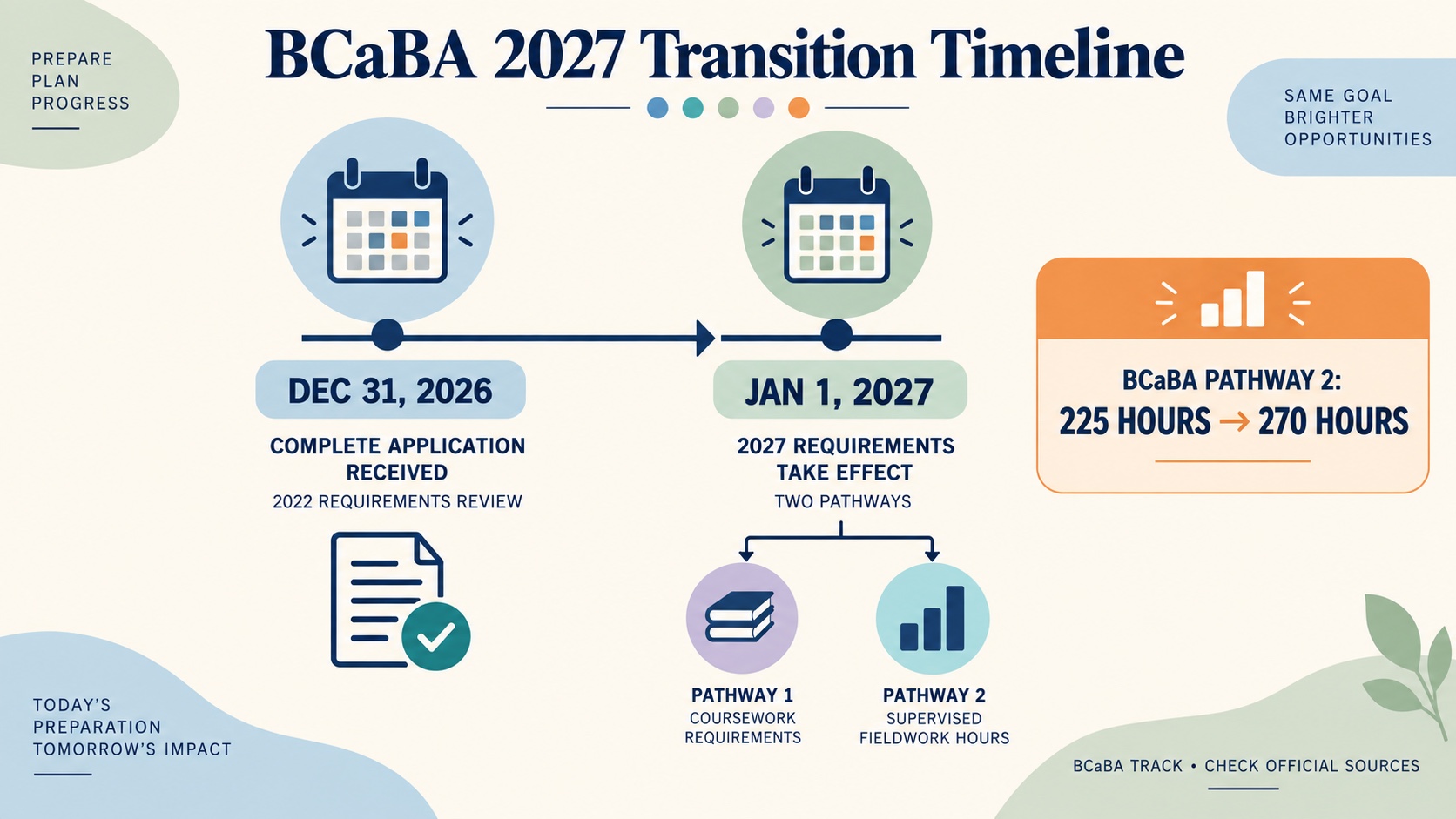
The BACB says significant BCaBA eligibility changes take effect January 1, 2027. A complete application—including payment and all required documents—must be received by December 31, 2026 to be reviewed under the current 2022 requirements. This guide explains the official BCaBA transition, but it is not an individual eligibility determination. Use the current BCaBA Handbook and transition guidance for your records.
Quick answer: beginning January 1, 2027, BCaBA applicants use two pathways: an ABAI-accredited degree pathway or a behavior-analytic coursework pathway. The degree requirements do not change in the transition summary. Pathway 2 coursework changes from 225 total hours under the 2022 table to 270 total hours under the 2027 table, with new content descriptions and freestanding-course conditions. The complete-application boundary for current-2022 review is December 31, 2026.
Keep the track boundary visible while you study. BCaBA is an undergraduate-level certification route, and the coursework map is not the same as the BCBA map. A page that gives you a BCBA number without labeling the difference is not a safe shortcut.
The transition date and complete application
Write down two dates:
- December 31, 2026: the BACB identifies this as the date by which a complete application must be received to be reviewed under current 2022 requirements. Complete includes payment and required documents.
- January 1, 2027: the new BCaBA eligibility framework applies to applications under the 2027 requirements.
If you are close to the boundary, do not treat “I opened an application” or “I sent one document” as the official standard. Verify completeness, forms, payment, and receipt with the current BACB instructions. If your application will be made in 2027, plan from the 2027 pathway and coursework documents instead of trying to combine old and new checklists informally.
The two BCaBA pathways
Beginning January 1, 2027, the BACB describes two BCaBA eligibility pathways. Both require a degree, behavior-analytic preparation appropriate to the pathway, practical fieldwork, and passing the BCaBA certification examination.
- Pathway 1: accredited degree. The applicant has a bachelor’s degree or higher from an ABAI-accredited behavior-analysis degree program, as described by the official requirements.
- Pathway 2: behavior-analytic coursework. The applicant has a bachelor’s degree or higher and completes the required behavior-analytic coursework under the 2027 structure.
The transition summary says the degree requirements do not change for either pathway. That does not mean every degree or program record automatically meets the rule. Keep the degree date, program status, transcript, course documentation, and Handbook section together when you ask for a review.
The 225-to-270-hour coursework change
The BCaBA Pathway 2 conversion table changes the total required content from 225 hours under the 2022 requirements to 270 hours under the 2027 requirements. It also changes the names and structure of the content areas. A freestanding course means the required content makes up the majority of that course.
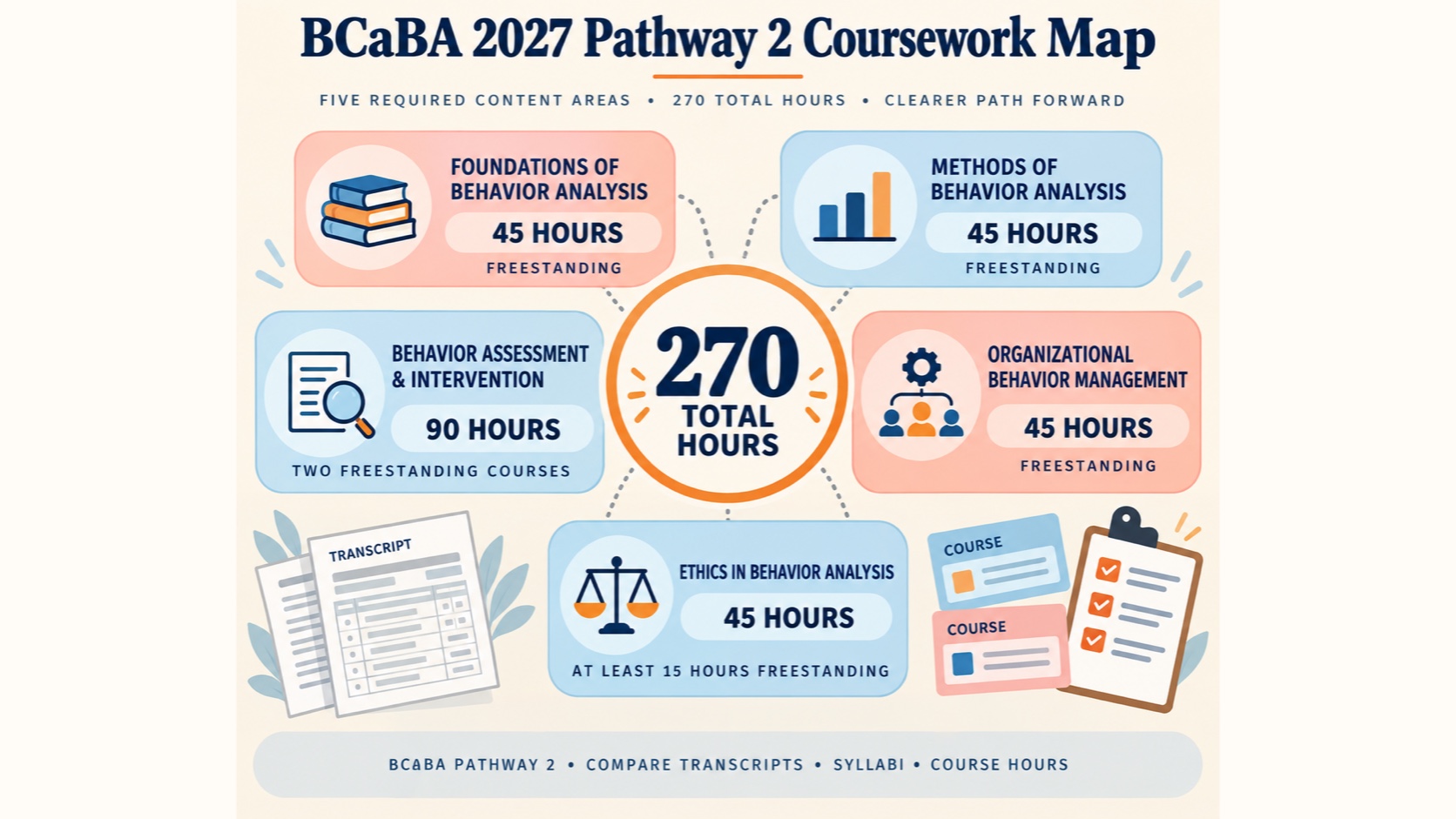
- Foundations of Behavior Analysis: 45 hours in one freestanding course.
- Methods of Behavior Analysis: 45 hours in one freestanding course.
- Behavior Assessment and Intervention: 90 hours across two freestanding courses.
- Organizational Behavior Management: 45 hours in one freestanding course.
- Ethics in Behavior Analysis: 45 hours, with at least 15 hours in a freestanding course.
Do not compare course titles only. Save the transcript, syllabus, content hours, term, and the source used for the mapping. If an older course combined areas that are separated in the 2027 table, flag it for a program or official review. Do not count the same hours twice simply because a course sounds broad.
Also keep the BCaBA number separate from the BCBA number. The 270-hour total in this article is for the BCaBA 2027 Pathway 2 table. It is not a shortened or alternate description of the BCBA 315-hour framework.
A simple audit example can make the difference visible. Imagine a transcript with a 45-hour course whose title includes principles and philosophy, a 30-hour measurement course, a 45-hour assessment course, a 60-hour intervention course, a 15-hour supervision course, and a 30-hour ethics course. Under an older table, those labels may appear to add up in a familiar way. Under the 2027 BCaBA table, you must ask which new category each course supports, whether the course is freestanding, whether the content hours meet the new allocation, and whether the combined assessment and intervention area is covered across two freestanding courses. The correct next step is a documented comparison, not a quick yes or no.
For every course, write five notes: the exact title, the term, the content area, the hours, and the evidence you used. If a course seems to support more than one category, mark that as an open question. This makes a conversation with your program contact more efficient and keeps the article’s 270-hour headline from being mistaken for a personal approval.
Degree, fieldwork, and examination checks
Coursework is one part of the application. Review the current BCaBA Handbook for practical fieldwork, supervision, verification forms, application steps, and examination requirements. The official BCaBA requirements page describes practical fieldwork and passing the BCaBA certification examination as part of the pathway.
The 2027 eligibility transition is not automatically a new examination edition. Keep exam content and testing procedures in their own source folder. If you see a study page using “2027” as though it proves a new exam outline, return to the BACB’s current test-content and examination pages before changing your study plan.
Fieldwork also deserves its own evidence trail. Keep supervision agreements, verification forms, dates, settings, and supervisor information together, then compare them with the current BCaBA Handbook. Coursework evidence answers a coursework question; it does not prove that fieldwork, supervision, or application documentation is complete. Separating the folders helps you notice what is actually verified and what still needs confirmation. This record structure is useful before any application deadline approaches or course decision.
A BCaBA records checklist
- Application timing: record whether you are relying on complete-application receipt by December 31, 2026 or planning for the 2027 framework.
- Pathway: note whether your route is an ABAI-accredited degree or behavior-analytic coursework.
- Degree: save the degree, date, institution, and program evidence.
- Coursework: map your transcript and syllabi to the 270-hour 2027 table.
- Freestanding courses: mark which courses meet the majority-content condition.
- Fieldwork: keep supervision and verification records in a separate folder.
- Examination: use current BCaBA exam information instead of guessing from a year label.
Common BCaBA 2027 mistakes
- Using BCBA numbers: the BCaBA 2027 Pathway 2 total is 270 hours, not 315.
- Assuming a started application qualifies: the official boundary refers to a complete application received.
- Matching titles instead of content: compare syllabi, hours, and course structure.
- Ignoring the 15-hour Ethics freestanding condition: the 2027 table includes a specific freestanding-course detail.
- Counting old coursework twice: map the conversion table carefully.
- Calling 2027 a new exam edition: eligibility changes and exam outlines are different questions.
BCaBA requirements 2027 FAQ
What changes for BCaBA in 2027?
The eligibility framework begins January 1, 2027. The two pathways remain the accredited-degree pathway and the behavior-analytic-coursework pathway, while the Pathway 2 coursework table changes in structure and total hours.
Is the BCaBA Pathway 2 total 225 or 270 hours?
The 2022 table lists 225 total hours; the 2027 table lists 270 total hours. Use the official BCaBA transition guidance and current Handbook for your individual record.
Does the BCaBA exam become a new edition in 2027?
Do not infer that from the eligibility transition. Check the current official BCaBA examination and test-content sources for exam-specific changes.
Can this page decide whether my courses count?
No. It gives you a track-specific map. Your transcript, syllabi, course hours, program evidence, and official review determine how your records fit.
Where study resources fit
After the requirement map is clear, use the BCaBA study path for concepts, the BCaBA practice questions for applied reasoning, and the ABA Definition Search for terminology. Study resources can organize learning, but they do not replace the BCaBA Handbook, official transition guide, forms, or eligibility review.