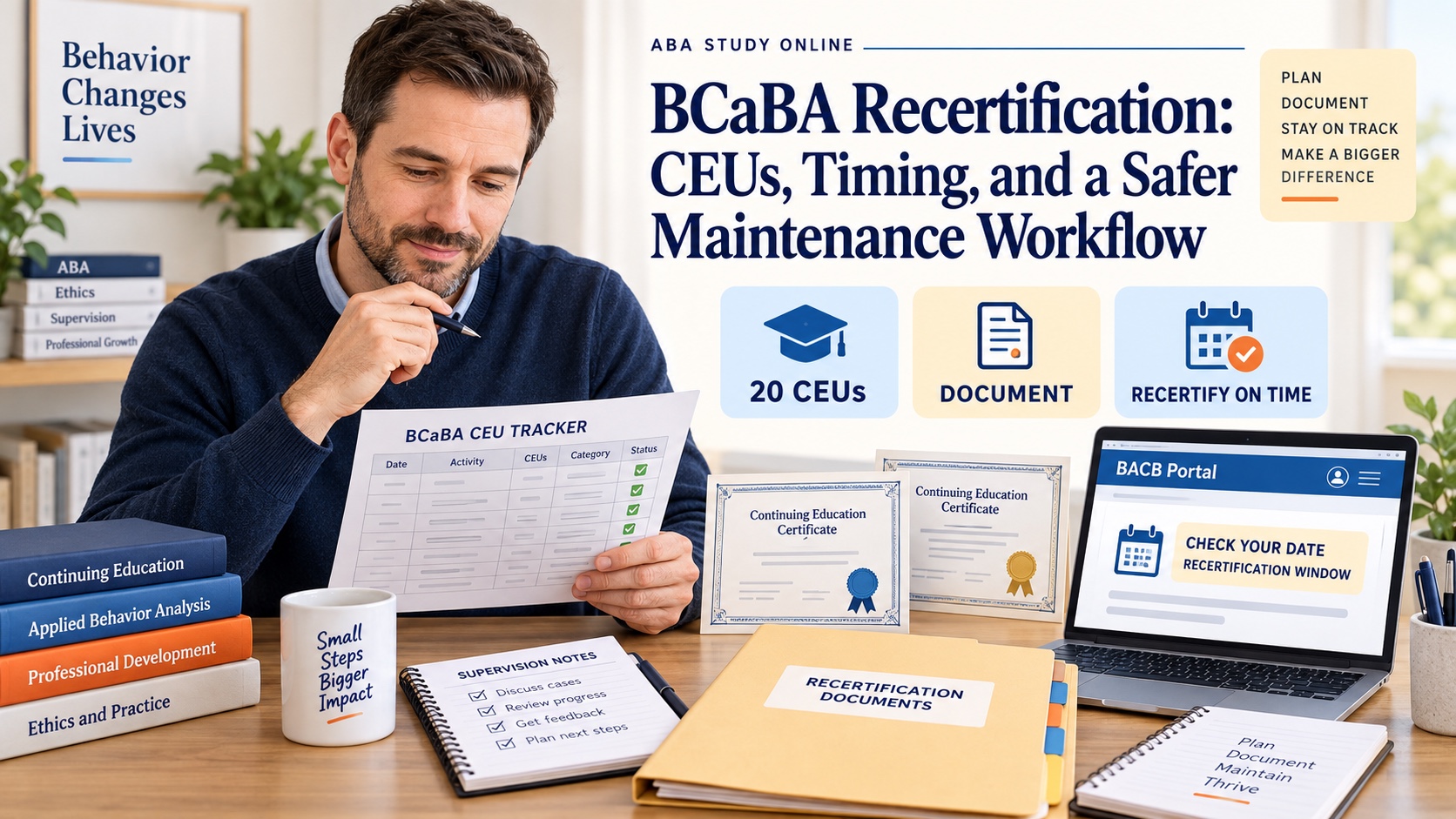
BCaBA Recertification: CEUs, Timing, and a Safer Maintenance Workflow
BCaBA recertification is not a task to discover a few days before your credential expires. The current handbook describes a two-year maintenance cycle with continuing education, documentation, ongoing supervision, ethics and self-reporting responsibilities, and a recertification application submitted through your BACB account.
The safest workflow is to track evidence as you earn it, keep category labels clear, check your recertification date, and submit when the application becomes available. The 2027 requirements add transition planning, but they do not turn every current-cycle record into a new application rule. Always verify the handbook and transition resource that apply to your cycle.
Table of Contents
Current BCaBA maintenance snapshot
The current BCaBA Handbook reviewed for this guide describes the following planning points:
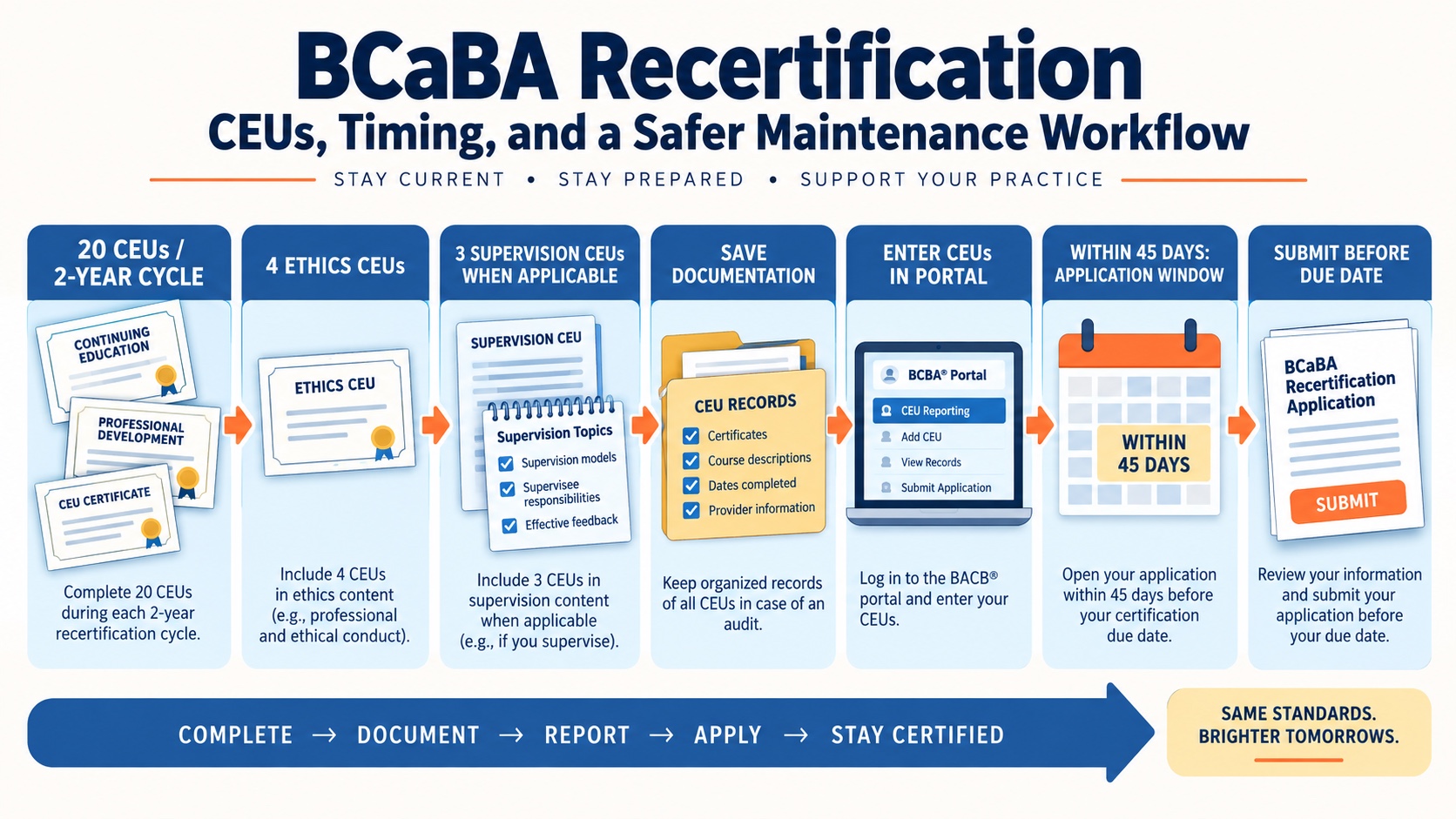
- Cycle: recertification is submitted every two years.
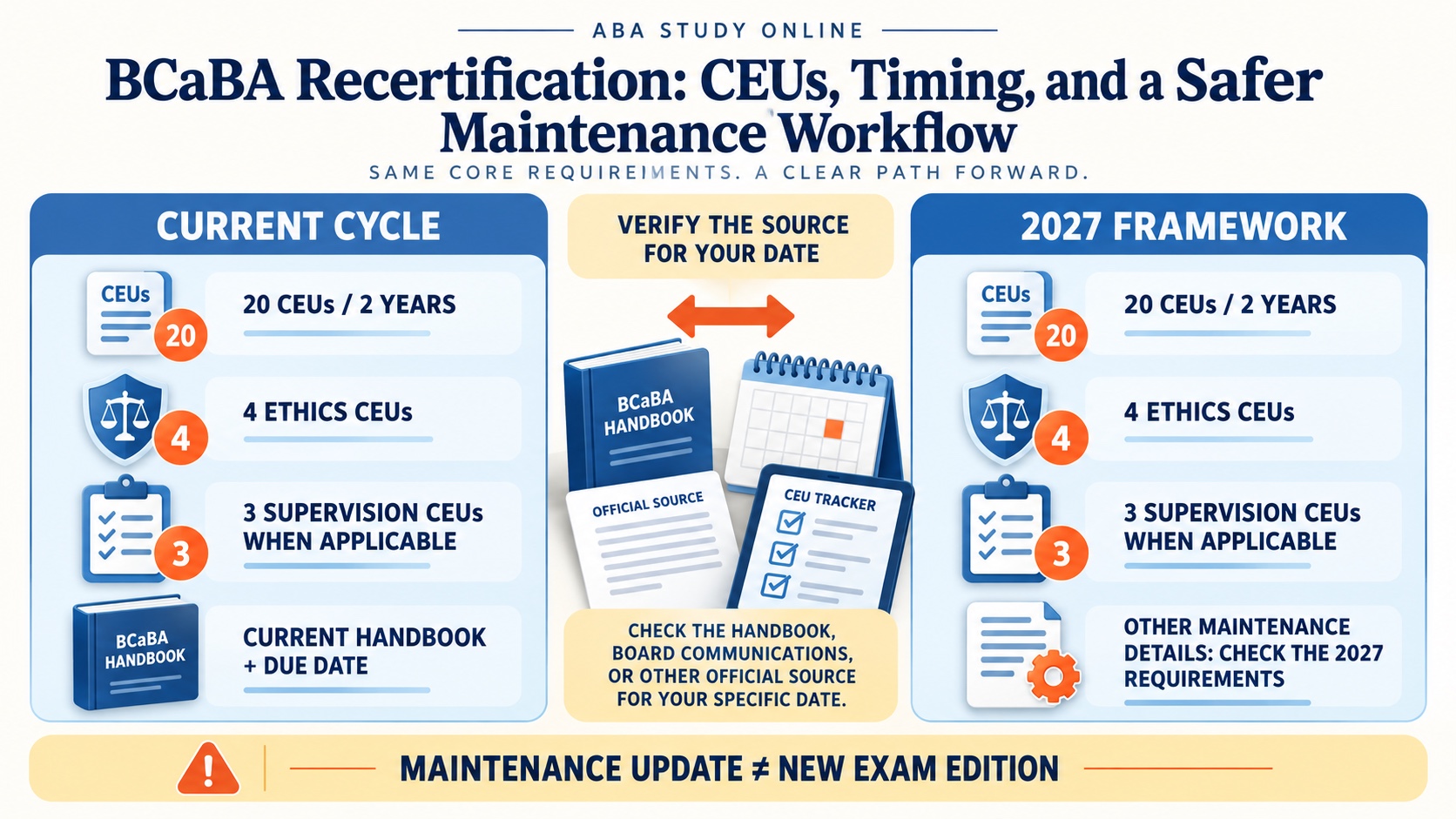
- Total CEUs: 20 CEUs are required in each two-year cycle.
- Ethics: 4 ethics CEUs are included in the cycle requirement.
- Supervision: 3 supervision CEUs are required when the BCaBA supervised the ongoing practice of one or more RBTs on record during the cycle.
- Documentation: each CEU entry needs supporting documentation and the category should be clear.
- Application timing: the recertification application becomes available in the BACB account within 45 days of the recertification date after the required CEUs are entered.
This is a planning snapshot, not a replacement for the live handbook. If your cycle, status, supervision role, or application date is unusual, confirm the details before you count an activity or submit a form.
Track CEUs and documents during the cycle
Do not wait until the end of the cycle to reconstruct your records. Create one row for each activity with the provider, event title, date, number of CEUs, category, certificate location, and the cycle to which you intend to apply it. Store the completion document with the row. A spreadsheet, folder, or organized app note is enough if you can retrieve the evidence quickly.
Category tracking matters. A general learning event does not automatically fill the ethics or supervision category. Read the provider’s description and certificate, check the current BACB category definitions, and record the category only when the documentation supports it. If the category is unclear, ask the provider or consult the current BACB guidance before treating the activity as complete.
Supervision also deserves its own check. If you supervise RBTs during the cycle, keep the supervision CEU target visible. If your role changes, record when it changed and recheck the current handbook rather than assuming the earlier plan still applies.
A monthly maintenance routine
Once a month, compare your CEU log with three questions: Is the total moving toward 20? Are the ethics and, when applicable, supervision categories documented separately? Can I open the certificate or record for every entry? This review takes less time than rebuilding the cycle later and gives you a chance to find a missing certificate while the provider can still help.
Use a simple status label for each activity: planned, completed, entered, or verified. “Completed” means you attended or finished the event. “Entered” means it is recorded in your BACB account. “Verified” means you have checked the category and documentation against the current rule. The labels keep a full calendar from being mistaken for a complete recertification record.
When an activity is unclear
Do not solve an unclear category by counting the same activity twice or by assigning it to the category that still has space. Save the event description, certificate, date, provider information, and your question. Ask the provider how the activity was designed and documented, then compare that answer with the current BACB guidance. If the evidence still does not establish the category, leave it out of the required minimum until you receive reliable clarification.
This conservative habit does not mean every learning activity is useless. An event can support professional development even when it does not fill a particular recertification category. Keep the learning value and the maintenance evidence as two separate notes.
Recertification is maintenance, not a new credential
Recertification confirms that an existing BCaBA continues to meet the applicable maintenance requirements. It is different from initial certification, which involves an eligibility pathway and examination. A CEU tracker cannot replace the original degree, coursework, fieldwork, or application evidence, and an initial-certification page cannot tell you whether a maintenance record is complete.
Keeping that boundary clear helps when you search online. If a page answers “how do I become a BCaBA?” it may be useful for a new applicant but still omit the cycle dates, category documentation, and recertification tab that a current certificant needs. Match the source and the action to your status.
Submit the recertification application
When you are within the applicable window and your CEUs are entered, open the Recertification tab in your BACB account. Review your contact details, read the application attestations, submit the required payment, and retain confirmation. Do not assume that an application is available simply because the calendar year is ending; the account window and your recertification date control the workflow.
Check every entry before you submit. Duplicate documentation, missing certificates, unclear categories, or a CEU total that includes an activity from the wrong cycle can create an avoidable problem. Keep the original evidence even after the application is approved because the BACB may audit records.
If you are waiting for a provider certificate, contact the provider early. If your account does not show the expected application or you receive an action item, use the current BACB instructions and processing updates. A general online article cannot see your account or determine whether a particular document satisfies a formal review.
Audits, lapses, and inactive status
The BACB may select CEU entries for audit. If an entry is incomplete, duplicated, or not supported by the required documentation, your certification status can be affected. The best audit preparation is ordinary recordkeeping: clear categories, original certificates, dates, provider details, and a note showing which cycle you used.
Missing the recertification date is more serious than being late with a personal reminder. The handbook describes an inactive status when recertification is not completed by the due date, which means you may not practice, bill, supervise, or represent yourself as a BCaBA during the inactive period. Reinstatement and loss-of-certification rules are time-sensitive, so read the current handbook rather than relying on a forum summary.
How to plan around 2027
The published 2027 BCaBA Requirements keep the 20-CEU total and the 4-ethics and 3-supervision category framework, while other eligibility and supervision details change. Treat 2027 as a transition boundary for the maintenance system, not as a reason to discard every current CEU record.
Write two labels in your notes: current cycle and future framework. Under current cycle, record the handbook and due date that govern your active certification. Under future framework, record the new source and the date it may affect your planning. If your recertification, supervision status, or application crosses January 1, 2027, open the official transition guidance and ask your supervisor or program contact for help with the specific case.
Common recertification mistakes
- Waiting until the final week: missing documentation is harder to repair under deadline pressure.
- Counting category by topic alone: ethics or supervision labels need supporting documentation.
- Mixing cycles: an activity completed after the new cycle begins may not fill the previous cycle.
- Ignoring supervision changes: a change in RBT-supervision role can change which record you need.
- Using a 2027 summary as today’s rule: verify the handbook and effective date that apply to your case.
BCaBA recertification FAQ
How often does a BCaBA recertify?
The current BCaBA Handbook describes a two-year recertification cycle. Check your BACB account for your individual recertification date.
How many CEUs does a BCaBA need?
The current planning snapshot is 20 CEUs per two-year cycle, including 4 ethics CEUs and 3 supervision CEUs when the supervision condition applies. Verify the live handbook and your role.
When does the recertification application appear?
The handbook says it becomes available in the BACB account within 45 days of the recertification date after required CEUs have been entered. Your account and current official instructions control.
Does 2027 change the BCaBA exam outline?
Maintenance and eligibility changes are not automatically exam-outline changes. Use the current BCaBA TCO for exam content and the 2027 requirements for the transition boundaries.