Free BCaBA Practice Exam: A Smarter Review Loop
Looking for a BCaBA practice exam free option can be a practical first step when you want to check your preparation without buying another resource. The important part is what happens after you answer. A free practice set should help you notice which content areas need attention, whether you can apply a principle to a scenario, and what to study before your next attempt.
This guide explains how to use free BCaBA practice as a diagnostic study session. It covers the current examination structure, the 6th-edition Test Content Outline (TCO), a simple error-review method, score interpretation, and the difference between 2027 certification-requirement changes and examination changes. ABA Study Online practice content is original study material. It is not a BACB examination, an official question bank, or a pass guarantee. Verify current rules with the BCaBA Test Content Outline and the BCaBA Handbook.
Table of Contents
Short answer: what free practice can show you
A free practice exam can show whether you can work through a question under a defined condition. It can reveal that you remember a term but miss the best application, confuse a measurement dimension, overlook an ethical boundary, or select an intervention before considering assessment information. Those patterns are more useful than a single percentage.
Free practice cannot tell you that you are ready for certification. Independent questions differ from secure BACB items in wording, difficulty, context, and content mix. A practice result is evidence from one study session. Treat it as a starting point for review, not a prediction of your examination result.
Know the current BCaBA exam
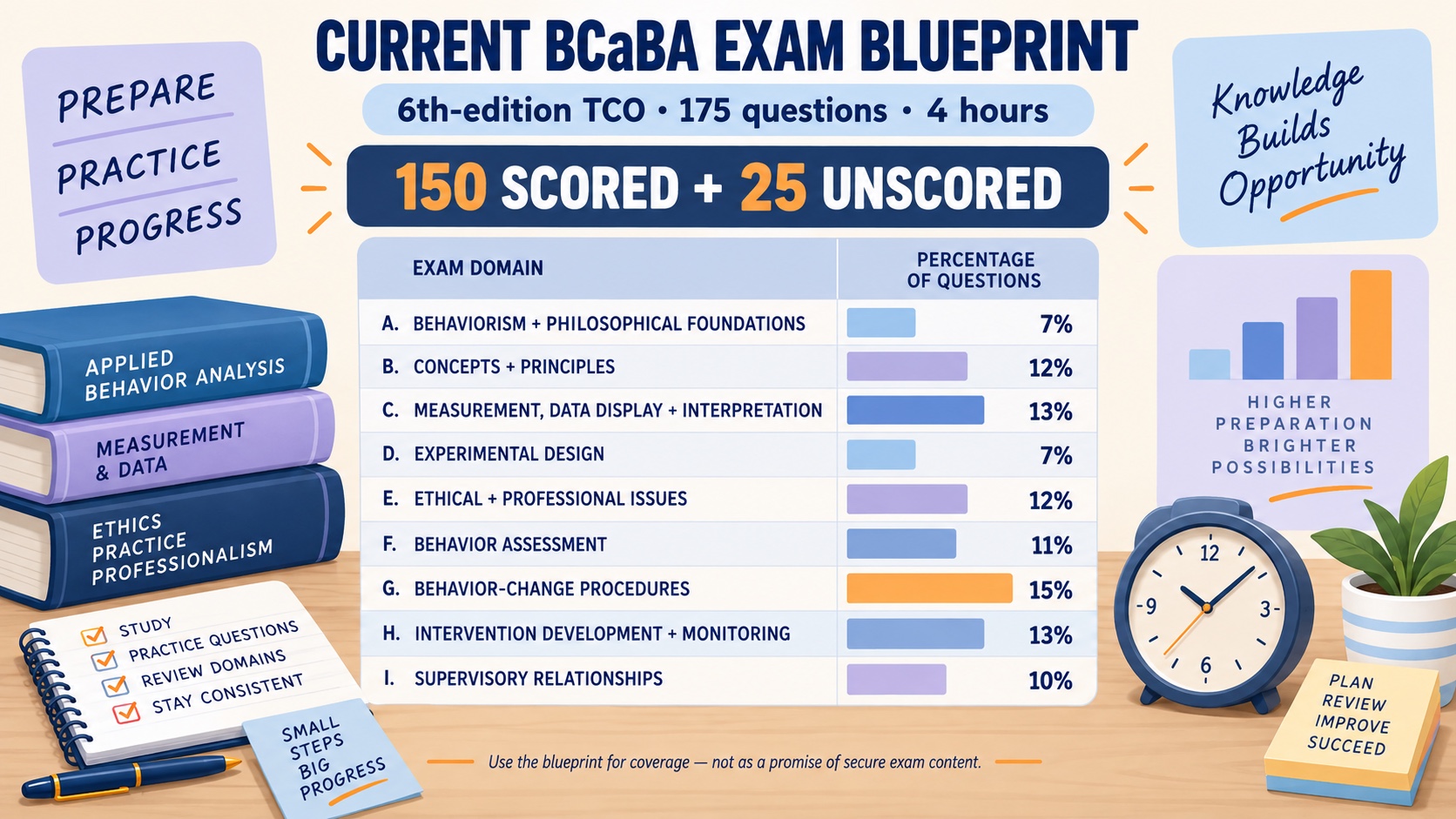
The current BCaBA examination is based on the 6th-edition TCO beginning in 2025. The examination contains 175 multiple-choice questions: 150 scored questions and 25 unscored pilot questions. Each question has four answer choices with one correct answer, and candidates have four hours to complete the examination. The BACB describes the examination as an in-person computer-based test delivered through authorized Pearson VUE sites.
The TCO and the examination total are related but not identical. The TCO chart shows the scored-question blueprint, while the full examination also includes unscored pilot questions. A free practice set does not need to imitate 175 questions every time. A 20-question learning session, a 50-question mixed session, and a longer timed rehearsal can all be useful when you label the purpose and compare like with like.
The current BCaBA Handbook also says that the BACB does not endorse specific study guides or preparation materials and that purchasing a study resource does not guarantee a pass. That is a useful standard for evaluating any free resource: look for transparent coverage, explanations, and a clear boundary between study support and certification.
Use the TCO to balance practice
A free BCaBA practice exam is stronger when its questions are connected to the current blueprint. The nine content areas have different shares, so a series of quizzes should not repeatedly test only familiar vocabulary.
| Domain | Content area | TCO share |
|---|---|---|
| A | Behaviorism and Philosophical Foundations | 7% |
| B | Concepts and Principles | 12% |
| C | Measurement, Data Display, and Interpretation | 13% |
| D | Experimental Design | 7% |
| E | Ethical and Professional Issues | 12% |
| F | Behavior Assessment | 11% |
| G | Behavior-Change Procedures | 15% |
| H | Intervention Development and Monitoring | 13% |
| I | Supervisory Relationships | 10% |
G has the largest share at 15%. C and H follow at 13%, while B and E are 12% each. That information can guide the number of questions you sample over time, but it is not a reason to ignore A, D, F, or I. A balanced review plan should also reflect your own errors. If a small domain repeatedly produces mistakes, it deserves attention even when it has a lower percentage.
Build a useful practice session
Start by writing the purpose of the session. This keeps a free quiz from becoming a score-collection habit.
- Choose a format. Use focused practice for one content area, mixed practice for switching across areas, or timed practice for pacing.
- Set a defined size. Choose 20, 40, 50, or another clear number before you begin. Do not add questions simply because the first result feels uncomfortable.
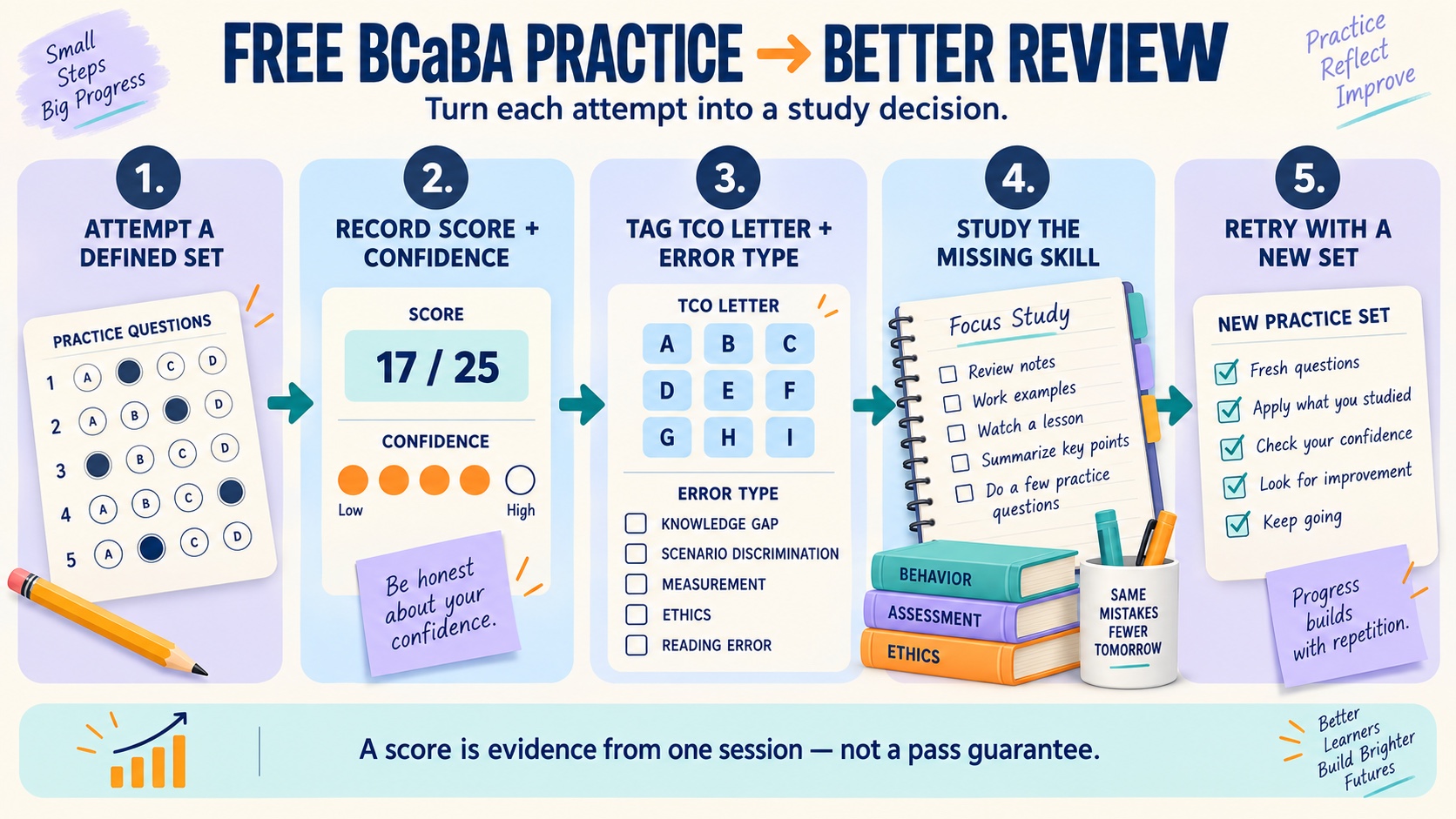
- Commit to an answer. Record your choice before checking the rationale. Mark your confidence as low, medium, or high.
- Tag the item. Record the TCO letter and a preliminary error type: knowledge gap, scenario discrimination, measurement, ethics, or reading error.
- Read the explanation. Identify the fact or relationship that makes the best answer stronger than the distractors.
- Plan the retry. Choose one short review action and a future practice set that is not identical to the first one.
For timed practice, keep your environment close to the conditions you want to rehearse and avoid looking up answers mid-session. For learning practice, pausing after you commit to an answer can be appropriate. These sessions answer different questions: one examines pacing, and the other examines understanding. Label the difference in your notes.
Review wrong answers by error type
Build a small error log with four columns: your answer, why it seemed attractive, the decisive cue in the scenario, and your next action. Add the TCO letter so your errors can be counted by content area later.
Imagine a question about measurement. You choose duration because the scenario mentions a behavior lasting a long time, but the actual question asks how long it takes the response to begin after an instruction. This is not necessarily a total knowledge failure. It may be a discrimination error: you noticed the word “time” but did not match the measurement dimension to the question. Your next action should be a short contrast among latency, duration, frequency, and interresponse time, followed by new examples.
For a behavior-change question, ask whether the answer fits the stated assessment information, the written plan, and the practitioner’s role. For an ethics question, identify the active boundary—such as competence, confidentiality, client welfare, consent, or a multiple relationship—before choosing an action. For a supervisory-relationship question, pay attention to communication, feedback, role clarity, and the limits of independent decision-making.
Do not simply copy the correct answer into a flashcard. Write the distinction that separates it from the distractors. That explanation is what helps a new scenario feel different from the one you just saw.
Interpret the score without overreading it
Write down how many questions you answered, which content areas were represented, whether the items were new, how much time you used, and whether you reviewed answers during the session. A 75% on familiar vocabulary is different evidence from 75% on new mixed scenarios under a time limit.
Look for three patterns:
- Accuracy: Did you select the best answer, or only an answer that sounded possible?
- Consistency: Does your performance hold across content areas and different scenarios?
- Independence: Can you explain the choice without immediately opening a note?
There is no honest universal practice percentage that guarantees a pass. A lower score can reflect an unfamiliar topic, a harder set, fatigue, or a timing problem. Change one variable in the next session and record what changed. Your goal is not to hide a weak result; it is to make the next study action more precise.
Does 2027 create a new BCaBA exam?
Not according to the current BCaBA transition guidance. The January 1, 2027 changes relate to certification requirements and maintenance. They are a separate issue from the examination blueprint. The guidance states that there are currently no upcoming changes to the BCaBA examination or the TCO, and it explains that future examination or TCO updates can occur independently of certification-requirement updates.
For exam-content study, continue to use the current 6th-edition BCaBA TCO unless the BACB publishes an official new edition and effective date. For your own eligibility or application timeline, read the current BCaBA Handbook and transition materials. Do not call a practice page a “7th-edition exam” guide based only on the 2027 requirements change.
Choose the next study action
After a free practice set, choose one small action: reread a TCO task, work three new measurement examples, write an ethics rationale, review an assessment distinction, or repeat a mixed set after a short interval. Then record whether your confidence and accuracy changed. A practice loop is complete only when the result changes what you do next.
FAQ and official sources
Is a free BCaBA practice exam worth using?
Yes, if you use it to find patterns and plan review. It is much less useful when you collect scores without reading rationales or tracking content areas.
How many questions should a free practice set include?
Choose the size that matches your purpose. Short focused practice helps with learning; longer mixed practice helps with transfer and pacing. Label the session so later comparisons are fair.
Can a free practice score predict whether I will pass?
No. Independent sets differ from the secure BACB examination. A practice score is evidence from one session, not a certification result or promise.
Where should I check the current BCaBA exam content?
Use the current BCaBA Test Content Outline, the BCaBA Handbook, and the BACB Examination Information page. For 2027 requirements changes, read the BACB’s BCaBA transition guidance.
Sources checked for this guide: Behavior Analyst Certification Board, BCaBA Test Content Outline (6th ed.); BCaBA Handbook; BACB Examination Information; BCaBA resource page; and Guidance for Meeting the BCaBA Requirements During the 2027 Transition.