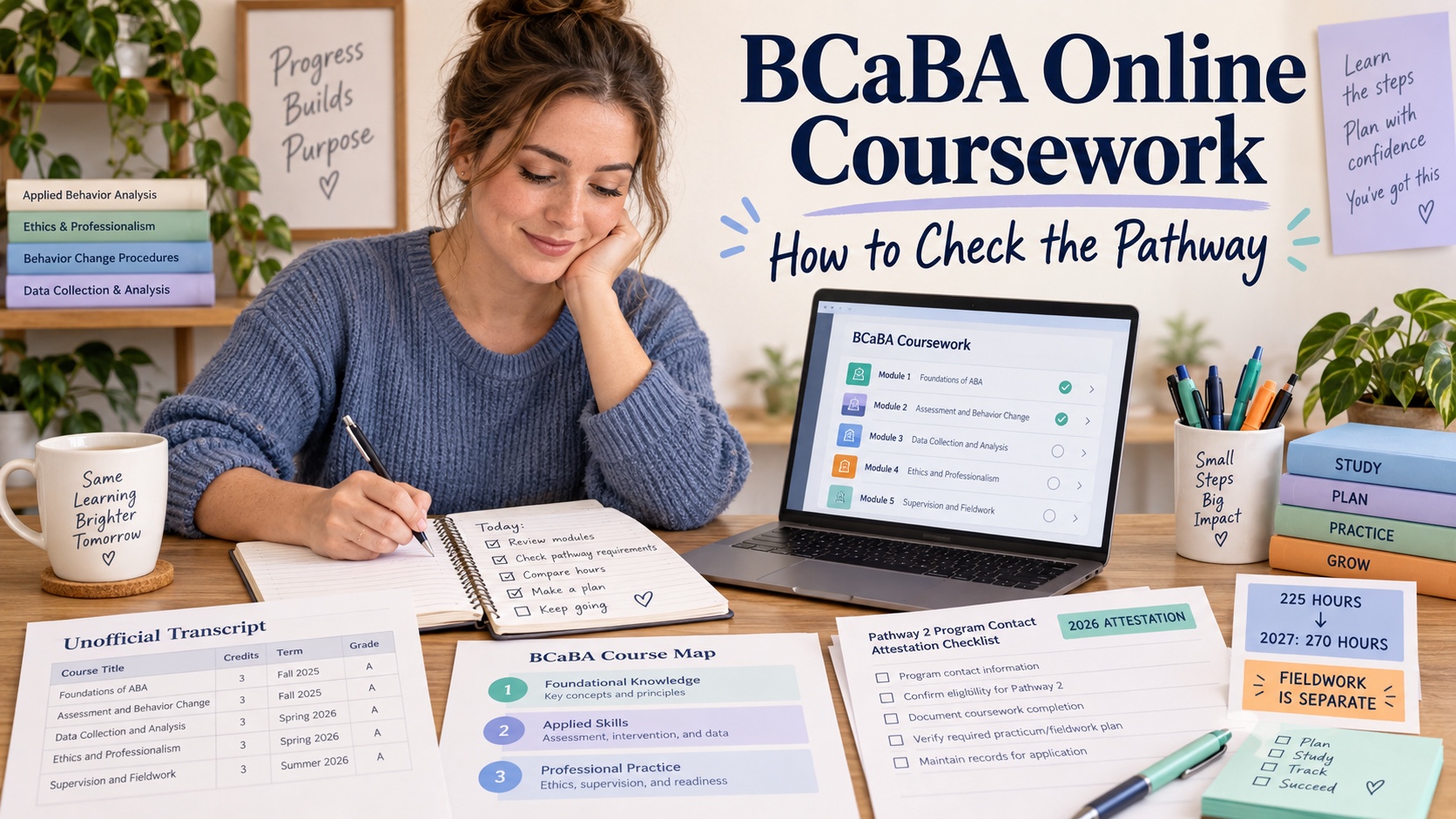
BCaBA Online Coursework: How to Check the Pathway
If you are searching for BCaBA online coursework, you may be looking for a flexible way to complete the behavior-analytic classes needed for certification eligibility. Online delivery may be possible, but the course format is only one part of the decision. You also need to verify the institution, course level, academic credit, content hours, transcript, Pathway 2 Program Contact, and the application year that will govern your requirements.
This guide focuses on how to check an online coursework pathway before enrolling. It does not rank universities or promise that a course will make you a BCaBA. Compare every plan with the current BACB BCaBA Handbook and your institution’s Pathway 2 contact.
Table of Contents
Short answer: can BCaBA coursework be online?
The BACB requirements focus on the institution, coursework, credit, content, transcripts, fieldwork, and certification process rather than using “online” as a universal approval label. That means an online class may be part of a qualifying pathway when the institution and coursework meet the applicable rules. It also means that a course advertised as “online BCaBA coursework” is not automatically qualifying just because it has ABA topics or a completion certificate.
The current BCaBA Handbook describes two eligibility pathways: a bachelor’s degree or higher from an ABAI-accredited program, or a qualifying degree plus behavior-analytic coursework through Pathway 2. Both pathways also require supervised fieldwork and passing the BCaBA examination. Coursework is one piece of eligibility, not certification by itself.
What makes online coursework count?
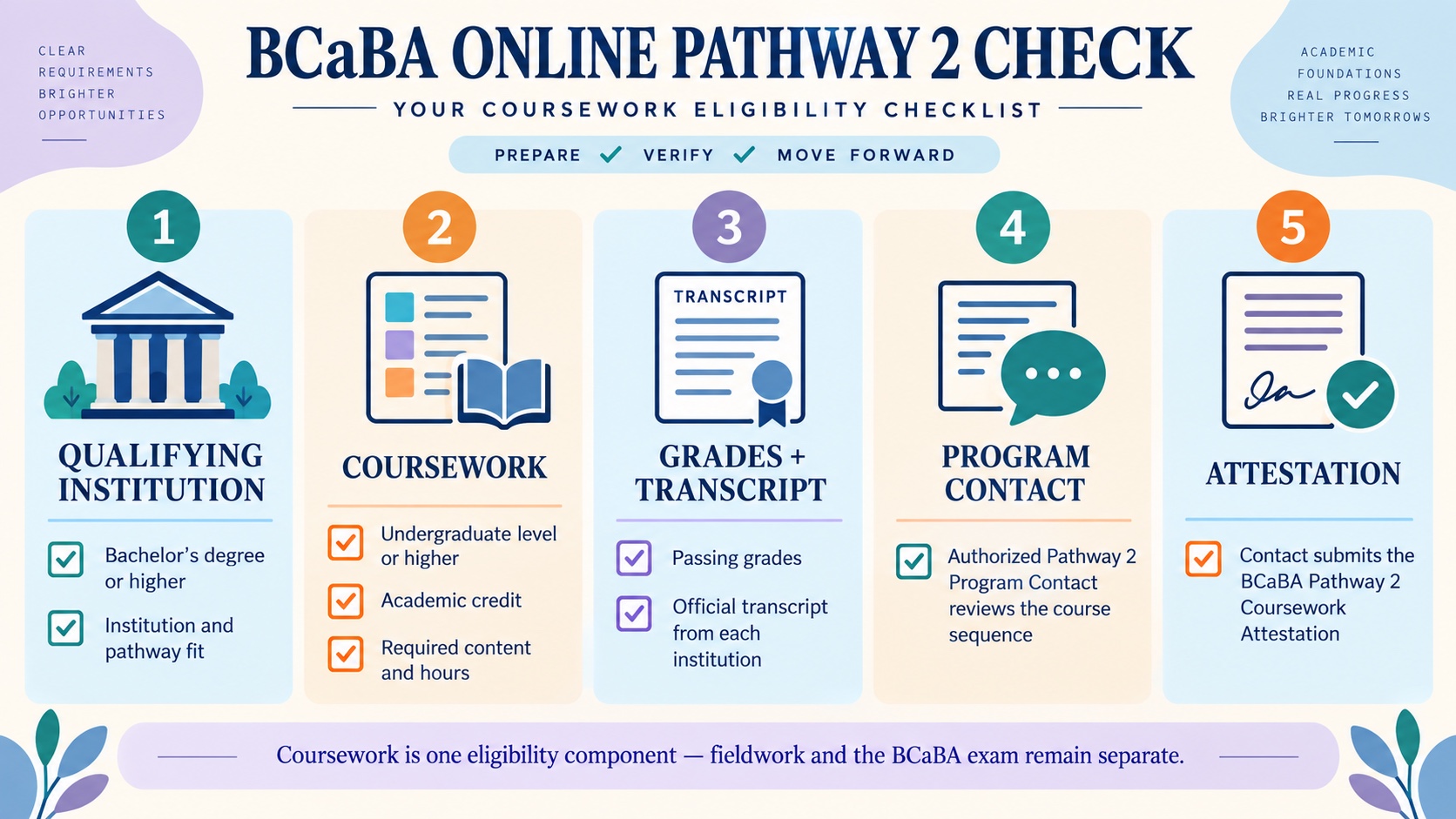
For current Pathway 2 planning, check these items before you enroll:
| Verification point | Question to ask |
|---|---|
| Institution | Is the school a qualifying institution for the applicant’s jurisdiction and pathway? |
| Course level | Are the courses undergraduate level or higher, as the current pathway requires? |
| Academic credit | Will the institution award academic credit and list the courses on an official transcript? |
| Content and hours | Does the course map cover every required content area and instructional-hour total? |
| Grades | Does each course meet the current passing-grade rule? |
| Program contact | Does the institution have an authorized Pathway 2 Program Contact who can review and attest to the coursework? |
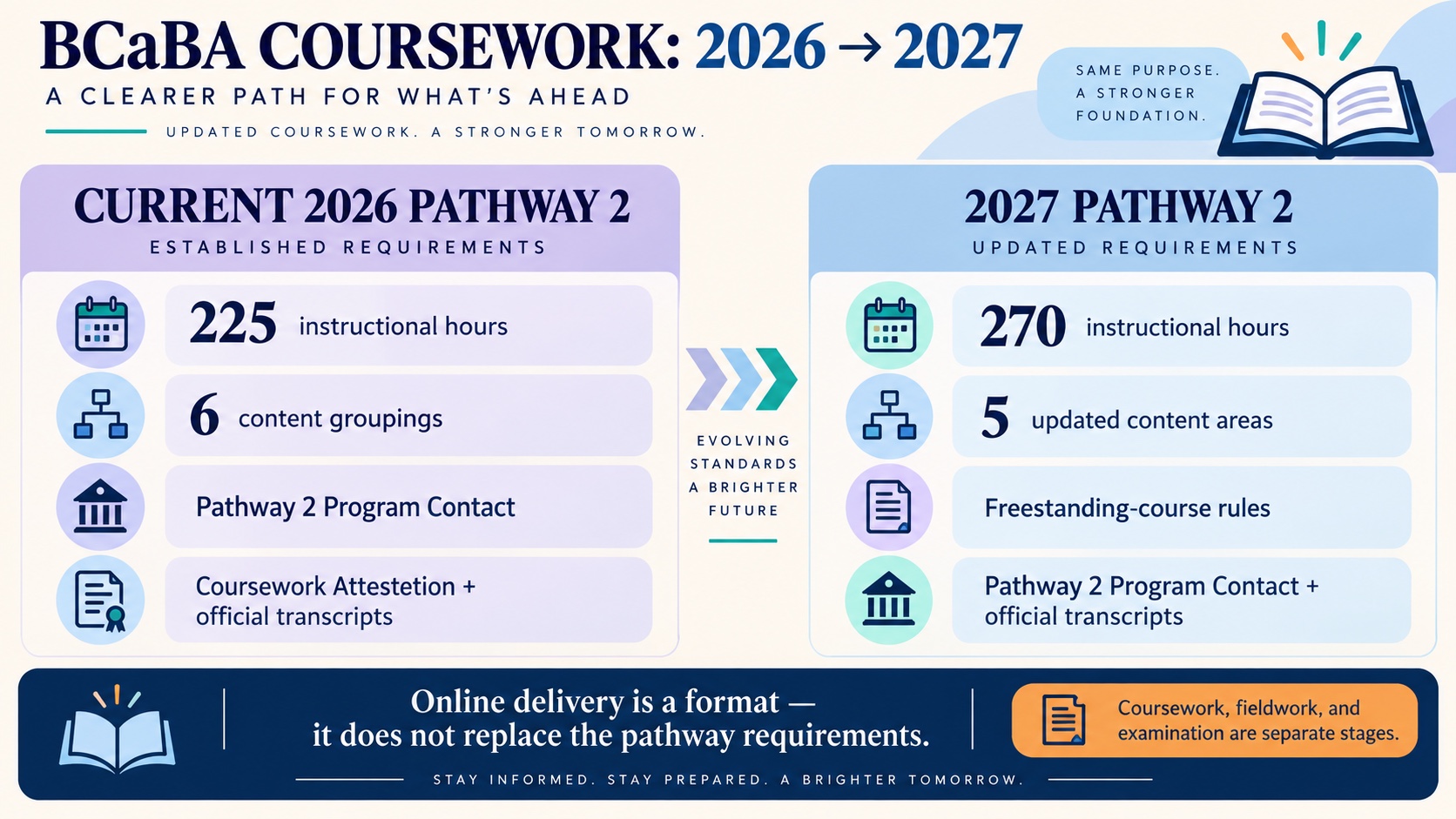
For the current 2026 Pathway 2 requirements, the BCaBA Handbook lists a total of 225 instructional hours across ethics and professionalism; philosophical underpinnings, concepts, and principles; measurement, data display, interpretation, and experimental design; behavior assessment; behavior-change procedures and intervention; and personnel supervision and management. The handbook also says the coursework must be within the required 10-year window, carry academic credit, meet the passing-grade standard, and be completed at an institution with a Pathway 2 Program Contact.
How the 2026 Pathway 2 attestation works
Beginning January 1, 2026, the BACB implemented a Pathway 2 Coursework Attestation System after ABAI discontinued its Verified Course Sequence System. The process is institution-based. A full-time faculty member in the department where the program is housed must hold an active BCBA or BCBA-D certification and serve as the Pathway 2 Program Contact.
The contact reviews the student’s course sequence, confirms whether the current Pathway 2 coursework requirements are met, and submits an attestation for an eligible applicant. The student also requests official transcripts from each institution where qualifying coursework was completed. If the attestation is not in the student’s BACB account, the student cannot complete the Pathway 2 application under the current process.
This is why a non-university online course or a collection of informal certificates needs careful scrutiny. It may be useful for learning, but it may not create the academic transcript and institution-level attestation required for the certification pathway. A provider’s statement that a course is “aligned with the BACB” is not the same thing as an authorized Pathway 2 Program Contact attesting to your coursework.
A prior VCS Coordinator Coursework Attestation submitted before December 31, 2025 may be used within the transition window described by the BACB. Do not assume that an old VCS page, a course catalog, or a screenshot of a former sequence is enough for a new application.
What to compare in the course map
Ask the program for a current course map rather than relying on course titles alone. Two classes can use similar names while covering different amounts of measurement, assessment, intervention, ethics, or supervision content. The program should be able to show where each required area is taught and how the instructional hours are calculated.
- Course descriptions: look for behavior-analytic content, not only broad psychology or education language.
- Hour mapping: check whether the listed hours are instructional hours or merely the estimated time a student spends online.
- Academic record: confirm that the course appears on an official transcript and carries academic credit.
- Grades: ask how passing grades are recorded, especially if the program uses pass/fail options.
- Transfer work: if you attended multiple schools, ask how each transcript will be submitted and reviewed.
- Pathway contact: verify the contact’s role with the institution, not only a marketing representative’s title.
A good online learning experience can include recorded lectures, live classes, discussion, quizzes, data exercises, and accessible office hours. Those features support learning, but they do not replace the administrative checks. The course should help you understand the content while the institution handles the records that the BACB uses to evaluate eligibility.
Before you pay, send the admissions or program contact a short written checklist: pathway, application year, course map, instructional hours, grade policy, transcript, and attestation. A clear answer is useful evidence of program readiness; a vague answer is a reason to keep researching.
What changes for 2027 applicants?
The BACB’s 2027 BCaBA requirements begin January 1, 2027. For a complete application to be reviewed under the current 2022 requirements, the BACB says the application, payment, and required documents must be received by December 31, 2026, subject to the transition guidance. If your application timing is close to that boundary, do not choose a course based only on the date you start it.
The 2027 Pathway 2 coursework outline totals 270 instructional hours in five areas:
| 2027 coursework area | Instructional hours |
|---|---|
| Foundations of Behavior Analysis | 45 hours |
| Methods of Behavior Analysis | 45 hours |
| Behavior Assessment & Intervention | 90 hours across two freestanding courses |
| Organizational Behavior Management | 45 hours |
| Ethics in Behavior Analysis | 45 hours, including at least 15 hours in a freestanding course |
| Total | 270 hours |
For 2027, the relevant institution and Pathway 2 Program Contact still matter. Online delivery does not remove the course-content, freestanding-course, transcript, fieldwork, or examination requirements. The 2027 BCaBA requirements also change fieldwork details, so a student should plan coursework and fieldwork together rather than treating the online class as a complete certification package.
What coursework does not complete
Completing coursework does not by itself award BCaBA certification. The pathway also includes a qualifying degree, supervised fieldwork, and passing the BCaBA examination. The current and 2027 rules may use different fieldwork numbers and forms, so a student should follow the handbook that matches the application requirements.
Coursework also does not authorize independent practice. BCaBAs provide behavior-analytic services under BCBA supervision, and the fieldwork and ongoing-supervision requirements remain separate from the classroom sequence. If a course page uses “BCaBA certification” as shorthand for enrollment or course completion, read the terms carefully.
Common online-coursework mistakes
- Confusing online with qualifying: delivery format does not prove institution, credit, or attestation status.
- Using a former VCS label as current evidence: check the 2026 Pathway 2 attestation process and the transition window.
- Counting estimated study time as instructional hours: ask how the program maps the official hour requirements.
- Ignoring the application year: 2027 coursework requirements are different from the current 2026 table.
- Forgetting transcripts: course completion screens and certificates do not replace official institutional records.
- Treating coursework as certification: fieldwork and the examination remain separate.
For structured review after enrollment, the BCaBA learning path can organize theory topics, free BCaBA questions can support application practice, the ABA glossary can clarify terms, and the ABA Study Online app can support repeatable study. These are learning resources, not BACB approval or a certification determination.
FAQ and official sources
Can BCaBA coursework be completed online?
Online classes may be part of a qualifying program when the institution, content, instructional hours, academic credit, transcript, and Pathway 2 attestation requirements are met. Online delivery alone is not proof.
Is VCS approval still the current Pathway 2 process?
For the current process, the BACB uses a Pathway 2 Coursework Attestation System. A limited prior VCS attestation transition window may apply; verify the date and current rule with the BACB and institution.
How many coursework hours are required?
The current 2026 BCaBA Pathway 2 table totals 225 instructional hours. The 2027 Pathway 2 outline totals 270 hours across five updated areas. Use the table that matches the requirements governing your application.
Does online coursework make me a BCaBA?
No. Coursework is one eligibility component. Degree, supervised fieldwork, the examination, application documentation, and other current requirements remain separate.