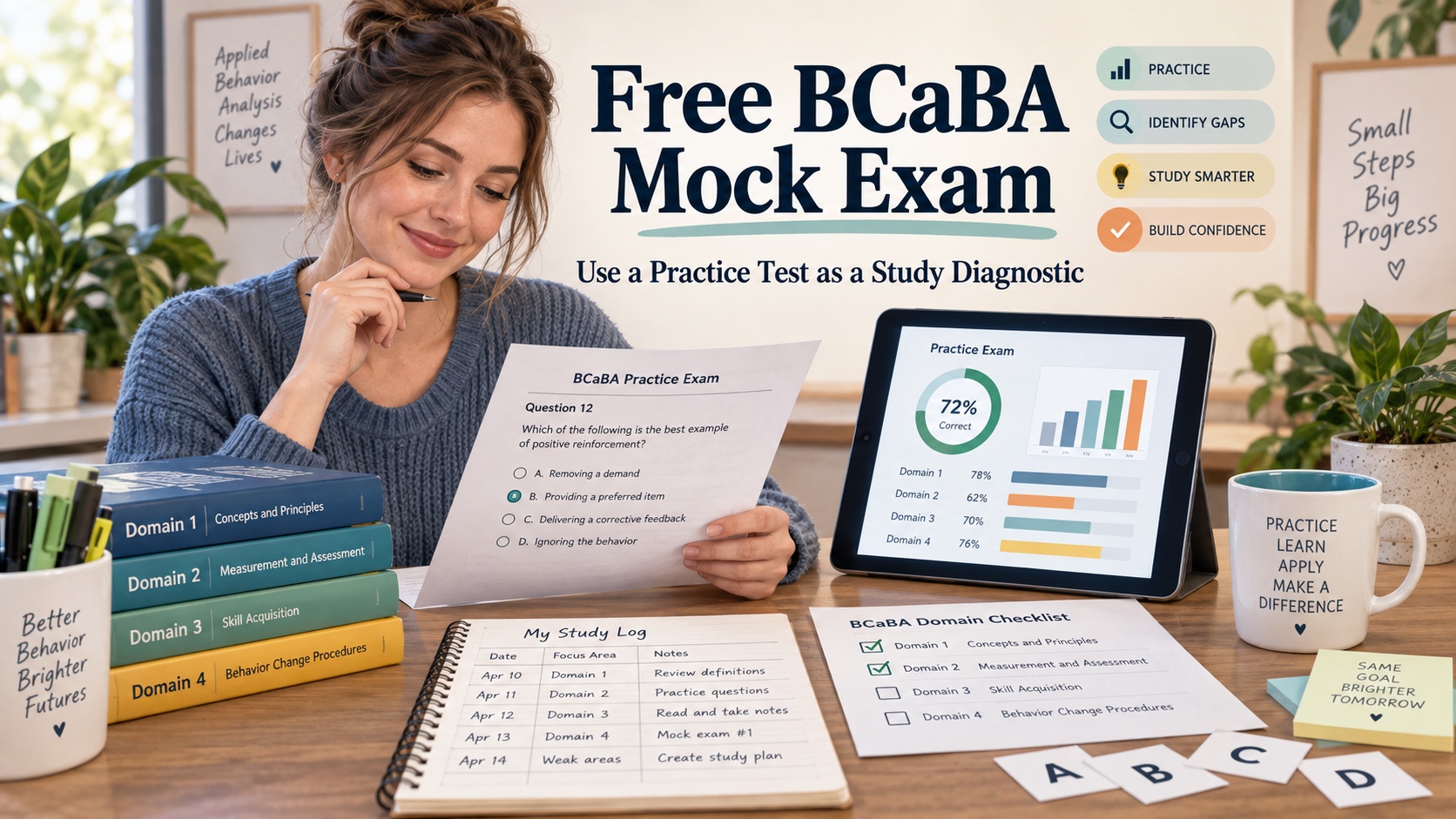
Free BCaBA Mock Exam: Use a Practice Test as a Study Diagnostic
If you are searching for a BCaBA mock exam free, you probably want two things at once: a chance to practice without paying first and an honest way to tell whether your studying is working. A useful free practice set should do more than display a percentage. It should show which content area needs attention, what kind of reasoning broke down, and what you can do before your next attempt.
This guide explains how to use an independent BCaBA practice experience with the current BACB examination boundary. ABA Study Online practice is original educational material. It is not official BACB examination content, recalled or leaked questions, individualized supervision, or a promise that a particular score will lead to certification.
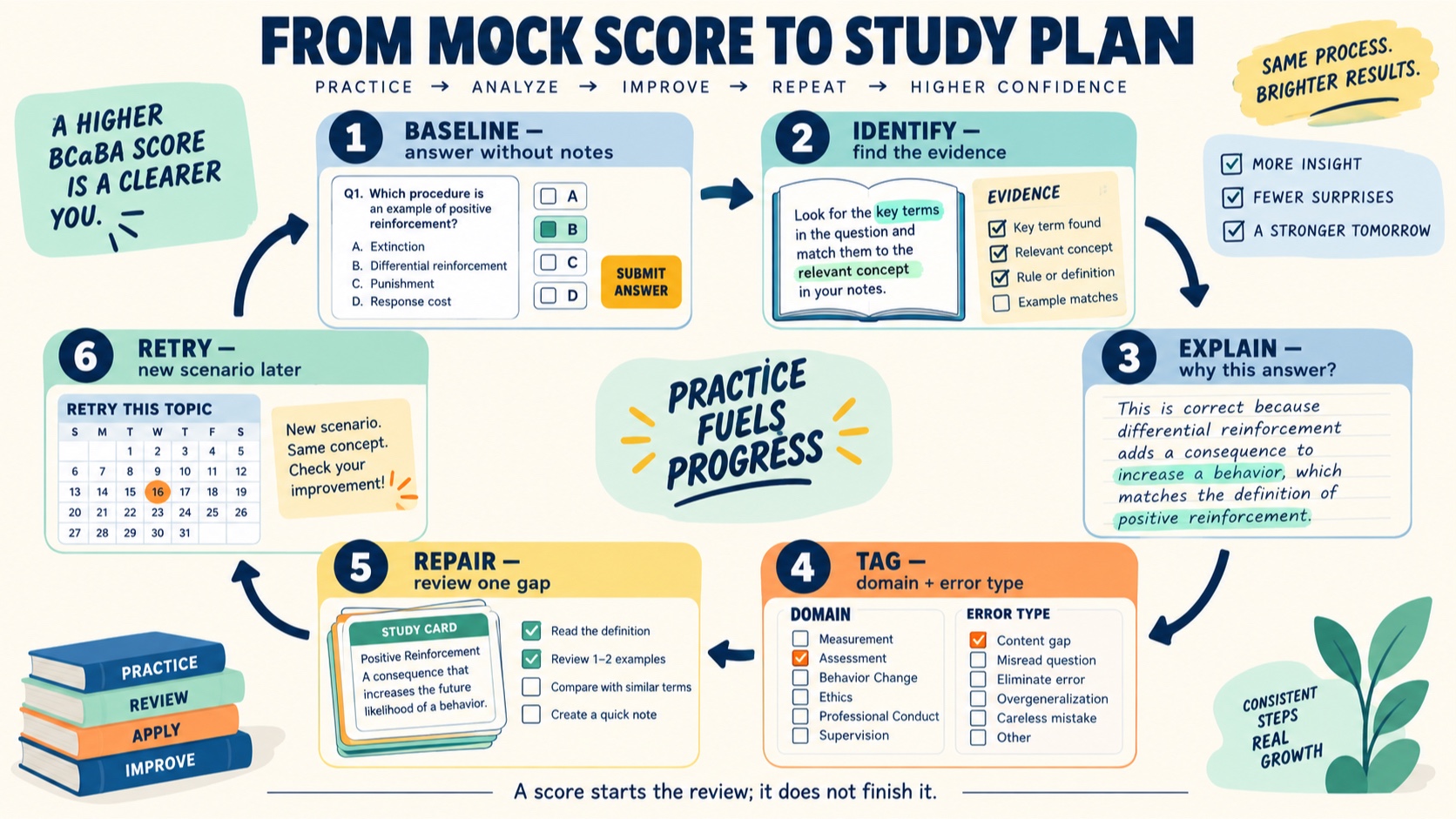
Quick answer: Take a free BCaBA mock exam as a baseline, not as a prediction. Complete a manageable mixed set without looking up answers. Then tag every miss by content domain and error type, explain why the best answer fits the facts, repair the smallest knowledge gap, and try a new question later. The review is more valuable than the raw percentage.
A practice result is also easier to trust when the page tells you what it cannot do. An independent mock cannot reproduce the exact live examination, determine eligibility, replace training or supervision, or reveal future questions. Its job is narrower and practical: give you evidence about your current preparation.
“Free” should also mean that the first step is genuinely useful without forcing a purchase. You should be able to see the purpose of the set, the track it covers, the current source boundary, and what kind of feedback follows a result. If a page hides all explanation behind a score or uses urgency to push a purchase, pause and check whether it is helping you learn. A transparent practice page gives you enough context to decide whether a longer mock, a study guide, or targeted app practice is actually the right next move.
What the current BCaBA blueprint tells you
The BACB’s current BCaBA Test Content Outline (6th ed.) describes the content for the examination beginning in 2025. It organizes 90 tasks into nine content areas. The current BCaBA Handbook describes an examination with 175 multiple-choice questions: 150 scored questions and 25 unscored pilot questions. Candidates have four hours, each question has four possible answers, and one answer is correct.
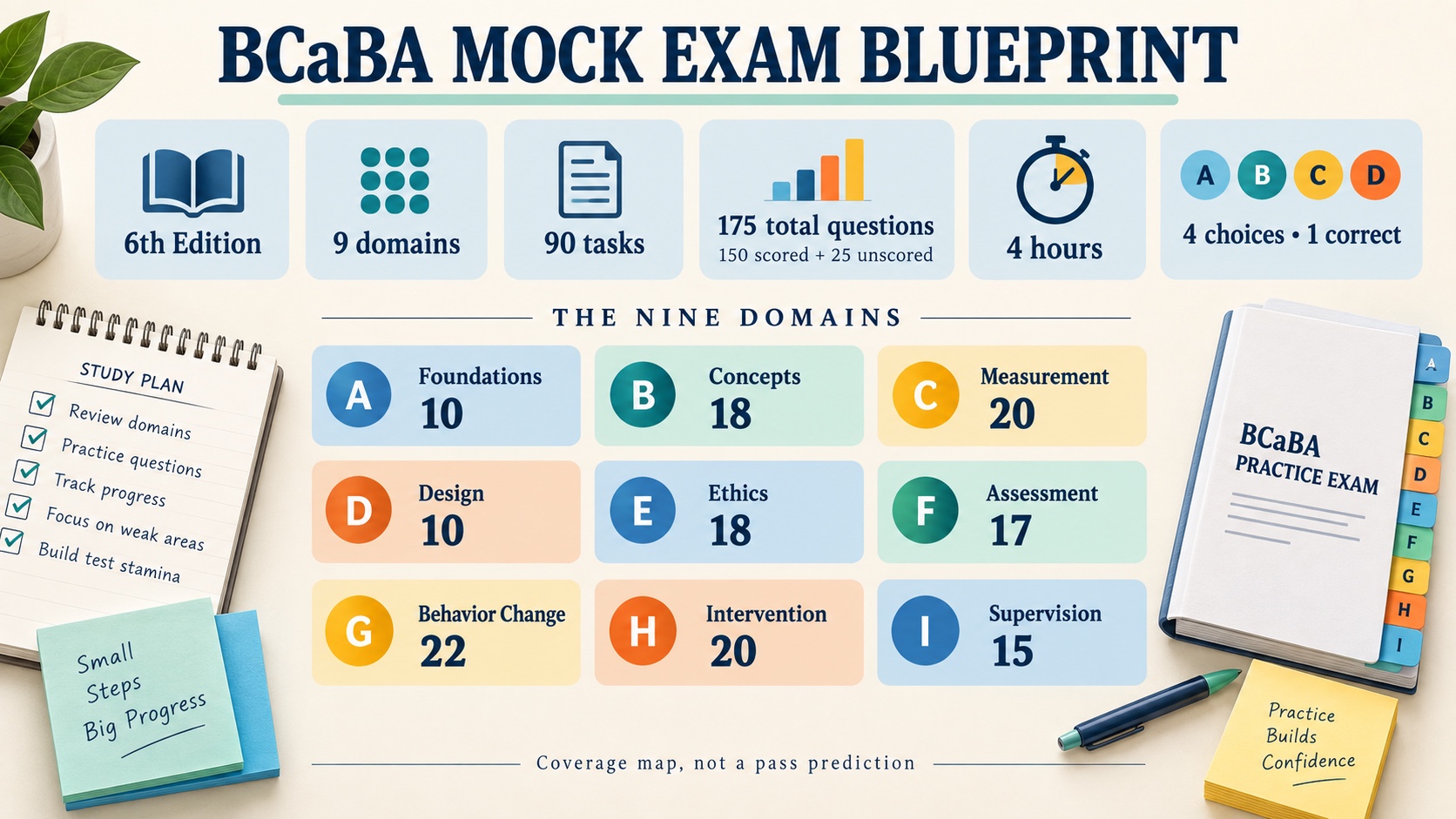
The outline is useful for planning because it shows where a balanced study session can go. It is not a reason to force a short free set to contain the same number of questions as the live exam. A good diagnostic set can sample several domains, then point you to a deeper review. It should not pretend that a small online quiz has the same measurement meaning as an official result.
The nine areas are Behaviorism and Philosophical Foundations; Concepts and Principles; Measurement, Data Display, and Interpretation; Experimental Design; Ethical and Professional Issues; Behavior Assessment; Behavior-Change Procedures; Intervention Development and Monitoring; and Supervisory Relationships. Some questions naturally connect more than one area. For example, choosing a behavior-change procedure may require you to read measurement data, consider contextual fit, and recognize the role or supervision boundary in the scenario.
Use the current official documents for facts that can change. The BACB recommends reviewing the current outline, the Ethics Code for Behavior Analysts, and materials from your training. It also says that it cannot endorse specific study guides and that purchasing study materials does not guarantee a pass. That is why a responsible free mock-exam page should make its independent status visible instead of borrowing official language to sound more authoritative.
How to take a free mock exam well
You do not need to make every free practice session feel like a four-hour testing appointment. Start with a set that is long enough to reveal patterns but short enough to review carefully. If you are new to the content, a mixed set of 20 to 30 original questions can establish a baseline. Later, a longer session can help you practice pacing and attention.
- Set the purpose. Decide whether this session is for diagnosis, content repair, or pacing. A diagnostic session should not be interrupted by answer searches.
- Use a quiet, realistic setup. Keep your notes closed for the baseline. If you need an accommodation or a different testing arrangement, follow the appropriate official process rather than treating an online quiz as a substitute.
- Read for evidence. Before looking at the choices, identify the behavior, measurement, goal, data, and professional context described in the stem.
- Record uncertainty. Mark items where you guessed, narrowed the options, or changed your answer. A correct guess can still identify a review need.
- Stop at a useful review point. A long set completed while exhausted may tell you less than a shorter set with careful explanations.
Do not use a free mock to memorize a letter pattern. The value comes from explaining the decision. Ask: What fact in the scenario supports the best answer? What does the strongest distractor assume that the scenario does not support? Is the answer within the role and information provided? This keeps practice tied to applied reasoning instead of answer-key familiarity.
How to review the result
A practical review log can have six columns: item or topic, content domain, your answer, best answer, evidence in the scenario, and next action. Add an error tag. Useful tags include definition confusion, measurement mismatch, graph interpretation, procedure discrimination, missing scenario evidence, ethics or scope boundary, careless reading, and pacing.
Look for patterns, not just misses
Suppose a fictional learner misses three items. The first asks which measurement fits a behavior defined by how long it lasts. The second asks how to interpret a graph after an intervention change. The third asks whether a proposed action stays within the role described. The learner might label these as three unrelated mistakes, but the review shows three different repairs: measurement selection, visual data interpretation, and professional scope.
Now imagine that the learner gets the definitions right when studying notes but misses them inside scenarios. The next task is not another hour of copying definitions. It is to practice identifying the evidence in a new scenario and explaining why two plausible choices differ. If the same error tag appears across several domains, repair the study process itself: slow down the stem, predict the decision before reading the options, or use spaced retrieval instead of rereading.
Use the blueprint without overinterpreting it
The domain percentages can help you avoid studying only the topics you enjoy. They do not tell you that a short free mock should have an exact official distribution, and they do not create a separate passing score for each content area. The handbook says the examination result is based on overall performance. For independent practice, use the blueprint to find coverage gaps and use the item explanations to decide what to repair.
Retrieval-practice research supports this sequence: retrieve an answer, receive feedback, repair the idea, and retrieve it again later. It does not support treating a single score as a forecast. Your review log should therefore end with a next date or next condition, such as “retry a measurement item after reviewing duration versus frequency” or “mix an ethics scenario with a supervision scenario tomorrow.”
Choose your next practice step
After the baseline, choose the next format based on what the evidence shows:
- Use another short free set when you are still learning how to read scenarios or need a low-pressure baseline.
- Use a longer curated mock when your content review is steadier and you need to practice sustained attention, mixed coverage, and pacing.
- Use targeted app practice when the review log points to a particular domain, task, or repeated error tag.
When you are ready, start with the ABA Study Online BCaBA mock-exam practice. It is designed as an independent educational practice destination, so read the page’s scope notes and use the result as a study signal. For shorter follow-up sessions, move the domain or task you need to repair into the ABA Study Online App. The app can support repeated practice; it cannot turn an independent score into an official result.
Common mistakes with free BCaBA mock exams
- Choosing a resource because it says “official.” Check the source and the current BACB documents. Independent practice should say what it is.
- Chasing a percentage without reviewing. A score with no error map does not tell you what to do next.
- Studying only one comfortable domain. Use the nine-domain outline to notice neglected areas, then connect them to your error tags.
- Copying question wording. Learn the decision rule and evidence, not the sequence of a particular item.
- Assuming one low score means you are not ready. First check the set length, fatigue, unfamiliar terminology, and the pattern of errors. Then make a specific repair plan.
- Expecting a mock to replace professional preparation. Practice questions complement training and current BACB materials; they do not replace them.
BCaBA mock-exam FAQ
Is a free BCaBA mock exam official?
Not unless the BACB itself identifies it as an official resource. ABA Study Online practice is independent educational content and should not be represented as BACB examination content.
How many questions should a free practice test have?
There is no single required length for an independent study set. Use a shorter set for diagnosis and a longer session for pacing. The official examination format is a separate question: the current handbook describes 175 multiple-choice questions over four hours.
Can my mock score tell me whether I will pass?
No. A mock score is a learning signal. It can reveal content and reasoning patterns, but it is not an official scaled score, eligibility decision, or guarantee.
Should I review every wrong answer?
Yes, and also review uncertain correct answers. A guessed correct answer may show the same gap as an incorrect answer. Explain the evidence, tag the error, and schedule a later retry.