
BCaBA Hours Requirements: How Many Fieldwork Hours Do You Need?
Searching for BCaBA hours requirements usually means you want one number: how many hours are needed before you can apply for certification? The answer depends on the type of supervised fieldwork you use and, during the 2027 transition, the requirements in effect when your complete application is received. The hours also have monthly supervision, observation, activity, and documentation rules around them.
This guide separates the current 2026 rules from the requirements for applications on or after January 1, 2027. It focuses on BCaBA eligibility fieldwork—not BCBA hours, post-certification ongoing supervision, or a promise that any individual job or activity will be accepted. Use it to organize questions for your supervisor and your official BACB documents.
The quick answer: BCaBA fieldwork totals
Under the current BCaBA eligibility rules, a trainee generally completes either 1,300 hours of Supervised Fieldwork or 1,000 hours of Concentrated Supervised Fieldwork. The concentrated route has a higher supervision percentage and therefore a lower total-hour requirement. A permitted combination can also be possible, but the requirements for each fieldwork type still need to be met when the hours are accrued.
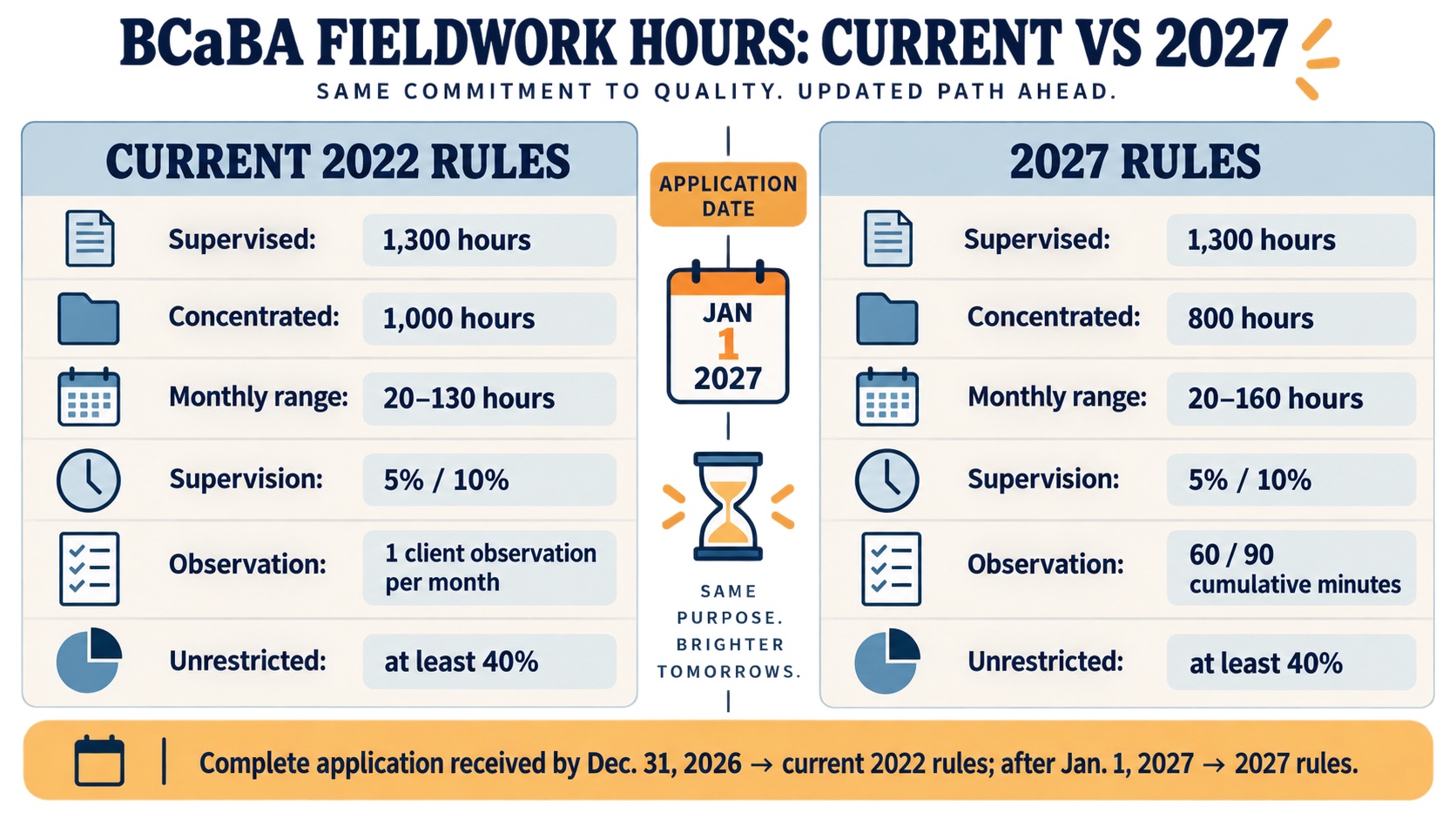
For a complete application received by December 31, 2026, the current 2022 requirements are the relevant transition lane. For applications received on or after January 1, 2027, the new BCaBA requirements apply. The 2027 change keeps Supervised Fieldwork at 1,300 hours but changes Concentrated Supervised Fieldwork to 800 hours.
| Application lane | Supervised Fieldwork | Concentrated Supervised Fieldwork |
|---|---|---|
| Current 2022 rules | 1,300 hours | 1,000 hours |
| 2027 rules | 1,300 hours | 800 hours |
| Supervision percentage | 5% of the period’s hours | 10% of the period’s hours |
| Unrestricted activities | At least 40% of total supervised fieldwork hours | |
Those totals are not a substitute for the rest of the eligibility pathway. BCaBA applicants also need the applicable degree and behavior-analytic coursework route, supervised fieldwork documentation, an application, and a passing examination. If you are comparing this page with a BCBA guide, stop and check the credential: BCBA and BCaBA fieldwork numbers are different.
Current 2026 BCaBA hours requirements
The June 2026 BCaBA Handbook describes the current fieldwork structure as a one-calendar-month supervisory period. A month must satisfy the requirements for the fieldwork type being claimed; you cannot usually fix a deficient month by averaging it with the next month. The current monthly range is 20 to 130 fieldwork hours for both Supervised and Concentrated Supervised Fieldwork.
For current Supervised Fieldwork, the supervision minimum is 5% of the hours in the period, and the handbook lists four supervisor contacts per period. For current Concentrated Supervised Fieldwork, the supervision minimum is 10%, and the handbook lists six contacts per period. Both types include one observation with a client per supervisory period, at least 50% individual supervision within the supervised hours, and at least 40% unrestricted activities across the supervised fieldwork.
“Concentrated” does not mean that the same work becomes more valuable just because a tracker labels it concentrated. It describes a more intensive supervision structure. The supervisor, documentation, activity mix, and monthly requirements still matter. The reduced total is connected to the higher supervision requirement, not to a shortcut around fieldwork quality.
What the monthly rules mean
Suppose a trainee records 80 eligible hours in a current month. On the standard Supervised Fieldwork route, 5% means at least 4 hours of supervision for that period. On the current Concentrated route, 10% means at least 8 hours. This is only an arithmetic illustration. It does not decide whether the hours, contacts, observation, or activities qualify.
The monthly record also needs to preserve the distinction between supervised hours and the total fieldwork hours in the period. At least half of the supervised hours must be individual; group supervision cannot exceed half of the supervised hours. The unrestricted requirement is different: at least 40% of the total supervised fieldwork should be made up of qualifying unrestricted activities. A spreadsheet that records only a grand total can hide a problem until the application or an audit.
Not every hour at an ABA employer is automatically BCaBA fieldwork. A qualifying experience must fit the current handbook, occur under the required supervision arrangement, and be documented in the relevant form. Direct implementation of an existing plan may be restricted work; observing clients, analyzing data, developing programs, and training caregivers or staff may be examples of unrestricted work. The supervisor must determine the status of an activity in context.
Before hours begin, the current handbook also expects a qualified supervisor, a signed supervision contract, and started qualifying behavior-analytic coursework. A trainee may be able to begin after attending the first class meeting, but the initial graded course must ultimately receive at least a C, or a pass in a pass/fail system, for those hours to count. Treat the start date as a documented decision, not a date guessed later from a payroll record.
What changes for applications in 2027
The 2027 BCaBA requirements take effect January 1, 2027. The application date is the key boundary: the BACB says that a complete application, including payment and required documents, must be received by December 31, 2026 to be reviewed under the current 2022 requirements. After that boundary, the 2027 rule set applies.
The most visible hour change is the concentrated total. Supervised Fieldwork stays at 1,300 hours, while Concentrated Supervised Fieldwork becomes 800 hours. The 2027 rules also allow 20 to 160 hours per supervisory period, rather than the current 20-to-130 range. Supervision remains 5% for Supervised Fieldwork and 10% for Concentrated Supervised Fieldwork.
Observation is described differently. Under the current rules, the table uses one observation with a client per period. Under the 2027 rules, the observation requirement is duration-based: 60 cumulative minutes for Supervised Fieldwork or 90 cumulative minutes for Concentrated Supervised Fieldwork. Individual supervision remains at least 50%, and unrestricted activities remain at least 40% of total supervised fieldwork hours.
Applicants after the transition also use the 2027 Monthly and Final Fieldwork Verification Forms. If your hours cross the transition and you are unsure when you will apply, the official guidance recommends planning and documenting to meet both sets of requirements. That may mean tracking both observation duration and the older observation count, retaining the appropriate forms, and asking your supervisor how the documentation system will support the eventual application lane.
Can you combine fieldwork types?
The BACB allows a permitted combination of Supervised and Concentrated Supervised Fieldwork. Combining them is not the same as adding two raw hour totals and stopping when the number reaches 1,300. Each month and supervision structure must satisfy the rules for the type used in that period.
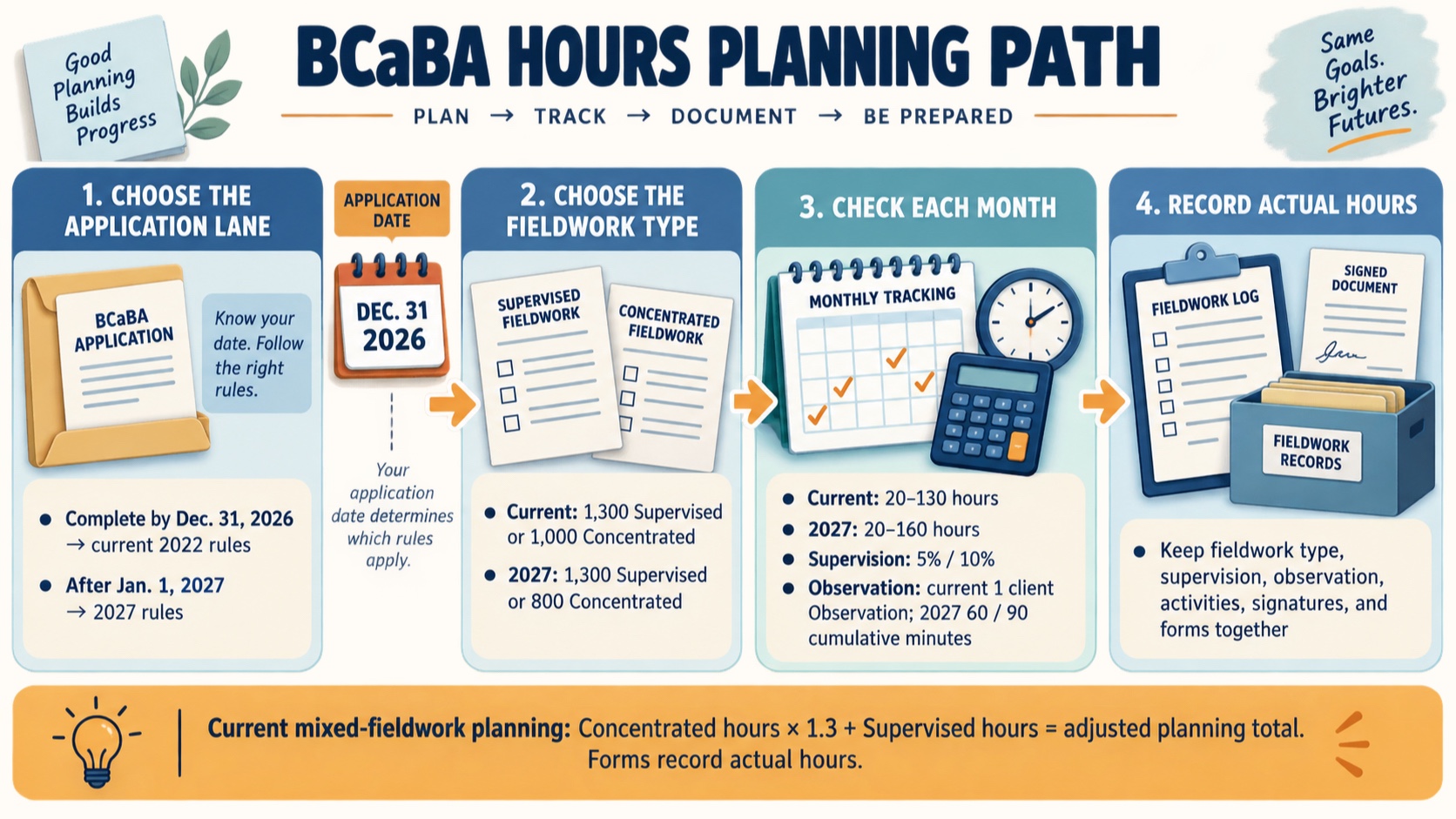
For the current mixed-total planning calculation, the handbook uses a 1.3 multiplier for Concentrated Supervised Fieldwork hours, then adds the Supervised Fieldwork hours. For example, 500 current concentrated hours would contribute 650 to the adjusted planning total, and 650 current supervised hours would bring the adjusted total to 1,300. The example is for planning only: forms, applications, and audit records use the actual hours accrued, not the adjusted number.
Because the 2027 concentrated total and documentation rules change, do not copy a current calculation into a future application plan without checking the 2027 handbook and transition guidance. If your fieldwork spans both periods, ask the supervisor which evidence needs to be maintained for each possible application date.
What to track before counting an hour
A useful BCaBA hours tracker is more than a running total. Before the first month closes, confirm that your record can answer these questions:
- Which rule lane? Record the expected application date and whether you are planning under the current or 2027 requirements.
- Which fieldwork type? Label each period as Supervised, Concentrated, or the structure approved for that month. Do not let a mixed spreadsheet erase the distinction.
- Who is supervising? Keep the supervisor’s qualification, contract, setting, and signatures connected to the month.
- What happened in the month? Record total fieldwork hours, supervision percentage, individual/group split, contacts or observation minutes, and unrestricted activities.
- What evidence remains? Retain the Monthly and Final Fieldwork Verification Forms and any supporting records required by the current handbook. The BACB transition guidance says fieldwork documentation should be retained for at least seven years.
This checklist does not approve an activity. It makes the question visible early enough for a qualified supervisor to answer it. If you work in more than one setting or under more than one supervision structure, each arrangement may need to meet the applicable requirements on its own.
Common mistakes with BCaBA hours
- Using BCBA numbers: BCBA fieldwork totals are not BCaBA fieldwork totals. Check the credential in every source.
- Confusing hours with supervision hours: the total fieldwork requirement, the supervision percentage, and ongoing supervision after certification are separate concepts.
- Counting employment automatically: an ABA job can provide useful experience without every paid hour meeting the fieldwork rules.
- Ignoring the application date: the 2027 concentrated total, monthly cap, observation rule, and forms make the transition date material.
- Replacing actual hours with an adjusted number: a mixed-fieldwork calculation may help planning, but the documentation should record actual accrued hours.
- Waiting until the application to find a missing form: monthly signatures, observation records, and supervisor evidence are easier to protect when reviewed during the month.
BCaBA hours requirements FAQ
How many hours do you need for BCaBA certification?
Under the current rules, the headline totals are 1,300 Supervised Fieldwork hours or 1,000 Concentrated Supervised Fieldwork hours. For applications under the 2027 rules, the totals are 1,300 Supervised or 800 Concentrated. The total alone does not establish eligibility; the monthly supervision, activity, observation, documentation, degree, coursework, and examination requirements also apply.
Are BCaBA fieldwork hours the same as BCaBA supervision hours?
No. Fieldwork hours are the broader practical-experience total. Supervision is a percentage and set of contacts or observations required within the fieldwork period. Ongoing supervision after certification is another requirement again.
Can I use hours from an ABA job?
Possibly, but a job title or payroll record is not enough. The hours must fit the applicable BACB fieldwork requirements, occur under the required supervision arrangement, and be documented. Ask the qualified supervisor before treating a work activity as qualifying fieldwork.
Where should I study the concepts connected to fieldwork?
ABA Study Online’s BCaBA theory path, free BCaBA practice questions, and ABA glossary can support terminology and reasoning review. They are educational study resources, not supervision, fieldwork approval, BACB certification review, or official exam content.
Official sources
- BACB BCaBA Handbook — current fieldwork, eligibility, documentation, and examination information.
- 2027 BCaBA Requirements — high-level 2027 totals, monthly rules, forms, and pathways.
- Guidance for Meeting the BCaBA Requirements During the 2027 Transition — current-versus-2027 fieldwork and documentation comparison.
- BACB BCaBA fieldwork resources — forms, checklist, documentation resources, and FAQs.
Requirements can change, and the BACB handbook and transition materials control. Confirm your application lane and documentation plan with the current official sources and your qualified supervisor before relying on any hour total.