BCaBA Handbook: Current Requirements, Exam Format, Fieldwork, and the 2027 Transition
Searching for the BCaBA Handbook usually means you are trying to answer a practical question: Which requirements apply to me, what should I document now, and what will change before I apply? The handbook is the best place to start because it connects eligibility, supervised fieldwork, the certification application, the examination, and ongoing maintenance in one current source. It is not a shortcut around the official requirements, and it is not the same thing as an exam-preparation book.
This guide explains how to read the June 2026 handbook, where the current BCaBA examination fits, and how to separate the current framework from the changes scheduled for January 1, 2027. Use the official handbook and transition documents for an individual eligibility decision; use this page as a planning and study map.
What the BCaBA Handbook is for
The BCaBA Handbook is a requirements document for the Board Certified Assistant Behavior Analyst credential. The BACB describes BCaBA certification as an undergraduate-level certification, and a BCaBA may provide behavior-analytic services only under the supervision of a BCBA. A BCaBA may also supervise RBT work when the applicable requirements are met. That role boundary matters because the handbook is not only about passing an exam; it also describes the education, supervised experience, ethical responsibilities, and ongoing supervision connected to the credential.
Think of the handbook as a sequence of decisions:
- Choose the eligibility pathway that matches your degree and coursework.
- Confirm that your supervised fieldwork can be documented under the rules that will apply when you submit your application.
- Submit the correct application and supporting documents through the BACB portal.
- Prepare for the current examination edition and testing rules.
- After certification, continue with supervision, ethics and self-reporting responsibilities, continuing education, and recertification.
The handbook also tells you what it cannot decide for you. It cannot approve a university program, determine whether a specific activity is appropriate for your clients, or provide an individualized licensing opinion. When a question depends on your transcript, supervisor, fieldwork structure, jurisdiction, or application date, bring the handbook to the relevant program contact, supervisor, licensing authority, or BACB contact channel.
The two current eligibility pathways
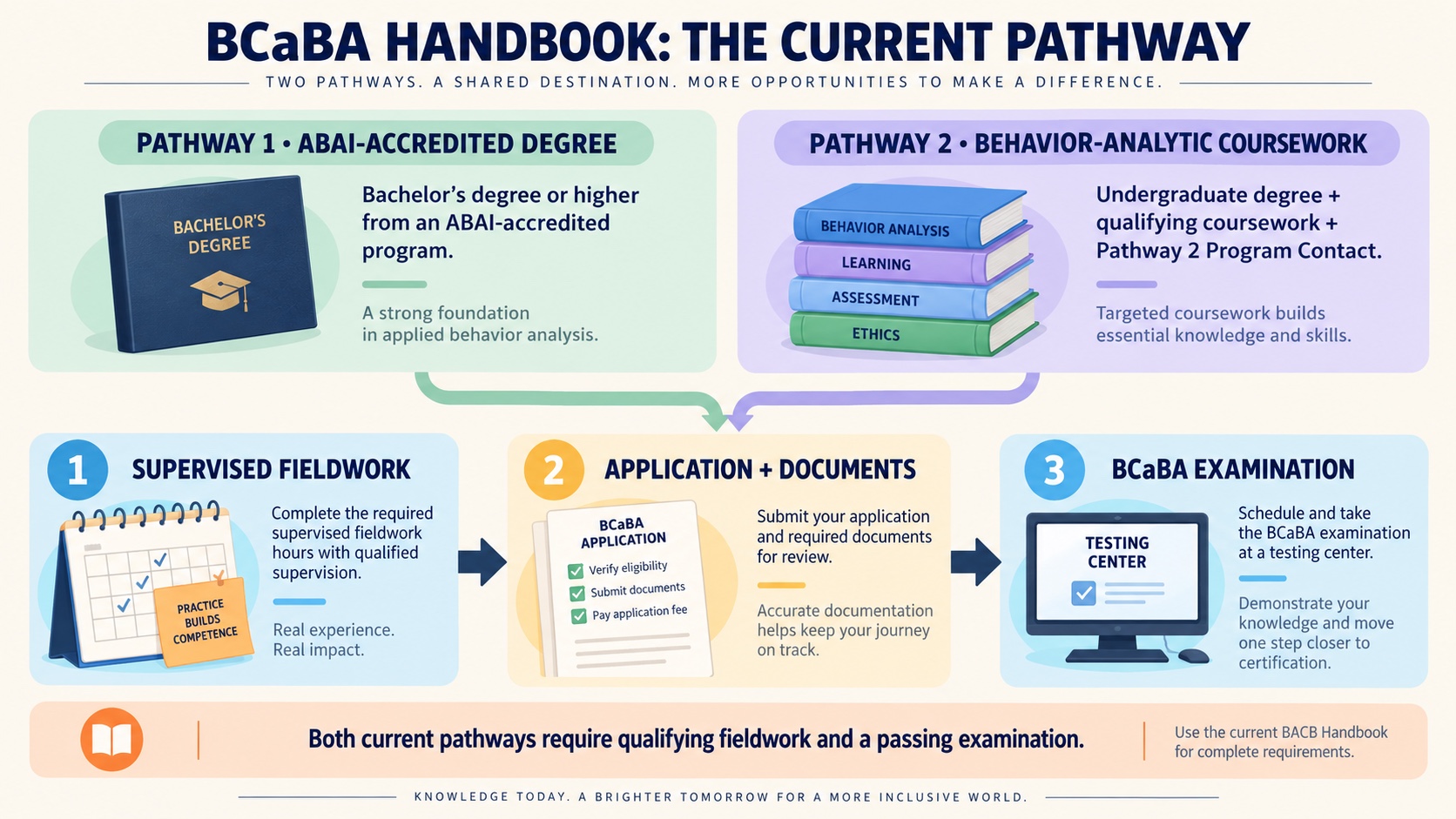
The June 2026 handbook lists two eligibility pathways. Pathway 1 uses a bachelor’s degree or higher from an ABAI-accredited program. The program’s degree and behavior-analytic content are intended to meet the pathway’s education requirements, but you still need qualifying supervised fieldwork and a passing examination. Pathway 2 uses an undergraduate degree plus behavior-analytic coursework completed through a qualifying institution with a registered Pathway 2 Program Contact. That route also requires supervised fieldwork and the examination.
The simple diagram is useful, but the details are where applicants can lose time. Under the current handbook, the BACB relies on official transcripts to verify the degree and coursework. A course title that sounds relevant is not enough by itself. Keep the transcript, course descriptions, program-contact information, and any attestation materials together so your application record tells one consistent story.
Before choosing a program, ask questions that can be answered with documents: Does the program clearly identify its pathway? Which courses meet the required behavior-analytic content? Who is the Pathway 2 Program Contact, if that route applies? How will the program help you locate a qualified supervisor and document fieldwork? The BACB does not endorse a particular study guide, university, or preparation product as a guarantee of certification.
Current fieldwork and supervision requirements
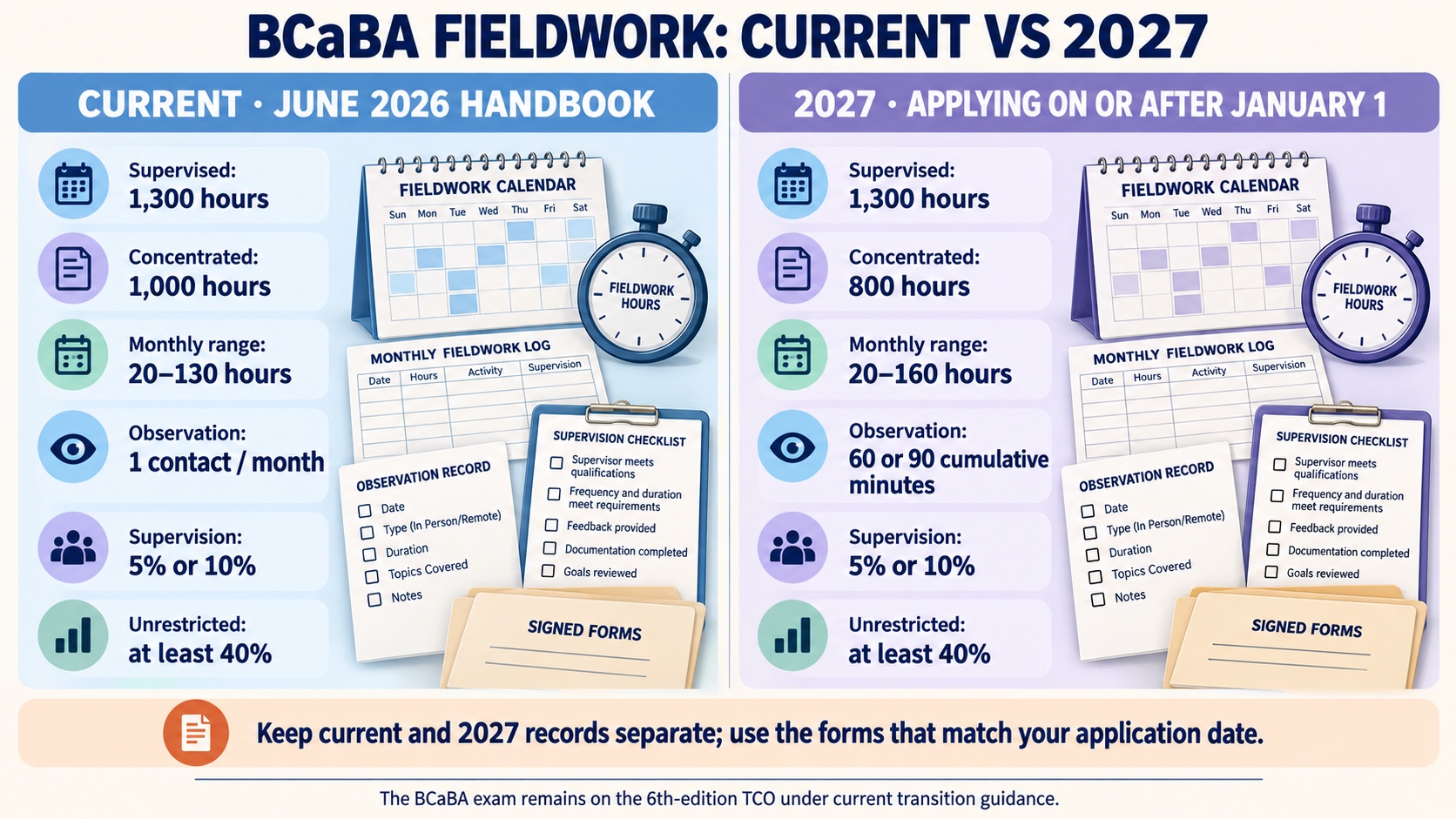
Fieldwork is where coursework is connected to real behavior-analytic work under ongoing guidance. Under the current June 2026 handbook, a trainee may meet the fieldwork total through 1,300 hours of Supervised Fieldwork, 1,000 hours of Concentrated Supervised Fieldwork, or an approved combination. The two types have different monthly structures, so “I have enough hours” is not a complete check. The fieldwork type, supervision percentage, contacts, observations, and activity mix must also line up.
- A supervisory period is one calendar month.
- The current monthly range is 20–130 fieldwork hours.
- Supervised Fieldwork uses 4 supervisor contacts and 5% supervision per month; Concentrated Supervised Fieldwork uses 6 contacts and 10% supervision.
- Each type requires one observation with a client per supervisory period.
- At least 50% of supervised hours must be individual supervision; group supervision may not exceed 50% of supervised hours.
- At least 40% of total fieldwork hours must be unrestricted activities.
Fieldwork cannot start just because you found a placement. The current handbook says that trainees must have a qualified supervisor, a signed supervision contract with each supervisor, and qualifying behavior-analytic coursework underway. Hours begin after the first class meeting, but the initial course must ultimately receive a passing grade. Keep the date of the first class, the contract, the supervisor’s qualification evidence, and the monthly records in the same documentation system.
Unrestricted activities are work that more closely represents the tasks a BCaBA performs after certification. Examples include client observation and data collection, behavior-analytic assessment, graphing and analyzing data, researching literature for a current client’s programming, writing or revising programs, and training staff or caregivers on behavior-analytic procedures. Restricted activities are not automatically “bad” activities; the issue is the overall balance. They may comprise no more than 60% of total fieldwork hours, and there is no minimum restricted-hour requirement.
A useful monthly audit asks four separate questions: Did the hours fall within the monthly range? Did the supervision percentage and contact count match the fieldwork type? Did the observation occur and get recorded? Is the running unrestricted percentage healthy across the total, rather than only in one month? This is a planning routine, not a substitute for the supervisor’s attestation or the handbook’s complete fieldwork section.
The current BCaBA examination
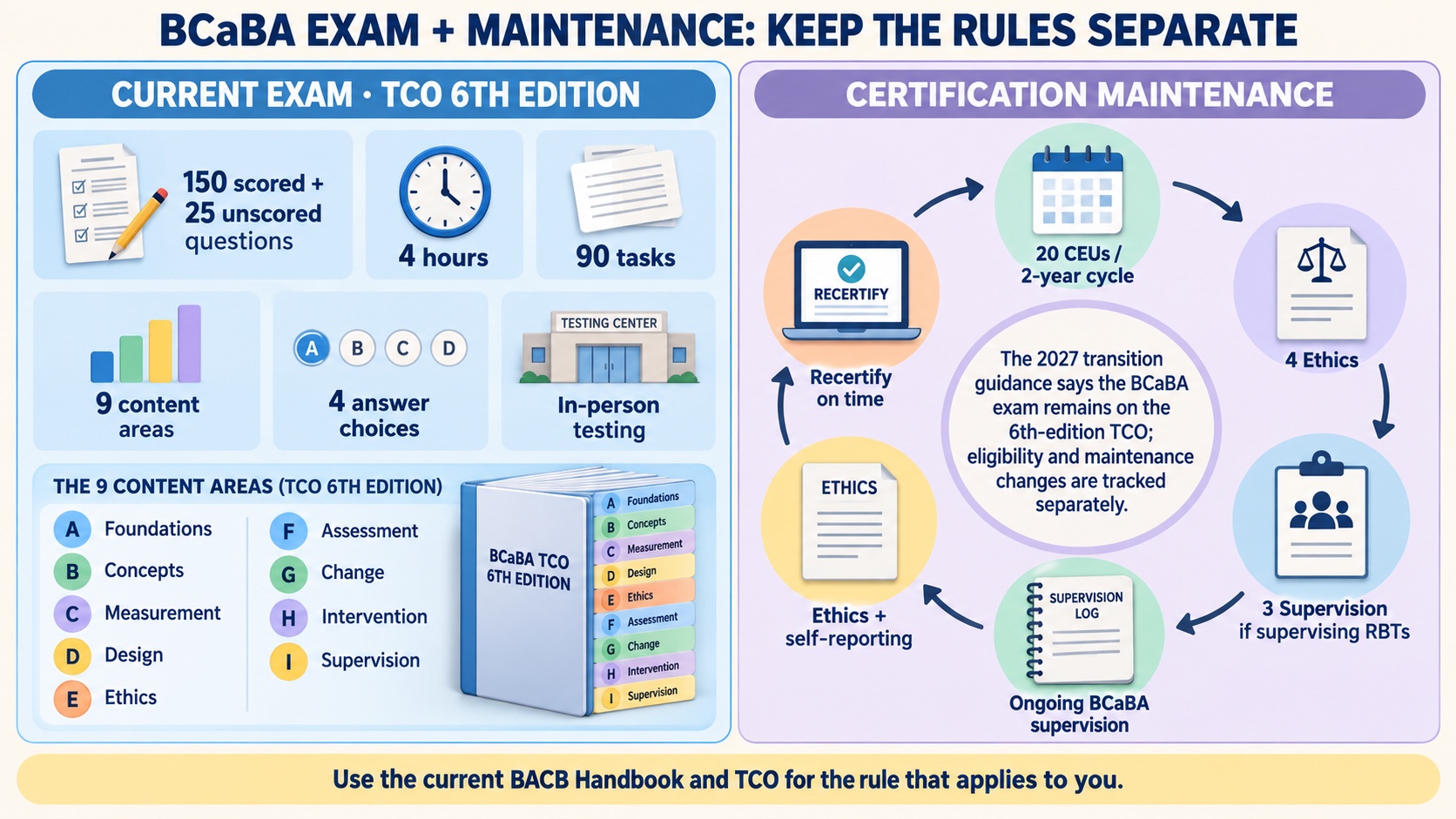
The June 2026 BCaBA Handbook says the examination is based on the BCaBA Test Content Outline, 6th edition. The current outline contains 90 tasks organized into 9 content areas. The examination includes 150 scored questions and 25 unscored questions, gives candidates 4 hours, presents 4 answer choices for each question, and weights the scored questions equally overall. The examination is delivered through Pearson VUE at authorized in-person testing sites.
The nine content areas are:
- Behaviorism and Philosophical Foundations
- Concepts and Principles
- Measurement, Data Display, and Interpretation
- Experimental Design
- Ethical and Professional Issues
- Behavior Assessment
- Behavior-Change Procedures
- Intervention Development and Monitoring
- Supervisory Relationships
The handbook recommends reviewing the current TCO, the Ethics Code for Behavior Analysts, and materials gathered from your training. It also states that the BACB cannot endorse specific study guides and that buying preparation materials does not guarantee a passing result. A strong study plan therefore uses the TCO as a coverage map, then turns each domain into definitions, applied examples, data decisions, and practice with rationales. ABA Study Online’s BCaBA Theory Blocks and free practice questions can support that learning loop, but they are independent study resources—not official BACB content.
What changes on January 1, 2027
The BACB’s transition materials state that important BCaBA eligibility and maintenance changes take effect on January 1, 2027. If an applicant wants to be reviewed under the current 2022 requirements, the BACB’s public announcement says the complete application, payment, and required documents must be received by December 31, 2026. If the applicant has not met the current requirements and applied by that boundary, the new requirements apply. The live BACB guidance is the authority for a real application decision.
The two eligibility pathways remain, but Pathway 2 coursework changes. The transition guide compares 225 hours under the 2022 requirements with 270 hours under the 2027 requirements. The new distribution includes 45 hours of Foundations of Behavior Analysis in one freestanding course, 45 hours of Methods of Behavior Analysis in one freestanding course, 90 hours of Behavior Assessment and Intervention across two freestanding courses, 45 hours of Organizational Behavior Management in one freestanding course, and 45 hours of Ethics in Behavior Analysis with at least 15 hours in a freestanding course.
Fieldwork also changes in ways that make documentation especially important. The 2027 overview uses 1,300 Supervised Fieldwork hours or 800 Concentrated Supervised Fieldwork hours, a 20–160-hour monthly range, 5% or 10% supervision, and duration-based client observations of 60 or 90 cumulative minutes. Applicants after January 1, 2027 use the 2027 Monthly and Final Fieldwork Verification Forms. If you are unsure when you will apply, the transition guidance recommends planning to meet both sets of requirements and retaining records that capture both the number of observations and their duration.
The BCaBA examination is a separate timeline. The transition guidance says the examination remains based on the 6th-edition TCO and that there are currently no upcoming changes to the BCaBA examination or TCO. In other words, a change in coursework or fieldwork requirements does not automatically mean a new exam edition. Do not label the BCaBA exam as a “7th edition” exam unless the BACB publishes that change.
Maintenance, CEUs, and recertification
Initial eligibility and ongoing maintenance are different parts of the handbook. The current maintenance section requires 20 continuing education units in each two-year recertification cycle, including 4 ethics CEUs and 3 supervision CEUs for BCaBAs who supervised the ongoing practice of RBTs on record during the cycle. CEUs must be earned within the cycle to which they are applied; extra CEUs do not roll into the next cycle, and missed CEUs cannot simply be made up after the recertification date.
Ongoing supervision is also separate from exam preparation. The 2027 maintenance summary keeps a minimum of 5% of behavior-analytic service hours supervised, at least monthly supervision, and a qualified active BCBA supervisor with no current disciplinary sanctions and the applicable supervision CEU requirement. A BCaBA without a qualified supervisor on record is considered inactive and may not practice or use the certification until the supervision record is corrected.
Use the portal as a live record, not as a last-minute storage box. Enter CEUs throughout the cycle, keep documentation that identifies the amount and category, check the supervisor record, and start the recertification application within the window described by the current handbook. If your status, jurisdiction, coursework, or fieldwork situation is unusual, the handbook’s individual guidance and BACB contact process should take priority over a general article.
A practical handbook checklist
Before you treat your BCaBA plan as “on track,” create one folder or digital workspace with these sections:
- Pathway: record whether you are pursuing Pathway 1 or Pathway 2 and why the program documents support that choice.
- Education: save official transcripts, course descriptions, the program contact, and any coursework attestation or verification required for your application date.
- Supervisor: record the supervisor’s certification status, supervision training, contract, and the structure used for your fieldwork.
- Monthly fieldwork: track actual hours, fieldwork type, contact count, supervision percentage, client observation, individual/group split, and unrestricted activity totals.
- Transition: if your application could occur near January 1, 2027, preserve separate current and 2027 records rather than rewriting old entries.
- Exam: use the current TCO 6th edition and the nine content areas to plan review; do not infer a pass prediction from practice scores.
- Maintenance: track CEUs, ethics and supervision categories, ongoing supervision, ethics/self-reporting obligations, and the recertification date.
This system turns a long handbook into a sequence of checkable decisions. It also makes conversations with a supervisor or program contact more specific: instead of asking “Do my hours count?” you can ask about the exact month, fieldwork type, observation record, supervision percentage, or documentation form that needs review.
Common questions about the handbook
Is the BCaBA Handbook the same as a BCaBA study guide? No. The handbook explains certification requirements and examination information. A study guide can organize concepts for learning, but it does not replace the official requirements or provide a certification decision.
How many fieldwork hours are required for BCaBA certification? Under the current June 2026 handbook, the overview lists 1,300 Supervised Fieldwork hours or 1,000 Concentrated Supervised Fieldwork hours, or an approved combination. The 2027 framework changes the concentrated total to 800 and changes other fieldwork documentation details.
Is the BCaBA exam changing to a 7th edition in 2027? The current transition guidance says the exam remains based on the BCaBA TCO 6th edition and has no announced upcoming exam change. Certification requirement changes and exam-outline changes are separate.
Can I use RBT work as BCaBA fieldwork? Some activities may be relevant, but RBT certification or RBT supervision does not automatically make every work hour qualifying BCaBA fieldwork. The activity must meet the BCaBA fieldwork rules and be documented under the applicable supervision structure.
Does ABA Study Online provide official BACB certification content? No. The site’s Theory Blocks, practice questions, glossary, app, and resources are independent educational study support. They do not replace the BACB Handbook, official TCO, supervisor, program contact, licensing authority, or BACB application process.
Official sources to bookmark
Start with the current BCaBA Handbook, then use the BCaBA overview page, Examination Information, the 2027 BCaBA Requirements, and the 2027 transition guidance. Check the Recent and Upcoming Changes page before relying on an older summary.
The most reliable way to use the BCaBA Handbook is to date your plan, separate current requirements from 2027 requirements, document fieldwork as it happens, and treat the exam outline as a coverage map rather than a promise. That approach keeps your study work useful while leaving certification decisions with the current BACB sources and the people authorized to advise your specific case.